Festivals Through the Year · The Tulu Year, Month by Month
Aati: Tulunadu's Monsoon Pause
Of all the months in the Tulu year, Aati is the one people remember for the rain. It pours for weeks. The paddy is planted but not yet ripe, the roads turn to mud, and the old farming year had little to offer a family that waited for the harvest. It is also the month when sickness is easiest to catch.
Out of that hard stretch came two of Tulunadu’s most distinctive customs: a bitter drink on the new-moon day, and a strange, leaf-skirted visitor who knocks on your door.
A hard season
Aati falls in the fourth month of the Tulu calendar, around mid-July to mid-August. For the people who farmed, the weather brought trouble from every side. Heavy rain could destroy crops, and the damp let insects and pests breed. Sickness spread easily. With little farm work to be done, many families went without income.
It is also a month of pause. Many Tuluva families still avoid holding weddings, housewarmings and similar celebrations during Aati, and wait for the next month. We have not found this in a written source. It comes from how families keep the month today.
Much of what Aati means follows from all this. It was a month to be careful, to protect the household, and to ask for good health. For where Aati sits in the rest of the year, see The Tulu Year, Month by Month.
Aati Amavasya: the bitter drink
The new-moon day of Aati is called Aati Amavasya, and it is also known as Aati Amavase, Ashada Amavase or Bhimana Amavasya. On this day Tuluva families drink paleda kashaya, a kashaya (a herbal decoction) with a famously bitter taste, made from the bark of the paale tree (Alstonia scholaris, called the devil tree in English).
There is a ritual to collecting the bark. The day before, people clean the ground around the tree, tie it with rope and dry banana leaves, and set a stone beneath it, so that it can be found easily in the early morning. They then pray to the tree: fill yourself with your healing qualities by tomorrow, and bless us with good health once we take your bark.
Many people say the drink cleans the stomach and gut, and it is taken as a health measure for the monsoon. After it, the family eats roasted cashews, pappads and a coconut rice made with fenugreek. As with other folk remedies, the benefits are what people believe and report, not something medical studies have confirmed.
Aati Kalenja: the visitor at the door
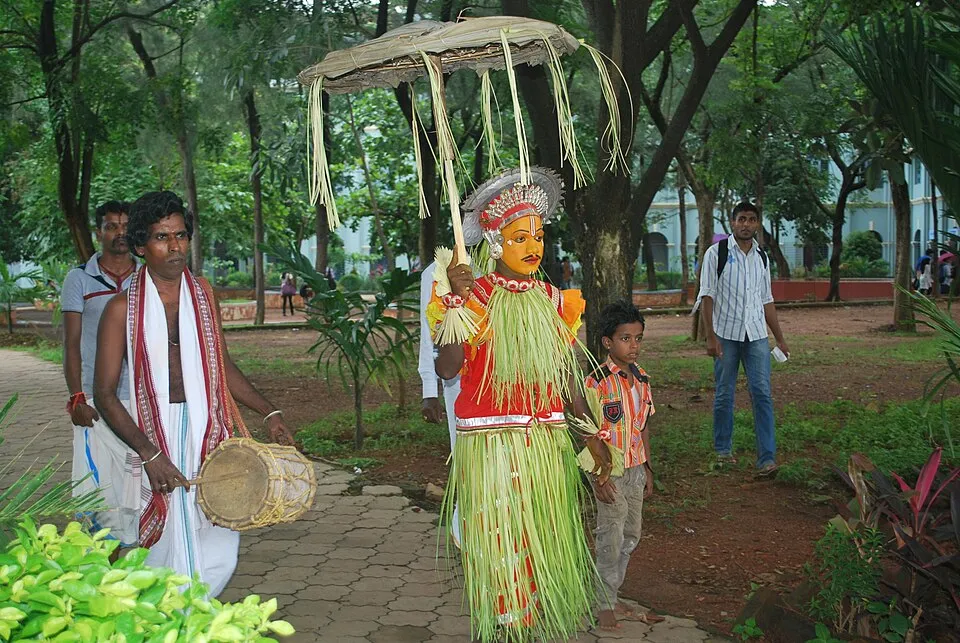

During Aati, a performer in a striking costume goes from house to house. This is the Aati Kalenja. People believe that during this month the spirit Kalenja comes down to earth to bless the land and its people, and the performer is that spirit.
The costume is made from what is at hand. The skirt is cut from tender coconut fronds woven with strands of banana sheath. The face and hands are painted in bright colours and patterns. The performer holds an umbrella of dry palm leaves. In Sullia, the performer wears a mask made from the spathe of an areca nut branch.
At each house, the Kalenja sprinkles water mixed with charcoal, turmeric and tamarind to remove any misfortune that has come to the family and their cattle. He dances to the tembere, a drum that belongs to Tulunadu, while an accompanist sings of the spirit: “Aateek Baththe Aati Kalenja”, Aati has come, the Kalenja has come. In return the household gives rice, vegetables or money. Some accounts add that he also acts as a healer and sometimes hands out medicinal herbs.
Who takes the role
In the sources we found, the Kalenja is played by members of the Nalike community, who are also hereditary performers of Bhuta Kola. We found this named in one source only, so we state it with care.
The tradition is fading. A former president of the Karnataka Tulu Sahitya Academy has said that younger Nalike community members in the city are less keen to carry it on, as other work has opened to them.
Related
- The Tulu Year, Month by Month, where Aati sits among the twelve months
- Bhuta Kola: When the Spirits Come to the Village, the other great performing tradition of the Nalike
Sources & further reading
The books and articles behind this page.
- Wikipedia, “Aati kalenja”: the monsoon hardships, the Nalike performers, the costume and the Sullia mask, the sprinkled water, the tembere drum, the song, the rice offered in return, the healer role, and the Tulu Sahitya Academy comment on its decline.
- Wikipedia, “Aatida Amaase”: Aati as the fourth month, the other names of Aati Amavasya, the bitter bark decoction, the preparations around the paale tree, and the food that follows.
This page leans on two Wikipedia articles, so treat the details as well attested but not deeply cross-checked. The Nalike community is named as the performers in only one of them. The pause in weddings and housewarmings is not from either article. It reflects what families do today.
Words on this page
What the Tulu and other Indian-language terms on this page mean.
- Aati
- The monsoon month, a pause in festivals.
- Aati Amavasya
- The new-moon day of the month of Aati.
- Aati Kalenja
- A masked performer who visits homes during Aati.
- bhuta kola
- The night-long ceremony in which a guardian spirit takes over a performer to dance, bless and judge.
- Nalike
- A community of hereditary performers.
- paddana
- A long oral ballad, sung to tell the story of a daiva or hero.
- paleda kashaya
- A bitter drink of tree bark taken on Aati Amavasya.
- tembere
- A drum of Tulunadu.
Themes
Spotted a mistake, or know more about this? Suggest a correction/addition.