Faith & Worship · Daivas, Nagas & Sacred Groves
Bhuta Kola: When the Spirits Come to the Village
Picture a village clearing late at night. Oil lamps flicker, drums and pipes keep up a steady beat, and whole families sit on mats, waiting. A figure steps into the light, face painted in bold yellow and red, a great decorated frame rising behind him, bells ringing at his ankles. As the night goes on, the people watching stop seeing a man in costume. They see the daiva, the guardian spirit of their village, come among them to dance, to bless, and to listen.
This is a bhuta kola, one of the oldest and best-loved traditions of Tulunadu, and it is still very much alive.
What a kola is
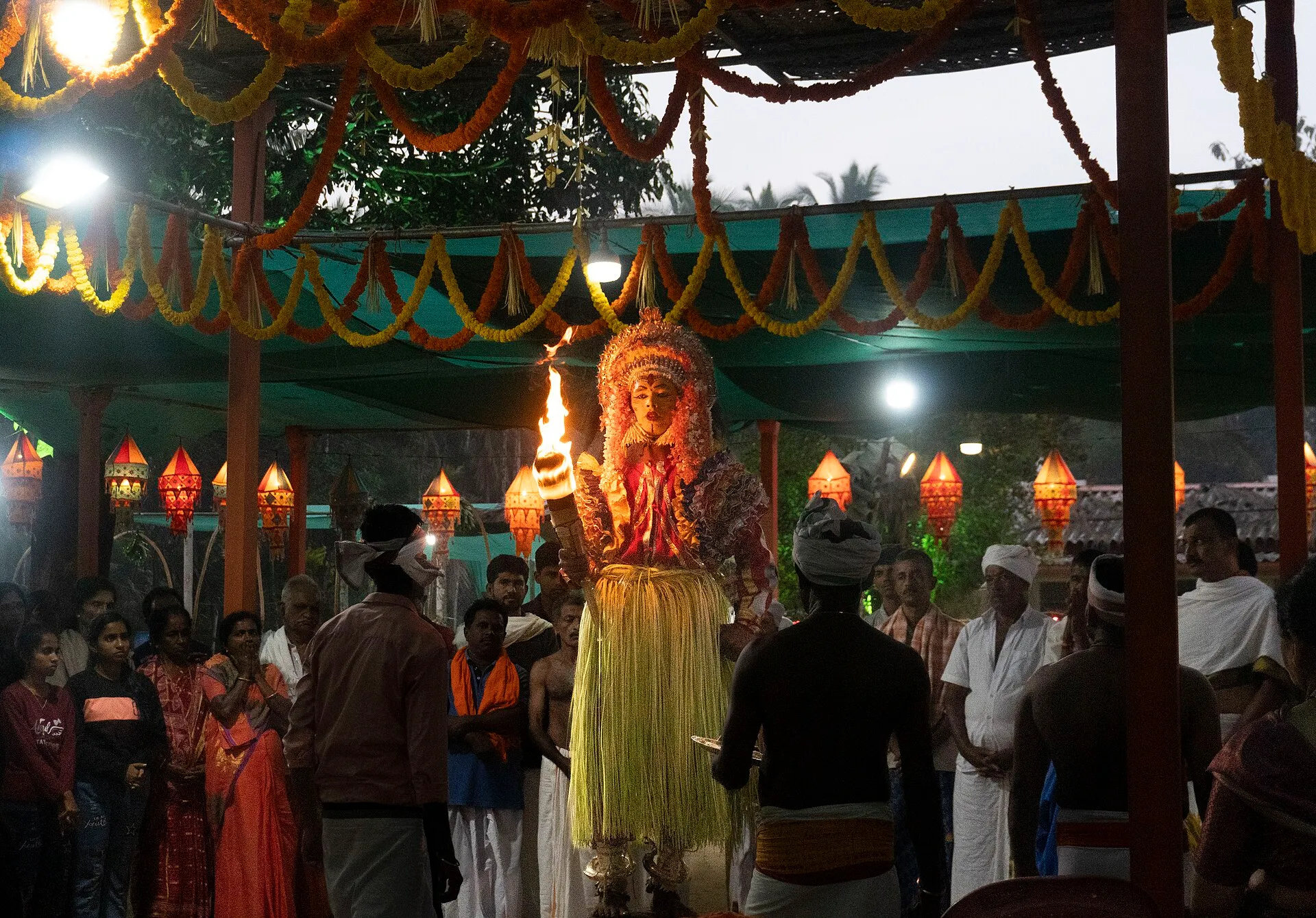

Across Tulunadu, villages, landed families and whole communities honour bhutas, also called daivas. These are guardian spirits tied to a particular place and its people; there is no single English word that fits them well. Some watch over a village, some a family’s ancestral house, some a stretch of fields or forest.
Once a year, the spirit is invited to come and take over a trained performer so that it can speak and act among the people directly. That night-long ceremony is the kola. Depending on the place and the scale, it may also be called a nema, a bhandi or an ayano.¹
There are a great many daivas. One scholar’s fieldwork counts more than 400.² Some, like Panjurli and Jumadi, are honoured all over the region. Others belong to a single village.
Three worlds in balance
Why would a village invite its spirits in, year after year? The answer lies in how Tuluvas have traditionally pictured the world. The anthropologist Peter Claus, who began watching kolas in the late 1960s, describes it as three worlds, each pressing against the next.³
At the centre is the cultivated world of homes, paddy fields and palm groves. It is carefully kept in order and watched over by a landlord or village chief, the yejaman, to whom the villagers owe loyalty and a share of the harvest.
Beyond the last field begins the forest, the jangala. It is wild and dangerous, the home of tigers, snakes, wild boar and gaur, the Indian bison, all of which threaten crops, cattle and people. In the old order, even the landlord entered the forest only once a year, for a ritual hunt to keep the wild at bay.
Behind both lies maya, the unseen world of spirits and ancestors. It is less a separate place than another layer of this one, always close at hand.
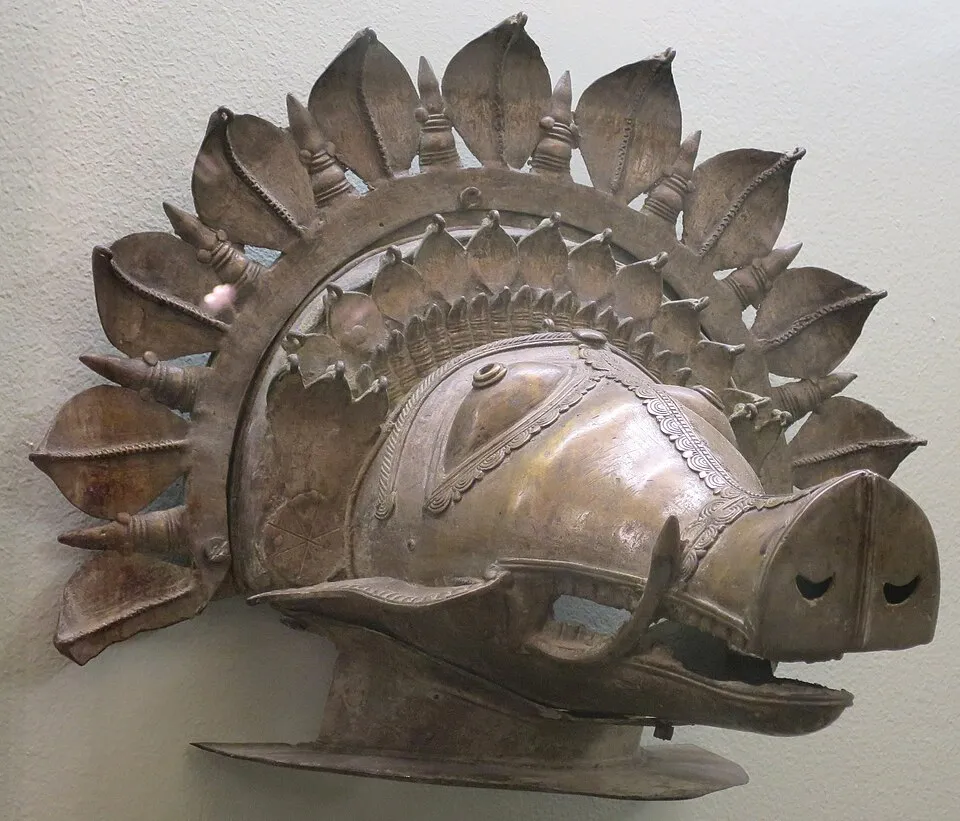

These three worlds mirror one another. Each danger of the forest has its counterpart among the spirits: Pilli the tiger, Naga the snake, Panjurli the boar, and Maisandaya the gaur. The powers that could ruin a harvest are the same ones that, properly honoured, protect it.
What holds the three together is balance. If people keep the order, the spirits protect them; if people upset it, the spirits turn fierce. No one stands above that order, not the landlord and not even the gods. This is why a daiva arrives as a judge rather than a friend of any one party. As Claus says of the daiva, “He may take a stand, he cannot take sides.“⁴
The kola is the night the unseen world steps into the village to see that the balance still holds.
How the night unfolds
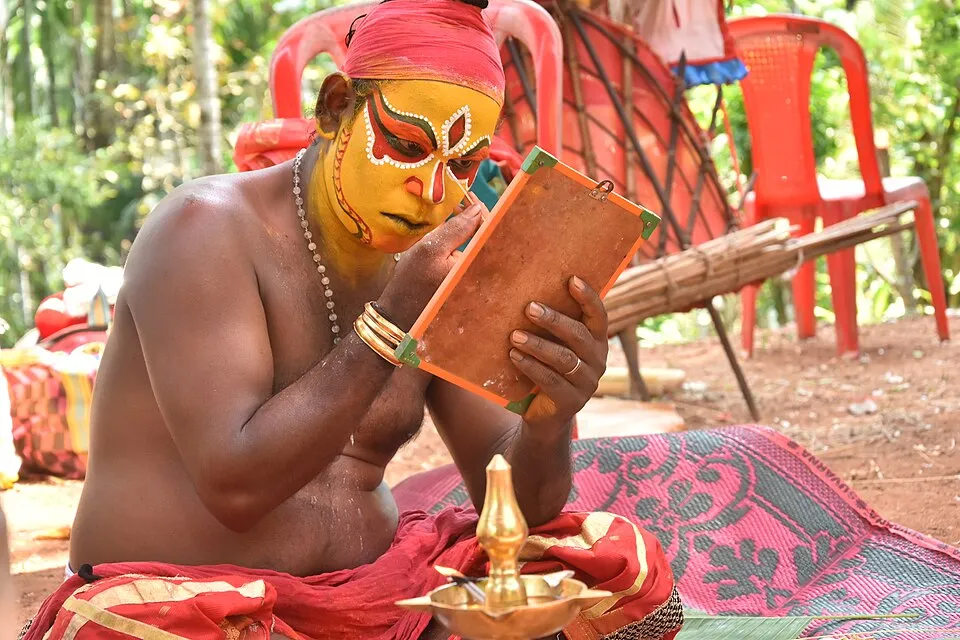

Every kola is a little different, but many follow a similar path.⁵
- The sacred objects arrive. The spirit’s swords, shields and ornaments, known together as the bhandara, are carried in procession from the bhutasthana, the spirit’s shrine.
- The invitation. In a rite called yenne boolya, the performer is formally invited and given a ceremonial oil bath to purify him.
- The spirit’s story is sung. Singers recite the paddana, the long oral ballad telling who this daiva is, where it came from and what it did.
- Make-up and costume. The performer is painted, dressed, and fitted with the ani, the tall, decorated frame that rises behind the back.
- The dance. The drums quicken and the spirit takes hold. To those watching, the performer is now the daiva.
- The spirit speaks. In the nudi, the daiva talks with the village, blessing, advising, warning and answering questions.
In the village Claus studied, the festival ran over two nights, with the landlord’s spirit on the first and a warrior spirit of the tenant families on the second, each with its own performers.³
The families who carry the tradition
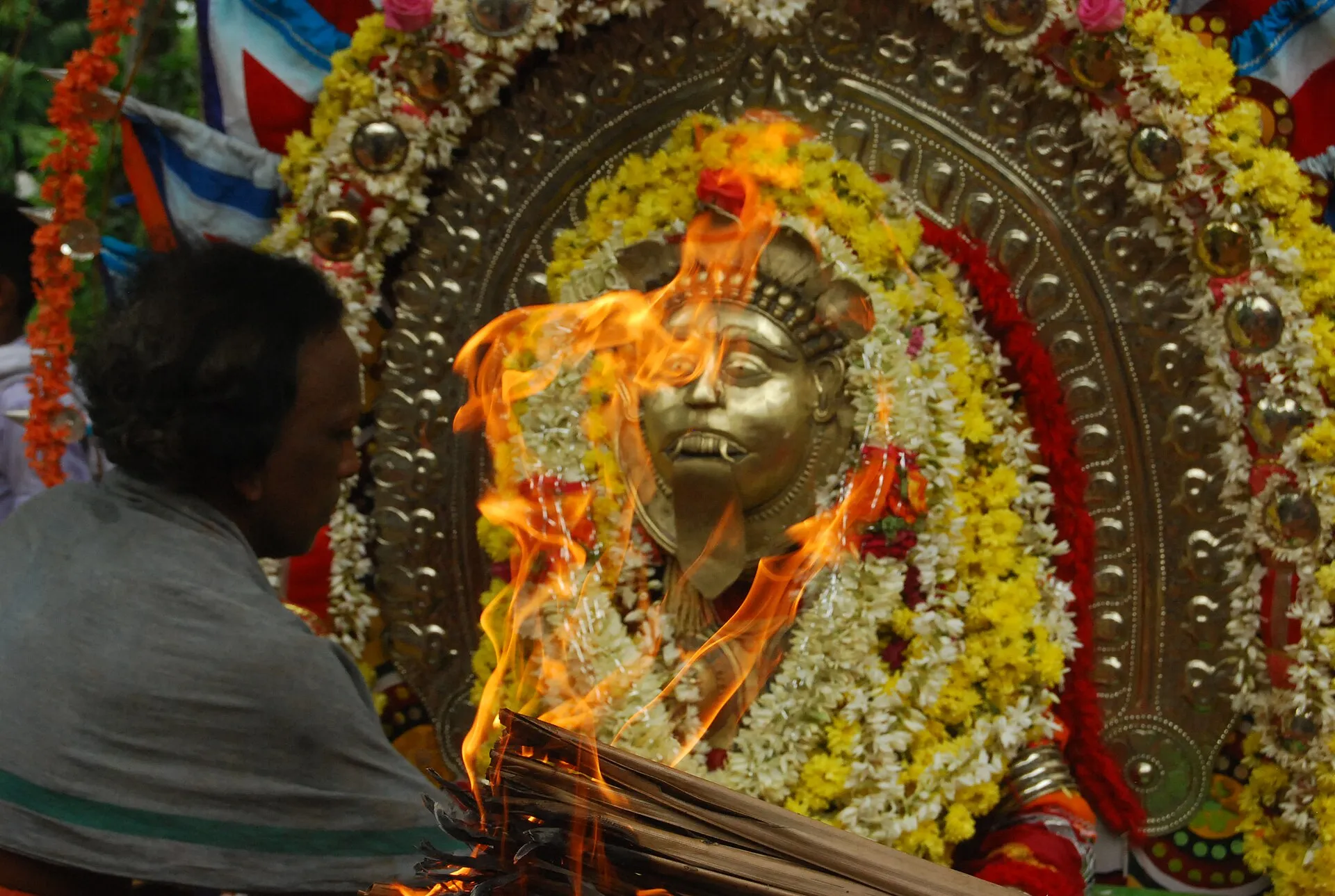

The performers come from hereditary communities who have carried this work for generations, chiefly the Pambada, Parava and Nalike families. The knowledge of songs, steps, make-up and costume passes from one generation to the next within these families.
At many shrines there is also a patri, a medium who holds the spirit’s sword and bell and speaks for it, always in the first person, as the daiva itself. In the traditions Claus studied, this role often fell to men of the Billava community.
The mediums are almost always men, even when the spirit is a goddess.⁶
A court as well as a ceremony
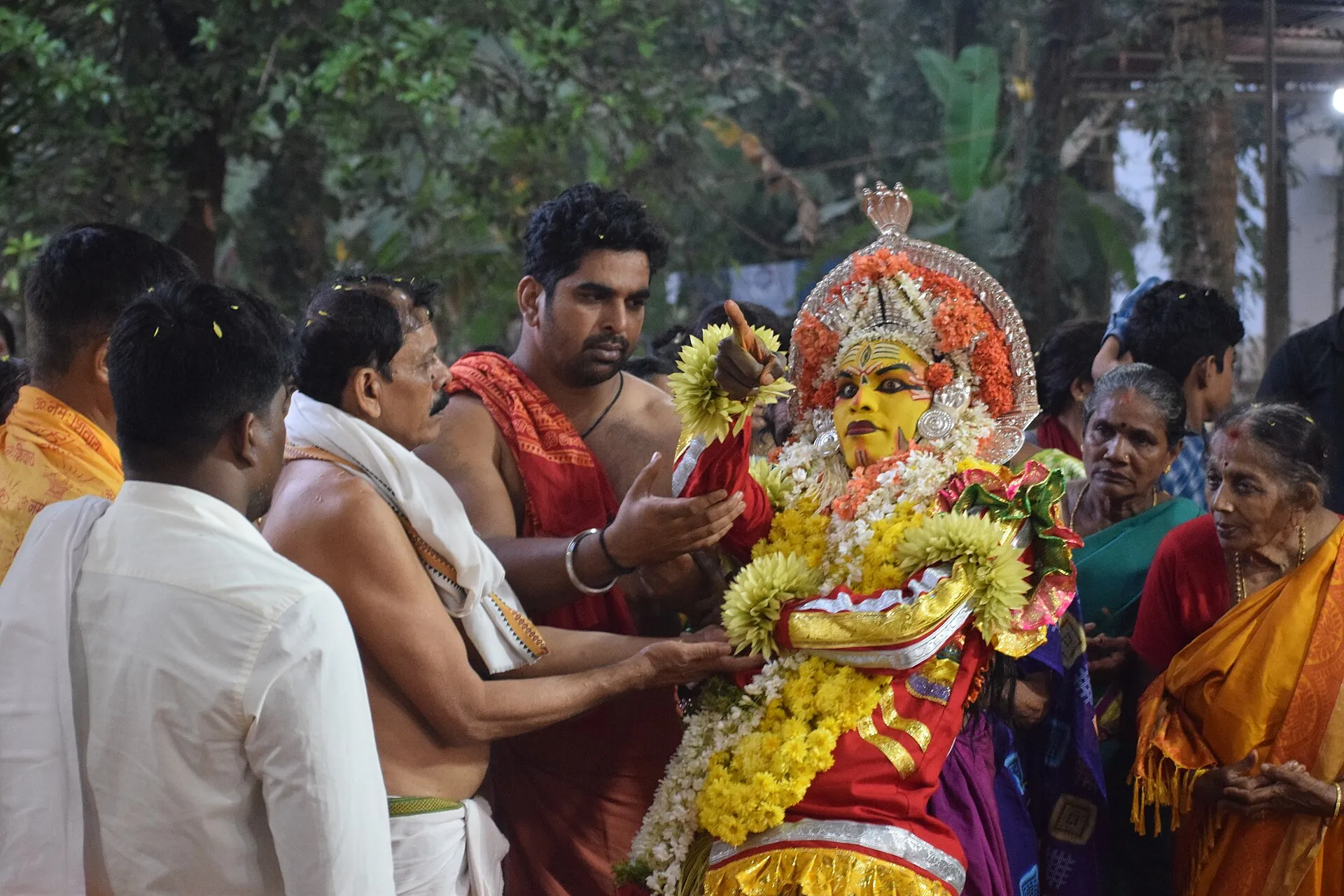

A kola is not only worship. It is also a court. Villagers bring their quarrels before the daiva, from boundary disputes to family rifts, and the spirit hears both sides. Sometimes the judgment is given by casting betel leaves or counting flower petals. A matter that cannot be resolved may be held over until next year’s kola.⁷
The ceremony also confirms the place of the family that hosts it. By staging the kola, the head of the landlord’s household shows himself, in front of everyone, as the natural leader of the community.⁷
Two daivas worth a closer look
Most daivas grew out of Tulunadu’s own soil: its forests, its animals and its local heroes. These two show something else. Their names and stories borrow from the wider Hindu world, and looking at them closely shows how a local tradition takes in outside ideas and makes them its own.
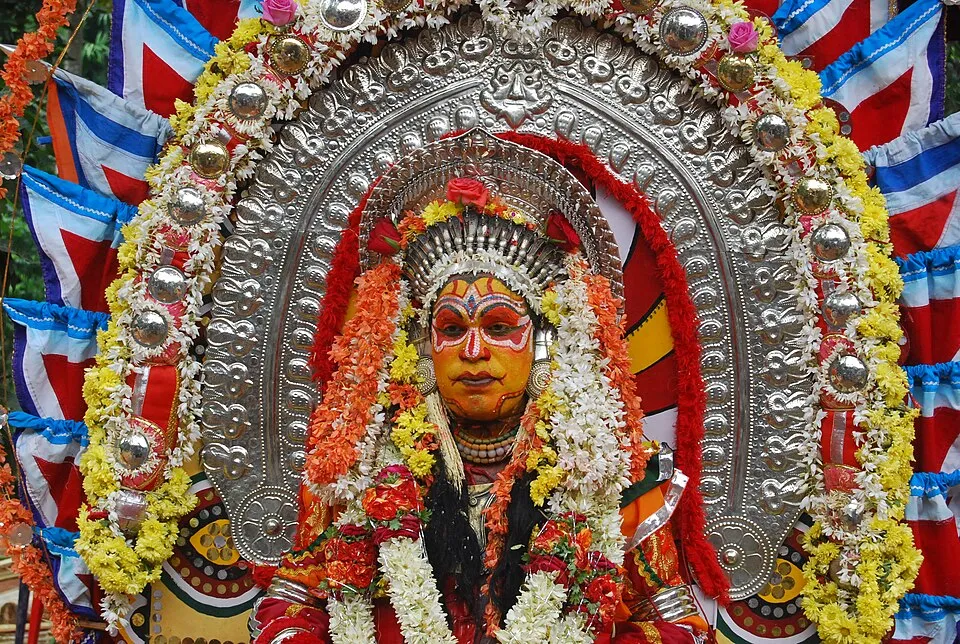

Jumadi is one of the most powerful daivas in Tulunadu, the great “royal” spirit of landholding families. Jumadi is most often the family daiva of wealthy landholding Bunt families, and the Chowta rulers of Moodbidri worship Jumadi at a shrine inside their palace, the Chowtara Aramane.⁸
The paddanas tell how Jumadi came to be. A demon named Dhumasura could be killed by neither a man nor a woman. Shiva and Parvati set out together to stop him, and on the way their two bodies fused into one, with Shiva’s moustached face above and Parvati’s body below. Being neither man nor woman, this new being could slay the demon. In the kola, Jumadi is rarely alone: beside the daiva stands Bante, a sword-bearing attendant often played for laughs, a lively contrast to Jumadi’s majesty.
Jumadi is also called Dhumavati, a Sanskrit form of the name. That can mislead readers who know the fierce Hindu goddess Dhumavati. The Tulu Jumadi is a different figure who simply shares the name. You can read Jumadi’s own stories on the Jumadi page.
Rakteshwari is honoured in some accounts as the guardian goddess of Tulunadu itself, a local form of the great Mother Goddess. Her name means “goddess of blood”, and people remember her offerings in different ways. Some describe blood sacrifice; others insist that proper worship of Rakteshwari uses only vermilion and coconut. Both views can be found, and the disagreement shows how one local goddess can be pulled in two directions, toward village folk practice on one side and more orthodox temple worship on the other.⁹ You can read her own story on the Rakteshwari page.
A tradition that keeps changing
It would be easy to think of bhuta kola as something frozen in the past. In fact it keeps changing, and the changes say a lot about Tulunadu itself. Three kinds stand out: changes in who worships, in who gets to perform, and in who comes home to take part.
Who worships, and why
For generations the kola was tied to the landlord’s household. The daiva reaffirmed the family’s right to lead, and the village took part under its patronage. When that world began to shift, worship shifted too.
The clearest example is Mayndala, also called Bale Mani, a goddess of childbirth. In the 1960s and 70s her worship spread fast. Thousands of women gathered at her newer shrines, while nearby ceremonies for the landlords’ spirits drew only dozens.¹⁰
Peter Claus linked this to changes in village life. Land reform laws weakened the big landlords, and many moved away from their rural manor houses, so the old ceremonies lost their main patrons. At the same time, women were taking a larger part in religious life. Claus also suggested, more tentatively, that women worried their households might suffer if the men neglected their duties to the spirits.¹⁰
Some things held firm. Women were Mayndala’s patrons, but a man still served as her medium. That makes an interesting contrast with the Siri tradition, where women themselves become possessed.¹¹
Who performs
The right to embody a daiva has long belonged to particular hereditary communities, and that, too, is now being questioned. Masked performance has traditionally been the preserve of certain communities, including the Parava, Pambada, Kopala, Nalike and Panara. More recently, as one study describes, the Mundala community, whose daivas have been performed without masks, has asked why that should be so.¹² Who may wear a daiva’s mask is still being worked out today.
Coming home to the kola
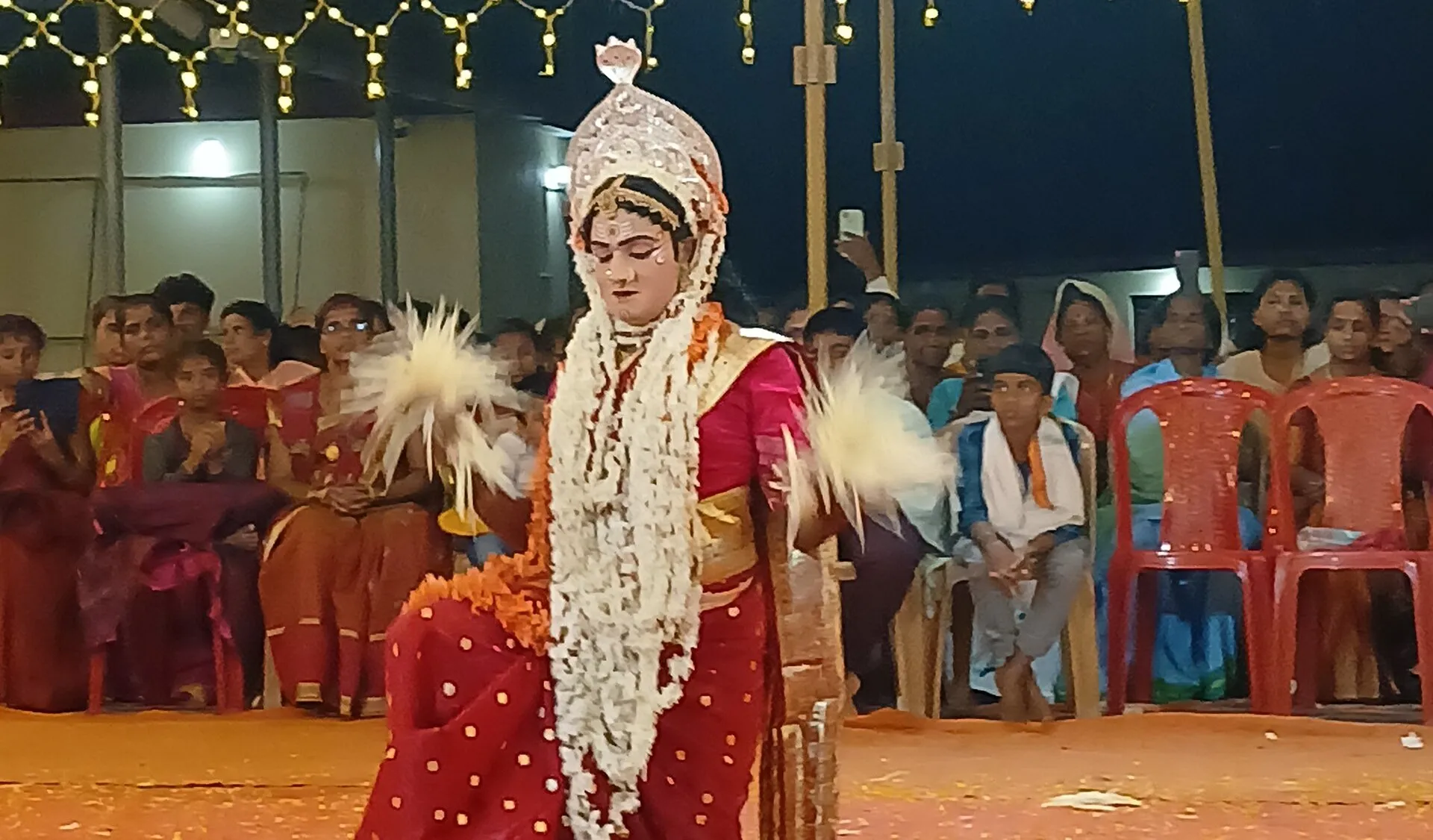

The same shifts that emptied the old manor houses also sent many Tuluva families further afield, to Mumbai and Bengaluru, to the Gulf and beyond. For a generation or two, the kola could feel like something left behind in the village. Today many of those families are finding their way back. Children and grandchildren raised far from Tulunadu fly home for the family kola, help repair ancestral shrines, and stand in the crowd at night to meet the daiva their elders spoke of. For them, the kola has become one of the surest ways to come home.
Meet the daivas
There are hundreds of daivas, and no list could hold them all. The stories gathered so far are on the Stories page, grouped by the part each daiva plays: read the stories of the daivas.
Related
- Siri, the Princess Who Walked Away, and the women of the Siri tradition
- Koti and Chennaya, the twin heroes
- Panjurli, the boar daiva
- Rakteshwari, the earth-born maiden
- Koragajja, the boy who was turned away
- Jumadi, neither man nor woman
- Guliga, the hunger that became a guardian
- Pilichamundi, the tiger goddess
- Maisandaya, guardian of the herd
- Ullaya and the Ullakulu, the king daivas
- Kodamanithaya, the daiva who followed his devotees
- Babbarya, the daiva of the sea
- Kalkuda and Kallurti, the sculptor and his sister
- Nagaradhane: The Serpent in the Sacred Grove, the worship of the snake
- Kadri Manjunatha: The Hill of Many Faiths, the Mangaluru temple whose linga, the legend says, the daiva Annappa carried to Dharmasthala
- Bermer, the great guardian figure honoured at many Tuluva shrines
- The Billava community
- The Mother Goddess in early Tulunadu
Sources & further reading
The books and articles behind the numbered notes on this page.
- Wikipedia, “Buta Kola”: kola, bandi and nema as kinds of bhuta worship. H. Vishwanatha and Ravindra Mundkur, “359. Āyana, Nema & Kola – II”, Tulu Research & Studies (blog, 1 May 2016): the āyana as an annual festival, and how it differs from a nema and a kola.
- Shilpa V. Sonawane, Diaspora of Bhuta (Daiva) Worshipping Cult: India and Indonesia (2019), citing the fieldwork of Professor K. Chinnappa Gowda of Mangalore University, who identified more than 400 bhuta forms and names. Read online.
- Peter J. Claus, “Mayndala: A Legend and Possession Cult of Tulunad”, Asian Folklore Studies 38(2) (1979), pp. 95–130. JSTOR · free PDF: the three worlds, the yearly ritual hunt, Claus’s first visit in 1967, and the two-night festival. The four spirit counterparts of the forest animals are from Wikipedia, “Buta Kola”.
- Peter J. Claus, “Spirit Possession and Spirit Mediumship from the Perspective of Tulu Oral Traditions”, Culture, Medicine and Psychiatry 3(1) (1979), pp. 29–52. Springer (subscription needed). The quotation is given in Wikipedia, “Buta Kola”, which cites this paper.
- Wikipedia, “Buta Kola”: the paraphernalia brought to the shrine, the performer communities and the patri. Raveesh Kumar, “A Night of Bhuta Kola” (blog, 27 January 2016): the bhandara, the bhuta sthana, yenne boolya and the oil bath, the paddana, make-up, the ani, the dance and the nudi.
- Claus, “Mayndala” (note 3), which describes the nema as “almost exclusively a male cult”, with a male medium even when the spirit is female.
- Wikipedia, “Buta Kola”, drawing on Claus (note 4): disputes brought to the spirit, judgments by betel leaves and flower petals, hard cases adjourned to the next year, and the manor head staging the nema to show himself as the community’s natural leader.
- Sonawane (note 2), “Jumadi (or Dhumavati)”: the Dhumasura story, Bante, the Chowta family’s Jumadi shrine in the Moodbidri palace, and the name Dhumavati. Wikipedia, “Jumadi”: Shiva’s moustached face on Parvati’s body, and Jumadi as distinct from the goddess Dhumavati. Wikipedia, “Buta Kola”: the “royal” daiva as mostly the family deity of rich landowning Bunt patrons.
- Wikipedia, “Rakteswari”: Rakteswari as an aspect of the Mother Goddess and the tutelary deity of Tulu Nadu, offered vermilion and coconut. Parwati Singari, “Guardian Goddess of Parashuramakshetra” (blog, 22 August 2022): coconut and kumkum in one style of worship, meat and animal blood in the other.
- Claus, “Mayndala” (note 3).
- Peter J. Claus, “The Siri Myth and Ritual: A Mass Possession Cult of South India”, Ethnology 14(1) (1975), pp. 47–58. JSTOR.
- C. S. Vijayashree, “‘Why Can’t Our Bhuta Have a Mask?’ Caste Contestations and Ritual Practice in Tulunadu”, South Asia: Journal of South Asian Studies 46(2) (2023), pp. 388–406. Taylor & Francis (subscription needed).
Further reading
- Heidrun Brückner, On an Auspicious Day, at Dawn: Studies in Tulu Culture and Oral Literature (Harrassowitz, 2009). Google Books.
- Peter J. Claus, “Possession, Protection and Punishment as Attributes of the Deities in a South Indian Village”, Man in India 53 (1973), pp. 231–242.
- D. Vanitha, “A Study of Bunt Community History, Beliefs and Traditions”, BEST: International Journal of Humanities, Arts, Medicine and Sciences 7(8) (2019), pp. 11–18. PDF.
Words on this page
What the Tulu and other Indian-language terms on this page mean.
- ani
- The tall, decorated frame worn on the performer's back.
- ayano
- A regional name for a daiva ceremony.
- bhandara
- The daiva's sacred objects: swords, shields and ornaments.
- bhandi
- A regional name for a daiva ceremony.
- bhuta
- A guardian spirit of a place, family or community; also called a daiva.
- bhuta kola
- The night-long ceremony in which a guardian spirit takes over a performer to dance, bless and judge.
- bhutasthana
- The shrine or shrine room of a daiva.
- daiva
- A guardian spirit; used interchangeably with bhuta.
- jangala
- The forest; the wild world beyond the fields.
- kola
- The ceremony in which a daiva is invited to possess a performer.
- maya
- The unseen world where the spirits live.
- nema
- Another name for a kola, the annual ceremony for a daiva.
- nudi
- The part of the kola when the daiva speaks with the village.
- paddana
- A long oral ballad, sung to tell the story of a daiva or hero.
- patri
- A medium who holds the daiva's sword and bell and speaks as the spirit.
- yejaman
- The landlord or head of a household who hosts and leads.
- yenne boolya
- The formal invitation to the performer, with a purifying oil bath.
Themes
Spotted a mistake, or know more about this? Suggest a correction/addition.