Stories: Daivas · Also in: Stories: Epics and Heroes
Koti and Chennaya, the Twin Heroes
Every year, in shrines all across Tulunadu, two brothers come back. Dressed in tall crowns and garlands, two performers become Koti and Chennaya for a night, and the crowd that gathers to see them has known their story since childhood.
The twins were Billavas, a Tulu-speaking community, and their paddana (the long sung ballad that tells a hero’s or a daiva’s story) is one of the two great long epics of the Tulu language.¹ ² It is a story of two brothers who would not accept an insult, of a king who forgot a promise, and of a death so remembered that the twins became daivas, protecting spirits, themselves.
The story
The paddana is long, and it is told in many versions. This is the outline most people know.¹
A healer found in the forest
The story begins with the twins’ mother. A Brahmin named Pijinar, who had no children, found a glowing golden egg floating in from the sea. Inside it was a baby girl, and he named her Suvarna Kedage.
She grew up quickly, and came of age when she was only seven, before she could be married. By the custom of the time, a girl like that could not stay in her family’s home. Weeping, her foster father left her asleep in the Sankamale forest.
There she was found by Sayana Baida, a Billava healer out gathering medicinal herbs. He took her home as his sister and gave her the name of a sister he had lost: Deyi. As Deyi Baideti, she became an expert healer herself. She was married to Kantana Baida, and she later became pregnant, the story says, by the grace of the family’s guardian deity, Kemmalaje Nagabrahma.¹
The king’s broken promise
In the kingdom of Padumale, King Perumale Ballala had made his palace-builder Mallaya a minister, with the title Budyanta, “the clever one”. Little by little the king handed over his power, and Budyanta grew cruel.
One day, after a frightening dream, the king went hunting as his ancestors had done. A thorn pierced his foot, and the wound would not heal. At last he sent for Deyi Baideti, who was heavily pregnant, and had her carried to the palace in a palanquin. He swore to give her anything she asked if she cured him.
She did. But when she gently reminded him of his promise, the king denied he had ever made it. As Deyi left the palace, his wound burst open again. The queen ran after her and begged her to come back, and Deyi healed him a second time. Ashamed, the king asked her forgiveness.¹
Twins in the palace
Deyi gave birth to twin boys, and the king himself named them Koti and Chennaya. The morning after the naming ceremony, Deyi died.
The king kept the twins in the palace and loved them like his own sons. They sat on his lap and ate from his hand. But Budyanta feared they would one day overshadow him. He turned the queen against them, and the boys were sent back to their uncle, Sayana Baida, who had them trained at the garadi, the gymnasium, in body-building, archery and swordplay.¹
When they were about seven, the twins asked to join a game of ball with Budyanta’s sons, who refused to play with boys of their caste. In the end the boys agreed that the winners would keep the ball. Koti and Chennaya won, and a scuffle broke out. Budyanta came over and took the ball from them by force. The twins swore that one day they would take it back.¹
The kambala and the flooded field
The twins grew up into famous fighters, and the king gave them land of their own. Budyanta saw it as his land, and set out to ruin them.
When Koti asked him to bring back an auspicious date for their kambala (a buffalo race through a flooded paddy field), Budyanta gave them the day of the new moon, when no kambala is ever held. The twins held their race that day anyway, and the village came to it. Later, Budyanta drained the water from his own field into theirs and destroyed their crop. When Koti went to ask why, Budyanta poured caste abuse on him.
Chennaya, standing nearby, lost his temper. The brothers killed Budyanta. Then, remembering their childhood vow, they went to his house and took back the ball.¹
Leaving Padumale
The twins asked the king, once more, for the gift he had promised their mother. Once more he refused. So they left Padumale for good, and no pleading from the king could turn them back.
On the road they came to a river at midnight. The boatman would not take them, so they trusted in their family deity and walked across the water. Further on, an old Brahmin asked them their caste. “We are Billavas,” Koti said. “And Brahmins by our deeds,” said Chennaya, and instead of drinking from the old man’s pot, he drank water from the blade of his sword.¹
A sister found, and a trap
In the neighbouring kingdom of Panja the twins found their elder half-sister, Kinnidaru, the daughter of the first Deyi, and there were tears of joy. But their fame worried Panja’s minister, Chandugidi. When the remorseful king of Padumale sent word asking for the twins to be handed back to him, Chandugidi read it as an order to seize them.
He had a palace-like building put up overnight and lured the brothers inside. Shut in total darkness, they prayed to Kemmalaje Nagabrahma, broke through the walls and escaped.¹
A new home in Enmur
Next door was Enmur, ruled by a just king, Deva Ballala. Panja had secretly moved a boundary stone to steal Enmur’s Tuppekallu forest, and on their way in the twins put the stone back where it belonged. At the shrine of Kemmalaje Nagabrahma the doors were already closed for the day, but as the brothers sat and prayed before them, the doors swung open on their own.
Deva Ballala welcomed them and gave them a piece of barren land. With the young men of the area, the twins turned it into rich fields, with new canals and new roads.¹
The boar and the last war
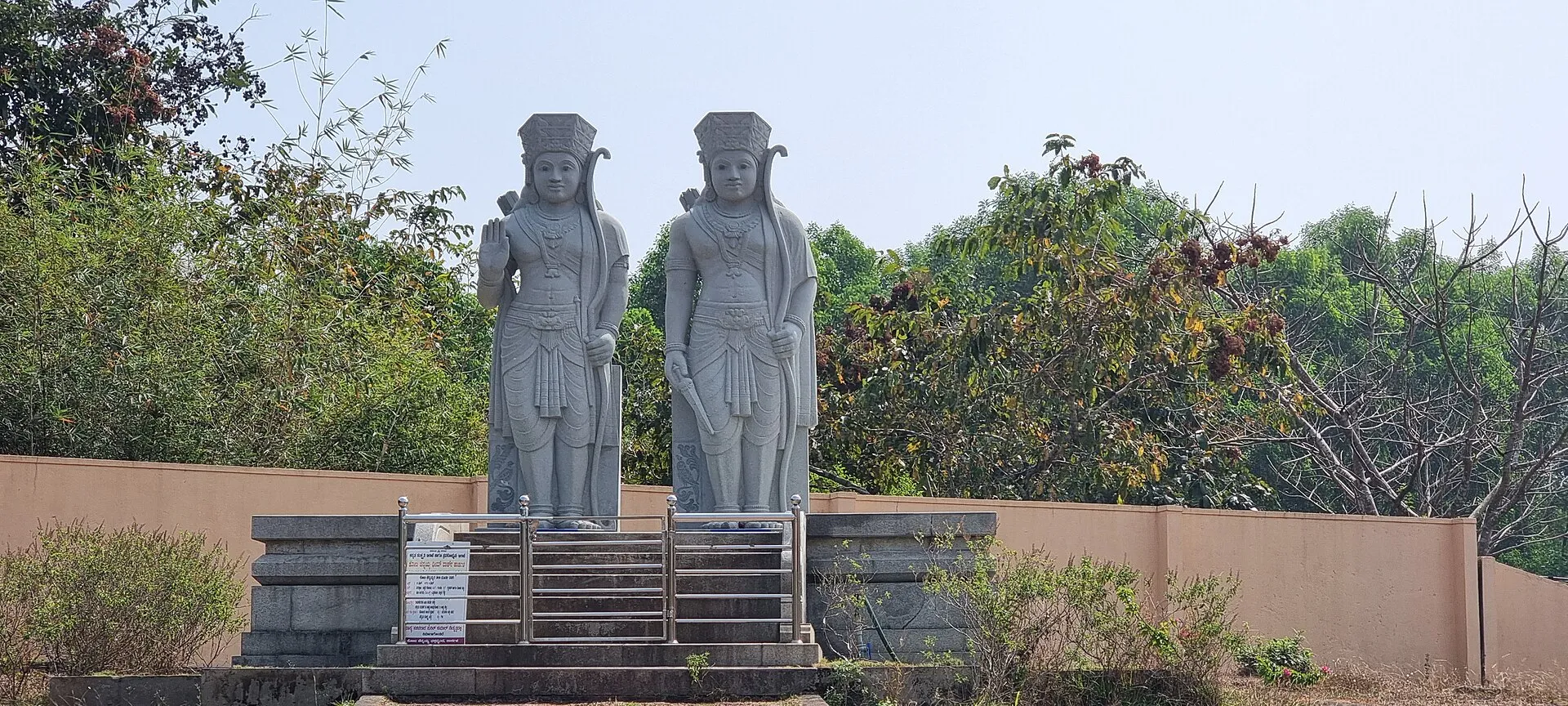

Wild animals kept raiding the new fields, so the twins went hunting. Chennaya shot a wild boar, which ran across the border and died on Panja’s land. Panja’s men claimed it, a fight broke out, and the twins carried the boar home. Panja demanded that Enmur hand the brothers over. Deva Ballala refused, and it came to war. The king of Padumale joined Panja’s side.
On the seventh day of fighting, Chennaya killed Chandugidi in a sword fight. The next morning Koti told his brother of a terrible dream, but he would not let Chennaya lead in his place. Koti faced the king of Panja, knocked the sword from his hand, and let him run, shouting that he did not kill a man who gave up.
At that moment an arrow struck Koti from behind.¹
The death of the twins
Koti turned, and saw Perumale Ballala hiding behind a tree: the king who had once fed him with his own hands. The king, overcome, drew his sword to kill himself. Dying, Koti pulled it from his hand, told him to end the war, and asked him to make peace with Enmur.
When Chennaya saw his brother dead, he could not bear it. He struck his head against a rock, and the twins died together.
It is said that Koti and Chennaya were never reborn, and that they still help and protect those who believe in them.¹
Where the twins are worshipped
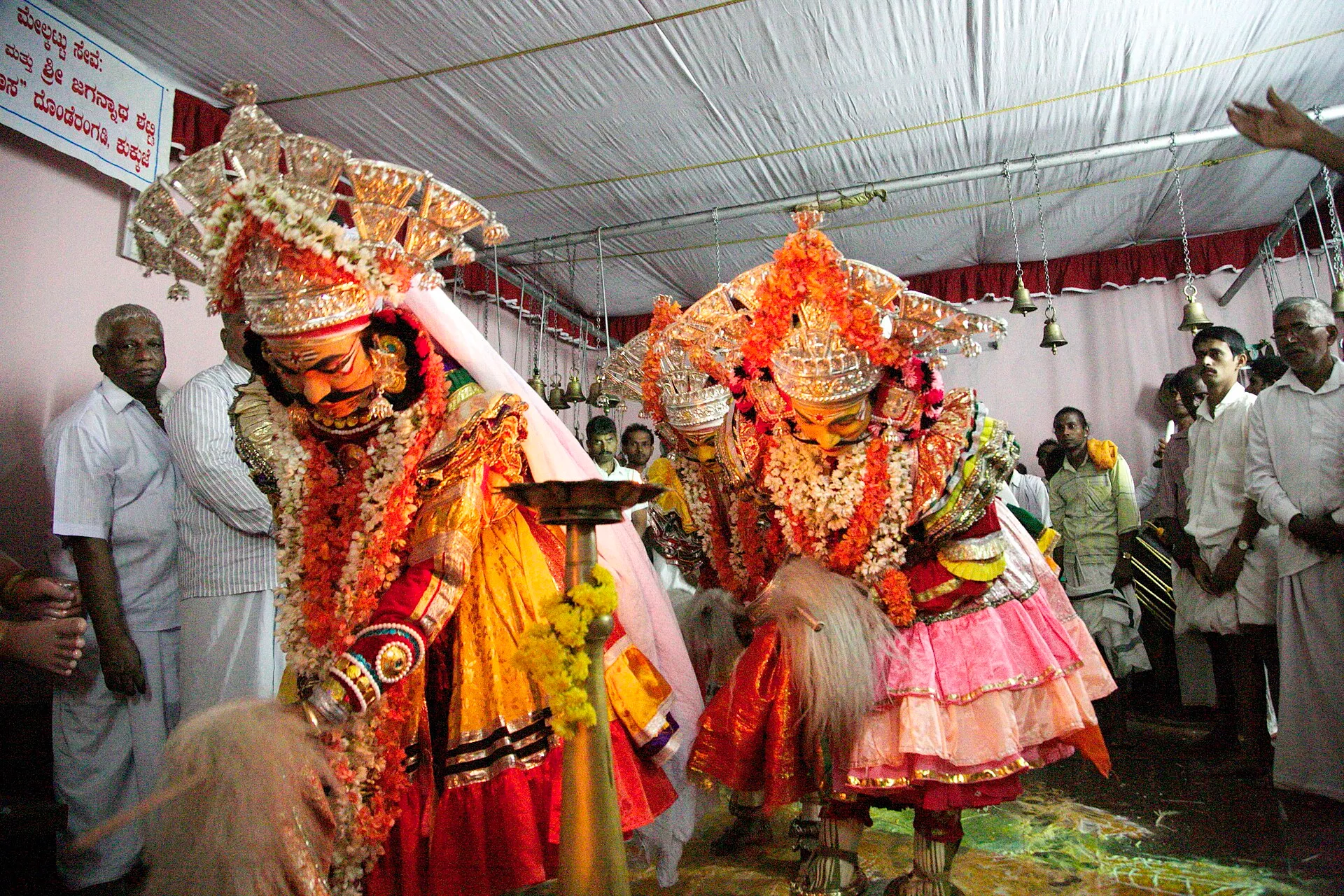

The twins are honoured at garadis, the same word as the gymnasiums where they trained. These shrines in their name stand all over Tulunadu.² Their best-known place of worship in a city is the Shree Brahma Baidarkala Garadi Kshetra at Kankanady in Mangaluru, a short way from the city centre.³ The garadi at Enmur, in Sullia taluk, where they fell, is honoured as their resting place.²
At the yearly nema, the ceremony at a garadi, performers take on the twins in costume, much as at a kola for any other daiva. You can read more about how such ceremonies unfold on the Bhuta Kola page.
For many Billavas, Koti and Chennaya are much more than heroes of an old song. They are the community’s own protectors, who keep it safe from harm.¹
The story today
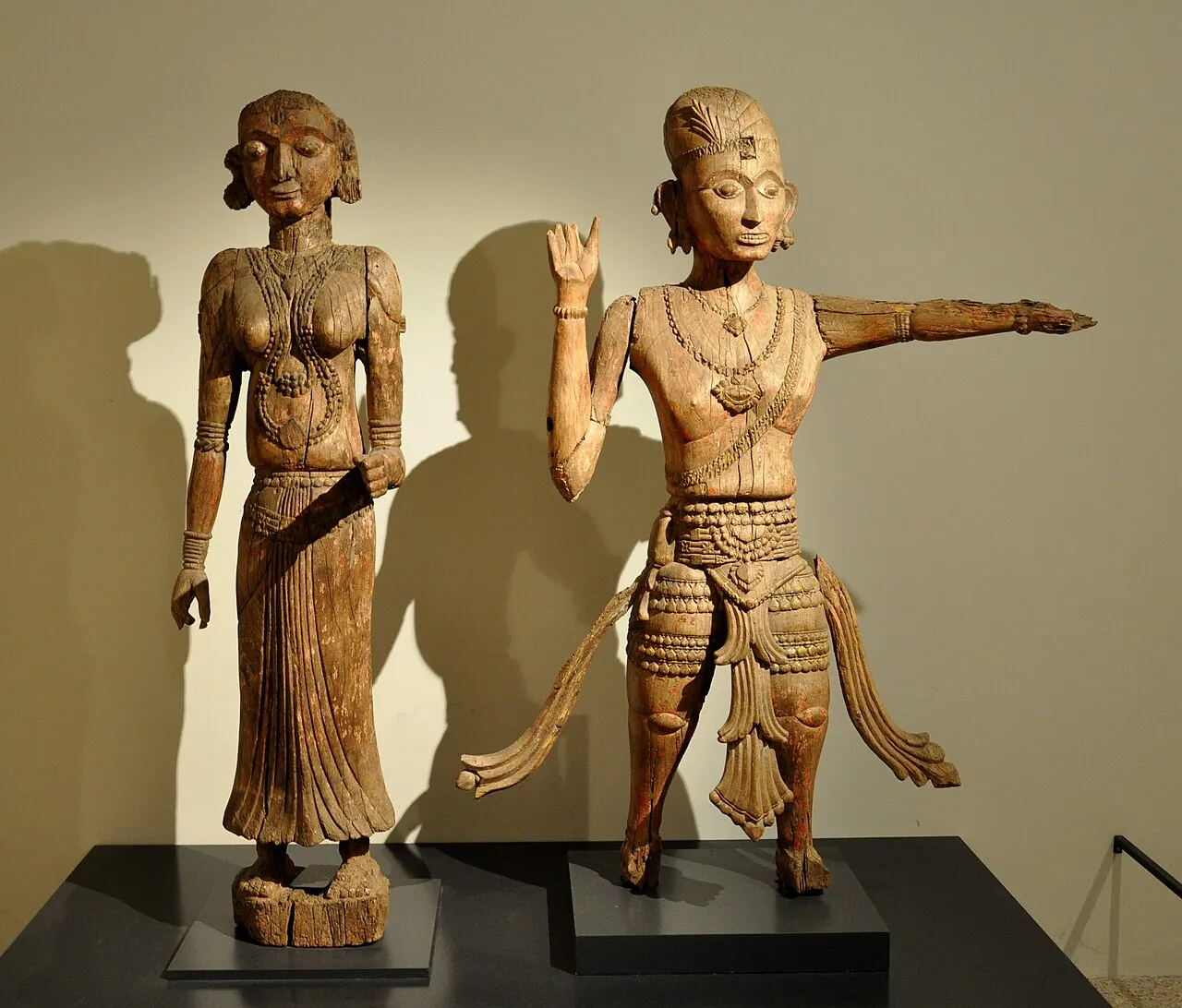

The twins’ paddana reached English readers early. A. C. Burnell’s translation, edited by R. C. Temple, was printed in the Indian Antiquary in 1894 and 1895.⁴
Since then the story has been retold again and again. It has been made into a television serial in Kannada.² An edition of the paddana with an English translation came out in 2007, and a retelling by Bannanje Babu Amin was published by the Sahitya Akademi in 2009.⁵ ⁶ The 2007 Tulu film Koti Chennaya won the National Film Award for Best Feature Film in Tulu, and in 2019 another Tulu film, Deyi Baidethi, told their mother’s story.² ⁷
Nobody knows for certain when the twins lived. One tradition, kept at the Kankanady garadi, places them between 1556 and 1591.² Others place them a century or more later.¹ Like the story itself, the dates have been handed down by word of mouth.
Related
- Bhuta Kola: When the Spirits Come to the Village
- Panjurli, the Boar Daiva
- Koragajja, the Boy Who Was Turned Away, a Koraga orphan raised in a Billava home
- Siri, the Princess Who Walked Away, the other great Tulu epic
- Pilichamundi, the Tiger Goddess, the rajan daiva of Padumale
- Kantabare and Budabare, the Twin Heroes of Mulki, the other pair of twins
- Kodamanithaya, the Daiva Who Followed His Devotees, whose shrine at Thodar has a Brahma Baidarkala garadi beside it
- Nagaradhane: The Serpent in the Sacred Grove, and the serpent deity behind the twins’ family god, Kemmalaje Nagabrahma
Sources & further reading
The books and articles behind the numbered notes on this page.
- The Billawar Association, Mumbai, “Koti Chennaya” (the community’s own retelling): the story from Deyi Baideti’s birth to the twins’ death, the dating to the 17th and 18th centuries, and the twins as protectors of the Billavas.
- Wikipedia, “Koti and Chennayya”: the epic as one of the two long Tulu epics, the garadis, the Enmur resting place, the 1556 to 1591 dating from the Kankanady garadi, the television and film retellings.
- Wikipedia, “Shree Brahma Baidarkala Garadi Kshetra”: the garadi at Kankanady, Mangaluru.
- A. C. Burnell and R. C. Temple, “The Devil Worship of the Tuluvas: The Song of Koti and Channayya”, Indian Antiquary 23 (1894), and “The Story of Koti and Channayya”, Indian Antiquary 24 (1895). Read volume 23 and volume 24 at HathiTrust.
- Damodar Kalmady (ed.), Epic of the Warriors (Koti Chennaya Pardana), translated by Shankar Narayana D. Poojary (National Folklore Support Centre, Chennai, 2007): the paddana with an English translation.
- Bannanje Babu Amin, The Tale of the Twin Warriors (Koti Chennaya) (Sahitya Akademi, 2009).
- Wikipedia, “Koti Chennaya” (the 2007 film): its National Film Award.
Further reading
- Vamana Nandavara, “Unrivalled ‘Two in the Biruva Crew’: Kóṭi-Chennaya, a Tulu Folk Epic”, Indian Literature 61, no. 2 (2017) (subscription needed).
- Shiva Billava, “Legendary Twins: Koti-Chennaya”, Indian Literature 52, no. 2 (2008) (subscription needed).
- Marine Carrin, “The Glorious Death of Koti and Chennaya and the Religious and Political Inspiration of the Billava”, on the twins’ worship and Billava identity today (free sign-in needed).
The story here follows the Billava community’s own retelling. The paddana is sung in many versions, and they differ in their details.
Words on this page
What the Tulu and other Indian-language terms on this page mean.
- daiva
- A guardian spirit; used interchangeably with bhuta.
- garadi
- A shrine to the twin heroes Koti and Chennaya; the word also means a gymnasium.
- kambala
- A buffalo race run through a flooded paddy field.
- nema
- Another name for a kola, the annual ceremony for a daiva.
- paddana
- A long oral ballad, sung to tell the story of a daiva or hero.
Themes
Spotted a mistake, or know more about this? Suggest a correction/addition.