Koragajja, the Boy Who Was Turned Away
Something has gone missing in the house: a ring, a document, a set of keys. Before anyone turns the rooms upside down, someone says a quiet prayer to Koragajja and promises him a small offering if it turns up. In homes all over Tulunadu, that is often the first thing people do when something is lost, when a piece of work won’t move, or when a problem needs solving.¹ ²
The daiva they are calling on was once a little boy with nobody in the world. His name was Koraga Thaniya. Koraga is his community, and ajja means grandfather, a name of love and respect.² ³ His story is short, and it turns on a single moment at a shrine gate, when a child who had carried an offering a long way was told he could not come in.
The story
The story is sung in paddanas, the long ballads that tell a daiva’s story, and it is told a little differently from place to place. This is the outline most tellings share.¹ ² ³
An orphan by the road
Thaniya was born to the Koragas. His mother, Maire, died when he was only thirty days old. Soon after, his father died too, and there was no one left to look after him.¹ ²
So the child left home in the middle of the night and walked until he came to a stretch of sand by the road. There, alone and hungry, he played at making an offering to the gods, as he had seen the grown-ups do: wild daddal fruit in place of coconuts, and sand in place of rice.¹ In another telling he simply sat in the sand and ate it, because he had nothing else.³
A Billava mother

Along the road came a woman named Bairakke Baidyedi (in the Kuthar shrine’s telling, Myrakke), with her family, carrying pots of toddy. The little boy had no clothes and was ashamed, so he hid behind a fence. Bairakke untied the cloth from her toddy pot and gave it to him to wrap around his waist, and he burst into tears.²
She asked him his story, and he told her he had lost his parents and had no one. She promised to raise him as her own son, and took him home to Ensuru Barike.¹ ² Bairakke was a Billava: Baidya is a common Billava family name, and toddy-tapping is the community’s old trade.⁴ So the Koraga orphan grew up in a Billava home.
From the day he arrived, the family’s luck turned, and their toddy business began to thrive.² ³
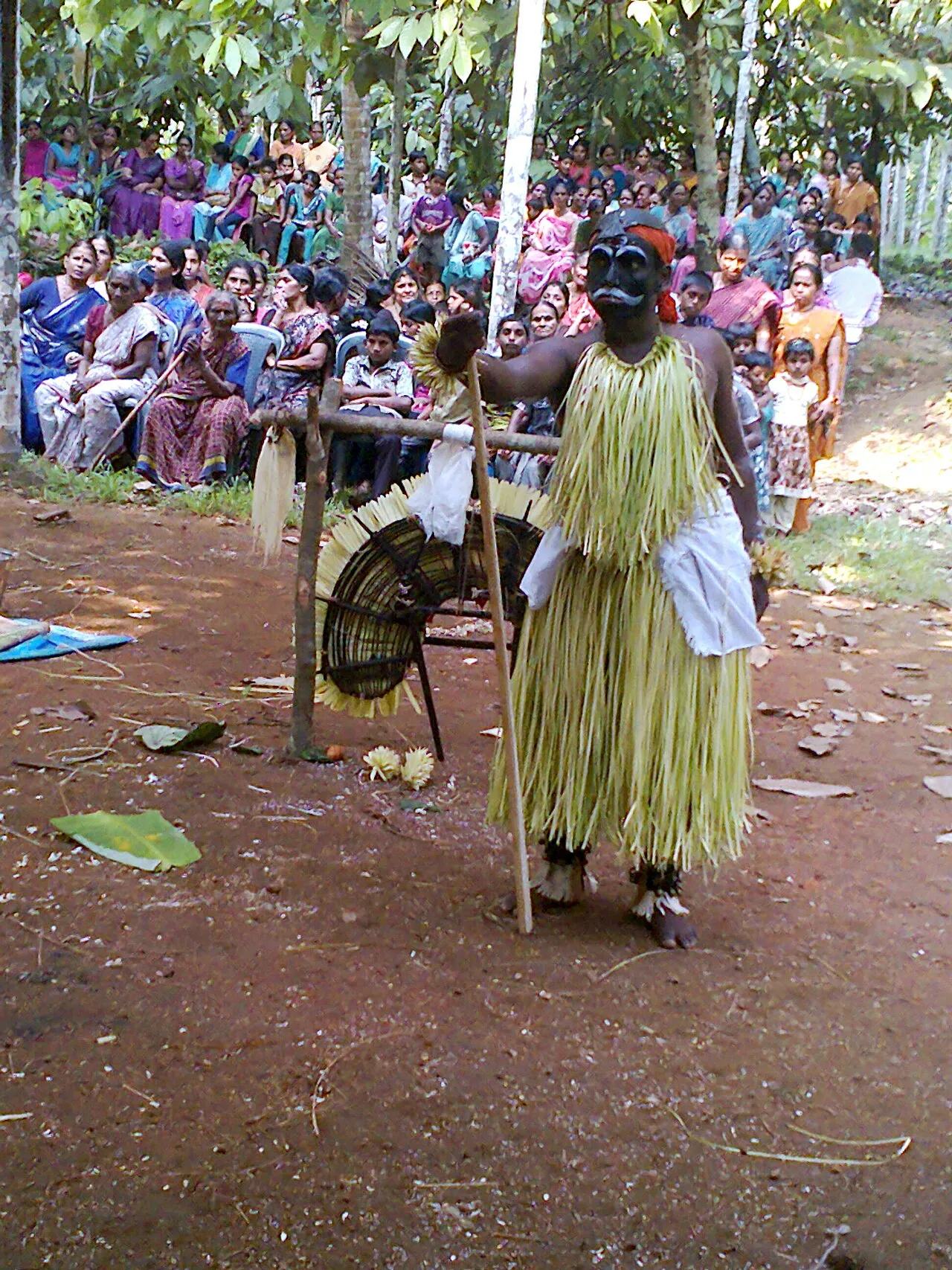
Thaniya grew up strong and became a skilled basket-maker. That is why, when Koragajja comes to life at a kola today, a basket hangs from his shoulder.² ³ He wove a thousand baskets, the Kuthar telling says, and offered them at a temple to keep a vow his parents had made.¹
The offering for the shrine
One year, a shrine closely tied to Bairakke’s family held its nema, its yearly festival for the daivas. It was the family’s turn to bring tender coconuts, coconut fronds and banana plants, a load so heavy it needed seven men to carry it, and no one could be found to take it.² ³
Bairakke asked Thaniya. He said he would carry it all alone, if she would first feed him a meal fit for seven men: rice, toddy, and a curry made from thirty mackerel. She gladly agreed.² ³
After he had eaten, he lifted the whole load. At the edge of the yard he looked back and began to cry. “You have raised me like my own mother,” he told her, in the blogger Vishal Babu Kadri’s telling. “Don’t expect me to come back.”²
Turned away at the gate
Thaniya carried the offering all the way to the shrine. But the man in charge saw who was carrying it, and told him to put it down and keep away. A Koraga could not come in.¹ ² ³
“The things I brought are good enough, but I am not?” Thaniya asked. “You make me stand far off because I belong to a lower community.” No one answered him.²
He set the load down and stood by the shrine. A tree grew there, leaning towards the shrine’s roof and heavy with citron, the sour fruit used for pickle. Thaniya remembered his mother saying the pickle jar at home was empty, and he decided to pick some fruit for her.¹ ²
He climbed up by the shrine, and still could not reach. So he put his foot on the kalasha, the sacred pot-shaped crown on the shrine’s roof.² ³ And there, the boy vanished. He was seven years old, the Kuthar shrine says.¹
The tellings agree that he did not simply die, but became divine. In one, the power inside the shrine took him away in anger; in another, the shrine’s deity drew him into itself.² ³ Either way, the boy who was not allowed in had become a daiva himself.
Driving out the royal spirits
For a while, the paddana says, Thaniya wandered unseen, with no place of his own.¹
At Kuthar, near Mangaluru, two daivas named Panjandaya and Banta were in trouble. The Arasu daivas, the royal spirits of Udyavara, had come to take over their land, and seven days and seven nights of battle had settled nothing. Thaniya came to them and asked if he could help, and what they would give him if he drove the royal spirits out.¹
Panjandaya was doubtful. How could a newcomer do what they could not? So Thaniya showed them his true, enormous form, and they believed him.¹
The royal spirits kept strict rules of purity, and Thaniya used that against them. He went to them carrying the leg of a cow, the one thing they could not bear to come near, and told them to go home. The royal spirits went back to Udyavara.¹ ²
Panjandaya kept his promise. He gave Thaniya seven adisthalas, original seats of worship, and the power to grant the wishes of devotees who worship him in the dark, without fire or lamps.¹
How Koragajja is worshipped
By the word of older generations, the Kuthar tradition counts about 800 years of worship for these daivas.¹ Koragajja’s seven adisthalas keep strict rules. No temple may be built on them and no image set up, and no lamps or incense are lit. Six of the seven take their kolas in the dark. Women may not enter between half past six in the evening and half past six in the morning, and photographs and video are not allowed at any of them.¹
At Deralakatte, one of the seven, his kola is held on the same night as the kola of Guliga, the fierce guardian daiva, and the two daivas meet.¹
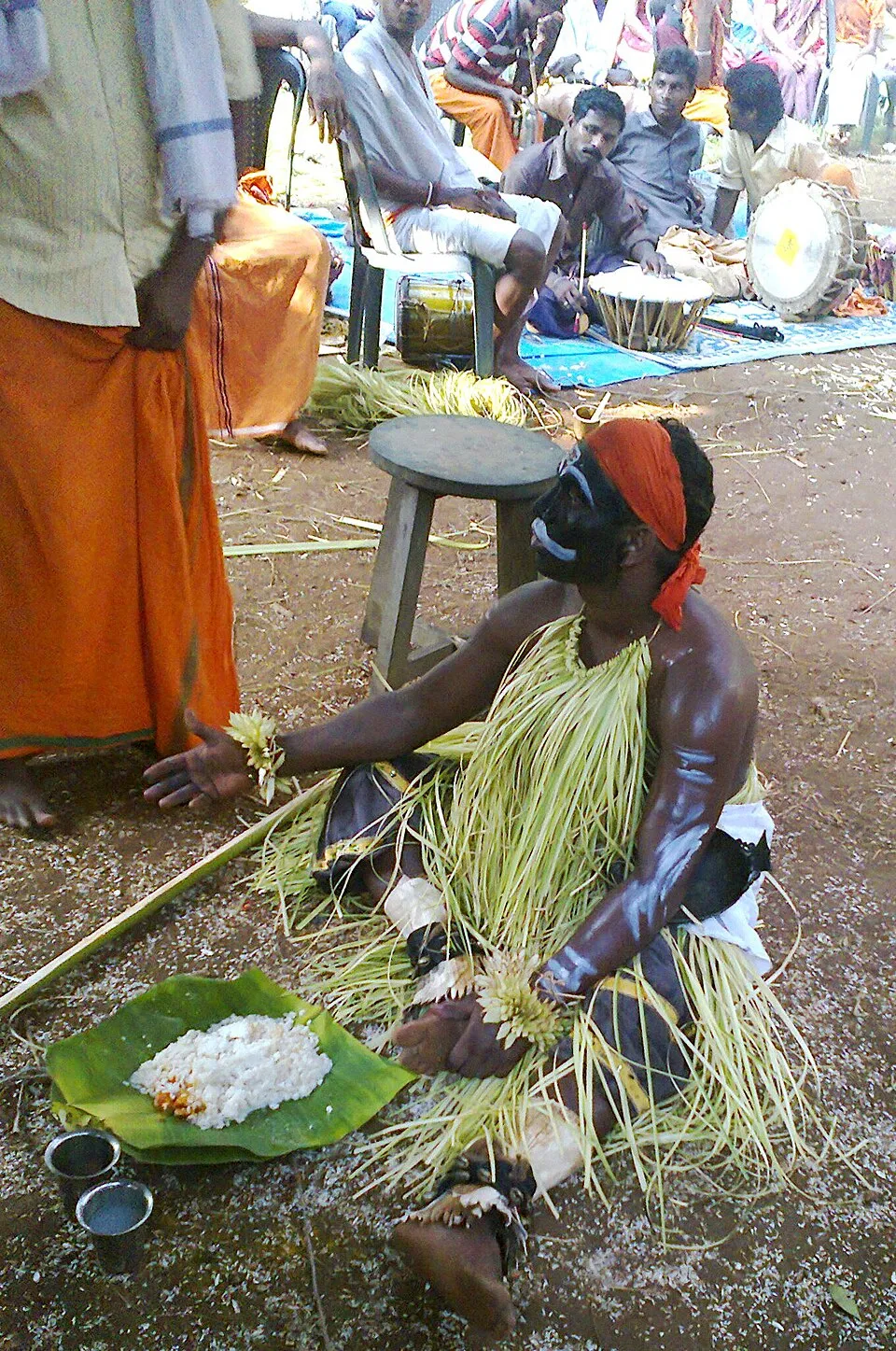

Beyond the adisthalas, Koragajja has many shrines around Mangaluru and beyond, at places such as Ullal, Urwa, Padavu and Udupi.³ His favourite offerings are country liquor, betel leaf and nut, and chakkuli, a crisp fried snack. People say this is because he grew up in a toddy-seller’s home.² ³ An old way of keeping a vow to him is to serve food on a plantain leaf laid on a winnowing basket, and this can be done anywhere, not only at a shrine.¹
The full-moon dancers
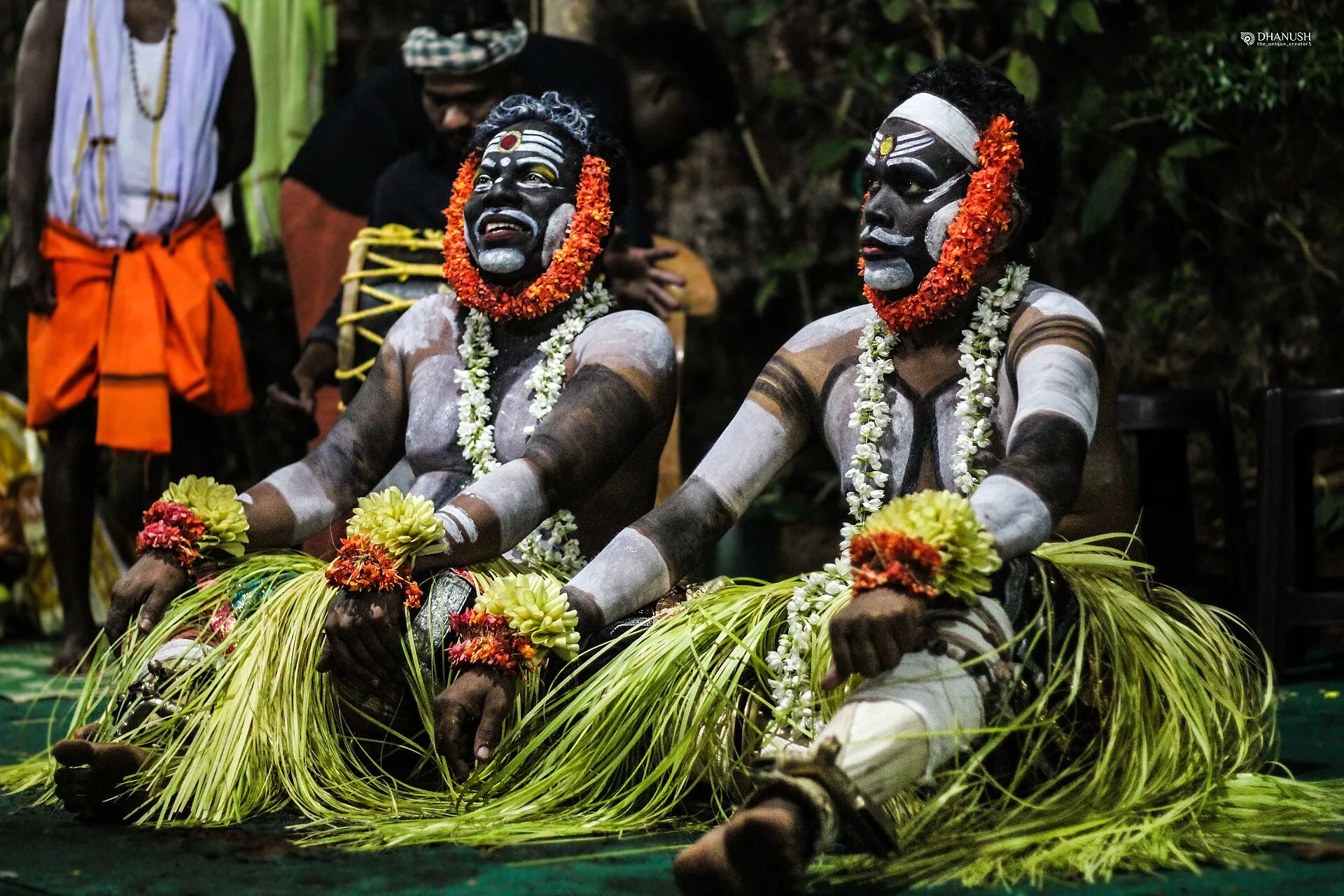
On the full moon of the Tulu month of Mai (Maayi), around March, Koragajja also comes out in a folk dance called kangilu. Dancers dressed in palm leaves, with heavy face paint, dance in a circle to drums and songs, to keep away disease and evil spirits. In the middle of the dance a performer appears in a mask, his body painted black, as Koragajja.⁵
Why his story matters

The Koragas are a small tribal community of the Tulu coast, traditionally basket-makers, who were long treated as untouchable. The Indian government now counts them as a particularly vulnerable tribal group. One humiliating practice used against them, called ajalu, was banned in Karnataka only in the year 2000.⁶
That is the world Thaniya’s story comes from. The Kuthar shrine counts him among the daivas who were once people, those who fought against inequality and injustice in life.¹ The child who was kept outside the shrine gate is now one of the first names people call on, across Tulunadu.² ³
Versions and open questions
How he died. The paddana says he vanished. Some people read that as a gentler way of remembering something harder. Vishal Babu Kadri suggests that he may have been killed for climbing onto the shrine, or may simply have slipped and fallen, and that the story of a vanishing came later.²
Names and places. Tellings differ on his foster mother’s name (Bairakke or Myrakke), on where she found him (near Bolungari or Kallapu), and on which daivas the family shrine belonged to. The Kuthar shrine names it the shrine of Maisandaya. Other tellings list Marlujumadi, Maisandaya, Lekkesiri and Kinnikodangade.¹ ² ³
When he lived. No one knows. The Kuthar shrine’s 800 years is a tradition, not a record. A feature film about him, Koragajja, directed by Sudheer Attavar and still awaiting release, sets the story in the 12th century.¹ ⁷
Related
- Bhuta Kola: When the Spirits Come to the Village
- Rakteshwari, the Earth-Born Maiden, who shares a shrine with Koragajja at Kuthar
- Koti and Chennaya, the Twin Heroes, Billava heroes who also stood up to caste insult
- Guliga, the Hunger That Became a Guardian, the fierce enforcer, who meets Koragajja at Deralakatte
- Jumadi, Neither Man nor Woman, the royal daiva
- Maisandaya, Guardian of the Herd, whose shrine turned the boy away, in the Kuthar telling
- Ullaya and the Ullakulu, the King Daivas, also called the Arasu daivas
Sources & further reading
The articles behind the numbered notes on this page.
- Swamy Koragajja Aadisthala, Kuthar, “Swamy Koragajja Story in English” (the shrine’s own account): his parents, Bolungari and Ensuru Barike, the thousand baskets, the seven loads, the citron tree, the Arasu daivas of Udyavara, the seven adisthalas and their rules, the meeting with Guliga at Deralakatte, the 800 years, and vows kept on a plantain leaf.
- Vishal Babu Kadri, “Story of Koragajja”, Inward of Tulunadu (blog, 2020): Bairakke’s family and the cloth from the toddy pot, the meal for seven, the words at the shrine, the kalasha, the doubts about his death, and why he is offered drink.
- Pundreeka Valli, “Swamy Koragajja Temple of Mangalore: History, Legend, and Significance”, Boldsky (2022): the meaning of his name, Kallapu, the nema load, the kalasha, his shrines and offerings, and what people pray to him for.
- Wikipedia, “Billava”: Baidya as a common Billava name, and toddy-tapping as the community’s traditional work.
- Wikipedia, “Kangilu”: the full-moon dance in the month of Mai and the dancer who appears as Koragajja.
- Wikipedia, “Koraga people”: the community, its listing as a particularly vulnerable tribal group, and the 2000 law against ajalu.
- Wikipedia, “Koragajja” (the film): its director and its 12th-century setting.
Further reading
- Adisthala Swami Koragajja, Kuthar, “Koragajja”, another Kuthar shrine’s account of his story.
Much of this page comes from devotees, shrines and local writers rather than published research. The paddana is sung in many versions, and they differ in their details.
Words on this page
What the Tulu and other Indian-language terms on this page mean.
- adisthala
- An original seat of worship of a daiva.
- ajalu
- A humiliating practice once used against the Koraga community.
- daiva
- A guardian spirit; used interchangeably with bhuta.
- kalasha
- The sacred pot-shaped finial on a shrine's roof.
- kangilu
- A full-moon folk dance in which Koragajja appears.
- kola
- The ceremony in which a daiva is invited to possess a performer.
- nema
- Another name for a kola, the annual ceremony for a daiva.
- paddana
- A long oral ballad, sung to tell the story of a daiva or hero.
Themes
Spotted a mistake, or know more about this? Suggest a correction/addition.