Guliga, the Hunger That Became a Guardian
Under a tree, out in the open, there is a stone that no one has carved. It has no roof and no face. The offering is laid out before it on a mat of tender coconut leaf, and a torch of dry palm leaf is held up to light it. Then everyone turns around and looks the other way for a few minutes, so that the daiva can come and eat.¹
The stone is Guliga. He is one of the oldest daivas (guardian spirits of the land) of Tulunadu, and by one account the one most commonly worshipped.¹ ² He is the fierce one, the guardian who punishes wrongdoing and does not let a broken promise go. His story is about a hunger so great it tried to swallow the sun, and about the one thing that could finally calm it.
The story
The story is told in different ways in different places. This is the outline most tellings share.¹ ² ³
A stone in the ash
On Kailasa, the mountain home of the gods, Parvati found an unusual stone in a heap of sacred ash, and brought it to Shiva. Shiva threw the stone to the ground, and from it Guliga was born.¹ ³ In one telling, Shiva flung the ash into water instead.²
Shiva sent the newborn to serve Vishnu.¹ ² ³
Born a second time
But Vishnu cursed him to be born again, this time from the womb of a serpent, the Nelaulla snake.¹
When nine months had passed, the child spoke to his mother from inside her. Which way should he come out? “The way all children come,” she told him. He would not. He tore his way out of her body instead, through her left breast, in Vishal Babu Kadri’s telling.¹ ³
A hunger nothing could fill
He was born starving. He leapt at the sun and tried to eat it. He drank Vishnu’s lake dry and ate every fish in it. He was given the blood of elephants and horses, and still he was hungry.¹ ³
At last Vishnu gave him his little finger. When Guliga bit it, divine peace flowed through him for the first time, and his rage was calmed.¹ ² His belly was full at last, and he was sent down to earth.¹
The seven water goddesses

One day, seven Jaladurgas, goddesses of the water, were sailing on the sea. They saw Guliga, took him in and blessed him, and made him the guardian of their temples. That is how he came to be called Kshetrapala, the guardian of sacred ground.¹ ³
The fight with Panjurli
Later, Guliga and Panjurli, the boar daiva, fought a fierce battle. The Jaladurgas calmed them both, and told them to live together as siblings. That is why, in some places, the two daivas are worshipped side by side.¹ ³
Panjurli, it is said, foretold that anyone who torments people and spreads evil will be killed by Guliga.²
How Guliga is worshipped
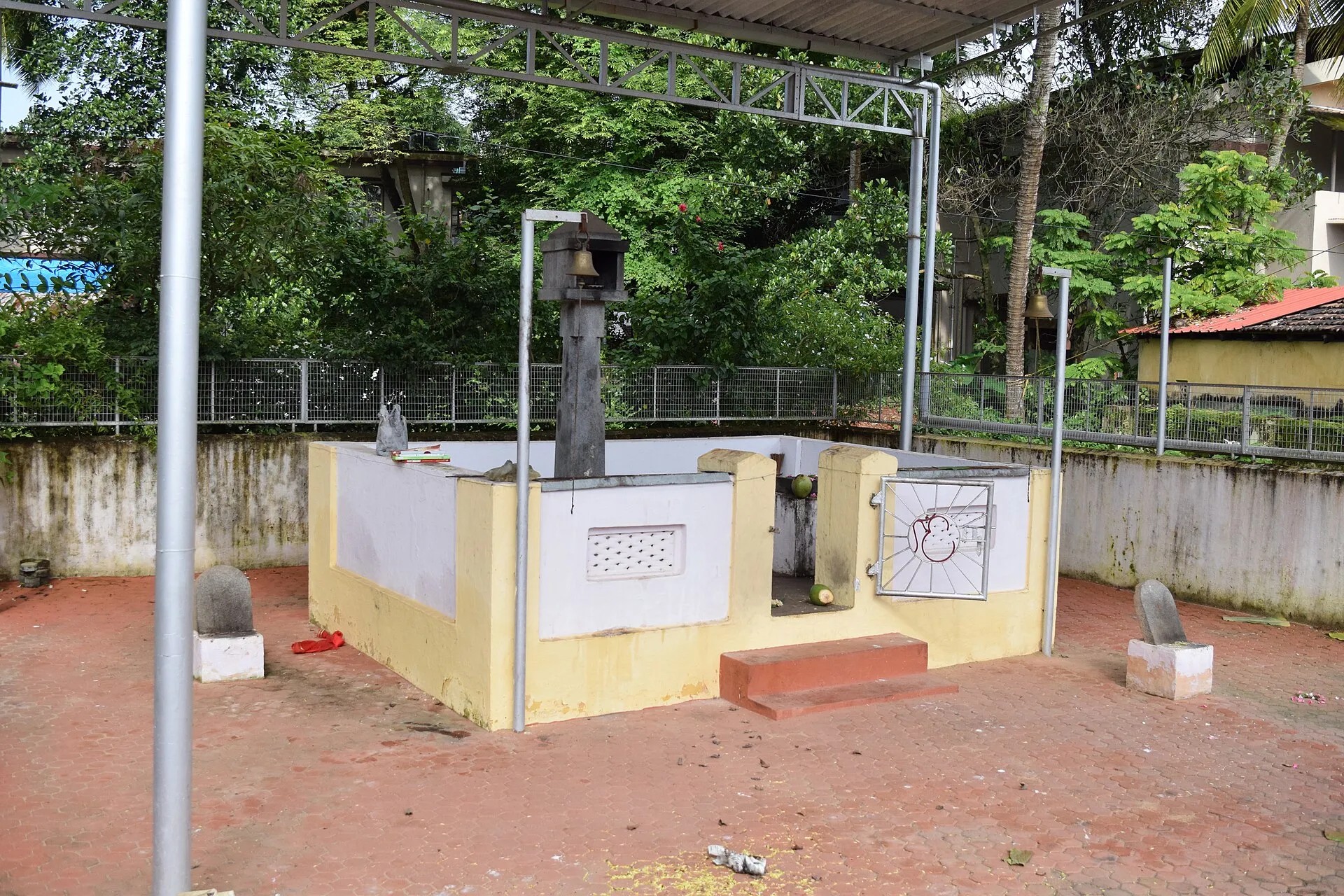

Guliga has no temple image. He is usually worshipped as an unshaped stone in an open place, often under a tree, and his devotees say his eye is always turned to the sky.¹ ³ He is set at the boundaries, as a guardian who keeps evil spirits away from what lies inside, and his shrine is known for keeping devotees in line.¹
His offering is laid on a mat of tender coconut leaf, or on a stone, and shown light with a sute, a torch made of dried palm leaf. After the last offering, people turn away for a few minutes, believing that the daiva comes to take his share. Women do not take part in this ritual.¹
Many names

Guliga’s worship changes from place to place, and with what kind of daiva he is there: the daiva of a place, of a family, or of a wider area.¹ Depending on the place, and on the other spirits he has merged with, he also goes by many names. Vishal Babu Kadri lists Rahu Guliga, Raja Guliga, Kathale Guliga, Mantravadi Guliga, Sanyasi Guliga, Chamundi Guliga (which he spells Chawndi), Mookamba Guliga and more.¹ ³
Rahu Guliga, Kadri explains, is really two spirits worshipped under one name. Rahu is a restless spirit with no fixed place and no proper form. People once held a kola for Rahu only when they needed to take the spirits of their ancestors back from him. Over time, that became a kola every year.¹
At the kola
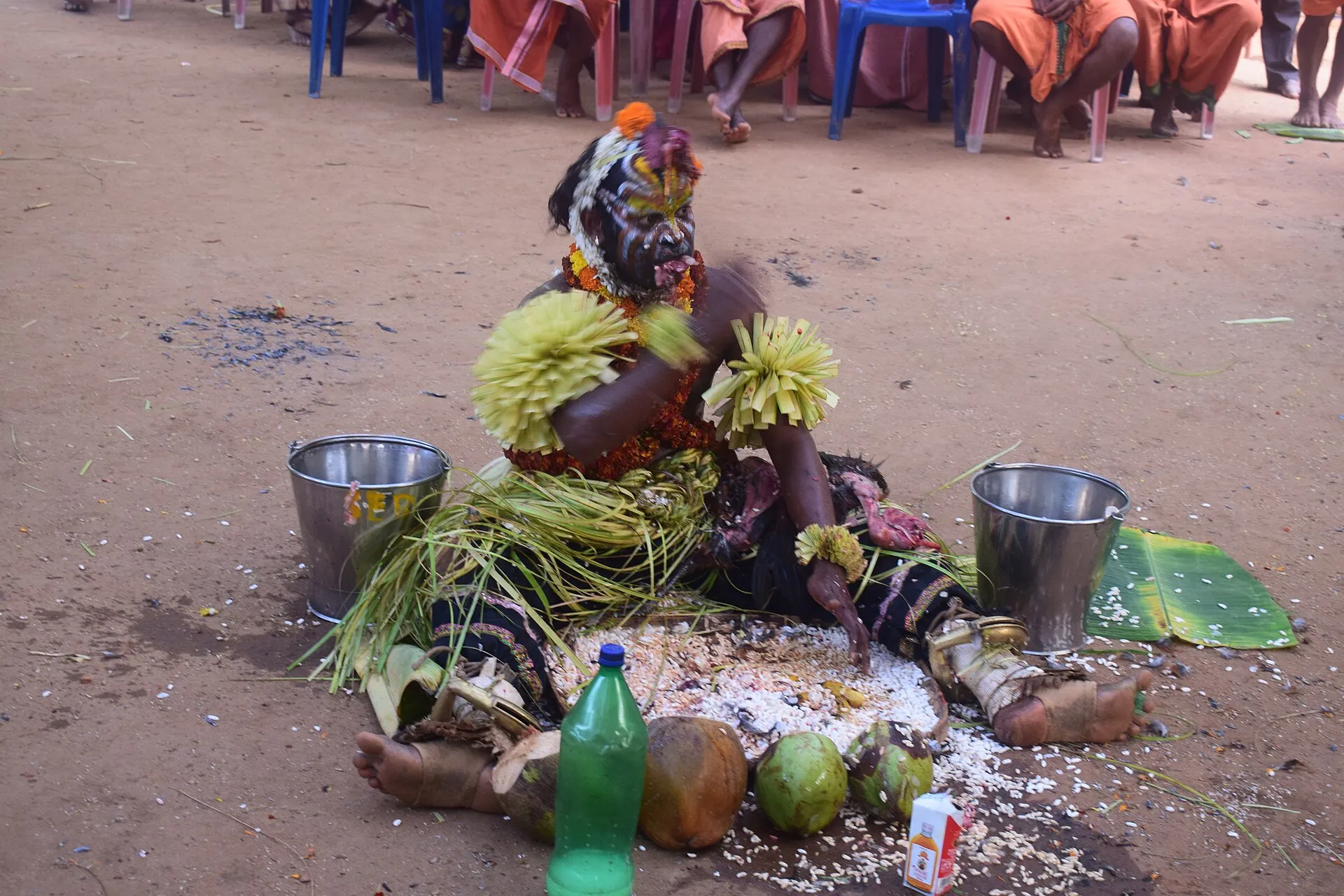

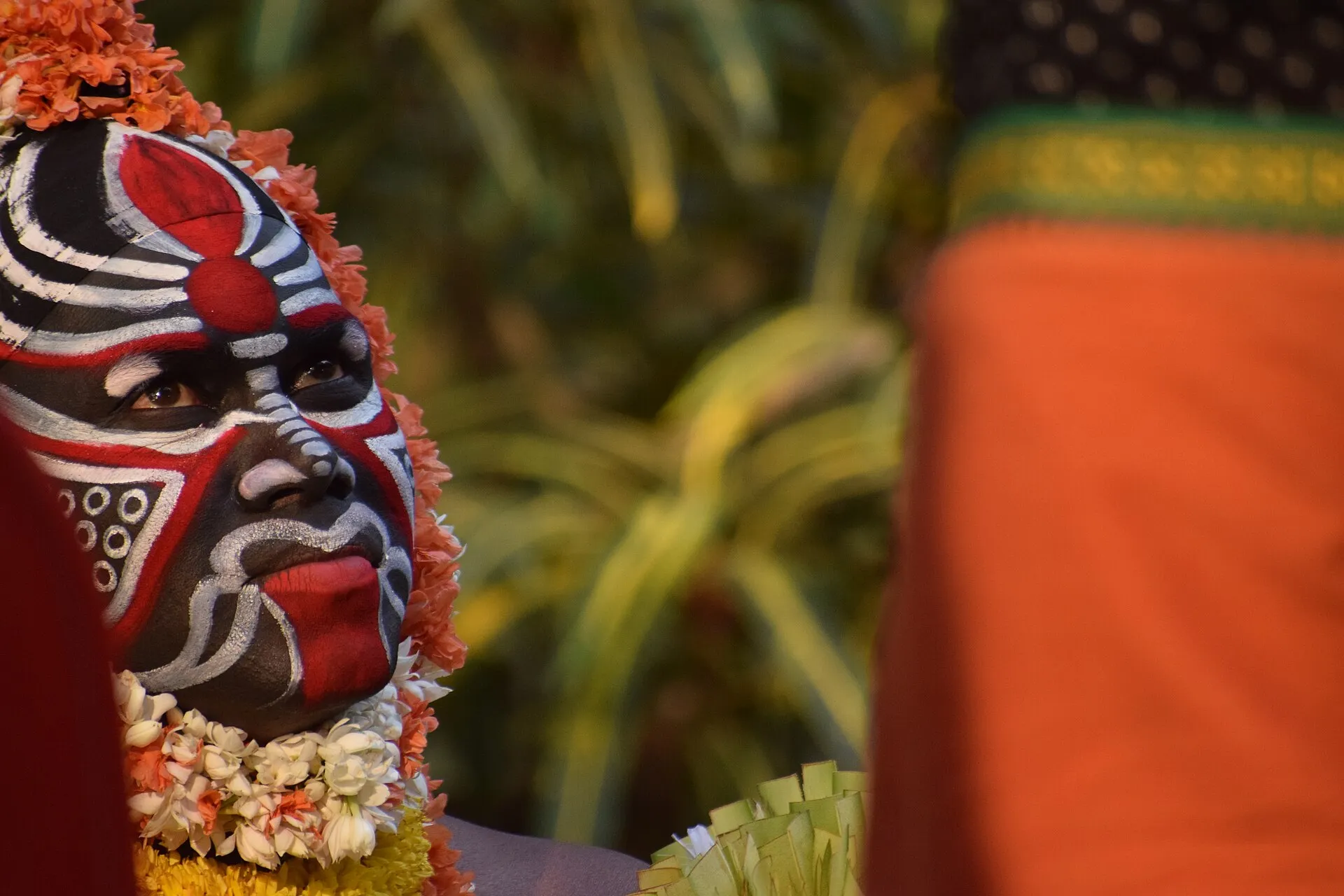
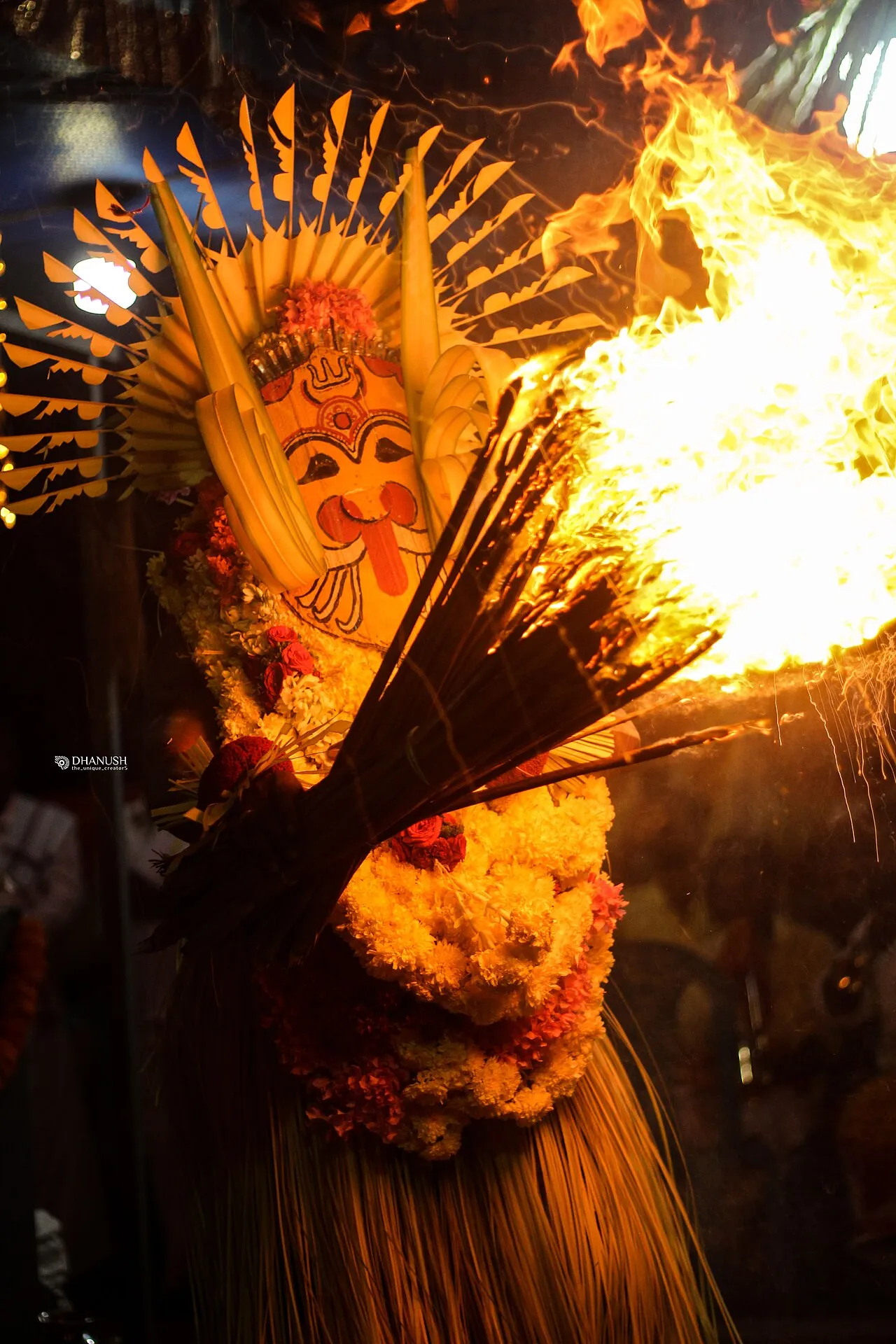
At a Guliga kola, the night-long ceremony in which a trained performer embodies the daiva, the performer’s face is painted black and decorated in red, white and green. Tender palm leaves are tied around his waist, and anklets called gaggara around his legs. He dances hard, holding a burning sute in his hand. Guliga’s hunger shows here too: in his kola he can be seen eating raw meat.¹
Meeting Koragajja at Deralakatte
At Kuthar, near Mangaluru, Guliga is part of Koragajja’s story. The Maganathadi family there keeps Guliga’s trident in its care, along with Koragajja’s sacred belongings. On an auspicious day in December, the bhandara, the sacred belongings of Koragajja and of Guliga, are carried to Deralakatte, one of Koragajja’s seven adisthalas (original seats of worship).⁴
Guliga’s kola is held at his own katte (a raised platform shrine) at Deralakatte, at the same time as Koragajja’s. Then Guliga goes to Koragajja’s adisthala, and the two daivas meet, in a custom the shrine says has been kept since ancient times.⁴ The Kuthar account also counts Guliga among the old daivas who were once worshipped at Koragajja’s seven adisthalas, before they were given places of their own.⁴
Old ways and new
Kadri worries that the old ways are slipping. In some places, he writes, the bare stone under a tree has given way to an idol in a concrete shrine, and the kola is drifting towards entertainment and exaggeration. He asks people to understand the meaning behind the customs before they follow them.¹
Guliga on screen
Guliga reached a far wider audience through the Kannada film Kantara (2022). In the film, a king takes a sacred stone from the forest in return for giving land to the villagers, and Panjurli warns, through a human medium, that his ferocious companion Guliga will not forgive any betrayal of that promise. At the climax, the hero strikes his head against Guliga’s sacred stone and is possessed by the daiva.⁵
The prequel, Kantara: Chapter 1, released on 2 October 2025, goes back to the origins of Panjurli and Guliga. In it, too, the hero is possessed by Guliga in battle.⁶
Why his story matters
Guliga is half of a pair that many Tuluvas know well. If Panjurli stands for kindness, Guliga stands for discipline and justice. People say that while Panjurli blesses the crops, Guliga guards the borders, and makes sure that promises made to a daiva are kept.³
His story also reaches into the worlds of two great gods. He is born from Shiva’s ash and counted among Shiva’s attendants, the ganas, and it is Vishnu’s finger that tames him.¹ Yet he is worshipped in a way all his own: a bare stone, out in the open, with no image at all.
Versions and open questions
Ground or water. Most tellings say Shiva threw the stone to the ground. Wikipedia’s account says he flung the ash into water.¹ ² ³
When the hunger ended. In Kadri’s telling, Vishnu’s finger fills Guliga’s belly before he is sent to earth. In Wikipedia’s, Vishnu exiles him to earth first, and only comes back with the finger when Guliga’s hunger keeps causing trouble there.¹ ²
Why so fierce. Kadri writes that, because of his strange birth, his rage and his animal hunger, Guliga was sent to earth “for an evil sacrifice”, and that this may be where his fierce ways began.¹ What that sacrifice means is not explained.
Who made peace. In most tellings the Jaladurgas end the fight between Guliga and Panjurli. One blog says it was the goddess Lakshmi, who reminded them of their duties: Panjurli to nurture life, Guliga to protect truth.³
A sister. The same blog gives Guliga a sister, a fierce protector whose story, it says, is “waiting to be told another day”. It spells her name Chamuni, meaning Chamundi.³ Another writer, Akhil Pillai, also gives Guliga a sister, Chaundi, another spelling of the same name, and counts her among the oldest daivas of the land.⁷ Chamundi is worshipped across Tulunadu in many local forms, named for the place or for the daiva she is paired with, much as Guliga himself takes names like Chamundi Guliga. Pillai calls Pilichamundi, the tiger goddess, the most famous of these forms.⁷
Related
- Bhuta Kola: When the Spirits Come to the Village
- Panjurli, the Boar Daiva, Guliga’s gentler companion
- Koragajja, the Boy Who Was Turned Away, who meets Guliga at Deralakatte
- Jumadi, Neither Man nor Woman, the royal daiva
- Pilichamundi, the Tiger Goddess, the best-known form of Chamundi
- Kordabbu and Tannimaniga, the Healer and the Sister Who Saved Him, the daiva whose army Guliga is said to command
Sources & further reading
The articles behind the numbered notes on this page.
- Vishal Babu Kadri, “Story of Guliga”, Inward of Tulunadu (blog, 30 July 2020): the stone in the ash, the serpent birth, the hunger and Vishnu’s finger, the Jaladurgas and the fight with Panjurli, Guliga among Shiva’s ganas, the stone in the open, the offering ritual, his many names, Rahu Guliga, the kola, and the changing customs.
- Wikipedia, “Buta Kola” (the section on Guliga): Guliga as the most commonly worshipped daiva, the ash flung into water, his exile to earth, Vishnu’s finger, and Panjurli’s promise.
- Two short blog accounts. Ambiladharma, “Guliga daiva of Kantara” (blog, 2023): the stone, the birth, the hunger, the Jaladurgas, Kshetrapala, the fight with Panjurli, the stone under a tree, and his names. “Who Is Gulige Daiva? Untold Story”, Beyoutiful Life (blog): Panjurli and Guliga as kindness and justice, Lakshmi’s peacemaking, and Guliga’s sister.
- Swamy Koragajja Aadisthala, Kuthar, “Swamy Koragajja Story in English” (the shrine’s own account): Guliga’s belongings, the December procession, the Guligana Katte at Deralakatte and the meeting of the two daivas, and the old daivas of the seven adisthalas.
- Wikipedia, “Kantara (2022 film)”: Panjurli’s warning about Guliga and the climax at Guliga’s stone.
- Wikipedia, “Kantara: Chapter 1”: its release date, its subject, and the hero’s possession by Guliga.
- Akhil Pillai, “The Spirit World of Kantara Chapter 1: A Thematic Study” (blog, 2 October 2025; read from an archived copy): Chaundi (Chamundi), Guliga’s sister, and Pilichamundi.
Further reading
- Rahul, “Panjurli and Guliga – The Gods From Kantara”, Hinduism Facts.
- Pranav Gogwekar, “The Divine Deities from Kantara”, Live History India (2022).
Almost everything on this page comes from devotees, a shrine and local writers rather than published research. Guliga’s story is told in many versions, and they differ in their details.
Words on this page
What the Tulu and other Indian-language terms on this page mean.
- adisthala
- An original seat of worship of a daiva.
- bhandara
- The daiva's sacred objects: swords, shields and ornaments.
- daiva
- A guardian spirit; used interchangeably with bhuta.
- katte
- A raised platform shrine.
- kola
- The ceremony in which a daiva is invited to possess a performer.
- Kshetrapala
- The guardian of a sacred place.
- nema
- Another name for a kola, the annual ceremony for a daiva.
- sute
- A torch made of dried palm leaves.
Themes
Spotted a mistake, or know more about this? Suggest a correction/addition.