Jumadi, Neither Man nor Woman
Look closely at Jumadi’s face and something seems not quite to fit. In much of Tulunadu the face is a man’s, with a moustache. But below it, the paddanas say, the body is a woman’s, with a sacred linga at the throat and a crown of snakes on the head.¹ ²
That is the point of Jumadi. This daiva (a guardian spirit of the land) is Shiva and Parvati in a single body, neither man nor woman. Jumadi is one of the great daivas of Tulunadu, worshipped by landholding Bunt families and royal houses, and by people of every caste.¹ ²
Jumadi has two stories. One is set among the gods, and tells how Jumadi came to be. The other is set on a Tulu battlefield, and tells what Jumadi can do for someone who calls.
The story
Jumadi’s stories are sung in paddanas, the long ballads that tell a daiva’s story.¹ This is how the two best-known ones go.
A demon no one could kill
A demon named Dhumasura was eating people. He had a thirst nothing could quench, and he had made whole peoples disappear. Worse, he held a boon: he could not be killed by a man, and he could not be killed by a woman.¹ ²
His victims prayed to Shiva and Parvati, and the two came down together from their mountain home, Kailasa, to destroy him.
The hunger on the road
On the way, Parvati was seized by a terrible hunger. Shiva tried everything he could find to satisfy her, and nothing was enough. At last he offered himself, and told her to swallow him.¹ ²
Parvati began to swallow her husband. But when she reached his head, it would not go past her throat. There the two bodies fused: Shiva’s moustached face above, Parvati’s neck and body below.¹ ²
The new being was male and female at once, and so the demon’s boon could not protect him. Jumadi fought Dhumasura and killed him, and took the name Dhumavati, “the one who defeated Dhumasura”.² Then Jumadi came down to the Tulu country to be worshipped there.¹
The house with no warrior
The second story happens on earth, at Perinje Guttu. A guttu is the great ancestral house of a landholding family. The lord of the house, Manjanna Poonja, had died, and the king ordered the family to hand over its authority, because there was no one left to lead its men in war.³
By Bunt custom, the heir was the dead lord’s nephew, his sister’s son. Inheritance passed through the mother’s line, the system called aliyasantana. But this nephew, Deramu, was afraid of war and had backed away. Manjanna’s widow, Shankari Poonjedi, could not bear it. She sat weeping in a dark room of the house.³
Her son Devu Poonja, a boy of sixteen, came home from playing and found her there. When she told him why she was crying, he said he would lead the war himself. His mother pushed the idea aside. He answered that a tiger gives birth to a tiger, not a rat: he was the son of Manjanna Poonja and the nephew of Kantanna Adhikari, and he would be no less than they were.³
The uncle’s gift
The enemy was Dugganna Konde of Manimajala Guttu, a warrior who had fought seven wars and won them all. So Shankari sent her son to train under her elder brother, the formidable Kantanna Adhikari.³
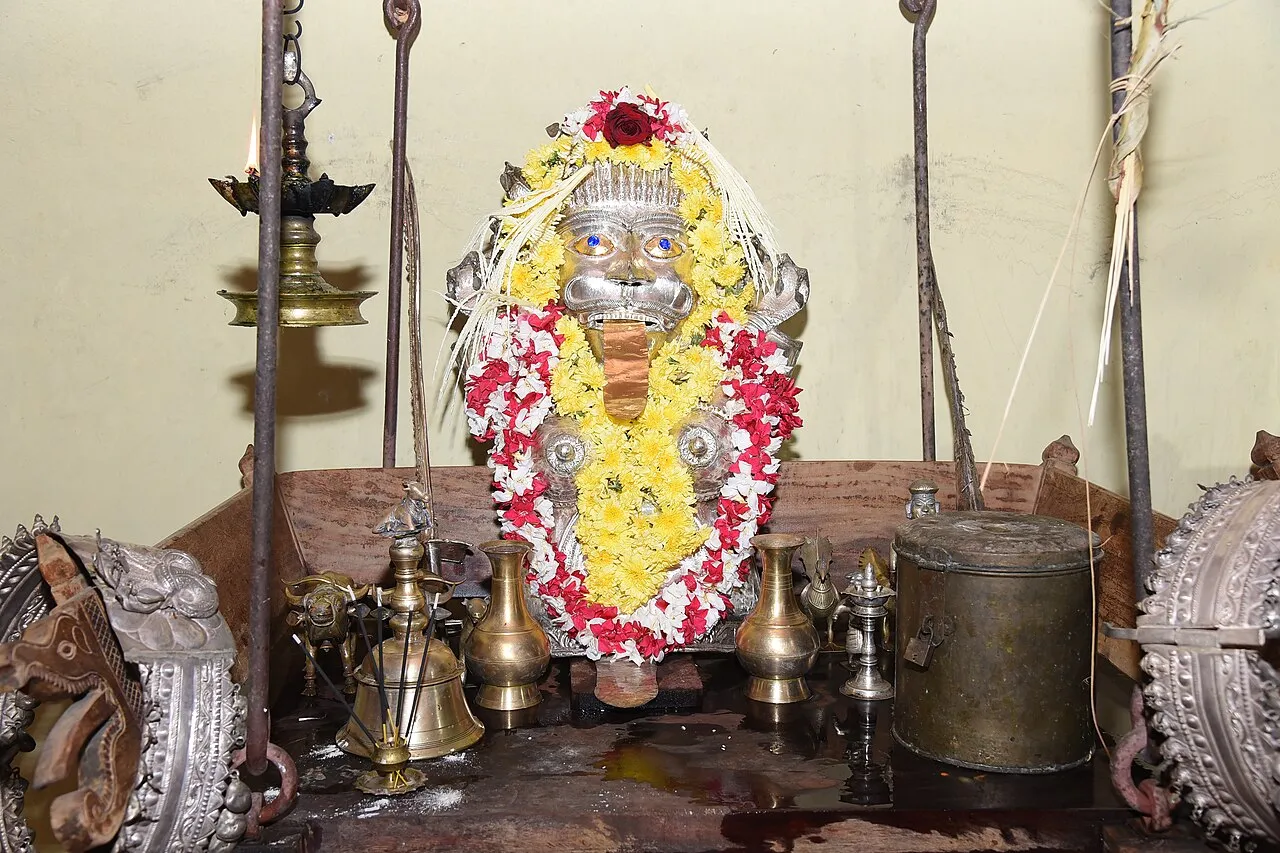

Devu learned fast. Soon he was beating his uncle in practice. Kantanna, delighted with his nephew, wondered what gift he could give him. Before he could decide, Devu asked for one thing only: that his uncle send with him Jumadi, the daiva Kantanna worshipped. Kantanna agreed, and prayed to Jumadi for the boy.³
One call is enough
On the battlefield of Karandetthi, Dugganna Konde laughed at the boy and told him to run. Devu teased him back: he was good at talking, but would he fight? Stung, Dugganna Konde caught the boy and locked him under his arm.³
In pain, Devu cursed the daiva. What had his uncle sent with him? This Jumadi was worthless.³
At once, he felt an enormous strength flood his body. Jumadi had always promised, Onji leppugu, patth oo kendh daiva yaan undaape: “If you believe in me, I will be there to help you at a single call.” Devu broke free, turned the hold on Dugganna Konde, and killed him. Perinje Guttu was saved, and Devu Poonja, with Jumadi’s blessing, grew up to be one of the great men of Tulunadu.³
A vow forgotten
Not every telling ends there. The Tulu researcher Lakshmi G Prasad writes that Devu Poonja later forgot a harake, a vow he had made to the daiva, and Jumadi brought disaster on him. Afterwards, Devu Poonja himself came to be worshipped as a lesser daiva in Jumadi’s circle.⁴
In Tulu belief, she explains, people who vanish in this way have not died. They have passed into maya, the unseen world, and they return as protectors.⁴ The boy Jumadi saved is now part of Jumadi’s own household.
How Jumadi is worshipped
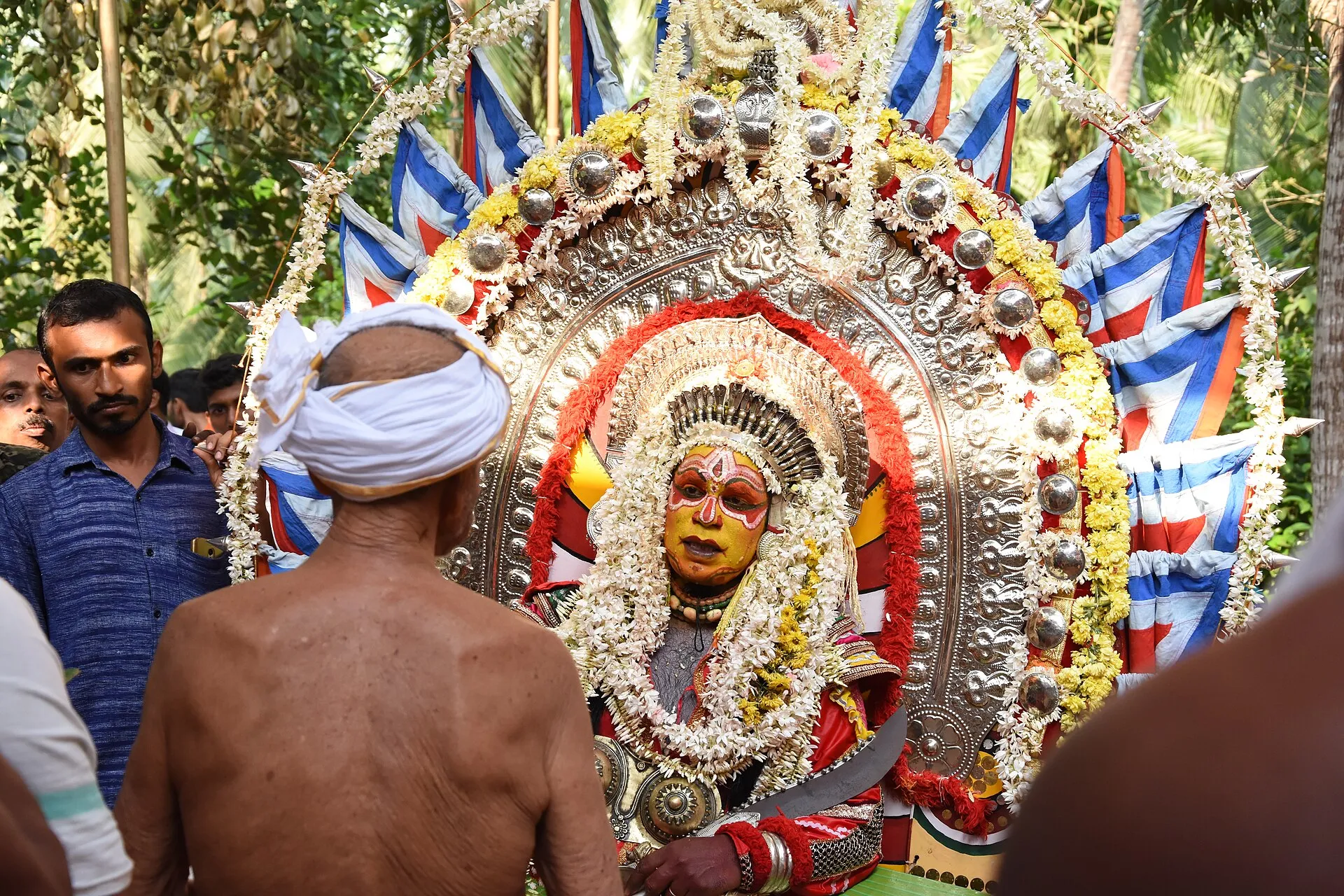

Jumadi has many forms, and the paddanas name them. Kanteri Jumadi is the Jumadi of Kantanna Adhikari and Devu Poonja. Marlu Jumadi is the wild, raging form. Sarala Jumadi is worshipped by a thousand households, Paddeyi Jumadi belongs to the Kumble area, and Pancha Jumadi is the form worshipped by Tulu Brahmins.¹
Jumadi’s muga, the face worn or set up for the daiva, changes across the region. Around Mangaluru and Udupi it is a man’s face with a moustache. Around Kasaragod and Kumble it is a great boar’s face with jutting tusks, with snakes for earrings and an elephant on each ear. The paddanas call that the daiva’s original form, and give it a trident, a shield, a sword, a fly-whisk and a bell.¹
The Chowta royal family worships Jumadi at a shrine inside its palace at Moodbidri, the Chowtara Aramane.² Offerings differ from shrine to shrine. Some give Jumadi only fruit and vegetarian food. Others offer the blood of a rooster, which stands for the demon Dhumasura; the rooster is then eaten by the devotees as a blessed offering, or given to the performers who embody the daiva.²
At the kola, Jumadi is rarely alone. Beside the daiva stands Bante, whom one account describes as a foolish messenger and warrior assistant, a down-to-earth companion for so majestic a daiva.²
Nellidadi Guttu
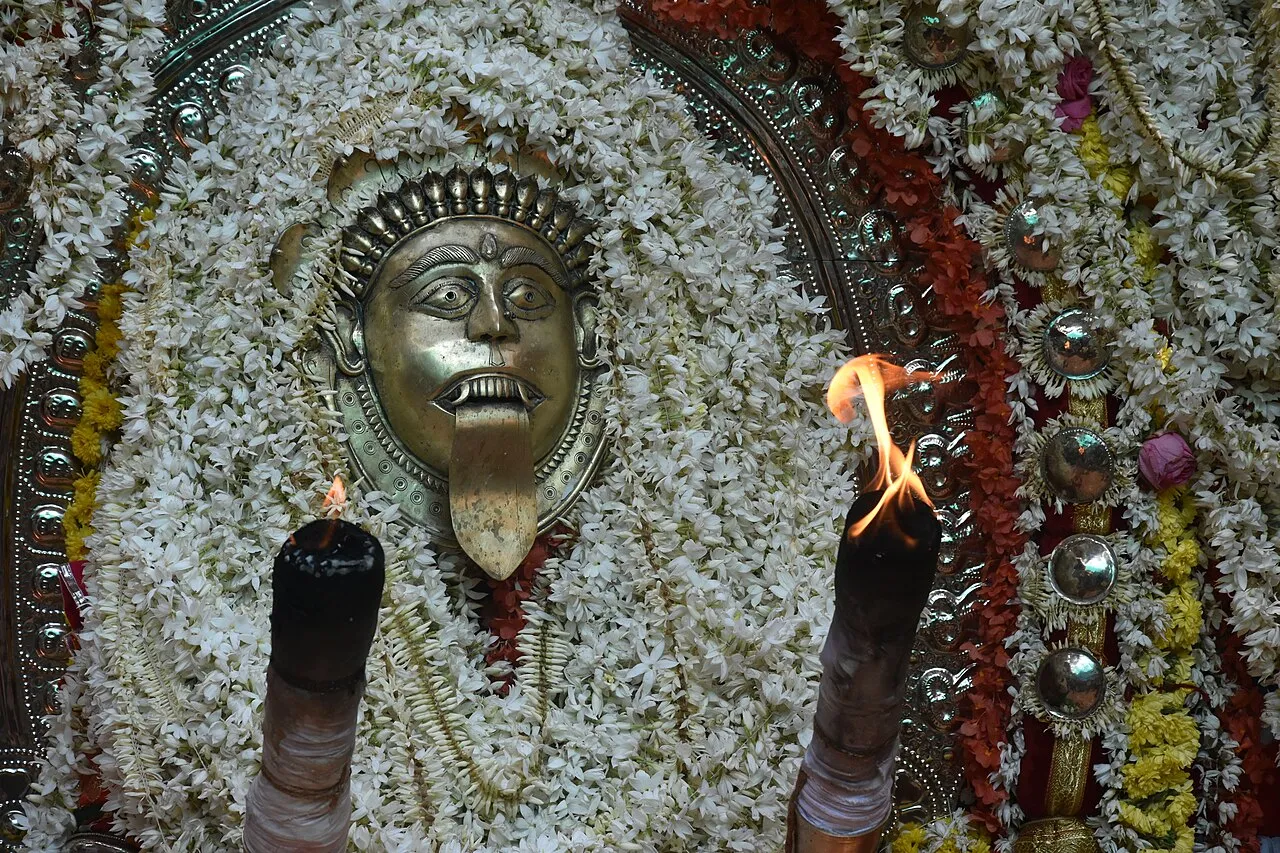

Jumadi’s bond with the land can still be tested. Nellidadi Guttu, a village near Mangaluru with a history villagers count at around 800 years, worshipped Jumadi at its own shrine. In 2006 the state’s industrial development board took over the land for the Mangalore Special Economic Zone, and the village was emptied.⁵
Having lost their homes, the villagers have asked for one thing: to keep worshipping their daiva on that ground. In 2025 the online magazine Vayuveg reported that the zone’s officials had told them their latest request for worship would be the last, and that they had petitioned the state and central governments to keep the shrine.⁵
Versions and open questions
Another birth. Not every story begins with Dhumasura. In one, Jumadi is a child born from Parvati’s belly with a thirst no one could quench. When even Vishnu failed to satisfy the child, Jumadi was sent to the land where devotees offer coconut water, and that finally did.²
He or she? People speak of Jumadi in both ways. Some accounts call Jumadi a goddess, while in Devu Poonja’s story Jumadi is “he”.² ³ ⁵ For a daiva who is both, neither is wrong.
Two Dhumavatis. Dhumavati is a Sanskrit form of Jumadi’s name. It is also the name of a fierce Hindu goddess, one of the ten Mahavidyas. The Tulu Jumadi is a different figure who shares the name.¹
Devu Poonja’s end. Whether his forgotten vow belongs to the same paddana as his victory, or to a separate tradition, is not clear from the accounts available.³ ⁴
Related
- Bhuta Kola: When the Spirits Come to the Village
- Panjurli, the Boar Daiva, often honoured alongside Jumadi
- Koragajja, the Boy Who Was Turned Away, whose story names a Marlujumadi shrine in some tellings
- Ullaya and the Ullakulu, the King Daivas, whose performer learned the kola from a Kantheri Jumadi
- Kodamanithaya, the Daiva Who Followed His Devotees, another royal daiva, whose festival at Shibaroor is followed by nemas for the Jumadis
- Guliga, the Hunger That Became a Guardian, the fierce enforcer
- Babbarya, the Daiva of the Sea, whose shrine stands beside Jumadi’s at Udupi
Sources & further reading
The articles behind the numbered notes on this page.
- Wikipedia, “Jumadi”: the Dhumasura story, the forms of Jumadi named in the paddanas, the masks around Mangaluru, Udupi, Kasaragod and Kumble, the Bunt lords of Kanteri Jumadi, and the difference from the Mahavidya Dhumavati.
- Shilpa V. Sonawane, “Jumadi (or Dhumavati)”, in Diaspora of Bhuta (Daiva) Worshipping Cult: India and Indonesia (thesis, via Wisdom Library): the Dhumasura story and the name Dhumavati, the other birth story, Bante, the Chowta family’s palace shrine, and the offerings.
- Bhavish Shetty, “Devu Poonja: A Tuluva Hero” (blog, 2018): Perinje Guttu, Shankari Poonjedi, Kantanna Adhikari, the fight at Karandetthi, and Jumadi’s promise.
- Lakshmi G Prasad, “What will happen to those who disappear in Tulunadu” (blog, 2023, reposting an English translation of her Kannada article from Pipa News): vanishing into maya, and Devu Poonja’s forgotten vow and worship in Kanteri Jumadi’s circle.
- “Nellidadi Guttu’s silent cry: A village’s fight to save its sacred land”, Vayuveg (2025): the village, its Jumadi shrine and the Special Economic Zone, and Jumadi called a goddess.
Further reading
- Heidrun Brückner, On an Auspicious Day, at Dawn: Studies in Tulu Culture and Oral Literature (Harrassowitz, 2009), on Google Books: a scholarly study of Tulu oral tradition, including Jumadi.
- Raviprasad Kamila, “Kantheri Jumadi paddana in English”, The Hindu (archived copy).
Much of this page comes from blogs and online writers rather than published research. The paddanas are sung in many versions, and they differ in their details.
Words on this page
What the Tulu and other Indian-language terms on this page mean.
- aliyasantana
- Inheritance through the mother's line.
- daiva
- A guardian spirit; used interchangeably with bhuta.
- guttu
- The ancestral headquarters house of a landed family.
- harake
- A vow made to a daiva or god.
- kola
- The ceremony in which a daiva is invited to possess a performer.
- maya
- The unseen world where the spirits live.
- muga
- The face or mask of a daiva.
- paddana
- A long oral ballad, sung to tell the story of a daiva or hero.
Themes
Spotted a mistake, or know more about this? Suggest a correction/addition.