Panjurli, the Boar Daiva
Ask a Tuluva family which spirits watch over them, and Panjurli is almost sure to be on the list. He is the boar daiva (a guardian spirit of the land), honoured in family shrines and village ceremonies right across Tulunadu. His name is usually taken to mean “young wild boar” in Tulu.¹
It is an odd choice of protector, when you think about it. For anyone growing rice, a wild boar is a disaster: one night in the paddy and a season’s work is gone. The story of how the boar became the guardian of the fields is one of the best-loved in Tulunadu.
The story
A piglet in the divine garden

High on Kailasa, Shiva and Parvati kept a garden where every flower was perfect. One day a family of wild boars, driven by hunger, wandered in and began rooting up the sacred plants. Shiva’s attendants, the ganas, killed the grown boars. Only one of the litter survived, a little male, left crying among the flowerbeds.²
Parvati, mother of all creatures, found the piglet sweet. She took him home and raised him as her own.
The tusks come in
As the young boar grew, his tusks began to come through, itching and aching. He eased them the only way a boar knows: by tearing up the earth. He ploughed through Shiva’s garden and uprooted everything in his path.
Shiva was furious and decided to kill him. But Parvati stood in front of the boar and pleaded for him. There was nothing evil in him, she said. He was only wild, and wildness simply did not belong in heaven.
Sent down to earth
Shiva relented. Instead of killing the boar, he sent him down to earth, and not as a punishment. He gave him a task. The creature that had wrecked a garden would now guard the fields of human beings, protect them from harm, and receive their worship in return. So the boar became the daiva Panjurli.³
Not everyone tells it this way. In another version, Shiva does kill the boar in his anger. When Parvati grieves, he brings the boar back as a spirit and sends him to earth to protect people.⁴ Either way, the story ends in the same place: the wild thing becomes the guardian.
Panjurli at the kola
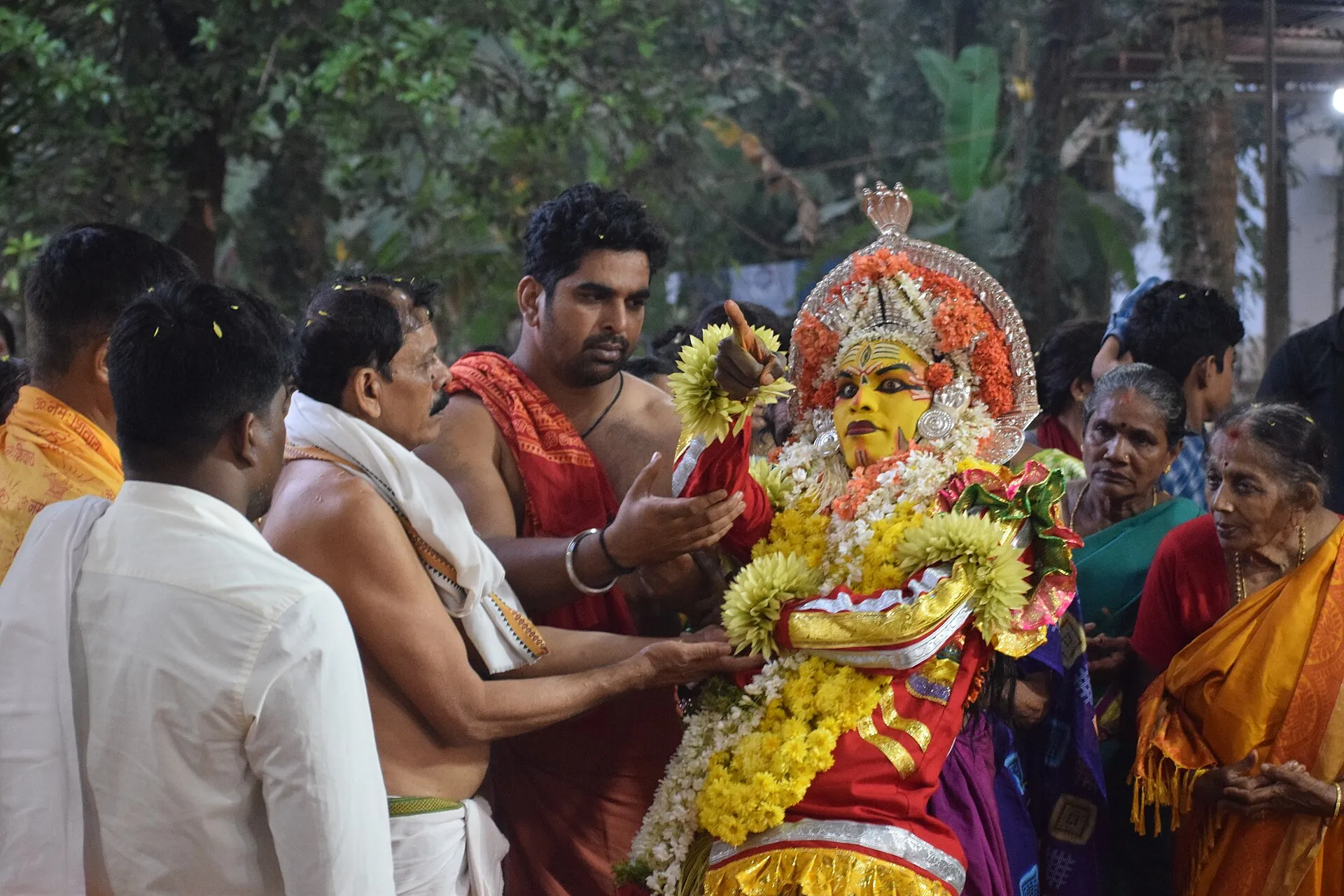

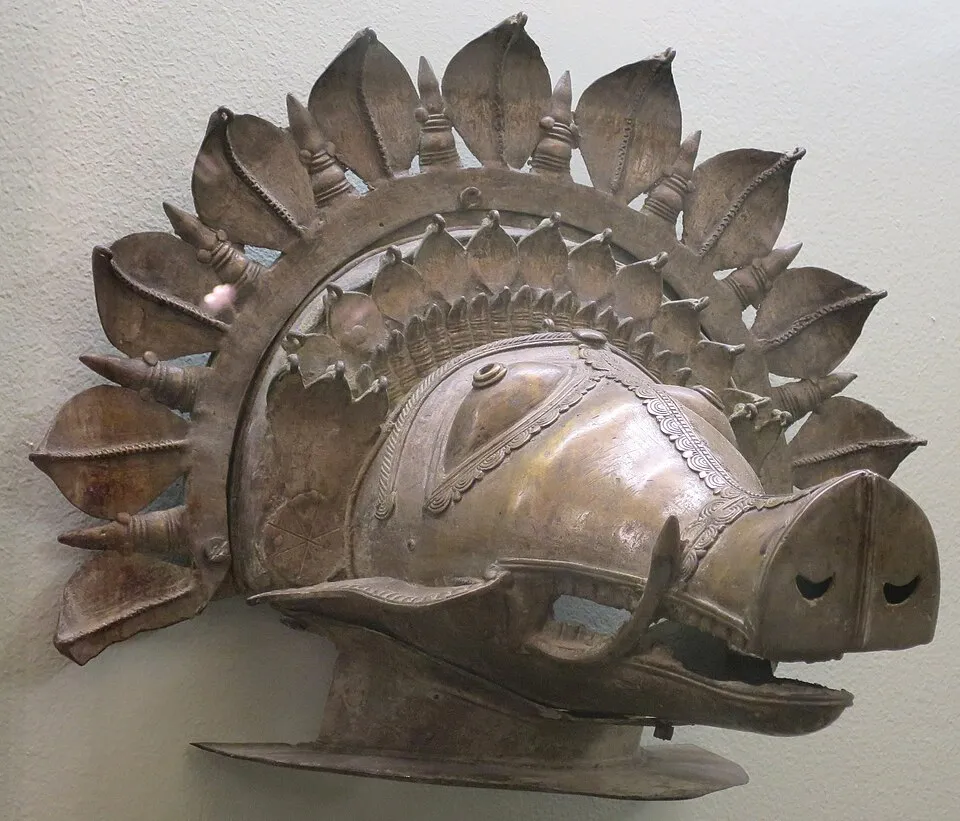
Panjurli is honoured in household shrines, at the village bhutasthana (a daiva’s shrine) and at kolas, the night-long ceremonies where a daiva takes over a trained performer. He often appears alongside other daivas such as Guliga and Jumadi. The performer who embodies him wears a boar-faced mask.
Devotees describe one small, telling moment in his kola. When the dancer tires, someone feeds him paddy rice, three times over. It is remembered as the farmers’ thanks to the boar spirit for keeping their crops safe.¹
Like other daivas, Panjurli also sits as a judge at his kola. People bring their quarrels before him, and what the daiva says is treated as final. You can read more about this side of the kola on the Bhuta Kola page.
People pair him with Guliga in a way many Tuluvas know well. One telling says the two once fought over the same land before making peace, which is why they are worshipped together.⁵ Panjurli is the gentler guardian, the one who forgives. Guliga is the fierce enforcer, the one who does not.⁴
A companion: Varte
Some families and shrines also honour Varte (or Varthe) beside Panjurli. Accounts differ on who she is. Some call her his sister, some his wife, and others say she is simply a female form of the same spirit. Where she is worshipped, her image or sacred stone usually sits just outside Panjurli’s own shrine rather than inside it.⁶
One explanation of her name looks back to the Kadamba kings, more than a thousand years ago. In their time, the boar spirit is said to have been worshipped in a female form called Varahi, the female counterpart of Varaha, Vishnu’s boar form. Over the centuries, the thinking goes, Varahi wore down to Varte.⁶ Another strand of tradition links Varte to Kallurti, the avenging sister in the story of Kalkuda and Kallurti: in the south of Tulunadu the pair are worshipped as Kallurti-Panjurli, and in the north as Varthe-Panjurli.¹ The same writers suggest that the pairing itself may be fairly recent, perhaps 300 to 400 years old, growing out of devotees who worshipped the two spirits together.⁶
Whose boar is he?
The same daiva is claimed from two directions. The Kailasa story makes Panjurli a child of Shiva and Parvati’s household. Many devotees, though, see him as Varaha, Vishnu’s boar form.³ ⁴ One of the oldest written versions of his paddana even opens not on Kailasa but in Vishnu’s heaven, Vaikuntha.⁷
Writers on Tulu folklore see something older underneath both. In their view, Panjurli belongs to one of the most ancient layers of Tulu belief, from the time when people were clearing forest to grow rice.¹ The animal that most threatened those first fields was made sacred and given the job of protecting them. That idea, of a dangerous power turned into a protector, runs through daiva worship as a whole.
The oldest versions of Panjurli’s paddanas (the long sung ballads that tell a daiva’s story) to appear in English were printed in the 1890s, in a collection drawn from the papers of the British scholar A. C. Burnell.⁷
Panjurli on screen
In 2022 the Kannada film Kantara told a story built around bhuta kola and a quarrel over sacred land, with Panjurli at its heart. Dubbed into Telugu, Hindi, Tamil, Malayalam and Tulu, it became one of the highest-grossing Kannada films ever.⁸ For many viewers, it was their first glimpse of daiva worship, and it carried Panjurli’s legend far beyond Tulunadu.³
Related
- Bhuta Kola: When the Spirits Come to the Village
- Rakteshwari, the Earth-Born Maiden, counted with Panjurli among the oldest daivas
- Koti and Chennaya, the Twin Heroes, whose last war began with a boar hunt
- Kalkuda and Kallurti, the Sculptor and His Sister, the story of the avenging sister
- Kallurti and Panjurli, the Sister and Brother Daivas, the pair worshipped together as the family’s judges
- Guliga, the Hunger That Became a Guardian, the fierce enforcer
- Jumadi, Neither Man nor Woman, the royal daiva
- Pilichamundi, the Tiger Goddess, another animal sent down from Kailasa
- Maisandaya, Guardian of the Herd, another of the animal daivas
Sources & further reading
The books and articles behind the numbered notes on this page.
- Vishal Babu Kadri, “Panjurli: The Satya’s Tales of Protection” (blog, 12 April 2020): the name (panjida kurle, young wild boar), the paddy rice fed to the dancer, the farming origin of his worship, and the Kallurti-Panjurli and Varthe-Panjurli pairings.
- K. Hari Kumar, “Panjurli: The Daiva of Tulunadu”: the garden story, the ganas killing the grown boars, and the orphaned piglet. The author tells it at greater length in his book Daiva: Discovering the Extraordinary World of Spirit Worship (HarperCollins India).
- Wikipedia, “Panjurli”: the Kailasa origin, Parvati’s adoption of the piglet, his role as protector of fields and forests, and Kantara. Wikipedia, “Buta Kola”: Parvati’s plea for the boar and the link with Varaha.
- Rahul, “Panjurli and Guliga – The Gods From Kantara”, Hinduism Facts (last updated 8 April 2025): the version in which Shiva kills and revives the boar, Panjurli as Varaha, and the forgiving Panjurli beside the unforgiving Guliga.
- Pranav Gogwekar, “The Divine Deities from Kantara”, Live History India (8 November 2022): Panjurli and Guliga’s fight over the same land, their truce, and why they are worshipped together.
- H. Vishwanath and Ravindra Mundkur, “233. Panjurli”, Tulu Research & Studies (blog, 20 March 2010): Varte as sister, wife or a second form of the same spirit, where her stone is kept, the Varahi-to-Varte history of the name, and the suggestion that the pairing is 300 to 400 years old.
- “Mr. Männer’s Variants, No. 2: The Origin of the Bhuta Panjurli”, in A. C. Burnell, The Devil Worship of the Tuluvas, edited by R. C. Temple, The Indian Antiquary 26 (1897). Read the volume at the Internet Archive: the paddana that opens in Vaikuntha.
- Wikipedia, “Kantara (2022 film)”: the story, the dubbed versions, and its place among the highest-grossing Kannada films.
Much of what is written about Panjurli comes from devotees and local writers rather than published scholarship, and the tellings vary from village to village.
Words on this page
What the Tulu and other Indian-language terms on this page mean.
- bhutasthana
- The shrine or shrine room of a daiva.
- daiva
- A guardian spirit; used interchangeably with bhuta.
- kola
- The ceremony in which a daiva is invited to possess a performer.
- paddana
- A long oral ballad, sung to tell the story of a daiva or hero.
Themes
Spotted a mistake, or know more about this? Suggest a correction/addition.