Kallurti and Panjurli, the Sister and Brother Daivas
When something goes wrong in a Tuluva household, a quarrel over land, a sickness, a family that will not settle, the old answer is to take it to the daivas. In most homes that means two of them, standing side by side: a boar and the sister of a sculptor.
They are an unlikely pair. One of them is among the oldest spirits of the fields. The other began as a woman wronged by a king. This page is about how they came to be worshipped together.
The story
Two wanderers meet
The story starts after the end of another one. Kalkuda and his sister Kallurti have taken their revenge on the king of Karkala, and have become daivas (guardian spirits of the land). That story is told on Kalkuda and Kallurti, the Sculptor and His Sister.
The two now wander across Tulunadu, making their power felt, and people begin to worship them. On the way, at a place called Baddakatte Rayara Chavadi, near Bantwal, Kallurti meets the boar daiva Panjurli, whose own story is on Panjurli, the Boar Daiva.¹
The two decide that from then on they will be worshipped together everywhere in Tulunadu as thage-thangadi sathyolu, “daivas who are brother and sister”.¹
One pair, two names
In the south of Tulunadu the pair are worshipped as Kallurti-Panjurli. In the north they are Varte-Panjurli, or Varthe-Panjurli.¹ ² Varte is a name that Panjurli’s own page discusses at more length: accounts differ on who she is, and some link her to Kallurti.³
How they are worshipped
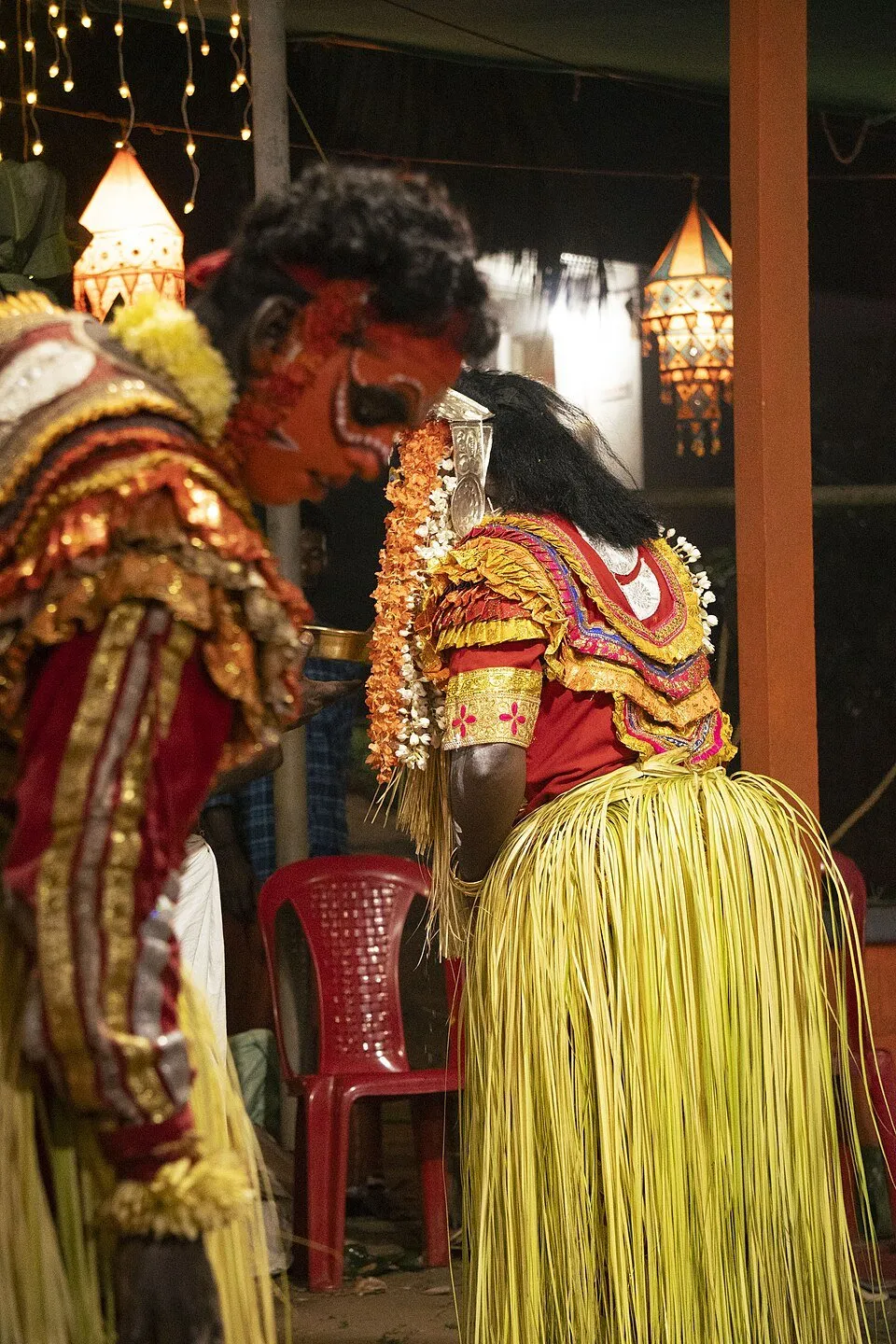

The head of the family. Vishal Babu Kadri, whose blog is our main source, says that Kallurti-Panjurli are believed to be the head of the family. Whatever trouble a family has should be brought to them, at a darshana, a visit to the daivas, or at a kola, the night of the spirits’ dance. They hold the right of judgement over the family. Kallurti gives advice, and Panjurli shows the right direction.¹ Another site, CuriousPort, says the same, that Kallurti suggests a solution and Panjurli takes the final decision, which all the family must accept.² It reads like a rewording of the first account, so it is not a second voice.
Mother and uncle. Kadri quotes a saying that these daivas “nourish like a maternal uncle and give birth like a mother”. Ancestors, he says, believed that a maternal uncle and a mother do not discriminate between their children, and that Kallurti-Panjurli are the same with the family in every situation.¹ In an aliyasantana family, where descent runs through the mother, the maternal uncle and the mother are the two relatives who matter most, and the saying gives the pair those two roles. That reading is ours, not Kadri’s.
Kadri also says that in Tulunadu there is hardly a family that does not worship Kallurti-Panjurli, and that they are treated not only as daivas but as one of the family.¹ ²
Where her stone sits. Where Varte is worshipped beside Panjurli, her image or sacred stone usually sits just outside his own shrine, not inside it.³
How old is the pairing?
One writer, in a source cited on the Panjurli page, suggests that the pairing may be fairly recent, perhaps 300 to 400 years old, and that it grew from devotees who worshipped the two spirits together.³ The Panjurli of the paddanas is much older than the story of Kalkuda and Kallurti, so it is easy to see how two different layers of belief could have been joined later. That is a reading, not a finding.
Renaming
Some worshippers now call Panjurli by the name Varahi or Varaha-Murthi, after Vishnu’s boar form, and Kallurti by names such as Vartheshwari or Maha Kali. Kadri objects. Daiva worship, he writes, is based on nature and ancestor worship, and he argues that Panjurli has no connection with Vishnu’s Varaha, because the paddana, the sung oral epic, has no stanza that says so. He regards the new names and stories as later changes under the influence of other traditions.¹ The Panjurli page has more on the Varaha question.
What we could not find
- A second source for the meeting. The meeting at Baddakatte Rayara Chavadi comes from Kadri’s blog, and CuriousPort appears to follow it. We found no paddana text, scholar or recording that tells it.
- The “brother’s gift” version. Our notes say that some tellings have Kalkuda giving his sister into Panjurli’s company. The source for that, a post on Tulu Research & Studies, could not be opened, so we have left it out.
- Where the shrines are. We have no list of shrines, apart from the meeting place.
- How the pair are shown at a kola. We have not found a description of Kallurti-Panjurli as a pair in performance.
Related
- Kalkuda and Kallurti, the Sculptor and His Sister, the story that comes before this one
- Panjurli, the Boar Daiva, the boar daiva and the question of Varte
- Bhuta Kola: When the Spirits Come to the Village, the night ritual in which they are brought the family’s troubles
Sources & further reading
The books and articles behind the numbered notes on this page.
- Vishal Babu Kadri, “Panjurli: The Satya’s Tales of Protection”, Inward of Tulunadu (blog, 12 April 2020; read on 9 October 2026): the meeting at Baddakatte Rayara Chavadi, the two names, the family’s judge, the saying about the maternal uncle and mother, and the objection to renaming.
- CuriousPort, “Know about Panjurli & Guliga Dev and Bhuta Kola” (website; read on 9 October 2026): the Bantwal shrine, the pair as head of the family, and Kallurti’s advice and Panjurli’s decision. It closely follows the first source.
- H. Vishwanath and Ravindra Mundkur, “233. Panjurli”, Tulu Research & Studies (blog, 20 March 2010): Varte, where her stone is kept, and the suggested age of the pairing. We could not open this page for this check, and these points repeat what Panjurli, the Boar Daiva says of it.
This page rests on two blogs and a community website. We found no scholarly source.
Words on this page
What the Tulu and other Indian-language terms on this page mean.
- aliyasantana
- Inheritance through the mother's line.
- daiva
- A guardian spirit; used interchangeably with bhuta.
- darshana
- A visit to the daivas, where a family can bring its troubles.
- kola
- The ceremony in which a daiva is invited to possess a performer.
- paddana
- A long oral ballad, sung to tell the story of a daiva or hero.
Themes
Spotted a mistake, or know more about this? Suggest a correction/addition.