Maisandaya, Guardian of the Herd
At the end of a nema for Maisandaya, its yearly ritual, a plantain leaf is laid out on a wooden plank. On it go boiled kudu (horse gram), the food given to oxen, with coconut, a sweet powder of rice and jaggery, and bananas. The daiva comes to the leaf and eats. As it eats, tender coconut water and milk are poured over its face, and with that the nema is over. A Tulu writer who describes it calls it a very beautiful nema.¹
Maisandaya is the daiva (guardian spirit of the land) of the herd. A dealer’s description of an old brass bull calls it “the divine spirit of a bull”, worshipped by the farming communities of the Tulu land “as a gesture to thank its contribution to the agriculture”.² An essay drawing on the researcher Chinnappa Gowda counts Maisandaya, the buffalo, among the animal daivas, with the tiger, the boar and the cobra, that were once the totems of different tribes.³
Unlike most daivas, Maisandaya has no long paddana (sung oral epic) that we have been able to find. Its story comes in pieces.
The story
Out of the forest
The Tulu writer K. Mahendranath Salethoor records the nudi, the words spoken in the name of Mula Maisandaya, “Maisandaya of the source”. In a rough English rendering, they run like this:¹
Leaving the forest behind, I took the road to the village.
I tied the yoke of justice and came down to the field of truth.
When the madness of men rises, when right weeps and wrong laughs,
to make the unrepentant sweat, to catch the proud,
pawing the earth with my hooves,
I stand guard, ready to strike with the tips of my horns.
It is the voice of a beast that came in from the wild to work for people, and that watches over right and wrong among them.
The gaur in the forest
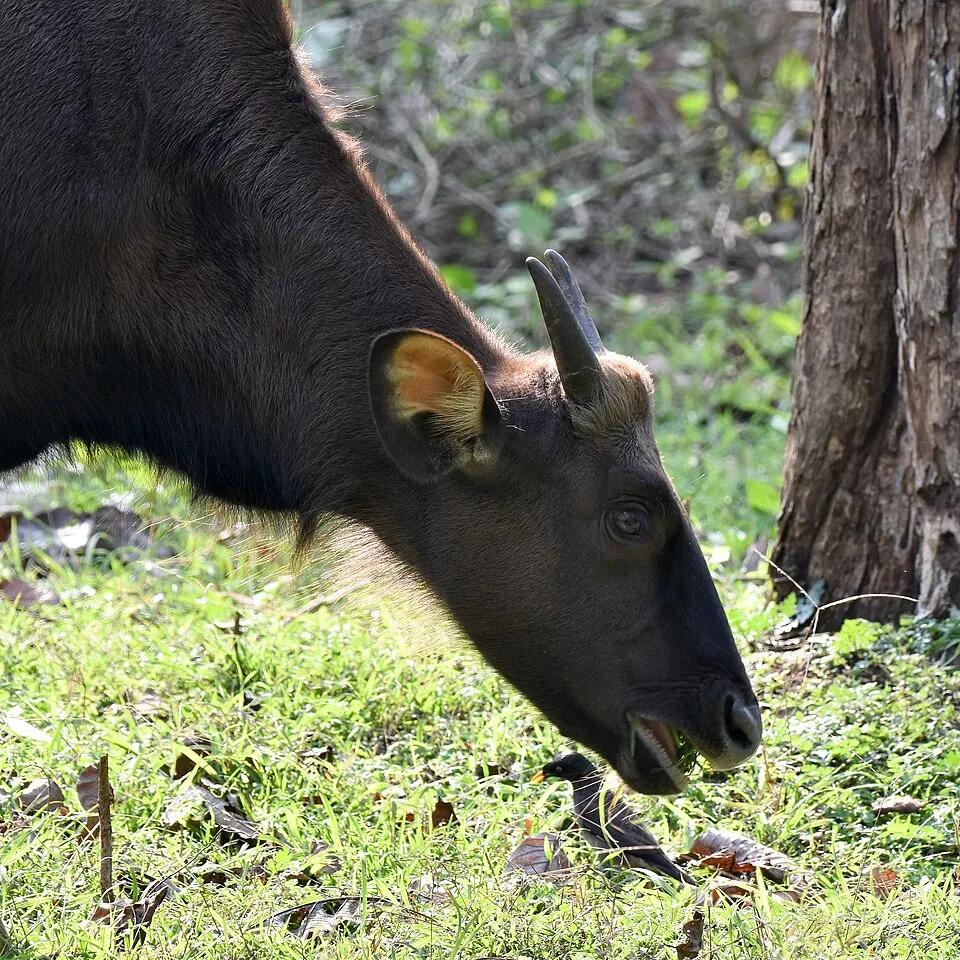

The ethnographer Peter Claus pointed out that the wild animals that threatened the farmer, the tiger, the snake, the wild boar and the gaur (the great wild ox of Indian forests), each have a mirror image among the daivas: Pilli, Naga, Panjurli and Maisandaya.⁴ In this reading Maisandaya is the gaur, a danger of the forest that became, once honoured, a protector of the field.
The Tulu researcher Ravindra Mundkur writes that before the worship of Bermer spread, the serpent, the bullock (Nandigona) and the buffalo (Mahisandaya) were already being worshipped by the tribes of the land. In the oldest shrines of Bermer, he adds, Bermer is usually worshipped together with Lekkesiri, Mahisandaya, Nandigona and Naga.⁵
Mahendranath sees the same pattern. The early Tuluvas, he writes, made daivas of whatever troubled them or nature, and worshipped them to find a remedy. Most of the daivas of Tulunadu, the royal ones included, take the form of animals, and the worship of daivas grew out of a hunting life.¹
The buffalo king
Some elders, Mahendranath writes, hold that Mahishandaya began as a warrior in the service of a Tuluva king of Mahishapura, that is, Mysore.¹
The journalist Naveen Soorinje takes this further. Different stories, he writes, give Mahishasura, the buffalo king killed by the Goddess, the names Mahisandhaya, Maisandhaya and Nandikona. Those killed by the daivas or the gods of the coast often become daivas themselves, and so, he argues, Mahishasura may have become one. He notes that Maisandaya’s worship is most common in the villages and guttu houses (ancestral houses of landed families) along the Nandini river, where the goddess of Kateel is said to have rested after killing Mahishasura.⁶ This is one writer’s argument, and the other sources do not make the link.
How Maisandaya is worshipped
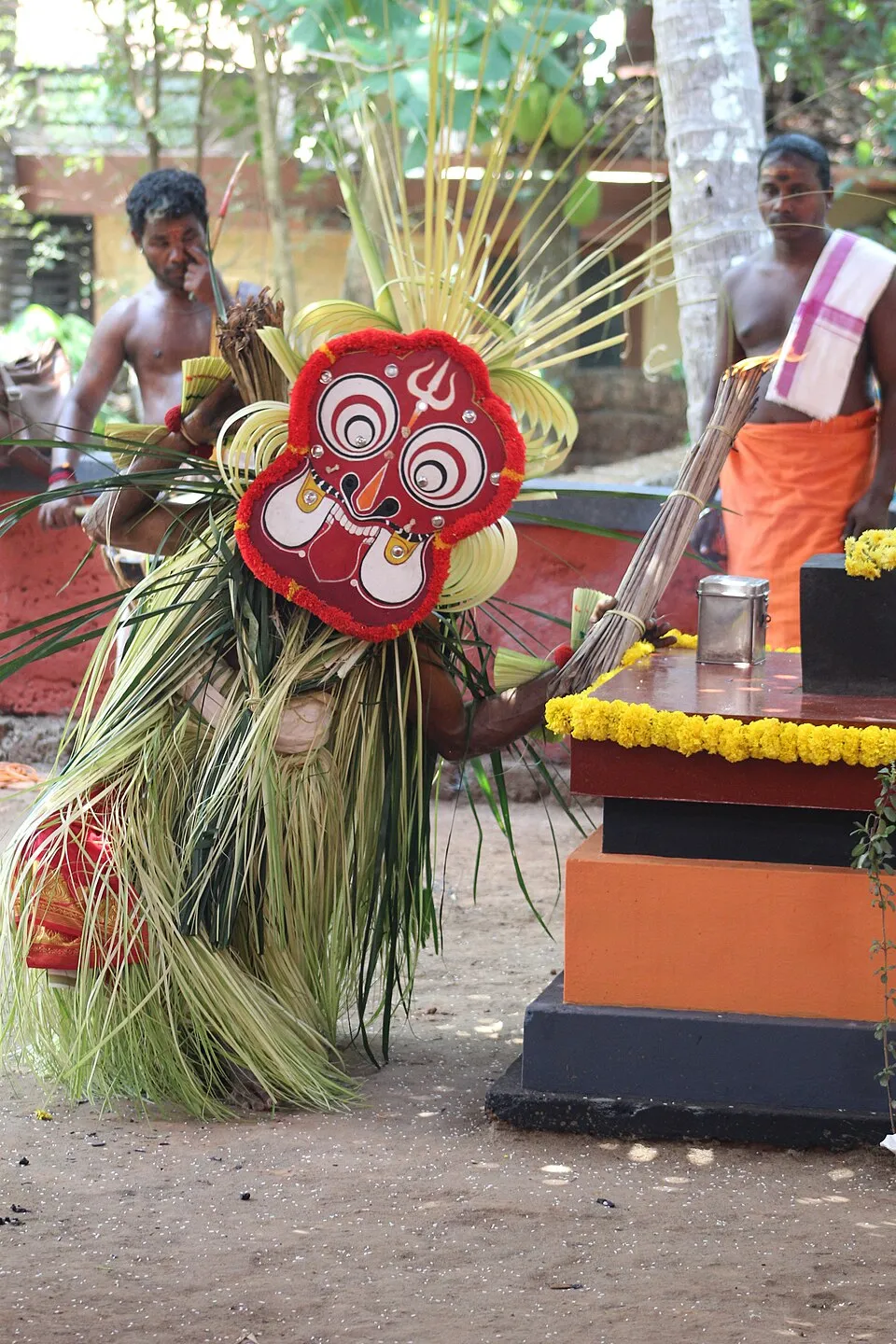

Its face. Just as Ganapati has an elephant’s head on a man’s body, Mahendranath writes, Maisandaya has a bull’s head on a man’s body. Its muga (mask) is usually of bronze, with little bells tied to the tips of the horns. The mask is worn over the face or on top of the head. The performer’s face is painted with sandalwood paste, in some places with designs in turmeric too, and sometimes a moustache is drawn on.¹
A daiva that bolts. During its nema Maisandaya often breaks away and runs, so people stand on every side to catch it. Sometimes it gets away, and sometimes it ends up in water. As with Guliga, Mahendranath writes, it has to be held when it runs.¹
The badikara. Maisandaya is said to love the badikara offering, a pot of auspicious things, here a measure of rice.¹ ⁷ A man holds it before the daiva and teases it, moving it this way and that, until at last the daiva seizes it.¹
Fed like an ox. The nema ends, as it began on this page, with horse gram on a plantain leaf, and coconut water and milk poured over the daiva’s face.¹
At the family houses
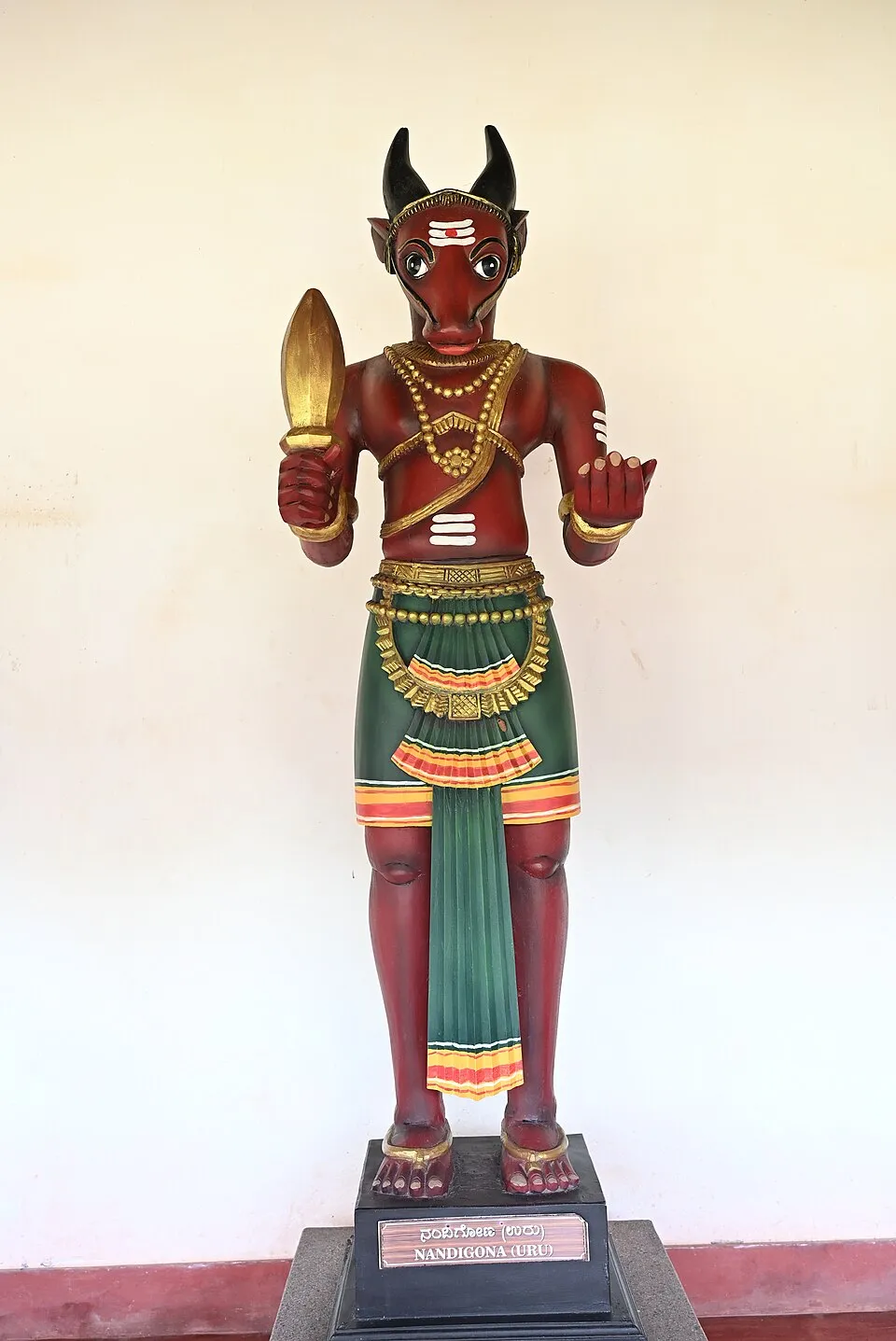

Maisandaya is worshipped above all by landed families at their ancestral houses. At Kudumbur, in the Baikampady industrial area of Mangaluru, the Kudumbur Guttu family has worshipped Moola Maisandaya, with Pilichamundi, Dhumavati and Jarandaya, for some eight hundred years. When Kudumbur’s farmland became an industrial area the people moved away, but the daivas, it is said, would not leave, so a nema is still held there every year.⁸
At Moodushedde Guttu in Mangaluru, a dharma nema for the Shedde Guttu and Nonal families included a Maisandaya nema at midday, before the evening nemas of Jarandaya, Dhumavati, Babbarya and others.⁹ And the Koragajja shrine at Kuthar says that the shrine where the boy Koragajja was turned away belonged to Maisandaya, as Koragajja’s page tells.
Bull, buffalo or gaur?
Which animal. The dealer’s description calls Maisandaya a bull.² The Wisdom Library essay and Ravindra Mundkur call it a buffalo, and Mundkur gives the bullock its own name, Nandigona.³ ⁵ Peter Claus pairs it with the wild gaur.⁴ Each may reflect how Maisandaya is understood in a different place.
One daiva or two. The dealer’s description says Maisandaya is “also referred to as Nandikona”.² But Mundkur names Mahisandaya and Nandigona separately, and so does a list of daivas in another part of the Wisdom Library essay.⁵ ¹⁰ Mahendranath writes that Maisandaya has now also become Nandigone and Nandikeshwara, names that tie it to Nandi, the bull of Shiva.¹
A silent spirit? The dealer’s description calls Maisandaya “a voiceless spirit”.² Yet Mahendranath records the nudi, the words spoken in its name, quoted above.¹ The sources do not settle whether, or how, Maisandaya speaks at its nema.
The mother’s line. Naveen Soorinje writes that Maisandaya, like Siri, upholds aliyasantana, inheritance through the mother’s line.⁶
Other spellings. Mahisandaya, Maisandhaya, Mahishandaya, and Nandikona, Nandigona or Nandigone for the bull.
Related
- Bhuta Kola: When the Spirits Come to the Village
- Panjurli, the Boar Daiva, the boar in Claus’s list of the wild powers
- Pilichamundi, the Tiger Goddess, the tiger, worshipped with Moola Maisandaya at Kudumbur
- Nagaradhane: The Serpent in the Sacred Grove, the snake
- Koragajja, the Boy Who Was Turned Away, turned away, in one telling, from a shrine of Maisandaya
- Rakteshwari, the Earth-Born Maiden, Lekkesiri, worshipped with Mahisandaya at the old shrines of Bermer
- Guliga, the Hunger That Became a Guardian, another daiva that bolts
- Siri, the Princess Who Walked Away, and the mother’s line
- Babbarya, the Daiva of the Sea, another vegetarian daiva of the Mogaveera shrines
- Jarandaya, the Prince Who Could Not Swallow an Insult
Sources & further reading
The articles behind the numbered notes on this page.
- K. Mahendranath Salethoor, “Maisandaya daiva”, Thulu Oripuga (blog, in Tulu, 2013): the nudi of Mula Maisandaya, its bull’s head and bronze mask, its face paint, how it bolts, the badikara, the feeding at the end of the nema, the elders’ view of a warrior of Mahishapura, and Nandigone and Nandikeshwara. The English renderings on this page are our own.
- The Antique Story, “Maisandaya Bull Spirit” and “Maisandaya” (an antiques dealer’s listings for a painted wooden bull and a brass bull): Maisandaya, “also referred to as Nandikona”, as a bull spirit thanked by farming communities, and “a voiceless spirit”.
- “The Bhuta Worship of Tulunadu [Part 1]”, Wisdom Library (an essay): Chinnappa Gowda on Pili Bhuta (tiger), Maisandaya (buffalo), Panjurli and Naga as animal spirits that were once tribal totems.
- Wikipedia, “Buta Kola”: Peter Claus on the tiger, snake, boar and gaur and their mirror images among the daivas.
- “354. Bhuta cult of Bermeru or Bommaiah”, Tulu Research & Studies (Ravindra Mundkur’s blog, January 2016): the bullock (Nandigona) and buffalo (Mahisandaya) worshipped before the Bermer cult, and Bermer’s shrines shared with Lekkesiri, Mahisandaya, Nandigona and Naga.
- Naveen Soorinje, “Mahishasura Dasara: Hindutva attack ignores coastal Karnataka’s buffalo worship”, The News Minute (opinion, 15 October 2023, translated by Anisha Sheth): Mahisandhaya, Maisandhaya and Nandikona as names for Mahishasura in local stories, Maisandaya’s worship along the Nandini river, and the mother’s line.
- Tulu Research & Studies, May 2016 (Ravindra Mundkur’s blog): the badikara as “an earthen pot containing auspicious things”.
- Mallika P, “Pilichamundi daiva blesses the Dakshina Kannada Deputy Commissioner”, Kannada Oneindia (in Kannada, 7 February 2024): the Kudumbur Guttu family and its daivas, Moola Maisandaya among them.
- “Mangalore: Grand Dharma Nemotsava Held at Moodushedde Guttu”, Daijiworld: the Maisandaya nema at Moodushedde Guttu.
- “Different Types of Bhutas of Tulunadu [Part 6]”, Wisdom Library (an essay): a list of daivas with Nandigona and Maisayndaya as separate entries.
Most of this page comes from writers, journalists and dealers rather than published research, and the main account of Maisandaya’s nema is a Tulu writer’s blog. Maisandaya’s worship differs from place to place.
Words on this page
What the Tulu and other Indian-language terms on this page mean.
- aliyasantana
- Inheritance through the mother's line.
- badikara
- A pot of auspicious things carried as an offering.
- daiva
- A guardian spirit; used interchangeably with bhuta.
- guttu
- The ancestral headquarters house of a landed family.
- muga
- The face or mask of a daiva.
- nema
- Another name for a kola, the annual ceremony for a daiva.
- nudi
- The part of the kola when the daiva speaks with the village.
- paddana
- A long oral ballad, sung to tell the story of a daiva or hero.
Themes
Spotted a mistake, or know more about this? Suggest a correction/addition.