Stories: Daivas · Also in: Stories: Epics and Heroes
Siri, the Princess Who Walked Away
Out in the flooded paddy fields, women bend to set the young rice plants in rows, and as they work, they sing. One of the songs sung there is the story of Siri.¹ It tells of a woman who was wronged by the men around her, and who would not accept it.
Siri’s story is the longest poem in the Tulu language, more than 15,000 lines long, and singing all of it takes around 25 hours.² Few people ever hear it whole. But every year, at the Siri festivals, crowds of women in white saris gather to sing parts of it, and many of them are possessed by Siri herself.³
The story
The story is sung as a paddana, a long ballad, and like every paddana it changes a little from singer to singer. This is the outline most tellings share.² ⁴
A daughter from areca flowers
Bermanna Alva was the ageing ruler of Sathyanapura, a small Bunt kingdom. He had lost his wife and his daughter, and in his grief he longed for an heir.²
One day the deity Bermer came to him dressed as a Brahmin, and told him to restore an old family shrine in the village of Nidgal. Bermanna did as he was told and worshipped there. He brought home the blessed offering from the shrine: areca nut flowers and sandalwood paste. And the offering turned into a baby girl.² He named her Siri. In one telling she is called Akkerasu Siri, after the flowers she was born from.⁴ Another describes the offering as a pod of pingara, the flowers of the areca palm, holding a ball of sandalwood paste.⁶
A marriage and a sari
Siri grew up into a beautiful young woman, and married Kantha Poonja, a lord from Basrur.²
When she was seven months pregnant, there was to be a ceremony for her and her baby, and Kantha Poonja bought her an expensive new sari for it. But first his mistress, Siddu, saw the sari and put it on.² ⁴ At the ceremony, in front of everyone, Siri refused to wear it, because another woman had already worn it. Kantha Poonja never forgot the shame.² ⁴
Betrayal and a curse
Siri gave birth to a son, Kumara, at her father’s house. Word was sent to Basrur, but Kantha Poonja never came to see his child.⁴ Soon after, Bermanna died. In one telling, an astrologer had warned him that holding the baby would cost him his life, and when the baby cried, he picked him up anyway.⁴
Kantha Poonja had promised to carry out his father-in-law’s funeral rites, but he broke his word. So Siri did it herself: she took her father’s body on her own shoulder and carried out the rites.⁴
Then came the fight over the kingdom. A rival, Annu Shetty, son of Bermanna’s relative Shankar Alva, claimed Sathyanapura. Kantha Poonja sided with him against his own wife, and a council of elders, who had been bribed, ruled against her.² ⁴
Siri used her divine power. She cursed Kantha Poonja, that his fields would stay barren and his family line would die out, and she destroyed the fortress Annu Shetty had taken.²
The road to Bola
With her baby son and her faithful maid, Daru, Siri walked out of Sathyanapura, taking almost nothing with her, and headed for the forest of Bola.² ⁴ On the way she lost both the child and the maid.² In one telling, she hid little Kumara away, promising to come back for him.⁴
In the forest she met twin kings, Kariya Kaasinghe and Boliya Deesinghe. They took her in as their sister, and arranged a second marriage for her, to Kodsar Alva of Kotradi.² ⁴ This marriage was a happy one. Siri bore a daughter, Sonne, and soon after, she left this life. Before she went, she promised that those who worshipped her would have plenty and be healed.²
Sonne and the twins
The epic goes on with Siri’s line. Her daughter Sonne grew up alongside a girl named Ginde, and married Guru Marla.⁴ For years they had no children. At last they made a vow to Bermer: any children born to them would be given to his worship. Twin girls were born, Abbaga and Daraga.²
But the parents forgot their vow. Bermer came to remind them, disguised as an astrologer, and they paid him no heed.²
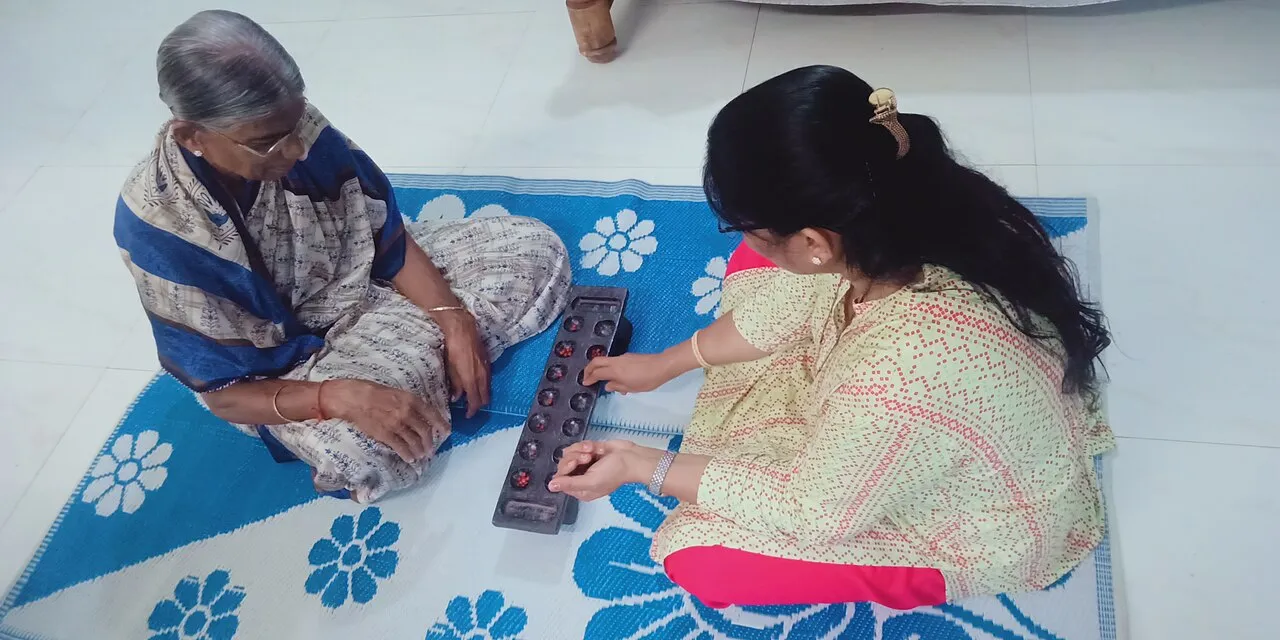

The twins loved to play chenne mane, a Tulu board game of seeds and hollows, and they always quarrelled over it, so their parents had locked the board away. While they were out, Bermer came again, dressed as a Brahmin, unlocked the box and set the girls to play.² ⁵ Daraga won, and mocked her elder sister.⁵ Abbaga struck her with the heavy wooden board and killed her, and then, in grief, threw herself into a well.²
When Sonne and Guru Marla came home, Bermer met them, and told them this was the price of their broken vow.²
How Siri is worshipped
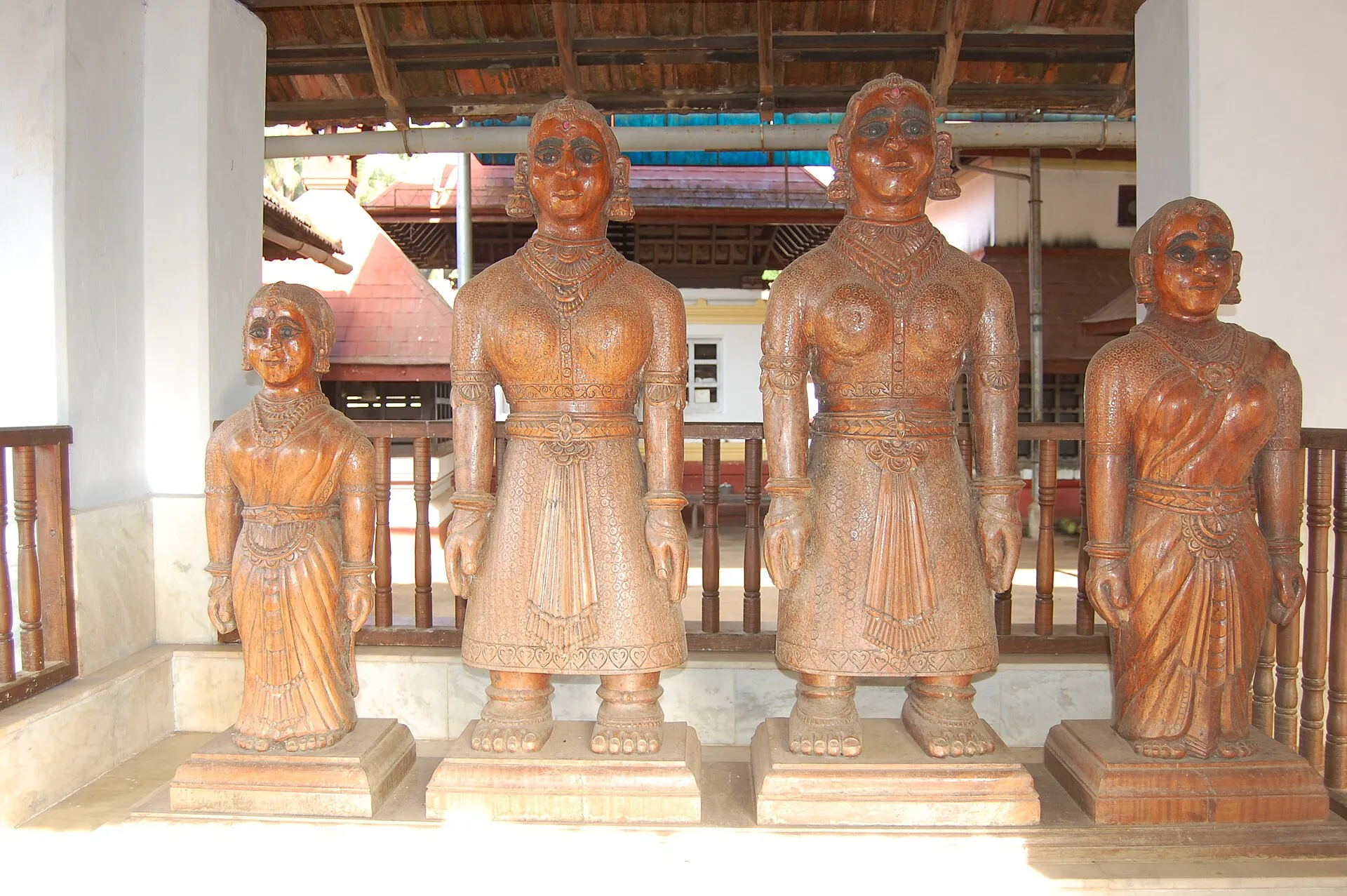

Siri is worshipped as a daiva, one of the divine spirits of Tulunadu, and her worship crosses the lines of caste.² She is honoured together with her family. One Tulu account counts “seven Siris”, among them Siri herself, Sonne, Ginde, Daru, Abbaga and Daraga, who are worshipped each year with her son Kumara.⁵
Their shrines are called alade. The five best known are at Hiriadka, Pangala and Nandalike in Udupi district, and at Kavathar and Nidgal in Dakshina Kannada.²
The Siri festivals
Once a year, on a full moon day between February and May, the main shrines hold their jatre, their festival. The best known are at Hiriyadka near Manipal, Nandalike near Karkala, Kavattaru near Mangaluru, and Nidgal near Ujire, and together they draw some 10,000 people.³ Other writers count Siri festivals at 15 to 20 places, or even more than 32.⁴ ⁶
Women dressed in white saris, holding pingara flowers, sing the Siri paddana.³ Parts of the epic are sung in a solemn ritual style, and the festival is also called Dayyol, or Daliyo-Paliyo.² ⁵
When Siri takes a woman
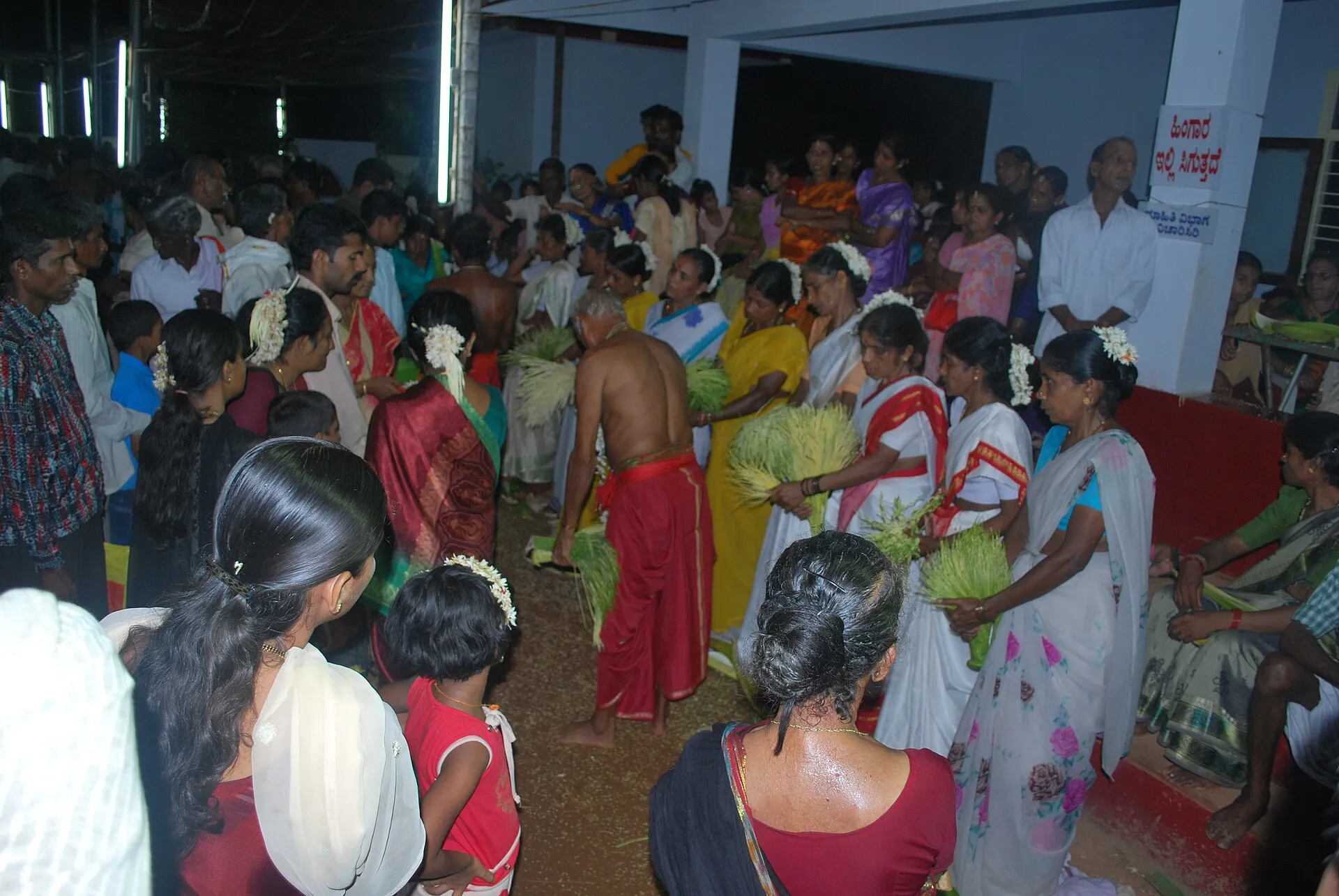

Then comes the heart of the festival. Women who are said to be troubled by a spirit are brought to the festival, and there they are possessed by Siri or one of her family.³ ⁶ Many of them, one guide says, are women who have suffered a great deal in their lives, and many come from lower castes.³
A male priest, possessed by Siri’s son Kumara, leads the singing, questions each woman’s spirit to find out who she is and what she wants, and keeps order among the women.³ ⁶ The woman’s family then promises to meet the spirit’s demands.³ At Nandalike, the festival is known for the moment when a patri, a medium possessed by Kumara, drives Siri out of the women who have fallen into a trance.⁷ Once a woman has been possessed in this way, she usually comes back every year after that, as one of Siri’s mediums.³
When the twins are acted out, the scholar Yogitha Shetty notes, Kumara steps in and stops their quarrel before the girls can play out their deaths.⁶
The anthropologist Peter Claus, writing in 1975, called the Siri festival “a mass possession cult”, because so many women are possessed together.⁸ For Shetty, the festival gives women a protected place to let out the anger, frustration and hopes that family, caste and class leave them no room for.⁶
The singer who knew it all
For a long time, nobody had heard the whole Siri epic sung from start to finish. That changed because of one man, Gopala Naika, a farmer from Machar, near Ujire, who led a group of about 80 women devoted to Siri. At their rituals he served as priest, and was possessed by Kumara.¹ ⁹
In 1985 and 1986 he dictated the epic to the scholar Chinnappa Gowda. Then, in December 1990, he sang the whole of it for a team that included Gowda, B. A. Viveka Rai, and the Finnish folklorists Lauri and Anneli Honko. Over several days, in about 26 hours of singing, he sang 15,683 verses, only five lines fewer, Lauri Honko noted, than the Iliad. Naika had never before sung it as one complete story.¹ The recording was published in 1998, with the Tulu text and an English translation on facing pages.¹
Gopala Naika died in April 2023, at 85.⁹
Why her story matters
Siri is a woman who stood up for herself. She refused a sari another woman had worn, carried her own father’s body when her husband would not, and walked away from a marriage and a kingdom that had wronged her.² ⁴ One local writer says her second marriage established the right of Tuluva women to marry again.⁴ Gopala Naika’s Siri, one tribute says, tells of the troubles of Tulu women within patriarchy, and their struggle to be free.⁹
And the story did not stay in the past. The women who sing it in the fields, and the women Siri takes at her festivals, still carry it today.¹ ³ ⁶
Versions and open questions
How many Siris. Tellings differ on who counts among the “seven Siris”, and the epic runs through several generations whose details do not always agree.⁵
The twins’ fate. In one telling only Abbaga throws herself into the well. In another both sisters go into it, and by Bermer’s blessing their souls become shining beetles.² ⁵
Kumara. Some tellings say Siri simply lost her son on the road to Bola. Others say she hid him, promising to return. Either way, Kumara is worshipped with her, and it is Kumara who speaks through the priests at her festivals.² ⁴ ⁶
Related
- The Siri Jatre: A Night of Possession and Healing, the festival in more depth
- Bhuta Kola: When the Spirits Come to the Village, and how Siri’s women mediums differ from Mayndala’s male medium
- Koti and Chennaya, the Twin Heroes, the other great Tulu epic
- Mayndala, the New Mother Taken into the Unseen, the goddess of childbirth
- Bermer, the ancient deity who blesses and punishes in Siri’s story
Sources & further reading
The articles behind the numbered notes on this page.
- Bryn Mawr Classical Review, review of Lauri Honko, Textualising the Siri Epic, and The Siri Epic as Performed by Gopala Naika (2002): the epic as a song of the paddy fields, Gopala Naika and his group of women, his possession by Kumara, the 1985–86 dictation, the December 1990 recording, the verse count, and the facing-page edition.
- Wikipedia, “Epic of Siri”: the length of the epic, the story from Siri’s birth to the twins’ death, her worship across castes, the five Adi Alade shrines, and the Siri Jatre and Dayyol.
- Udupi Live, “Siri Jatre Festival of Udupi” (local guide): when and where the festival is held, the women in white with pingara flowers, the possessed women and the priest who questions them.
- Vishal Babu Kadri, “Story of Satyanapura Siri, part 1” and “part 2”, Inward of Tulunadu (blog, 2020): Akkerasu Siri, the sari, Kumara’s birth and Bermanna’s death, the funeral, the bribed council, Kumara hidden, Ginde, the second marriage, and festivals at more than 32 places.
- Tulupedia, “The Siri Epic” (community encyclopedia): the seven Siris, Daliyo-Paliyo, the chenne mane game and the twins’ fate.
- Yogitha Shetty, “Ritualistic World of Tuluva: A Study of Tuluva Women and the Siri Possession Cult”, Rupkatha Journal on Interdisciplinary Studies in Humanities 5(2): the pingara pod, the 15 to 20 festival sites, the possessed women, Kumara’s role, and what the festival offers women.
- Daijiworld, “Karkala: Nandalike Ayanotsava, Siri Jatre on March 27” (news report): the Nandalike festival and the patri possessed by Kumara.
- Peter J. Claus, “The Siri Myth and Ritual: A Mass Possession Cult of South India”, Ethnology 14(1) (1975), pp. 47–58. JSTOR.
- The South First, “Remembering Gopala Naika, the remarkable poet-singer of Tulu’s Siri epic” (2023): his home near Ujire, his death, and his Siri as a story of women’s struggle.
Further reading
- Lauri Honko, Textualising the Siri Epic, FF Communications 264 (Helsinki: Academia Scientiarum Fennica, 1998).
- Lauri Honko, Chinnappa Gowda, Anneli Honko and B. A. Viveka Rai, The Siri Epic as Performed by Gopala Naika, FF Communications 265–266 (Helsinki, 1998).
- Folklore Fellows, “Experiencing the Siri Epic”.
Much of the story on this page comes from encyclopedia summaries, local writers and a blog rather than from the published epic itself, which runs to two large volumes. The paddana is sung in many versions, and they differ in their details.
Words on this page
What the Tulu and other Indian-language terms on this page mean.
- alade
- A shrine of Siri and her family.
- chenne mane
- A Tulu board game of seeds and hollows, a kind of mancala.
- daiva
- A guardian spirit; used interchangeably with bhuta.
- jatre
- A yearly temple festival or fair.
- kola
- The ceremony in which a daiva is invited to possess a performer.
- paddana
- A long oral ballad, sung to tell the story of a daiva or hero.
- patri
- A medium who holds the daiva's sword and bell and speaks as the spirit.
- pingara
- The flowers of the areca palm.
Themes
Spotted a mistake, or know more about this? Suggest a correction/addition.