Faith & Worship · Daivas, Nagas & Sacred Groves · Also in: Stories: Daivas, Festivals Through the Year
Nagaradhane: The Serpent in the Sacred Grove
At the edge of the paddy fields behind many Tuluva homes, there is a patch of trees that nobody touches. The undergrowth is thick, the shade is deep, and no one would dream of taking firewood from it. In a clearing among the trees sit a few carved stones, each shaped like a cobra with its hood raised. Once a year the family gathers here with milk, flowers and turmeric, to honour the serpent who has watched over their land for longer than anyone can remember.
This is a nagabana, a serpent grove, and the worship that happens there is called nagaradhane, the worship of the naga (the serpent deity). Of all Tulunadu’s traditions, it may be the one most quietly woven into ordinary family life.
The grove and its stones
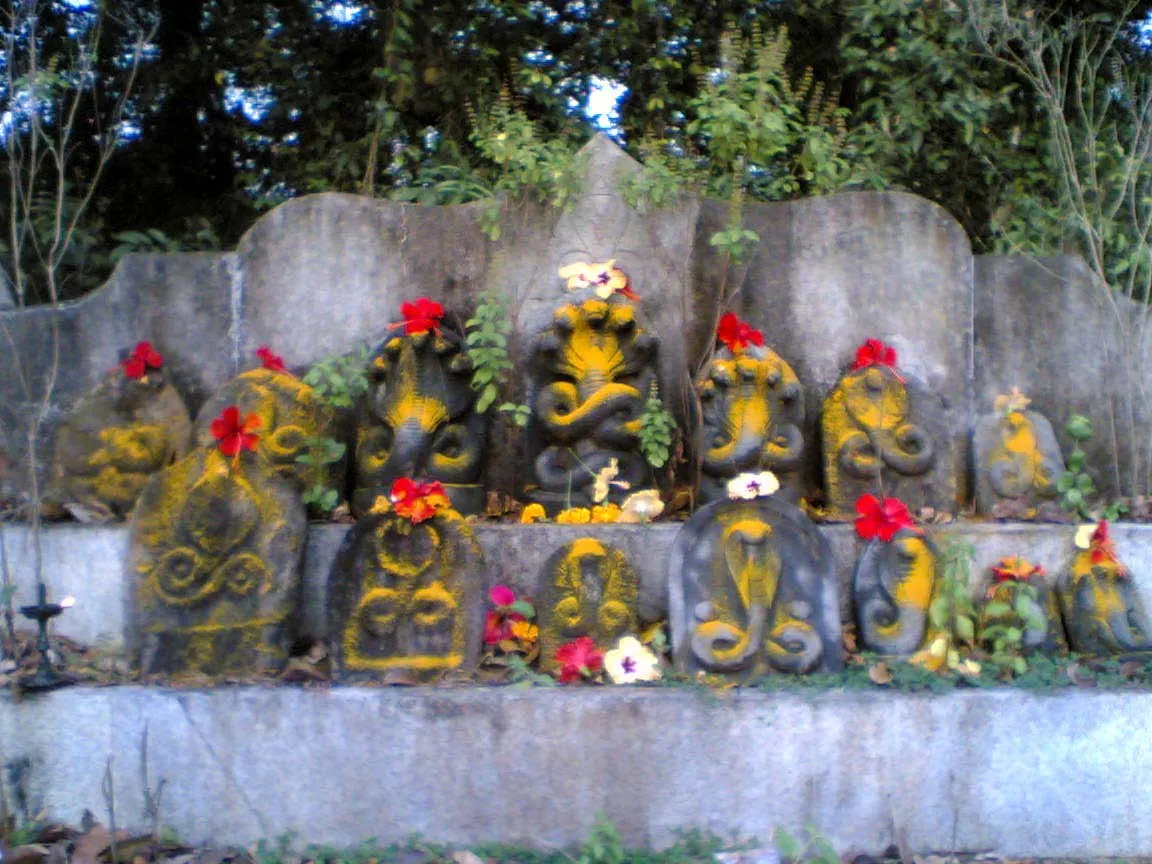

A nagabana is a shrine and a small forest at the same time. The naga is believed to dwell there, and it is represented by stone images of cobras, often carved with coiled bodies and spread hoods, standing together under the trees.¹ Sacred groves like this go by several local names, among them devarakadu, “god’s forest”.²
The most important rule of the grove is simple: you do not cut its trees or damage it in any way. Doing so counts as an offence against the naga itself.¹ Harming a snake is just as serious. A family that hurts or kills a cobra is expected to perform a cleansing rite, and many believe that failing to do so brings misfortune that can last for generations.¹
Many Tuluva families keep a nagabana, and the practice runs across communities. One heritage writer says there is hardly a Bunt house without one, and at the bigger serpent shrines, worship is open to everyone regardless of caste.³
A shrine for the whole family line
What makes nagaradhane unusual is how closely it is bound to family. A village has its daivas and its kola, but the naga belongs first of all to a lineage.
Many Tuluvas belong to a bari, a clan. Among the Bunts, for example, the bari passes down the mother’s line, in keeping with aliyasantana (inheritance through the mother’s line), and people of the same bari traditionally do not marry each other.⁴ Each bari has its own moolasthana, its “original seat”: the ancestral serpent shrine of that clan, which may stand far from where its members live today.¹ The historian Indira Hegde, in a book-length study of these shrines, describes them as the original homes of Tulu communities, each community with its own.⁵
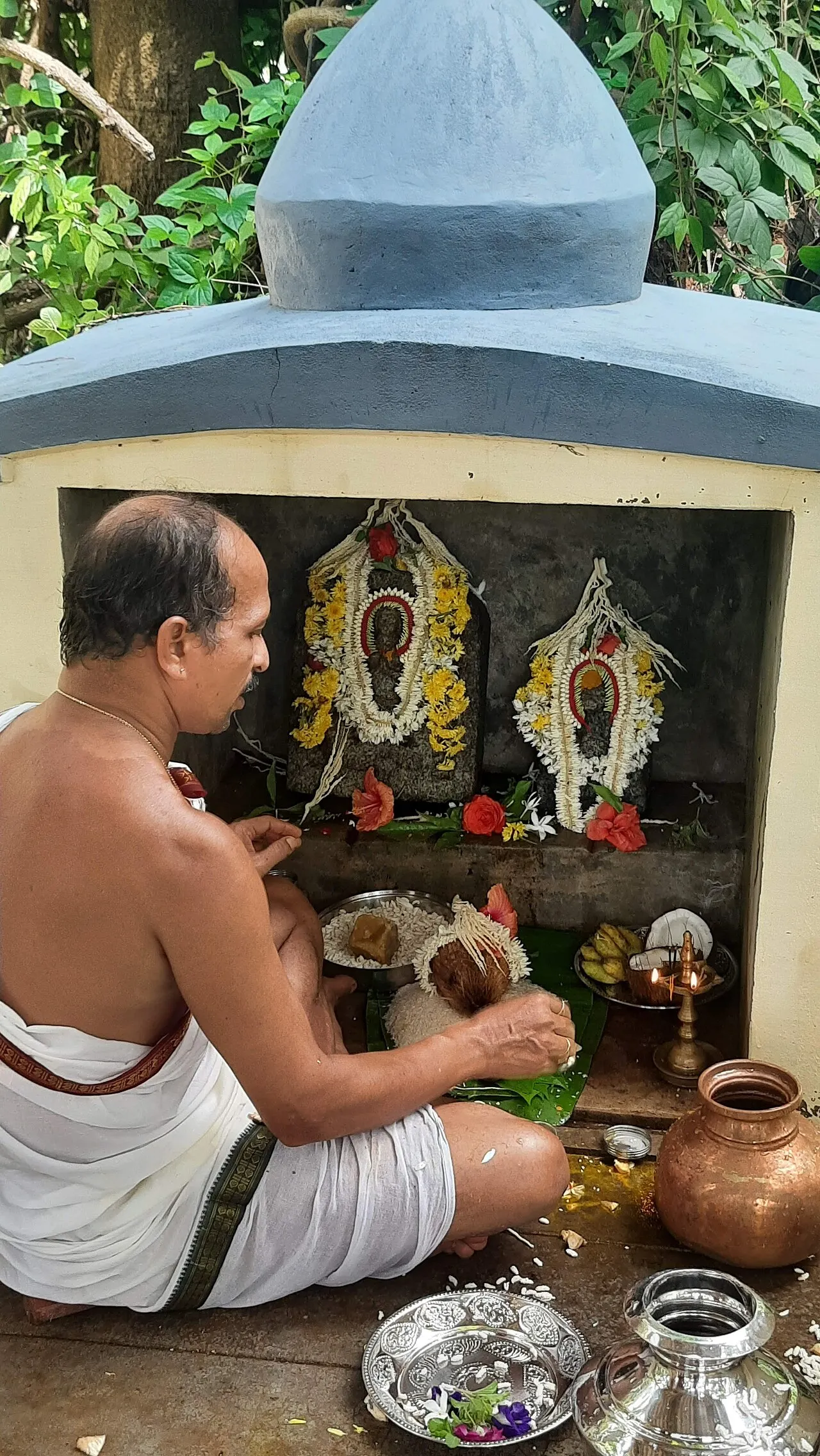

The great day for the naga is Nagara Panchami, which falls in the monsoon months. Families clean their groves and decorate the stones with turmeric paste and flowers. They bathe the stones with milk, honey, curd, tender coconut water and ghee, then share what flows off as a blessed offering. Coconuts, bananas, puffed rice and pingara (the flowers of the areca palm) are laid before the naga.⁶ Many households avoid fried food that day and cook steamed sweets instead.⁶ The households of a bari each come to worship at their ancestral shrine, so the day can bring scattered relatives back to the same small grove.¹
Why the serpent?
For a farming people, the snake is easy to respect. Cobras keep down the rats that would otherwise eat the rice in the fields and the granary, and they can also kill.¹ ³ A creature that both protects and threatens is exactly the kind of power the Tuluvas have long honoured. The same idea runs through bhuta kola, where Naga stands beside Panjurli the boar and Pilli the tiger among the forest’s spirit powers. As the retired professor Thukaram Poojary puts it, “In ancient times, humans revered the presence of serpents, with which they co-existed.“⁷
How and when this worship began, no one can say for certain. Some Tuluvas hold that their communities descend from the Nagavanshi, a “serpent lineage”, and carried the worship with them. Researchers of Tulu history have found no clear evidence for this, so it is best read as tradition rather than history.⁸ What does seem clear is that the naga is old. Writers on Tulu history believe the serpent was already being worshipped before the cult of Bermer, the great spirit-god of early Tulunadu, took hold.⁹ At the old shrine clusters, Naga still sits beside Bermer, Lekkesiri, Maisandaya and Nandigona.⁵
Old roots, Hindu stories
However old the practice, the words used for it today come largely from the wider Hindu world. Priests recite Sanskrit verses to the serpents,¹ and the main festival, Nagara Panchami, is celebrated across India. The naga is linked with the great serpents of Hindu story.
The best known of these stories belongs to Kukke Subramanya, the famous temple in the forested foothills of the Western Ghats. There, the story goes, Vasuki, king of the serpents, fled from Garuda, the great eagle, and found refuge under the protection of Subrahmanya, the son of Shiva. That is why the god at Kukke is honoured as the lord of all serpents.¹⁰ Many people come to Kukke for Ashlesha Bali, a food offering to the serpents, and Sarpa Samskara, a two-day rite to lift what devotees believe is a curse from the serpents.¹ ¹⁰
Another telling, shared along the coast as far south as Kerala, links the serpent to the very making of the land. When Parashurama raised the land from the sea, it was salty and bare until Vasuki’s venom turned it green.¹¹
Not everyone accepts these layers as the whole story. Hegde has argued that the Parashurama legend’s story of how the coast was settled came to Tulunadu from a Kerala chronicle, and that it pushed aside older ways of worship, the naga among them, that the region’s communities already kept.¹²
When the serpents dance
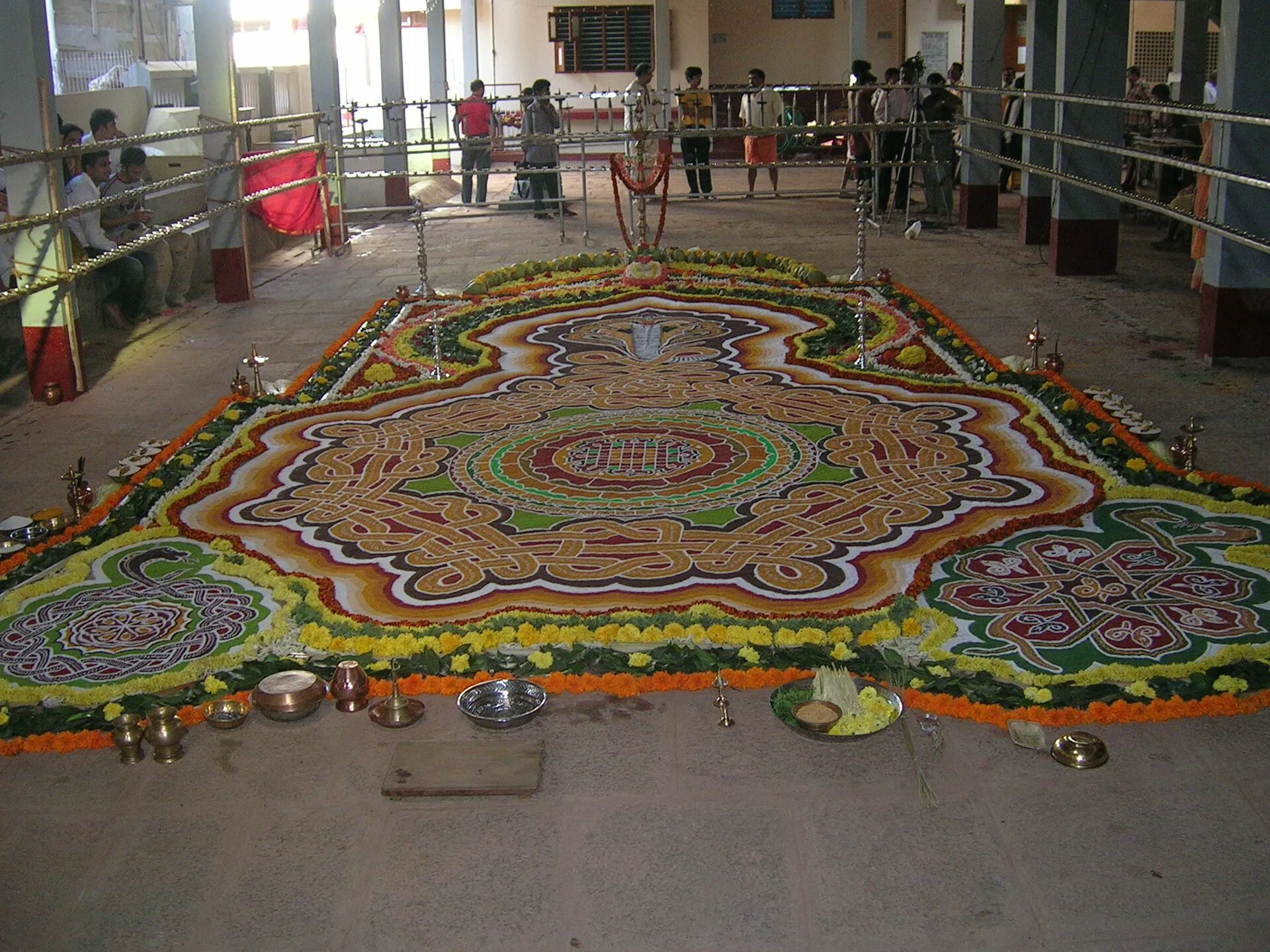

Most worship at a nagabana is quiet. But on special occasions a family, or a whole village, may hold a Nagamandala, the most spectacular of all the serpent rites.
It starts with a drawing. On the ground, an artist lays out an enormous serpent design in five colours, all from nature: white from white earth, red from lime mixed with turmeric, green from powdered leaves, yellow from turmeric, and black from roasted paddy husk.¹ ¹³
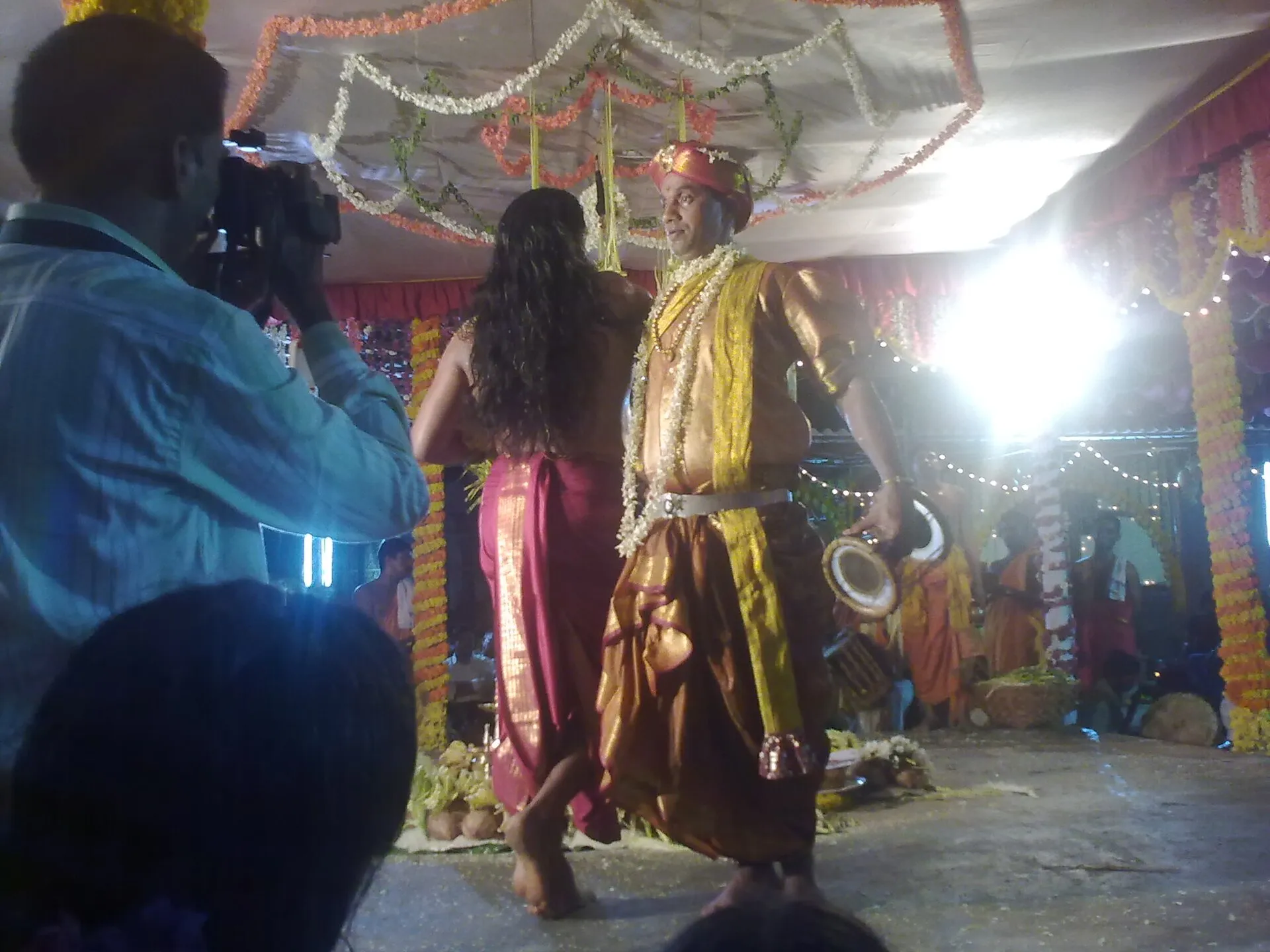

The ceremony usually begins late and lasts until dawn. A patri, a priest who becomes the male serpent, breathes in the scent of the areca flower and falls into a trance.¹ ¹⁴ A second performer, the naga kannika (the female serpent), dances around the drawing, swaying to the beat of the dakke, a small hourglass-shaped drum.¹ Through the night, the two act out the union of the male and female serpents.¹ ¹³
A close cousin of the Nagamandala, called Dakke Bali, is kept especially in Udupi district. Its drummers come from Vaidya families, who pass the skill of the dakke down within the family.³ ¹⁵ The patris are not chosen by birth. They are chosen through prashna, a ritual reading that asks what the deity wants.³ At Padubidri, where Dakke Bali is held every other year, the night is lit only by oil lamps, and phones and photography are kept out.¹³
These rites are costly to stage, and the people who know how to perform them are getting fewer. Writers who have watched them describe a tradition that is precious and, in places, fragile.¹³ ¹⁴
Groves under pressure
Because their trees have been left alone for generations, many nagabanas have become small refuges of old forest in a heavily farmed landscape. A study of nine sacred groves in Udupi district, most of them dedicated to the naga, found 54 kinds of plants. Fifteen of them grow wild only in a limited area, and 31 are rare or threatened.¹⁶
Those same groves are changing fast. In Hegde’s account, as one reviewer of her book puts it, trees around ancient nagabanas are being destroyed “under the guise of renovation and aesthetic modification” and replaced with concrete structures.⁵ Others point to land development swallowing groves on the edges of growing towns.¹⁴ ¹⁶ Families who still keep their grove as it was, shady and overgrown, are protecting something that is both sacred and alive.
Related
- Bhuta Kola: When the Spirits Come to the Village, where Naga is one of the forest’s spirit powers
- Koti and Chennaya, the Twin Heroes, whose family deity is Kemmalaje Nagabrahma
- Rakteshwari, the Earth-Born Maiden, and Lekkesiri, counted with the Nagas among the oldest powers
- Bermer, the great spirit-god honoured beside Naga at the old shrines
- Maisandaya, Guardian of the Herd, honoured with Naga and Bermer at the same old shrines
- Kukke Subramanya, the serpent temple of the Western Ghats
- Kadri Manjunatha: The Hill of Many Faiths, another place where older worship and Hindu story meet
- Aliyasantana, inheritance through the mother’s line
- Nagara Panchami and the Tulu year
Sources & further reading
The books and articles behind the numbered notes on this page.
- Wikipedia, “Nagaradhane”: the nagabana and its stone cobras, the ban on cutting trees, cleansing rites for harming a snake, the bari and its moolasthana, family worship at Nagara Panchami, snakes protecting the crops from rodents, the five colours of the Nagamandala, the patri and the naga kannika, the dakke, and Ashlesha Bali with the Sarpa Sukta.
- Ashwani Kumar N. K. R., “Celebrating nature in the sacred groves of Tulunadu”, Deccan Herald (7 August 2024): devarakadu and other local names for sacred groves, and nagabanas as groves of the serpent deity.
- Mangalore Heritage, “Naga Aradhane: Snake Worship Popular Among Bunt Community”: “there is not a single Bunt house that does not have Nagabana”, and snakes saving the crop from rodents. Mangalore Heritage, “Dakke Bali: A Special Form of Nagaradhane in Tulunadu Region”: worship at nagabanas open to all regardless of caste or class, the Vaidya families’ family skill with the dakke, and patris chosen through ashtamangala prashne rather than by birth.
- Wikipedia, “Bunt (community)”: the Bunts’ matrilineal septs called bari, whose members did not intermarry. Wikipedia, “Nagaradhane”, compares the bari to the gotra.
- Ravindra Mundkur, “313. Mooltāna Alades in Tulunadu”, Tulu Research & Studies (blog, 30 April 2013), reviewing Indira Hegde’s book (see Further reading): each community’s own mooltana as its original home, nagabanas in dense groves, the five-shrine cluster of Bermer, Rekkesiri, Maisandaya, Nandigona and Naga, Dakke Bali and Nagamandala among the forms of serpent worship, and the quotation on concrete “renovation”.
- “Mangaluru: Nagara Panchami: Devotees flock to temples to revere serpent god”, Daijiworld (27 July 2017): cleaning the groves, turmeric and flowers, bathing the stones with milk, honey, curd, tender coconut and ghee, the offerings, and no fried food on the day.
- “Nagaradhane: An age-old practice of the locals of Tulunadu, Karnataka”, Deccan Chronicle (8 August 2024), quoting Thukaram Poojary.
- “285. Nagavanshi Kshatriyas”, Tulu Research & Studies (blog, August 2011): recent Nagavanshi claims by some communities, including some Bunts, and “no distinct evidences” in Tulunadu that rulers came exclusively from a Naga dynasty.
- “354. Bhuta cult of Bermeru or Bommaiah”, Tulu Research & Studies (blog, January 2016): “Before the arrival of the Bermer cult Serpent (Nāga), Bullock (Nandigona), Buffaloe (Mahisandaya) and other animistic spirit deities were being worshipped”.
- Wikipedia, “Kukke Subramanya Temple”: Subramanya as “lord of all serpents”, Vasuki’s refuge from Garuda, and Ashlesha Bali and the rites to remove curses tied to the snake god. Kukke Subrahmanya Temple pilgrim guide (an independent guide, not the temple’s own site): Sarpa Samskara as a two-day Vedic ritual.
- Wikipedia, “Thiruvallam Sree Parasurama Temple”: the land risen from the sea “filled with salt”, and Vasuki turning it fertile.
- Indira Hegde, “Parashurama srishtiya kathe eshtu nija?” (“How true is the story of Parashurama’s creation?”), Chalukya magazine, 17th year, annual special issue (2024), pp. 53 and 55 (Kannada): the 64-families settlement story traced to the Keralolpatti, and the myth’s place in pushing aside earlier Naga worship.
- Sandhya Mendonca, “When the Serpents Dance: An Enchanted Night in Padubidri”, The Sunday Guardian (20 September 2025): Dakke Bali at Padubidri, the five colours, oil lamps only, the night until dawn, and how few dakke players remain.
- “Nagamandala: An Exotic Tradition on the Wane”, Organiser (30 January 2019): the patri and the areca flower, the cost of the ritual, and groves lost to land development.
- Wikipedia, “Dakkebali”: Dakke Bali in Udupi district and the Vaidya families who play the dakke.
- Sachin Dadaji Kuvar and Sudhakar Narayan Kothari, “Study on sacred groves of Udupi district from Karnataka, India”, International Journal of Botany Studies 9(6) (2024): nine groves, mostly dedicated to the naga, with 54 plant species, 15 endemic and 31 threatened, and traditional protection “becoming weaker day by day”.
Further reading
- Indira Hegde, Tuluvara Mooltāna Adi Alade: Parampare mattu Parivartane (Navakarnataka, Bengaluru, 2012), in Kannada: a study of the ancestral shrines of Tulu communities.
- Heidrun Brückner, On an Auspicious Day, at Dawn: Studies in Tulu Culture and Oral Literature (Harrassowitz, 2009). Google Books.
Words on this page
What the Tulu and other Indian-language terms on this page mean.
- aliyasantana
- Inheritance through the mother's line.
- Ashlesha Bali
- A food offering to the serpent deities on the day of the Ashlesha star.
- bari
- A clan, in many Tulu communities passed down the mother's line.
- daiva
- A guardian spirit; used interchangeably with bhuta.
- dakke
- A small hourglass-shaped drum played in serpent rituals.
- Dakke Bali
- A form of serpent worship, close to the Nagamandala, kept especially in Udupi district.
- moolasthana
- The ancestral shrine of a clan, its "original seat".
- naga
- The serpent deity, usually pictured as a cobra.
- naga kannika
- The female serpent, danced by a performer in the Nagamandala.
- nagabana
- A sacred grove where the serpent deity dwells.
- Nagamandala
- An all-night ritual in which the union of the serpents is danced out.
- nagaradhane
- Worship of the naga, the serpent deity.
- patri
- A medium who holds the daiva's sword and bell and speaks as the spirit.
- pingara
- The flowers of the areca palm.
- prashna
- A ritual divination, often by an astrologer, to learn what a daiva or deity wants.
- Sarpa Samskara
- A two-day rite to lift what devotees believe is a curse from the serpents.
Themes
Spotted a mistake, or know more about this? Suggest a correction/addition.