Faith & Worship · Temples, Mathas & Basadis · Also in: Stories: Temples and Sacred Places
Kadri Manjunatha: The Hill of Many Faiths
Climb the steps of Kadri hill on a festival morning and you will pass pilgrims dripping from the temple tanks, where water from a spring said to be the Ganga herself spills down the slope. At the top, inside a temple to Shiva, stand a few dark bronze figures. The oldest, about the height of a person, has three faces and six arms. It is not Shiva at all. It is a Buddhist figure of compassion, and an inscription on its pedestal says a king set it up here about a thousand years ago.
Kadri Manjunatha is many things at once: a busy city temple, a pilgrimage stop, the scene of a great yearly festival. It is also the clearest place in Tulunadu to see one faith grow out of another, because almost nothing from the earlier faiths was cleared away.
The legend of the plantain grove
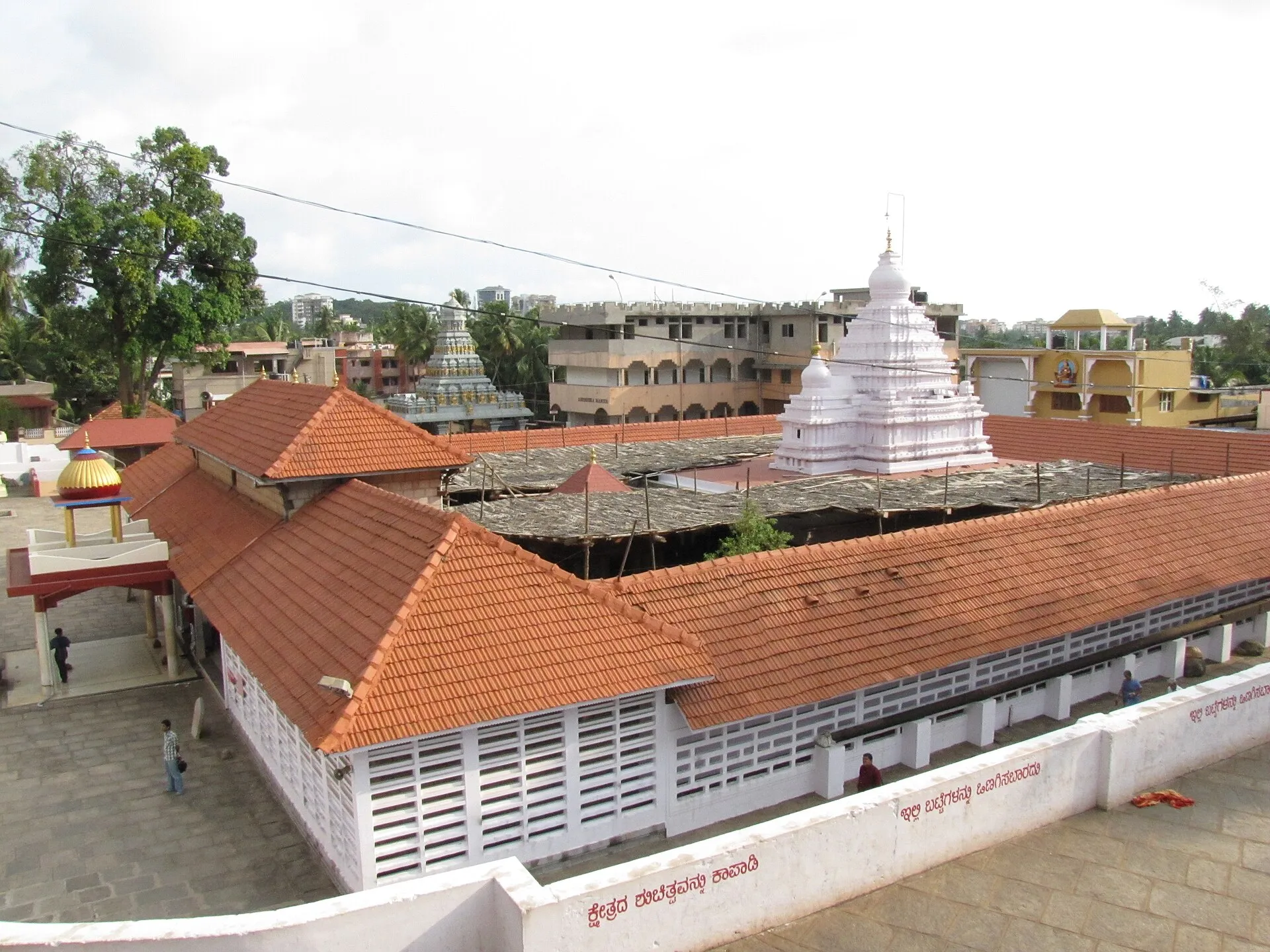

The temple’s own story begins with Parashurama, the warrior-sage who, in the best-known legend of the coast, raised the land of Tulunadu from the sea. After his long war against the kings, he gave away all the land he had won and was left with nowhere to live. He prayed to Shiva, who told him to meditate in a kadalivana, a plantain grove, and promised to appear there.¹ ³
Parashurama found the grove, with a well in it, and Shiva came to him there as Manjunatha. The seven crore sacred chants Parashurama had recited settled on the hillside as seven holy ponds, and Shiva told him to build a temple with the help of Vishwakarma, the architect of the gods.¹
The name is said to come from that grove. Kadali means plantain, and Kadri is usually explained as a worn-down form of it.² The oldest written form of the name, though, is Kadarika, which may simply mean a hillside pasture.¹
A Buddhist monastery on the hill
The legend is the story the temple tells about itself. The evidence on the hill tells an older one. Long before it was a Shiva temple, Kadri was a Buddhist monastery, a vihara, of the Vajrayana school, the tantric form of Buddhism.³ ⁴ Buddhism seems to have flourished here until about the 10th century.²
The proof is in bronze. The largest of Kadri’s old images is a seated figure of Lokeshwara, also called Avalokiteshvara, the bodhisattva of compassion. A bodhisattva is a being who has reached enlightenment but stays in the world to help others. The image is about one and a half metres tall, with three faces and six arms, and a small seated Buddha in its crown. It is cast in panchaloha, an alloy of five metals.³ ⁵ One writer called it the best bronze in the country, worthy of a place among the great bronzes of the world.²
An inscription on the pedestal records that the Alupa king Kundavarma installed the image at Kadarika Vihara. It also calls Mangaluru by its old name, Mangalapura.¹ Most sources date the inscription to 968 CE, though some read it as 1068 CE.³ ⁴
Two more bronzes of the same fine workmanship stand beside it. One is another bodhisattva, which local people call Narayana, and the other a Buddha, known locally as Vedavyasa.³ The Hindu names they carry are themselves a clue to how the hill changed hands.
The yogis of the Jogi Math
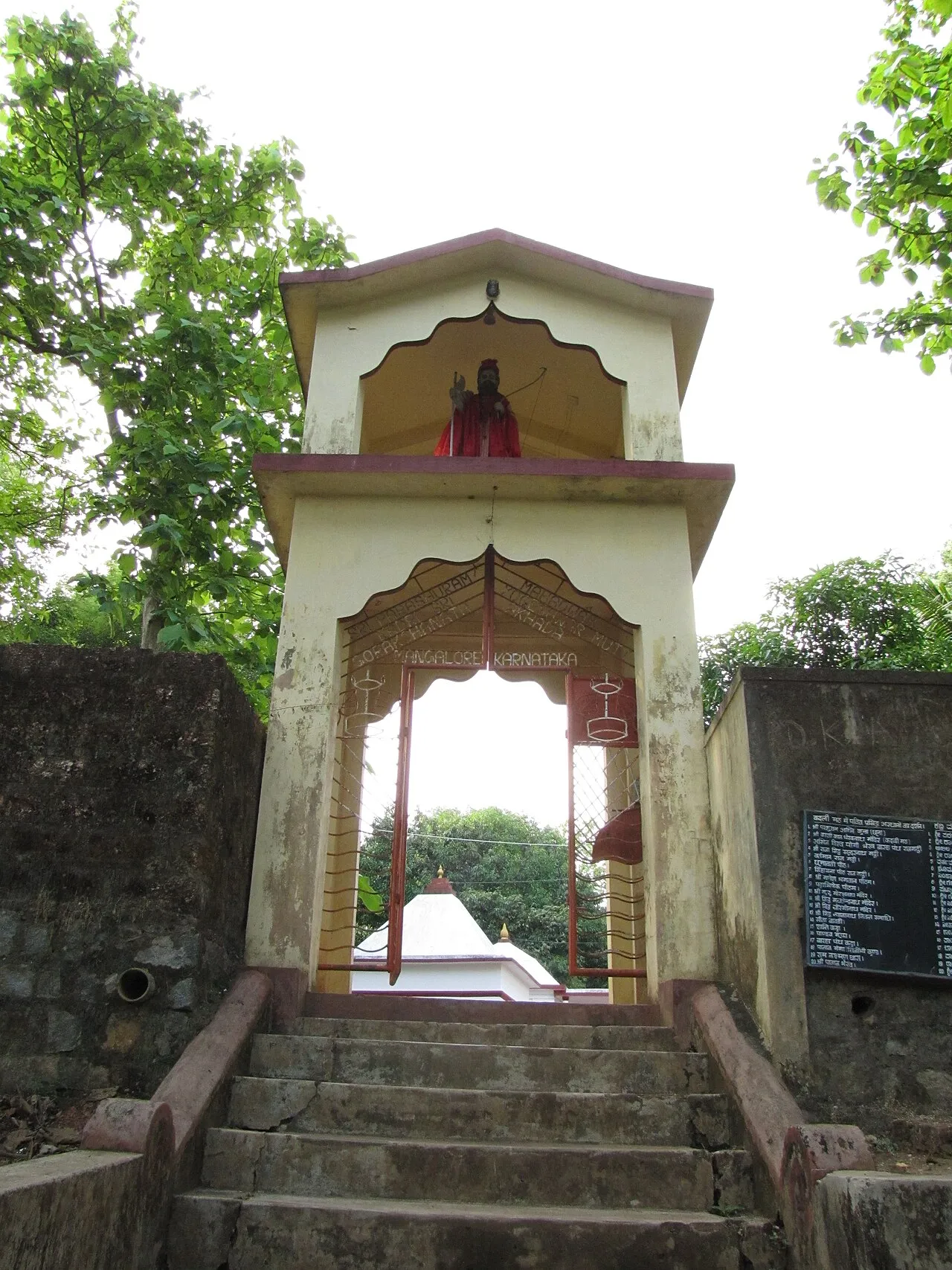

As Buddhism faded, a new tradition took root on the hill: the Nath yogis.¹ The Naths were wandering ascetics who traced their line to two great teachers, Matsyendranath and his disciple Gorakhnath, and their practice drew on both tantric Buddhism and the worship of Shiva. That made them a natural bridge between the old monastery and the temple to come.⁵
Kadri became one of the most important Nath centres in South India.² ⁴ Their monastery, the Jogi Math (also called the Yogeshwar Math), still stands beside the temple and traces its founding to Matsyendranath himself.⁶ Laterite caves near it are known as the Pandava caves, where the five brothers of the Mahabharata are said to have hidden in their exile. They are more likely to have been meditation cells, first for Buddhist monks and later for the yogis.¹ ⁶
The Jogi Math still keeps an unusual custom. Its head, called the Raja or Arasu, is chosen every twelve years at a gathering of Nath yogis at Trimbakeshwar, near Nashik in Maharashtra. The new Raja then walks to Kadri, more than a thousand kilometres, halting at Nath centres along the way, and is enthroned on Mahashivaratri.⁴ ⁷ At the temple’s festival, he rides a horse in the courtyard and helps start the temple car on its way.⁷
The yogis also tie Kadri to another of Mangaluru’s great temples. Legend says the city’s Mangaladevi temple was built by the same King Kundavarma under the guidance of Matsyendranath. To this day the hermits of the Kadri math visit Mangaladevi at the start of the Kadri festival, with prayers and an offering of silk cloth.⁸
From Manjushri to Manjunatha
The name of the god may hold the whole story. The historian M. Govinda Pai concluded that Kadri was once a centre for the worship of Manjushri, the bodhisattva of wisdom, and that its bodhisattvas were later taken as forms of Shiva.³ Others note how neatly the name turned over: the Buddhist Manju stayed, and natha, “lord”, the title of the Nath yogis, was added. Manjushri became Manjunatha.⁴
Much of that past is still on view. The Shiva of Kadri is worshipped in the form of a linga, the smooth, rounded stone that stands for Shiva, while images of Lokeshwara, Manjushri and the Buddha remain in the temple, and figures of the Nath teachers are kept in the Jogi Math.³ ⁴ Few temples hold on to their own past so openly.
How the change happened is still argued over. The historian P. Gururaja Bhat suggested that Kundavarma’s Lokeshwara could already be read as Shiva, or as Matsyendranath, pointing to the rosary of rudraksha beads it holds and to the king’s own devotion to Shiva.⁴ A more recent study by Chandrakanth Bhat finds that hard to accept. If the image was Shiva all along, he asks, why was it moved out of the main shrine? He proposes instead that the king built the vihara for a Lokeshwara who was already being merged with Matsyendranath.⁴ Others see the bronze as a bodhisattva worshipped as a form of Shiva from early on.³ ⁵ The evidence allows more than one reading, and the experts still disagree.
The temple today

The temple was already receiving gifts in the 12th and 13th centuries: an inscription in its kitchen records a king and local landlords granting land.¹ The Alupa queen Balli Mahadevi, who ruled from 1277 to 1288, called herself a devotee of Manjunatha.¹ ² The temple was rebuilt in granite later, in the 14th or 15th century.³ ¹
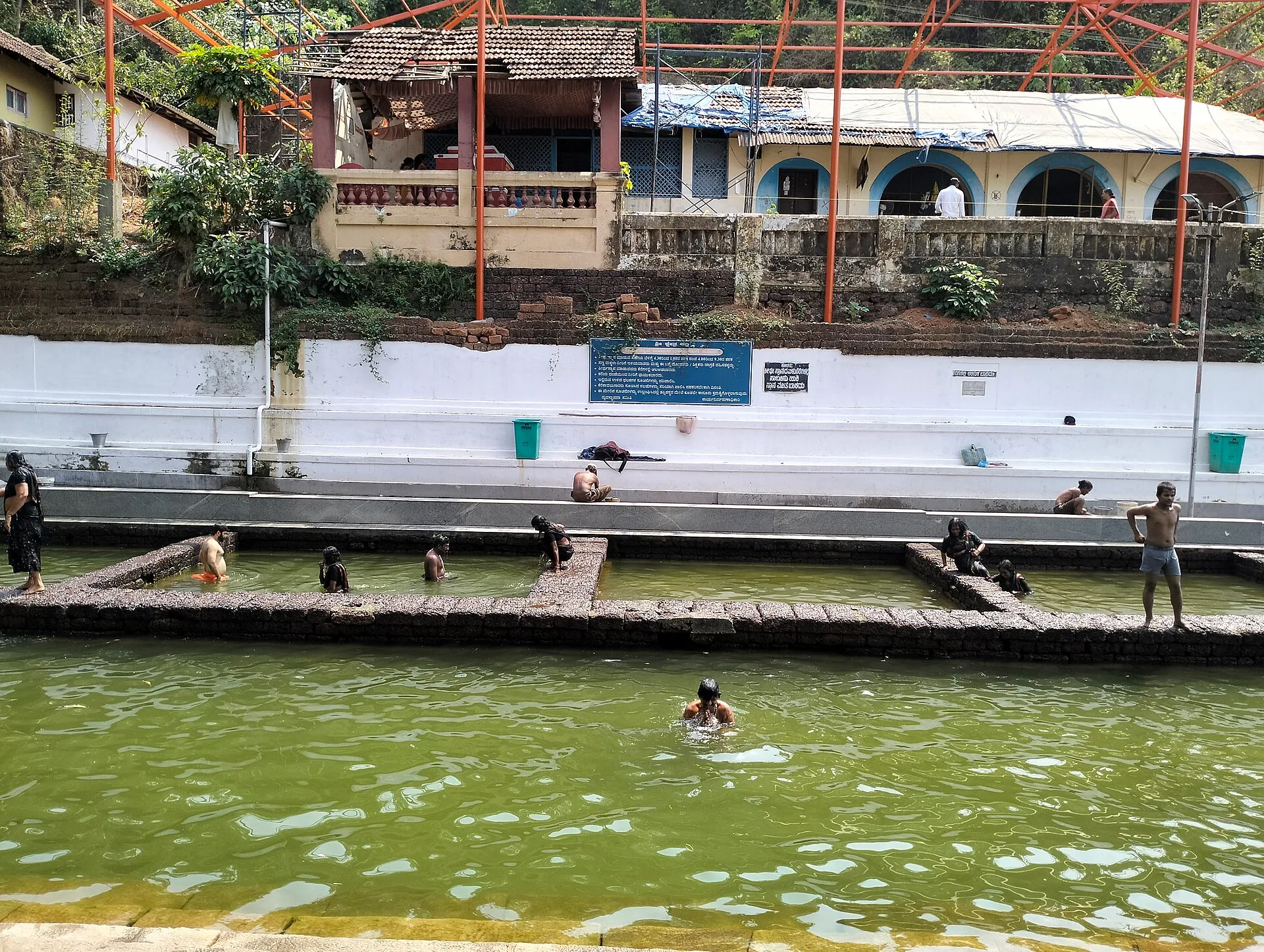
Below the temple, a spring flows from a stone spout shaped like a cow’s mouth. It is believed to be the Ganga, and it feeds the chain of tanks down the hillside. Pilgrims bathe in them before they go up to the shrine.³ ⁶ Legend speaks of seven ponds, though there are usually said to be nine.³ ⁶
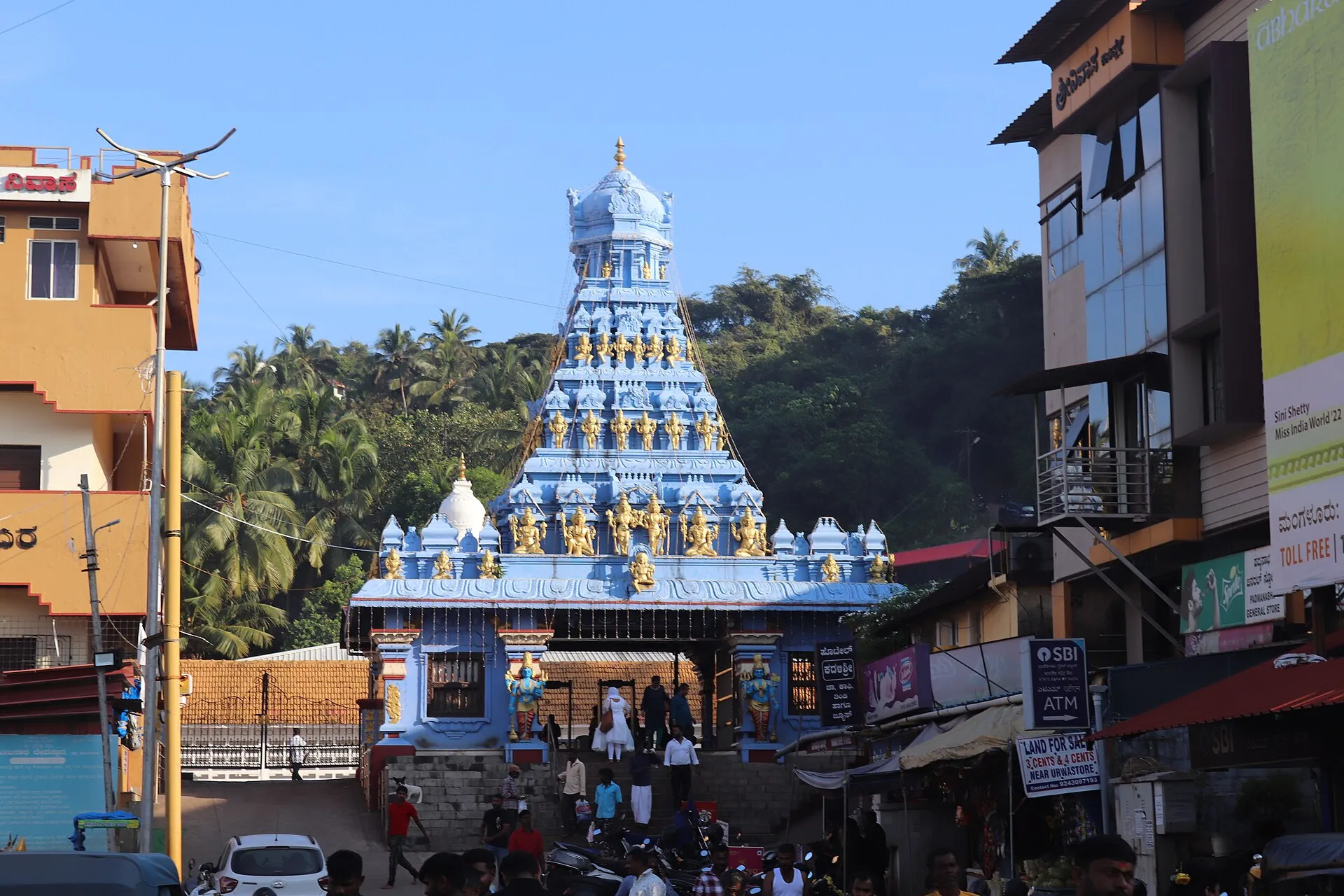

The year’s great event is the nine-day jatre, the temple festival, which begins on Makara Sankranti in January and includes the pulling of the great temple car.³ ⁶ ⁷ In the month of Karthika, around November, the temple is lit with rows of oil lamps for the Lakshadeepotsava, the festival of a hundred thousand lamps.⁶
Kadri also belongs to the daivas’ story. The Tulu legend of Dharmasthala says the daivas there sent their servant, the daiva Annappa, to fetch a Shiva linga from Kadri, and that the Manjunatha temple at Dharmasthala was built around it.⁹ So the god of Tulunadu’s most famous pilgrimage town carries the name, and in legend the very stone, of this Mangaluru hill.
Related
- Bhuta Kola: When the Spirits Come to the Village, for the daivas, among them Annappa, who carried Kadri’s linga to Dharmasthala
- Nagaradhane: The Serpent in the Sacred Grove, another tradition that Hindu story drew into its own
- Dharmasthala: The House the Daivas Asked For, where the Manjunatha linga from Kadri is said to rest
- Mangaladevi and Sharavu: Two Temples, One King, the temple that gave Mangaluru its name, and its neighbour
- Parashurama and the Coast That Rose from the Sea, the legend the temple’s story begins with
- The Alupa kings, who ruled the coast when the Lokeshwara bronze was set up
Sources & further reading
The books and articles behind the numbered notes on this page.
- Ranjith, “Shri Manjunatheshwara Temple, Kadri”, Shivalli Brahmins (2009, updated 2022): the Parashurama legend, the plantain grove and well, the seven ponds and Vishwakarma, the 968 CE inscription naming Mangalapura and Kadarika Vihara, the meaning of Kadarika, the Nath Panth and the Jogi Math, the Pandava caves, the 12th–13th century land grant, Balli Mahadevi, and the rebuilding in granite.
- Amrita Nayak, “History set in bronze”, Deccan Herald (12 April 2005, archived copy): Buddhism at Kadri until the 10th century, Kadri as the biggest Nath centre in South India, the Lokeshwara as “the best bronze in the country”, the name from kadali, and Balli Mahadevi.
- Wikipedia, “Kadri Manjunath Temple”: the Parashurama legend, Kadri as a Vajrayana Buddhist vihara, M. Govinda Pai on Manjushri, the Lokeshwara bronze (three faces, six arms, about 1.5 metres, panchaloha, dated 968 or 1068 CE), the two other bronzes called Narayana and Vedavyasa, images kept in the temple, the rebuilding in stone, the Ganga spring and tanks, and the January festival.
- Chandrakanth Bhat, “A study of footsteps of the Natha Sampradaya at Kadri: Karnataka state”, International Journal of History 6(1) (2024), pp. 103–104: from vihara to Vajrayana centre to Nath centre, the 968 CE inscription of Kundavarma, Manjushri becoming Manjunatha, P. Gururaja Bhat’s reading of the Lokeshwara and the author’s reply, the Nath idols in the math, and the Raja of the math chosen at Trimbakeshwar for twelve years.
- Meera S. Joshi, “Vajrayana Relics in a Shiva Shrine: The Kadri Enigma”, India Narrative (19 April 2026): the bronzes’ Vajrayana features, panchaloha, and the Nath Panth as a bridge between Buddhist and Shaiva worship.
- Udupi Pages, “Kadri Sri Manjunatha Temple”: the Yogeshwar Math founded by Matsyendranath, the Pandava caves as meditation cells, the Ganga spring and tanks, bathing before entering the shrine, the January festival, and the Lakshadeepotsava.
- John B. Monteiro, “Mangaluru: Kadri’s Jogi Math set for fresh focus”, Daijiworld (17 January 2015): the Raja of the Jogi Math chosen every twelve years at Trimbakeshwar, his walk of over 1,150 km by way of Nath centres, his enthronement on Mahashivaratri, and his part in the temple festival.
- Wikipedia, “Mangaladevi Temple”: Kundavarma building the temple under the patronage of Matsyendranath, and the hermits of the Kadri math visiting at the start of the Kadri festival with prayers and silk cloth.
- Wikipedia, “Dharmasthala Temple”: the daivas sending Annappa to fetch the linga from Kadri, and the Manjunatha temple built around it.
Words on this page
What the Tulu and other Indian-language terms on this page mean.
- bodhisattva
- In Buddhism, an enlightened being who stays in the world to help others.
- daiva
- A guardian spirit; used interchangeably with bhuta.
- jatre
- A yearly temple festival or fair.
- linga
- The rounded stone form in which Shiva is worshipped.
- Nath
- An order of yogis who trace their line to Matsyendranath and Gorakhnath.
- panchaloha
- An alloy of five metals used for sacred images.
- rudraksha
- The dried seeds strung into prayer beads sacred to Shiva.
- vihara
- A Buddhist monastery.
Themes
Spotted a mistake, or know more about this? Suggest a correction/addition.