Faith & Worship · Temples, Mathas & Basadis · Also in: Stories: Daivas, Stories: Temples and Sacred Places
Dharmasthala: The House the Daivas Asked For
Go to Dharmasthala at midday and you will be swept along with the crowd to the dining hall. Thousands of people sit down in long rows, and everyone is served a meal on a plantain leaf: rich and poor, from any caste or faith, without paying a rupee. People say you should never leave Dharmasthala without eating there, or your pilgrimage is not complete.¹
That meal is the keeping of a promise. The temple’s own story says it was made about eight hundred years ago by four daivas, the guardian spirits of Tulunadu, to a Jain couple who gave up their home to them. Dharmasthala is famous across India as a Shiva temple. In its own telling, though, the daivas came first, and Shiva came because they sent for him.
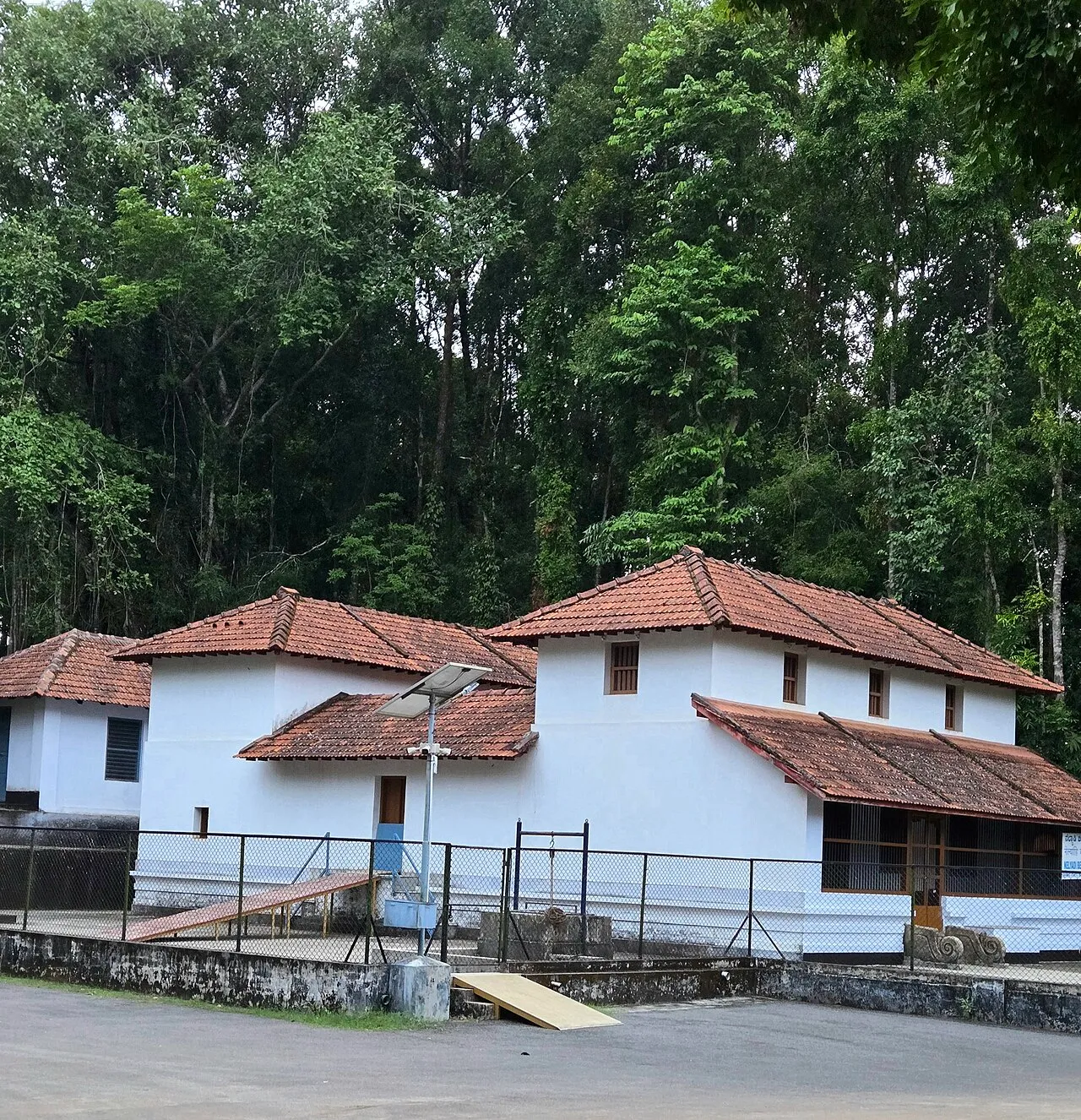
Guests at Nelyadi Beedu
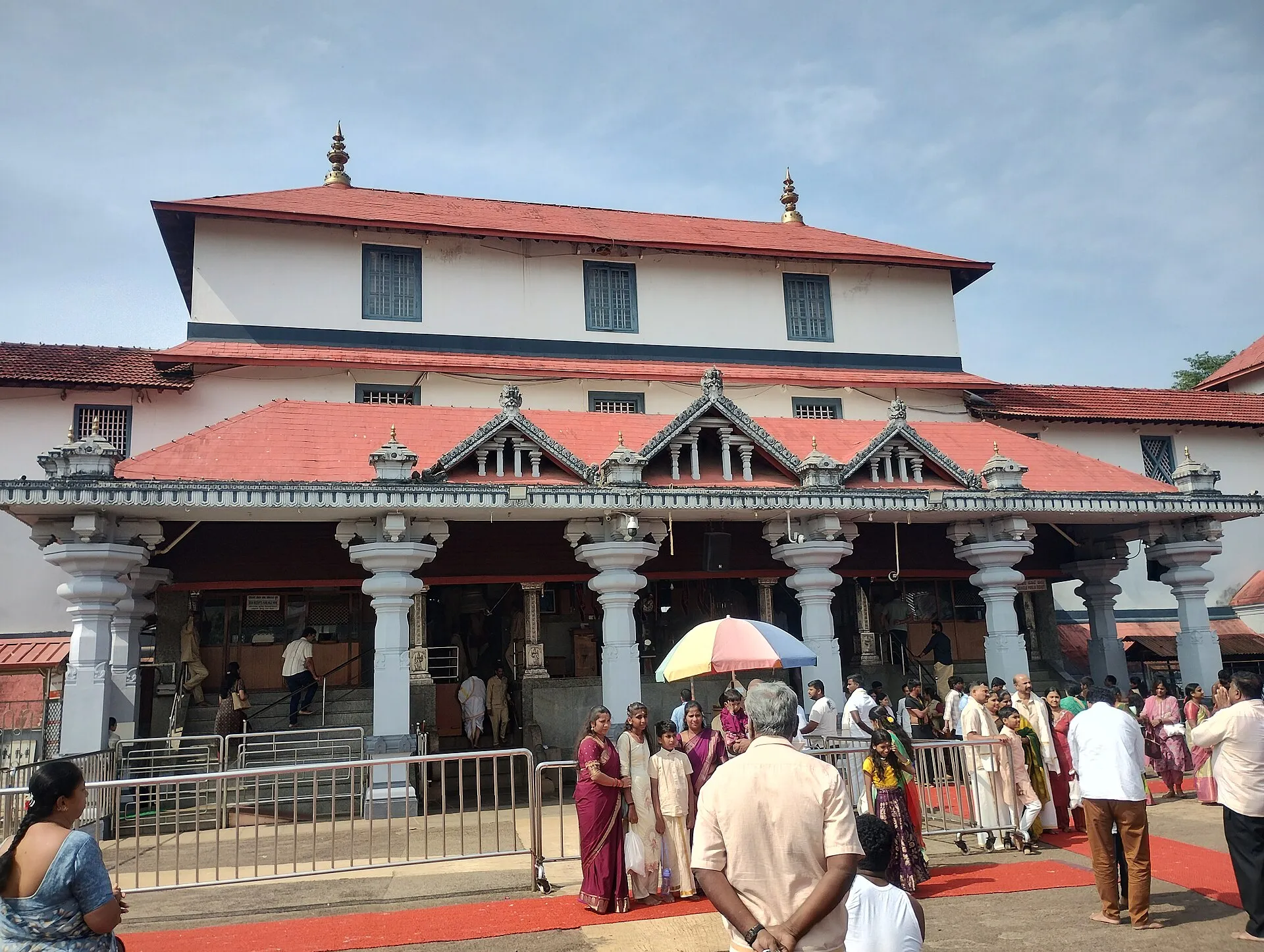

Long ago, the place was a village called Kuduma, in Mallarmadi. A Jain chieftain named Birmanna Pergade lived there with his wife, Ammu Ballalthi, in a house called Nelyadi Beedu. They were known for their kindness: no traveller was ever turned from their door.²
One day a group of dignified strangers arrived. They were the Dharma Daivas, guardian spirits of dharma, the right way to live, who had taken human form to look for a place where dharma was truly practised. The couple welcomed them with every honour they could give.² ³
That night the daivas came to Birmanna Pergade in a dream and told him who they were. They asked him to leave his house and give it over to their worship, and to spend his life spreading dharma. He asked no questions. He built himself another house and began to worship the daivas at Nelyadi Beedu, and the worship there goes on to this day.² ³
The daivas came to him again. He was to build a shrine for each of the four of them: Kalarahu, Kalarkayi, Kumaraswamy and Kanyakumari. He was to choose two men of good family to speak for them as their oracles, and four worthy people to help him run the shrines. In return, they promised his family protection, the means to give endlessly in charity, and fame for the place.² ³
The god who came last
Birmanna Pergade built the shrines and invited Brahmin priests to perform the rites. The priests asked for one more thing: a Shiva linga, the rounded stone in which Shiva is worshipped, to stand beside the daivas.² ³
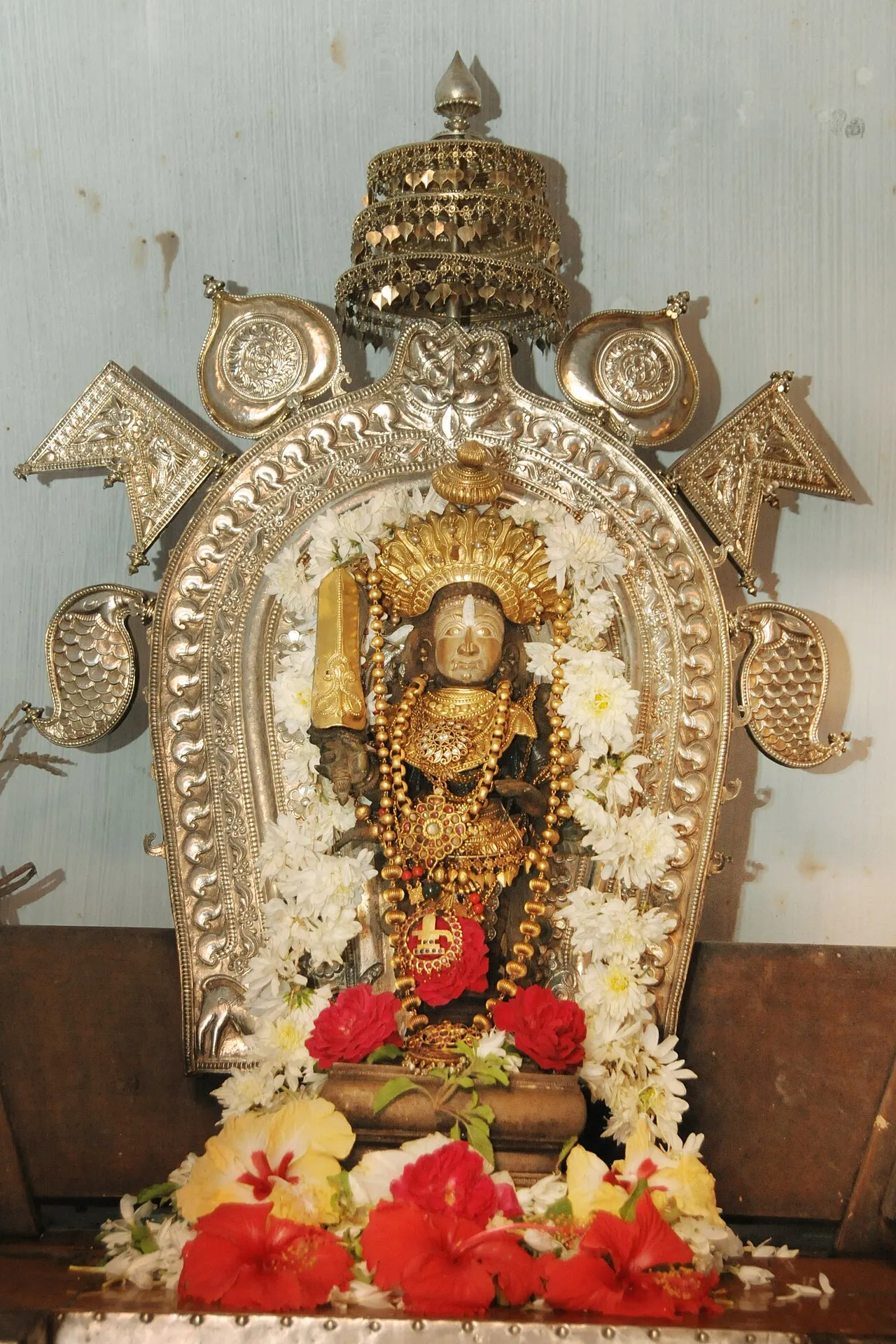

So the daivas sent their trusted servant, Annappa, to fetch one. He went all the way to the old temple of Kadri in Mangaluru and brought back the linga of Manjunatha, Shiva as he is worshipped there. The Manjunatha temple of Dharmasthala was built around it.² ³ Annappa is worshipped as a daiva himself, with a shrine of his own.⁴
Notice the order of the story. The daivas choose the family, the family gives them its house, and the pan-Indian god arrives last, at the daivas’ wish, carried by a daiva’s own messenger. Every April the daivas still have their own festival, a nema, the rite at which daivas come to speak through a performer, held for the Dharma Daivas and Annappa during the temple’s nine-day festival, the jatre.⁵
How Kuduma became Dharmasthala
The village kept its old name for centuries. Around the 16th century, the Heggade of the day, Devaraja Heggade, invited the great Madhva saint Vadiraja Tirtha of Udupi to visit. The saint came, but would not accept a meal, because the linga had never been consecrated with the proper Vedic rites. So the Heggade asked him to consecrate it himself. Pleased with the rites and with the family’s charity, the saint gave the place a new name: Dharmasthala, the abode of dharma.² ⁶
This explains a puzzle in the dates. The temple counts its history from about eight hundred years ago, while some popular accounts place the whole legend in the 16th century.⁷ The two dates seem to belong to two different events: the founding of the shrine, and its renaming centuries later. That is our own reading of the sources rather than something any one of them says.
Three faiths, one family
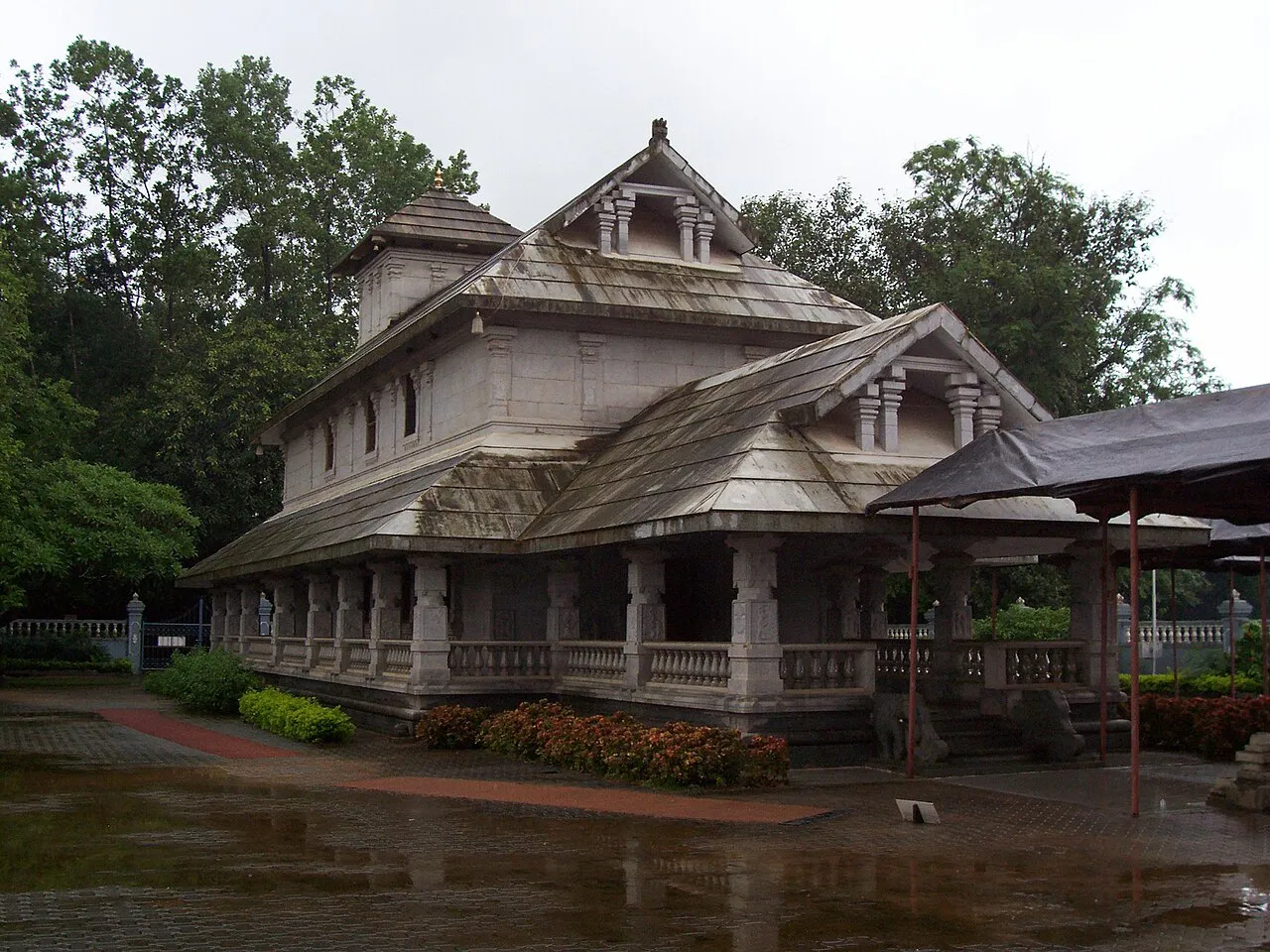

What makes Dharmasthala unusual is who looks after what. The family that runs it is Jain: the Pergades, a Jain Bunt family descended from Birmanna Pergade.³ The temple is to Shiva. Yet its priests are Madhva Brahmins, who are devotees of Vishnu. As one writer put it, “the priests are Madhva brahmins—Vaishnavites—but Hegde, the dharmadhikari of all temples, is a Jain.“³ And the daivas who began it all still have their shrines, alongside those of the goddess Ammanavaru, Ganesha and Subramanya.⁴
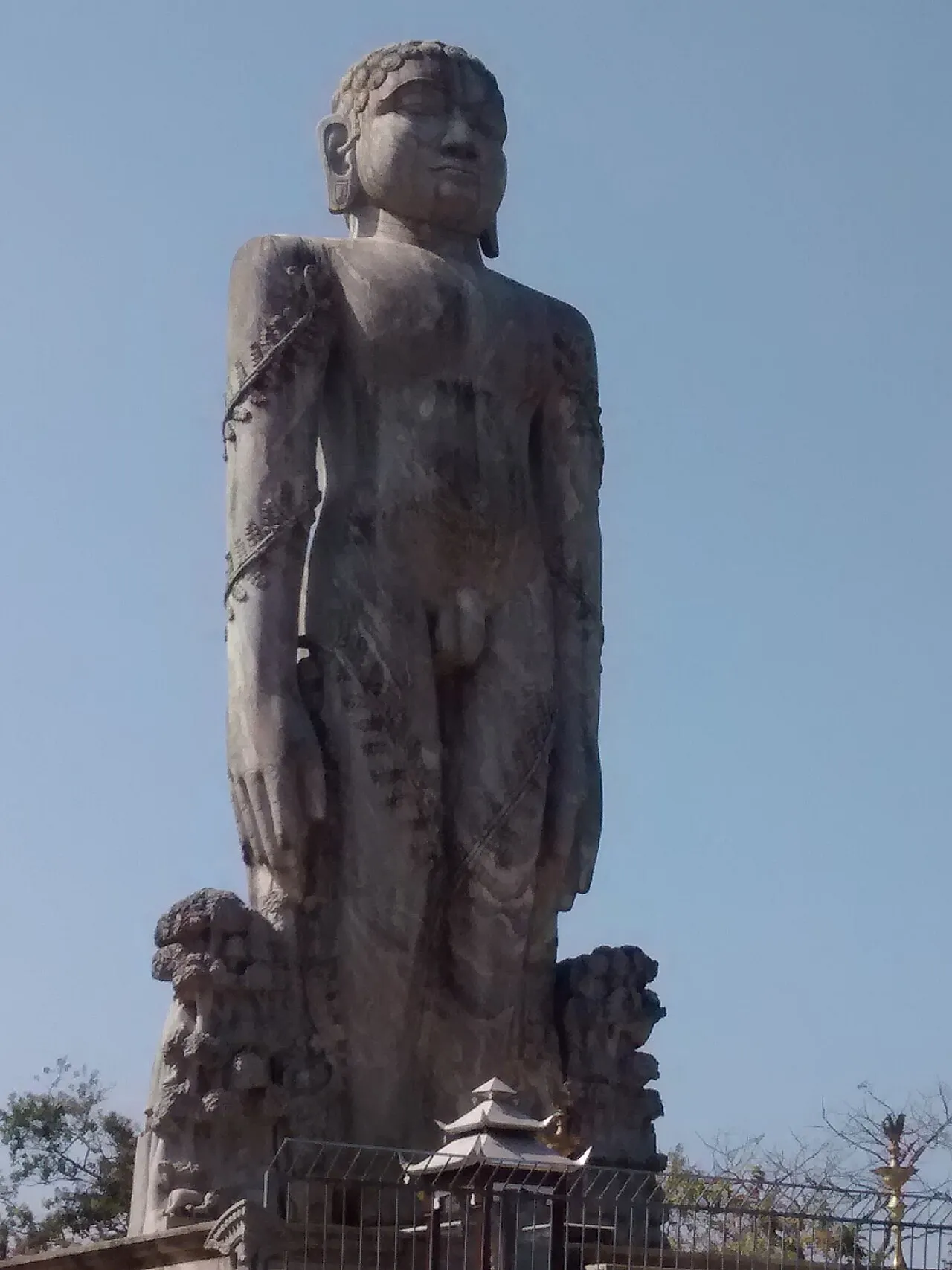

The town keeps its Jain side too. It has a Jain basadi, or temple, to Chandranatha, one of the 24 great teachers of the Jain faith.³ ⁸ On a low hill nearby stands a statue of Bahubali, the Jain saint, carved from a single rock and set up in 1973. It is about 12 metres (39 feet) tall and weighs about 175 tonnes, one of five great stone Bahubalis in Karnataka.⁸
None of this was a later compromise. The legend built it in from the start: a Jain family, chosen by Tulu daivas, keeping a Shiva shrine with Brahmin priests. At Kadri, one faith slowly grew out of another over centuries. At Dharmasthala, three were meant to live together from the first day.
The Heggade

The eldest man of the family takes the title Heggade, a later form of Pergade, and serves as the Dharmadhikari, the head of the temple.² ³ The temple’s own list names 21 Heggades, from Birmanna Pergade to the present one.² ⁹ In its tradition the Heggade stands for Manjunatha himself, and the daivas are said to accept him as their foster son.¹⁰
The Heggade was once the lord of the temple town, and he still sits in judgement. People of every faith bring him their civil disputes, called hoyulu. Both sides are called to the temple, and his ruling is accepted as final.³ ¹⁰ There is also an old custom called “Maatubida Manjunatha”. A person who has run out of every other way to settle a quarrel raises an arm, shuts their eyes and calls on Manjunatha’s name. From then on the two sides have nothing to do with each other until the Heggade decides the matter.¹⁰
The Heggades are expected to give the four traditional gifts: food, medicine, education and freedom from fear.¹⁰ Two of them shaped the modern town. Manjayya Heggade, who led from 1918 to 1955, began the yearly meeting of all faiths, the Sarva Dharma Sammelana, and built the causeway over the Nethravathi that made the journey easier.⁹ Ratnavarma Heggade followed him, and in October 1968 the present Heggade, Veerendra Heggade, took office at just 19, the 21st in his line.¹¹
The temple today
The temple is built in the Kerala style, of granite and laterite, with a steep roof of wood covered in gold-plated copper against the monsoon rains of the Western Ghats.¹² Many pilgrims have their heads shaved as an offering to Manjunatha, then bathe in the Nethravathi.¹³ Saint Vadiraja wrote that the river was born from the tears of joy the earth shed when Vishnu, as the boar Varaha, lifted it out of the flood.¹⁴
The free meal, annadana, is the temple’s best-known gift. Its kitchen was built to feed between 30,000 and 70,000 pilgrims a day, and is often read as the daivas’ promise of “abundance of charity” coming true.¹ ³ ¹¹ The year’s greatest festival is the Laksha Deepotsava, the festival of a hundred thousand lamps, held over five days in the month of Kartika, around November. The meeting of all faiths is held as part of it.⁵ Under the present Heggade, the family’s charity has grown into schools and colleges, hospitals and a large rural development programme.¹¹
Dharmasthala is famous today for its size, its kitchen and its colleges. Underneath all that is a small, old Tulu story: guests at a door, a house given away, and a daiva sent to fetch a god.
Related
- Kadri Manjunatha: The Hill of Many Faiths, the Mangaluru temple Annappa’s linga is said to have come from
- Bhuta Kola: When the Spirits Come to the Village, for the daivas and the rites at which they speak
- Udupi Sri Krishna Matha: Eight Monasteries, One Child God, where the same Vadiraja Tirtha reformed the temple’s rota of monasteries
- Moodabidri: Eighteen Basadis and the Thousand Pillars, a different kind of Jain institution: eighteen basadis under one monk
Sources & further reading
The books and articles behind the numbered notes on this page.
- Shri Kshetra Dharmasthala, “Annaprasadam”: free food for every pilgrim whatever their caste or creed, a kitchen designed for 30,000 to 70,000 a day, meals on plantain leaves, and the tradition that a pilgrimage is incomplete without the meal.
- Shri Kshetra Dharmasthala, “History”: Kuduma in Mallarmadi, Birmanna Pergade and Ammu Ballalthi at Nelyadi Beedu, the Dharma Daivas’ visit and dream, the house given up, the four shrines, oracles and helpers, the daivas’ promises, the priests’ request, Annappa fetching the image from Kadri, Vadiraja’s visit and reconsecration around the 16th century, the new name, and 21 generations of Heggades.
- Wikipedia, “Dharmasthala Temple”: the legend, the Pergade family as Jain Bunts, the Heggade as Dharmadhikari and judge of hoyulu, the Madhva priests (quoting M. V. Kamath, The Other Face of India, 1988, p. 40), the Chandranatha basadi, and the list of Dharmadhikaris.
- Divine Traveller, “Dharmasthala” (2024, archived copy): shrines for the four Dharma Daivas, Ganesha, Subramanya, Ammanavaru and Annappa.
- Shri Kshetra Dharmasthala, “Festivals”: the Laksha Deepotsava over five days of Kartika with the Sarva Dharma Sammelana, and the nine-day April jatre with the Dharma Nemotsava for the Dharma Daivas and Annappa.
- Karnataka State Gazetteer, Part 2 (1983), p. 1199, as quoted in Wikipedia, “Dharmasthala Temple”: Vadiraja of the Sode Matha reconsecrating the linga in the 16th century and naming the place Dharmasthala, “which was till then called Kuduma”.
- Famous Temples of India, “Sri Kshetra Dharmasthala Temple”: the 16th-century dating of the legend found in some popular accounts.
- Wikipedia, “Dharmasthala”: the town on the Nethravathi, about 75 km east of Mangaluru, the shrine of Chandranatha, and the Bahubali statue of 1973 (about 39 feet, 175 tonnes, one of five in Karnataka).
- Shri Kshetra Dharmasthala, “The Past Heggades”: the list of Heggades, and Manjayya Heggade (1918–1955), who began the Sarva Dharma Sammelana and built the causeway over the Nethravathi.
- Shri Kshetra Dharmasthala, “Tradition”: the Heggade as representative of Manjunatha and foster son of the daivas, the four gifts, hoyulu, and “Maatubida Manjunatha”.
- Wikipedia, “Veerendra Heggade”: his succession on 24 October 1968 at 19 as the 21st in his line, the Annapoorna kitchen feeding about 50,000 a day, and the SDM Educational Society.
- Shri Kshetra Dharmasthala, “Architecture”: the Kerala style, granite and laterite, and the wooden roof covered in gold-plated copper.
- Shri Kshetra Dharmasthala, “Shri Mudi”: head-shaving as an offering, followed by a bath in the Nethravathi.
- Shri Kshetra Dharmasthala, “Holy River – Nethravathi”: the river’s course and Vadiraja’s story of its birth from the earth’s tears of joy.
Words on this page
What the Tulu and other Indian-language terms on this page mean.
- annadana
- The gift of food: a free meal served to all at a temple.
- basadi
- A Jain temple.
- daiva
- A guardian spirit; used interchangeably with bhuta.
- Dharmadhikari
- The hereditary head of Dharmasthala, the Heggade.
- hoyulu
- A dispute brought to the Heggade of Dharmasthala to settle.
- jatre
- A yearly temple festival or fair.
- linga
- The rounded stone form in which Shiva is worshipped.
- nema
- Another name for a kola, the annual ceremony for a daiva.
Themes
Spotted a mistake, or know more about this? Suggest a correction/addition.