Faith & Worship · Temples, Mathas & Basadis · Also in: Stories: Temples and Sacred Places
Moodabidri: Eighteen Basadis and the Thousand Pillars
In most temple towns of the coast, one temple stands at the centre and everything else gathers round it. Moodabidri is different. Walk through this small town east of Mangaluru and you pass one Jain temple after another, eighteen in all, some grand and some small.
Moodabidri was the capital of a Jain royal family, the home of a medieval Kannada poet, and for centuries the keeper of some of the oldest books of the Jain faith. Its temples are not run by a family or by priests taking turns, but by a single monk, the Bhattaraka, who heads them all.
The town of eighteen basadis

The name is usually explained as “eastern bamboo”, from the Kannada moodu, east, and bidiru, bamboo, because bamboo once grew thickly here.² ⁴ Today it is better known as the Jain Kashi of the South, after Kashi (Varanasi), the holy city of the north.² ⁴
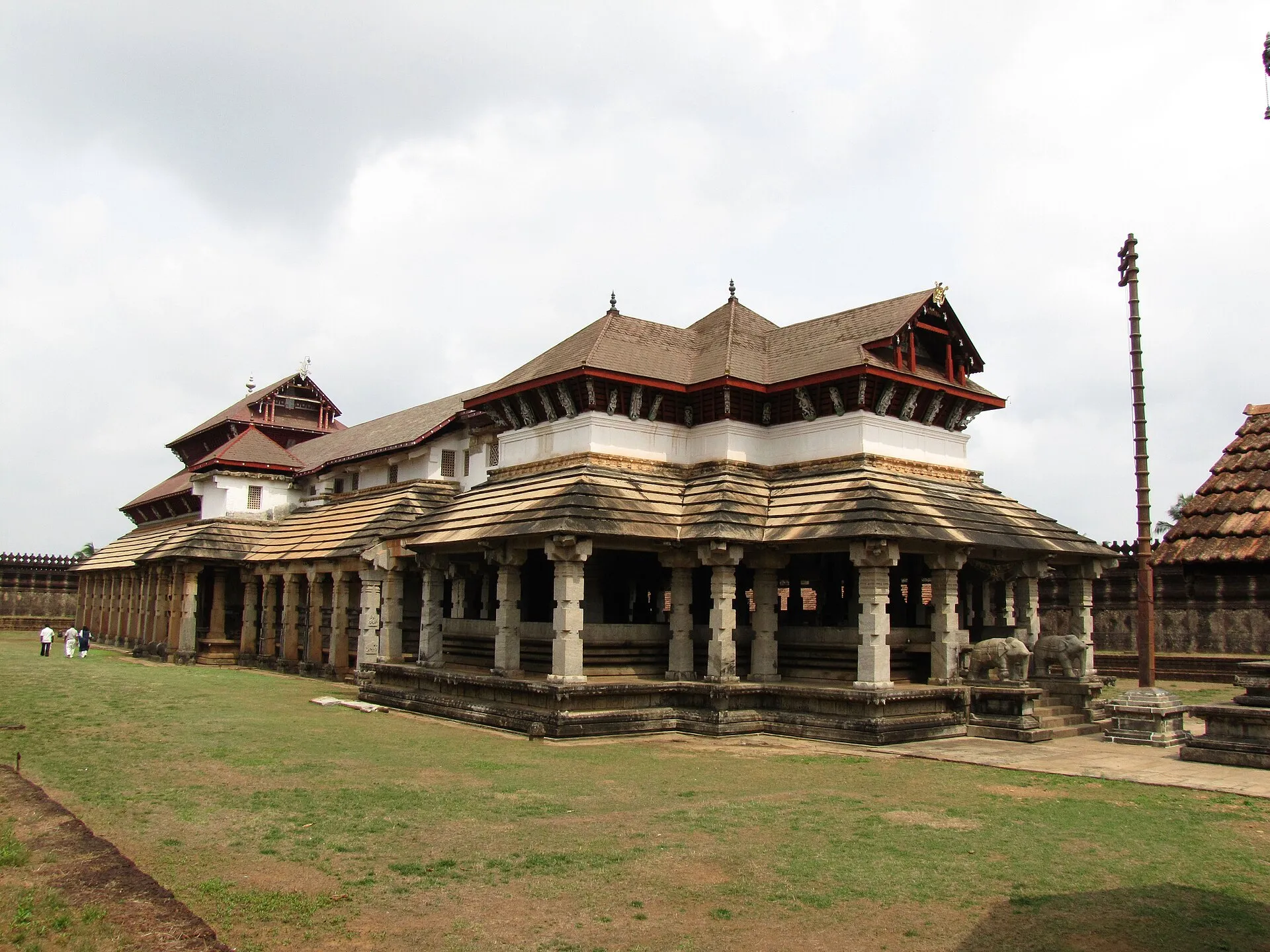
Between the 14th and 16th centuries Moodabidri grew into a centre of Jain faith, art and building, and its eighteen basadis, as Jain temples are called in Karnataka, were built in that time.² People like to say the town runs on eighteens: eighteen basadis, eighteen lakes and eighteen roads leading out to the villages around.² ⁴ The basadis include the Guru Basadi, the Thousand Pillar Basadi, the Leppada Basadi with its stucco images, and fifteen more with names such as the Koti, Vikrama Shetti and Deramma Shetti basadis.⁴
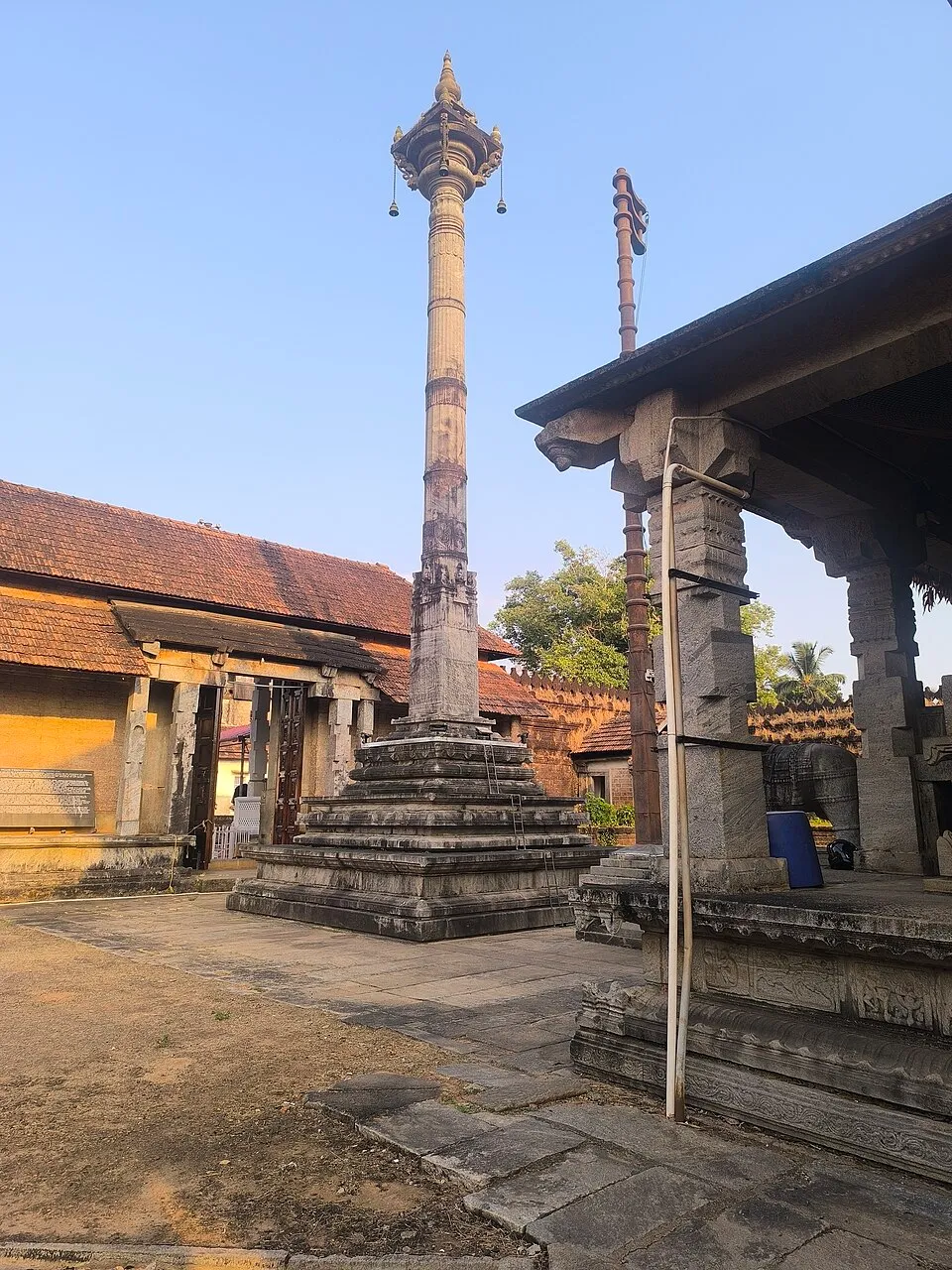
Each basadi is a home for one or more tirthankaras, the 24 great teachers of Jainism who are worshipped in its temples. In front of many stands a tall stone pillar, the manastambha, which in Moodabidri usually carries a small figure of the guardian Brahmadeva at the top.¹⁰
The cow and the tiger
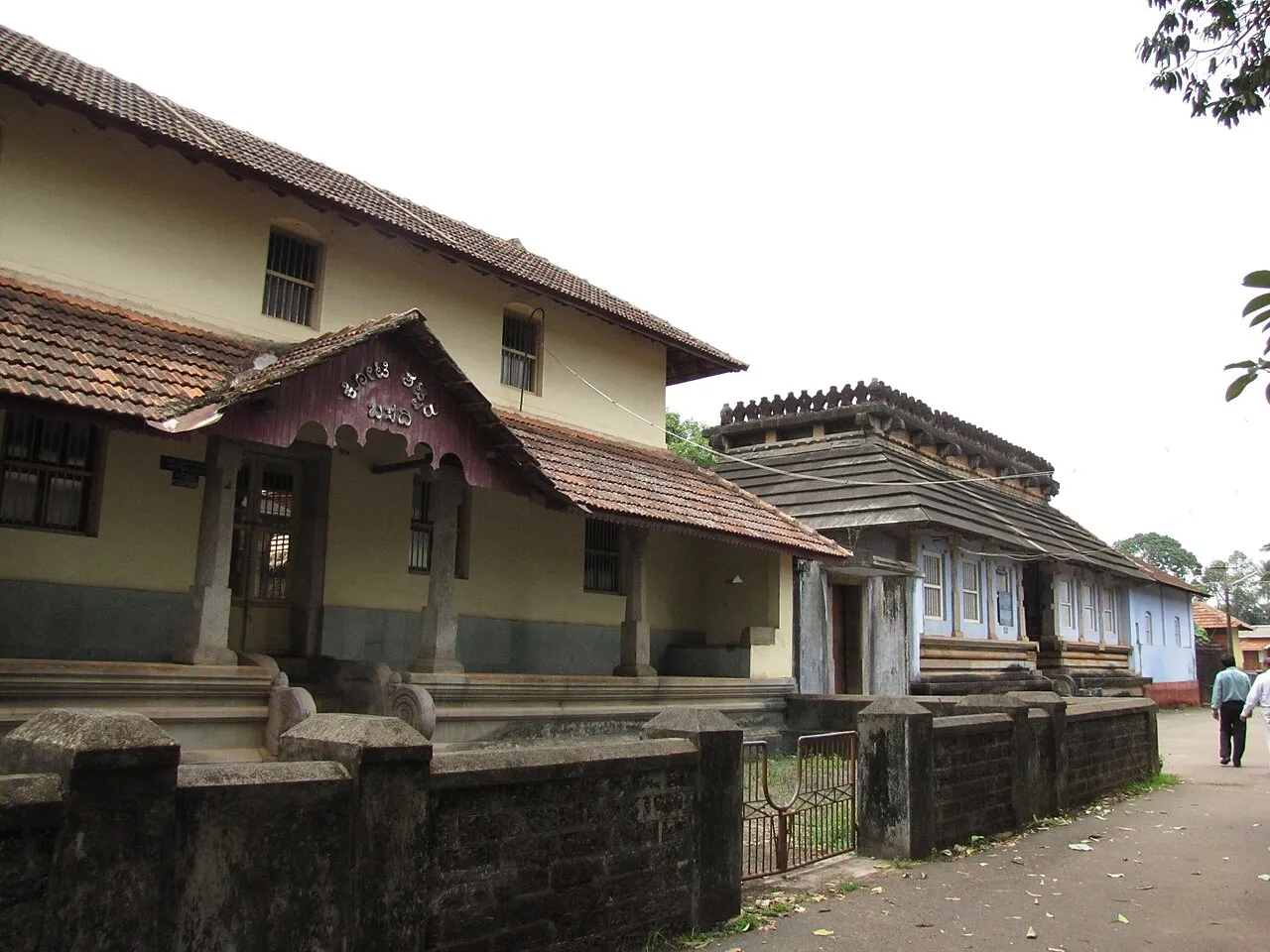

The oldest of the eighteen is the Guru Basadi, which tradition dates to 714 CE.³ ⁴ Its founding story is a gentle one. A Jain monk walking through the thick forest here saw a cow and a tiger drinking from the same pool, the tiger nursing the calf and the cow nursing the tiger’s cubs. Taking it as a sign, he had the ground dug up, and an image of Parshvanatha, the 23rd tirthankara, was found there. A temple was built on the spot.³
The black stone Parshvanatha in its sanctum stands about 3.5 metres tall.³ ⁴ Inside the Guru Basadi is a smaller shrine, the Siddhanta Basadi, which keeps images of the 24 tirthankaras made of precious stones.³ The Guru Basadi is also where each new Bhattaraka is installed.³ It is known as the Hale Basadi, “the old basadi”, and by the name of the books it kept for so long.³
The crest jewel of the three worlds

The most famous of Moodabidri’s temples is the Saavira Kambada Basadi, the “thousand-pillar basadi”. Its formal name is Tribhuvana Tilaka Chudamani, “the crest jewel of the three worlds”, and because its main image is of Chandraprabha, the 8th tirthankara, it is also called the Chandranatha Basadi.¹
It was built by a local chieftain, Devaraya Wodeyar, who began it in 1430. It is said to have taken 31 years to complete.¹ ⁴ It went up in stages. First came the sanctum, with an image of Chandranatha about 2.5 metres tall made of panchaloha, an alloy of five metals. Then came the great pillared hall. Last of all, a queen of Karkala, Nagala Devi, set up the stone manastambha in front, about fifteen metres (fifty feet) tall.¹ ² ⁴
The temple has seven halls, and its pillars are carved so richly that no two are said to be alike.¹ Among the carvings are a giraffe and a dragon, which have been linked to trade with China in the 15th century.¹ The sloping roofs of the upper storeys are of wood covered in copper, which are often compared to the temples of Nepal.¹ Near the temple are the tombs of Jain monks.¹ It is still the town’s great temple, and in 2025 a three-metre mechanical elephant named Airavata was set up there.¹
The books that were kept hidden
The Guru Basadi’s greatest treasure is not a statue but a set of books. The Dhavala, Jayadhavala and Mahadhavala are long commentaries on the oldest scriptures of the Digambara Jains, written in the 8th century. Together they are called the Siddhanta. The palm-leaf manuscripts at Moodabidri, Prakrit texts written in old Kannada script, were for centuries the only copy anyone had.⁴ ⁷
The manuscripts are said to have been kept first at Shravanabelagola and moved to Moodabidri for safety, during the Mughal invasions according to the usual story.¹ ³ ⁴ ⁷ At Moodabidri they were treated with such reverence that they became objects of worship, and ordinary people were not allowed to study them.⁷ Between 1896 and 1920 they were secretly copied into modern scripts, without the knowledge of the temple trustees, and in the 20th century a group of scholars led by Hiralal Jain began to edit and publish them, against strong opposition from monks and lay people who felt that printing would make the scriptures impure.⁷
One monk for all the basadis
The basadis of Moodabidri are looked after together by a Jain math, headed by a monk called the Bhattaraka.¹ ² A Bhattaraka is the head of a Digambara Jain institution. He trains scholars, keeps its libraries, manages its lands and gifts, and presides when new images are consecrated.⁵ Unlike the wandering Digambara monks, he wears an orange robe and stays in one place.⁵
The Bhattarakas of Moodabidri belong to the Desiya Gana and Pustaka order, the same order as the math at Shravanabelagola, and like the heads of that math they all take the name Charukeerti and the title Panditacharya.⁵ ¹¹ The present Bhattaraka took his seat on 29 August 1999.⁵ ⁶ At Moodabidri there are memorials to earlier Bhattarakas, small pyramid-shaped stupas called nishadhikas.¹¹
This makes Moodabidri very different from the other great temples of the coast. At Dharmasthala one Jain family passes the temple down from generation to generation. At Udupi eight monasteries take turns. At Moodabidri a single monk, not a family, heads a whole town of temples.
Kings in a Jain town

Moodabidri was an important place long before its great temples were built. The last known inscription of the Alupas, the dynasty that ruled Tulunadu for more than a thousand years, is dated 1444 and was found in a Jain basadi at Moodabidri. It names King Kulasekharadeva Alupendradeva.⁹
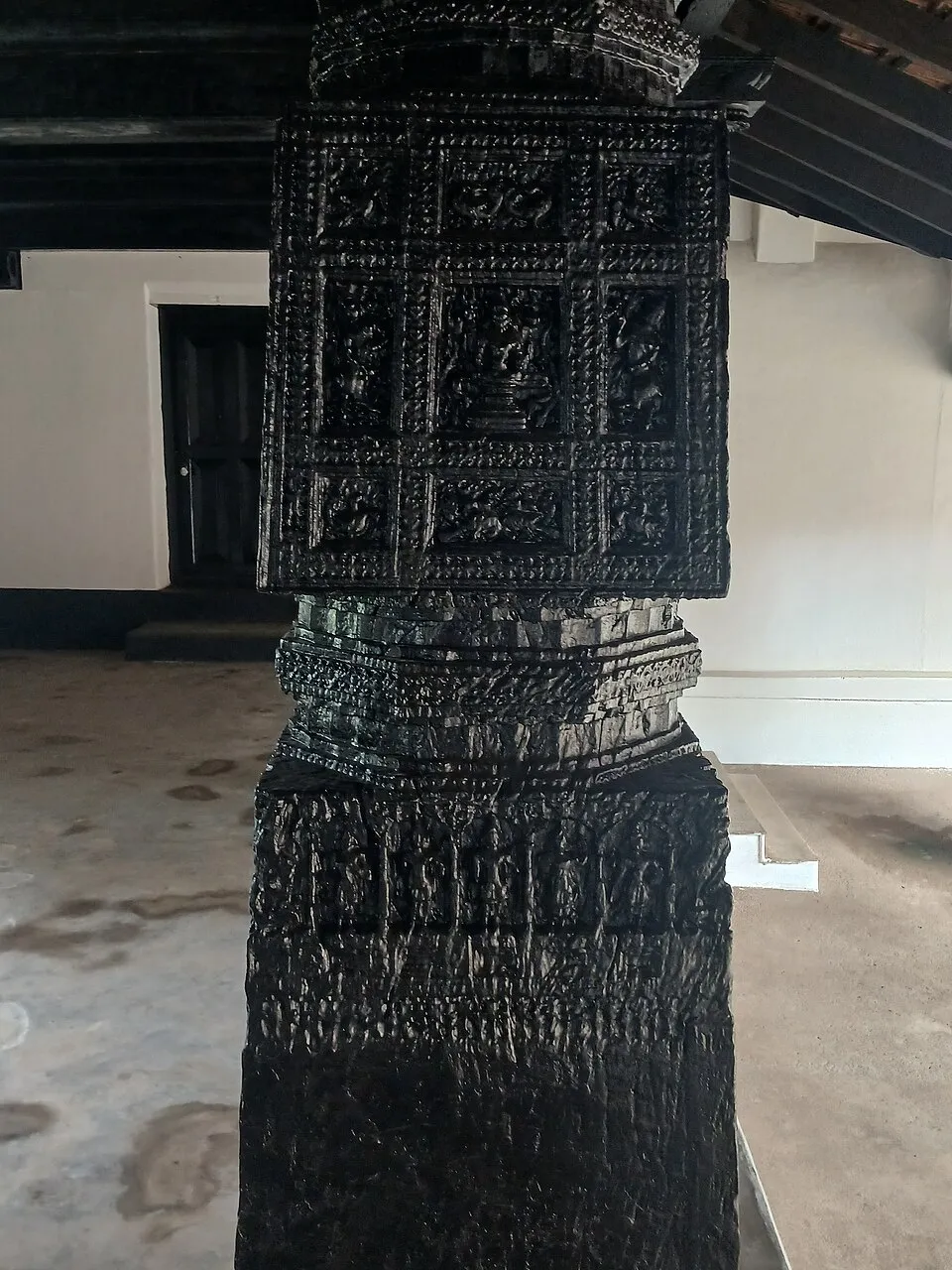
In about 1603 the Chowtas, a Jain ruling family who had ruled from Puttige nearby and from Ullal, moved their capital to Moodabidri.² ⁸ They lost most of their lands to Hyder Ali and Tipu Sultan, and under the British they kept only a small pension, but they went on holding coronations as a ceremony. The last was held at Moodabidri in 1865.² ⁸ Their descendants still live in the Chowta Palace, known for its carved wooden pillars and ceilings, and for a carving called the Nava Nari Kunjara, an elephant made up of nine women.² ⁸
The town was a home of writers too. Ratnakara Varni, the medieval poet who wrote the Kannada epic Bharatesha Vaibhava, came from Moodabidri.² ⁴
Related
- Dharmasthala: The House the Daivas Asked For, a Shiva temple looked after by a Jain family, with its own basadi and a great statue of Bahubali
- Udupi Sri Krishna Matha: Eight Monasteries, One Child God, where eight monasteries take turns to run one temple
- Kadri Manjunatha: The Hill of Many Faiths, another holy place shaped by monks
- Kalkuda and Kallurti, the Sculptor and His Sister, the legend of the sculptor of the Bahubali statues at Karkala and Venur
Sources & further reading
The books and articles behind the numbered notes on this page.
- Wikipedia, “Saavira Kambada Basadi”: the names Tribhuvana Tilaka Chudamani and Chandranatha, Devaraya Wodeyar and 1430, the 31 years, Nagala Devi’s manastambha, the seven halls, the pillars, the giraffe and dragon carvings and trade with China, the copper roofs, the monks’ tombs, the Dhavala texts and the move from Shravanabelagola, the matha and the Bhattaraka, and Airavata (2025).
- Wikipedia, “Moodabidri”: the name, the Jain Kashi of the South, the eighteen basadis, lakes and roads, the 14th to 16th centuries, the Bhattaraka of the Mula Sangha, the 15-metre manastambha, the Chowtas’ move in 1603, the coronation of 1865, the Chowta Palace and Ratnakara Varni.
- Wikipedia, “Guru Basadi”: the date 714 CE, the legend of the cow and the tiger, the Parshvanatha image, the Siddhanta Basadi and its jewelled images, the Dhavala texts, the names Hale Basadi and Siddhanta Basadi, and the installation of the Bhattarakas.
- Hazel Colaco, “The myriad moods of Moodabidri”, Deccan Herald (2015), reprinted by Jain Heritage Centres: the name, the eighteens and the list of the eighteen basadis, Guru Basadi, the Dhavala, Jayadhavala and Mahadhavala, the three building phases of the Thousand Pillar Basadi and Nagala Devi of Karkala, the Leppada Basadi and Ratnakara Varni.
- Wikipedia, “Bhattaraka”: what a Bhattaraka does, the orange robe, the seats at Shravanabelagola and Moodabidri of the Desiya Gana and Pustaka order, the name Charukeerti, and the present Bhattaraka taking his seat on 29 August 1999.
- Jain Math Moodbidri, blog: the 24th anniversary of the Bhattaraka’s installation, celebrated on 29 August 2023.
- Wikipedia, “Shatkhandagama”: the Dhavala, Jayadhavala and Mahadhavala, their move from Shravanabelagola, the manuscripts kept from scholars, the secret copies of 1896 to 1920, and Hiralal Jain’s edition.
- Wikipedia, “Chowta dynasty”: Puttige and Ullal, the move to Moodabidri around 1603, Hyder Ali and Tipu Sultan, the British pension, and the Chowta Palace with the Nava Nari Kunjara.
- Wikipedia, “Alupa dynasty”: the last Alupa king, Kulasekharadeva Alupendradeva, and his inscription of 1444 in a Moodabidri basadi.
- Wikipedia, “Manastambha”: the manastambhas of Moodabidri with Brahmadeva at the top.
- Jain Puja, “Digambar Jain Atishaya Kshetra Moodabidri”: the math and its Bhattaraka, the name Charukeerti and the title Panditacharya shared with Shravanabelagola, and the nishadhika memorials.
Words on this page
What the Tulu and other Indian-language terms on this page mean.
- basadi
- A Jain temple.
- Bhattaraka
- The monk who heads a Digambara Jain math.
- manastambha
- A tall stone pillar in front of a Jain temple.
- tirthankara
- One of the 24 great teachers of Jainism.
Themes
Spotted a mistake, or know more about this? Suggest a correction/addition.