Faith & Worship · Temples, Mathas & Basadis · Also in: Stories: Temples and Sacred Places
Udupi Sri Krishna Matha: Eight Monasteries, One Child God
Walk round to the back of the Krishna temple at Udupi and you will find people standing at a small window in an old wall, trying to catch a glimpse of the god inside. In most temples you would see the god from the front door. At Udupi, the story goes, the god turned his back on the front door to face a man who was not allowed in.
Udupi is a temple of stories like that one. Its image of the child Krishna is said to have crossed the sea from Dwaraka hidden in a lump of clay. Its founder, Madhvacharya, started one of India’s great schools of philosophy here. And for eight hundred years it has been looked after not by one owner, but by eight monasteries taking turns.
The child Rukmini wanted to see

The story begins in Dwaraka, Krishna’s city by the western sea. His mother Devaki had spent his childhood in prison and never saw him grow up. Now she wished she could see him as a child. So Krishna took a child’s form again for a while, playing and stealing butter as he once had. His queen, Rukmini, watched and fell in love with this little Krishna, Balakrishna.¹ ²
Rukmini asked the divine craftsman Vishwakarma to make an image of him. He carved the child holding a churning rod in one hand and its cord in the other, and Rukmini worshipped it every day.² ³ After Krishna left the world, Arjuna is said to have buried the image in Rukmini’s forest, and over the ages it was lost, wrapped in gopichandana, the pale sacred clay of Dwaraka.² ³
Ballast in a ship
Long afterwards, a sailor from Dwaraka took on a heavy lump of that clay as ballast for his ship, never guessing what was inside. As the ship came near Malpe, on the coast by Udupi, it was caught in a terrible storm.³ ⁴
Madhvacharya was meditating on the shore. Seeing the ship in trouble, he guided it to safety by waving his cloth, and the grateful captain told him to take anything he liked from the ship. He asked only for the lump of clay. When it broke open, there was the child Krishna. Madhvacharya carried the image to Udupi and installed it there.² ³ ⁴ The temple dates the founding to the 13th century.¹
Like most temple legends, this one has more than one version. In another telling the ship sank in the storm, and Madhvacharya later went down to Malpe and drew the image out of the wreck.³ ⁴
Madhvacharya and the eight mathas
Madhvacharya was born at Pajaka, near Udupi. His dates are given either as about 1199 to 1278 or as 1238 to 1317, and scholars have not settled which.⁵ He founded Dvaita, the school of “dualism”. Its central teaching is that the human soul and God, whom Madhvacharya worshipped as Vishnu or Krishna, are forever distinct: the soul always depends on God and is never the same as him. That set him against the older and more famous school of Advaita, which holds that the two are ultimately one.⁵
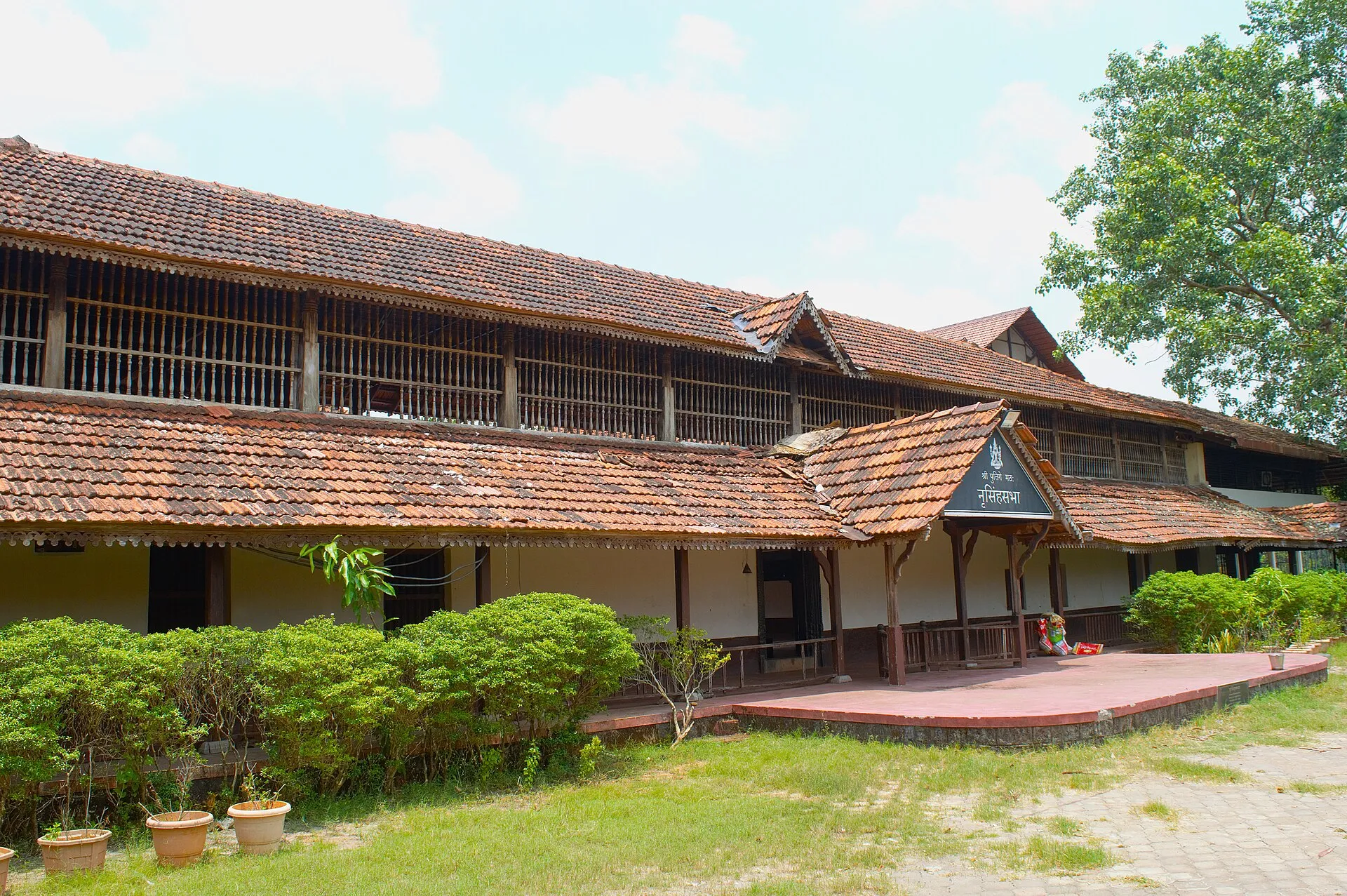

To look after the image, Madhvacharya set up eight mathas, or monasteries, each headed by one of his disciples. They are named after the villages where they first stood: Palimaru, Adamaru, Krishnapura, Puttige, Shiroor, Sode, Kaniyooru and Pejavara.⁶ Each has its own line of swamis and its own image of Vishnu, and the eight are paired off two by two.⁶ They are sometimes called the Tulu mathas, and their old palm-leaf records are written in the Tulu script.⁶ ⁷
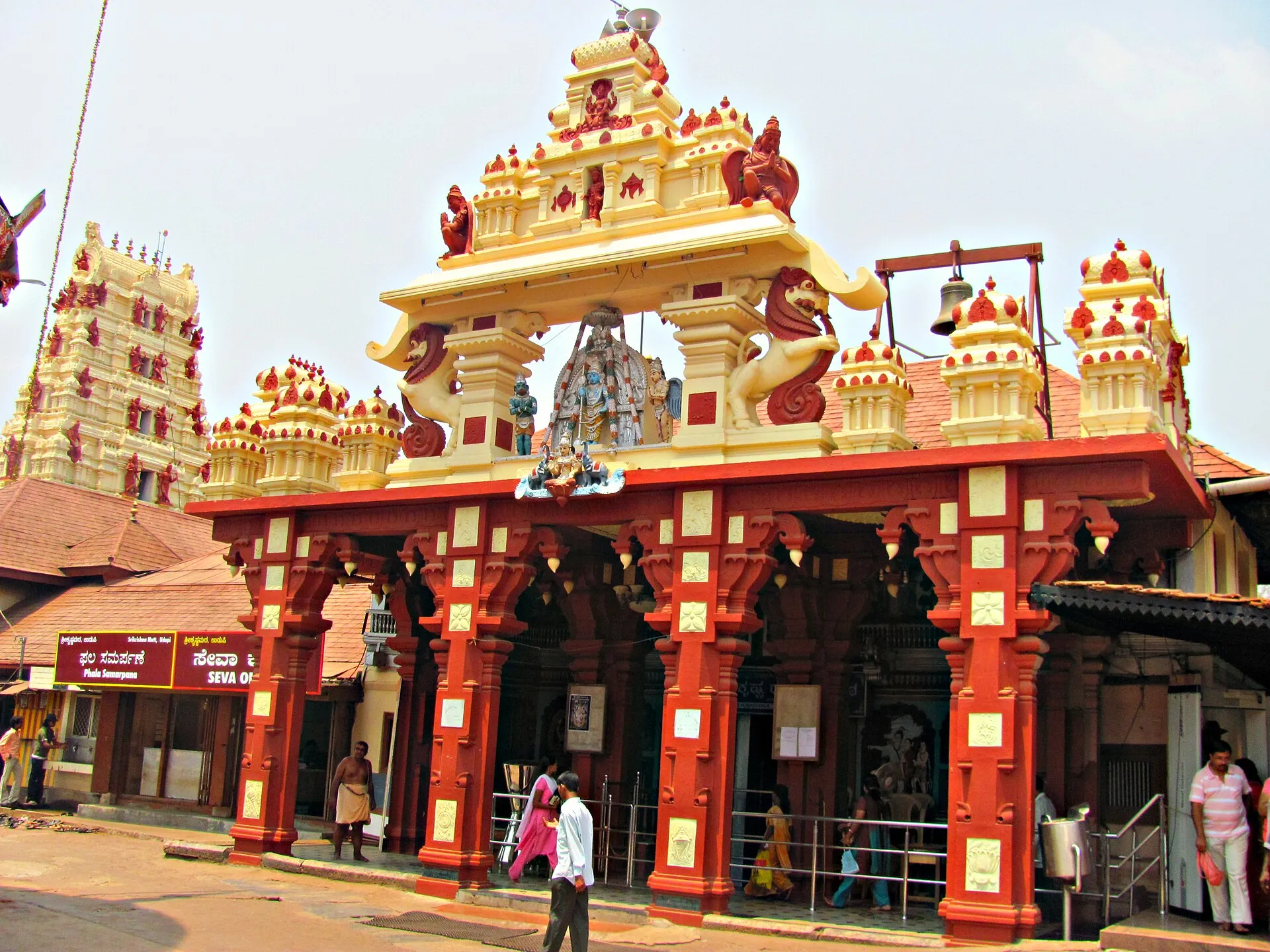
Today all eight mathas stand together around the temple on Udupi’s Car Street.⁶ ⁸ The temple’s daily rites are performed by the swamis themselves.¹
The Paryaya: taking turns
At first, the eight swamis lived together in the Krishna Matha and shared the worship among themselves. Later each took charge for two months in turn.⁷ ⁸
In the 16th century a swami of the Sode Matha, Vadiraja Tirtha, changed that. Each matha would now run the whole temple for two years at a time, which left the swamis free to travel between turns. The handover itself became a ceremony, the Paryaya. The first two-year Paryaya was held in 1522, when the swami of Palimaru took charge, and Vadiraja’s own first turn came in 1532.⁷ ⁸ The same Vadiraja is remembered at Dharmasthala, where he is said to have consecrated the linga and given the place its name.
The order of the turns never changes. It begins with Palimaru and ends with Pejavara.⁹ The handover takes place in the early hours of 18 January in every even-numbered year. The new swami bathes at Dandatirtha, south of the town, comes into Udupi by night carried in a palanquin in a procession with cultural shows, and is handed the keys of the shrine and the akshaya patra, the vessel for the god’s food, at the Sarvajna Peetha, the seat inside the matha.⁹ Since January 2026 the temple has been in the care of the Shiroor Matha. Sode is next, in 2028.⁹
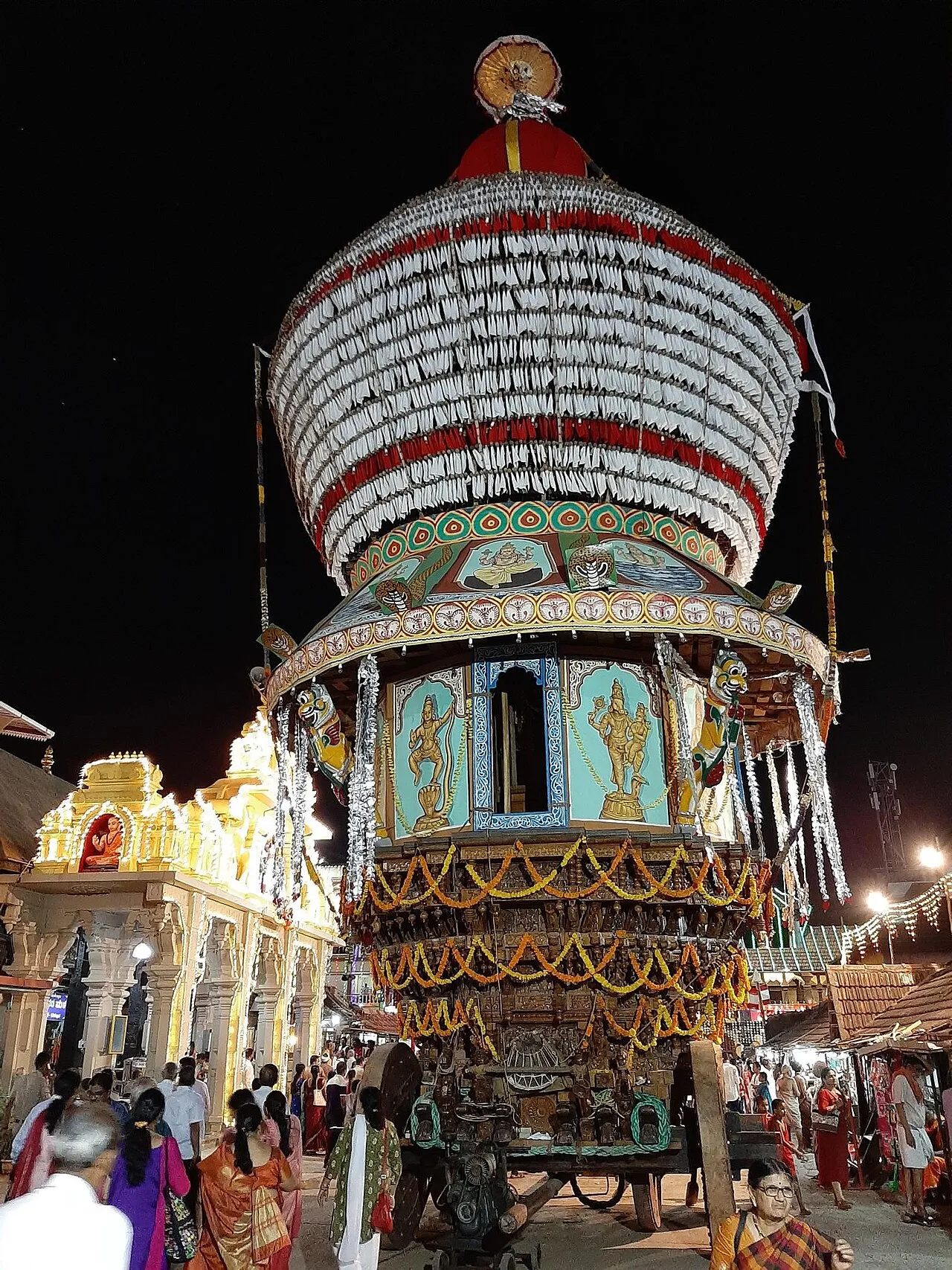

Preparations begin a year before. In a series of small ceremonies, the incoming matha plants plantains and tulasi for the worship and stores rice, firewood and paddy for the two years of cooking ahead. The firewood is stacked in the shape of a temple chariot.⁹ Today these rites are mostly symbolic. The temple and the mathas lost their lands under Karnataka’s Land Reforms Act of 1975, and the temple now runs on devotees’ gifts. A matha sometimes has to borrow to meet the costs of its turn.¹ ⁹
Kanaka’s window
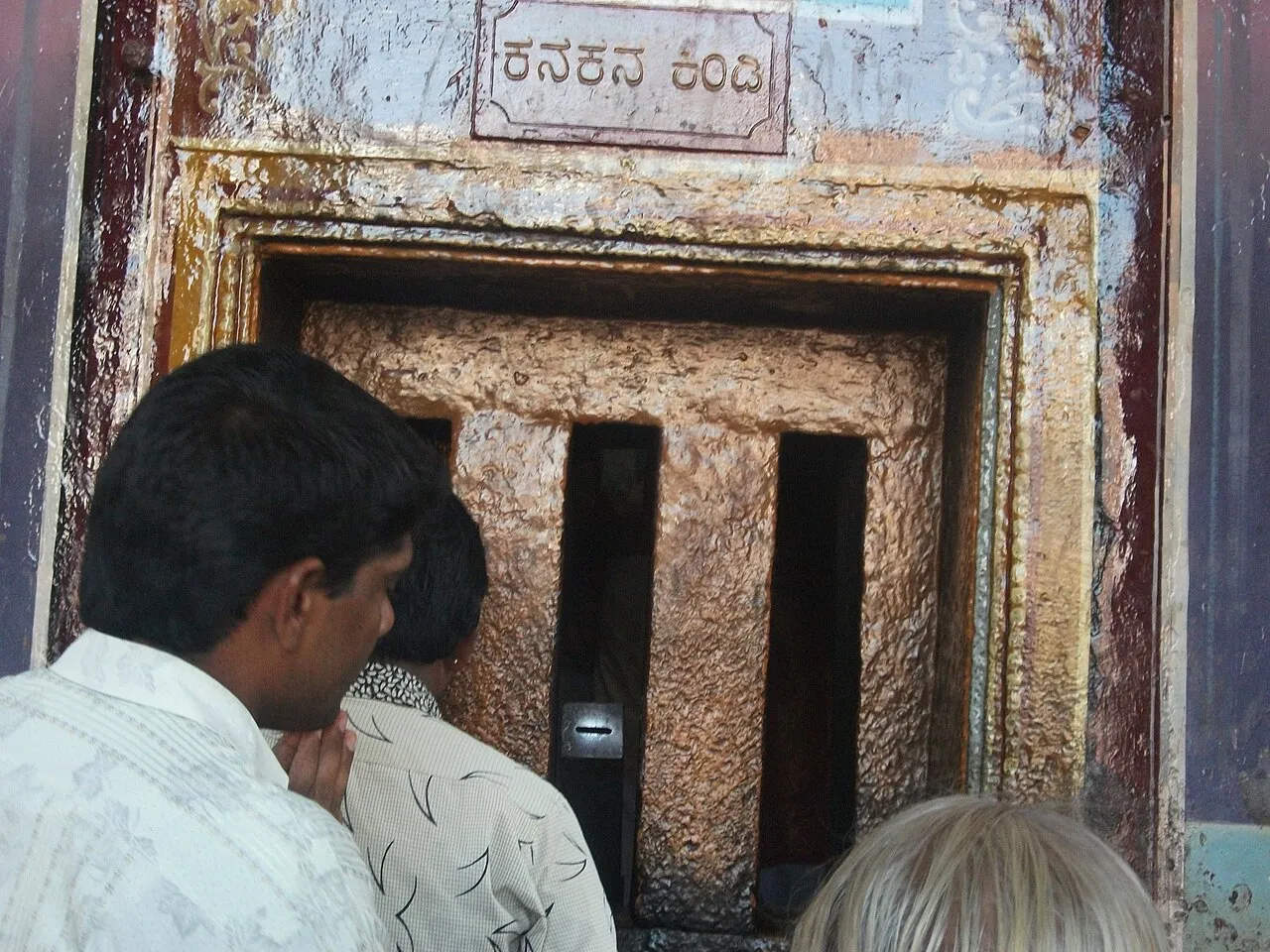

The most famous Udupi story belongs to the 16th century. Kanakadasa was born into a Kuruba (shepherd) family and was a warrior before he became a wandering singer of songs to Krishna.¹⁰ When he came to Udupi, he was not allowed into the temple because of his caste. He was given a hut behind it, and he sat by the back wall, singing to the god he could not see.¹ ¹⁰
One night, the story goes, the earth shook. A crack opened in the wall, and Kanakadasa could see the image inside. In the best-known version, Krishna himself turned round to face him.¹ ⁷ Vadiraja, who was in charge of the temple, did not seal the crack. He made it into a window, which became the Kanakana Kindi, “Kanaka’s window”.¹ ⁷ A statue of Kanakadasa stands nearby, and inside the temple the image is seen through a silver-covered screen with nine openings.¹ ⁷
Not everyone agrees on the details. Some read Madhvacharya’s own writing as saying the image first faced east and turned for Kanakadasa.¹ Others, looking at how the old shrine is built, argue it always faced west, and that the earthquake simply opened the one wall Kanakadasa could stand behind. One of Kanakadasa’s own songs does speak of the earth shaking at night as he prayed.⁷ When a German missionary, Hermann Mögling, wrote the story down in the 1860s, about two hundred years later, it was already told a little differently from today.¹
Either way, the story has become one of the best known in the region about caste and devotion: a god who turned away from the rules to face the man they kept outside.
The temple today
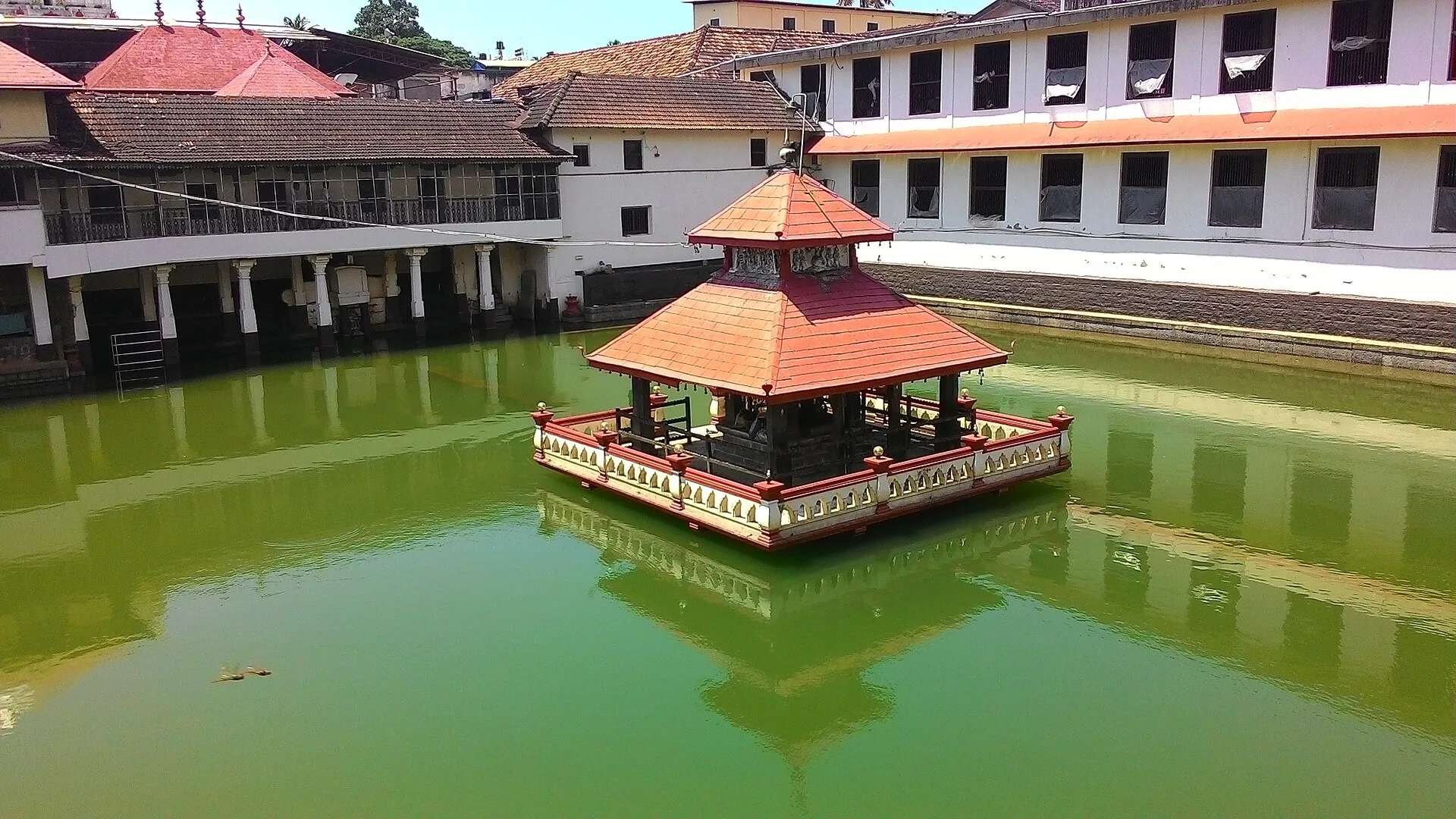

The temple opens before dawn, and the day runs through some eighteen rites, from the first worship at five in the morning to the god being put to rest at night.¹ At noon it serves a free meal to pilgrims, and its feeding of so many people every day has earned it the name Anna Brahma, roughly “food is God”.¹ Around the temple and the mathas are older shrines, among them the Anantheshwara temple, said to be more than a thousand years old.¹ Udupi is also the home of a famous school of devotional song in Kannada, the songs of the Haridasas, the “servants of Vishnu”, among whom Kanakadasa was one of the greatest.¹ ¹⁰
The temple keeps the great festivals of the year, from Makara Sankranti and Krishna Janmashtami to Navaratri and Deepavali. The biggest of all comes every second January, when a new matha takes its turn.¹
Related
- Dharmasthala: The House the Daivas Asked For, where the same Vadiraja Tirtha is said to have given the town its name
- Kadri Manjunatha: The Hill of Many Faiths, another temple whose past shows through its present
- Moodabidri: Eighteen Basadis and the Thousand Pillars, a Jain town where one monk heads eighteen basadis, a different way of keeping a holy place
- Kollur Mookambika, a temple now run by the state
Sources & further reading
The books and articles behind the numbered notes on this page.
- Wikipedia, “Udupi Sri Krishna Matha”: founding by Madhvacharya in the 13th century, the gopichandana, the Tantrasara Sangraha and the east-facing reading, the Navagraha Kindi and Kanakana Kindi, Kanakadasa and Vadiraja, Mögling’s record of the 1860s, the daily rites, Anna Brahma, the 1975 land reforms, the Anantheshwara temple, Dasa literature and the festivals.
- Thrilling Travel, “Udupi Krishna Temple Story”: Devaki and Rukmini, Vishwakarma’s image, Arjuna burying it in Rukmini’s forest, and Madhvacharya guiding the ship with his cloth and choosing the ballast.
- Bhagavatam Katha, “Udupi Krishna”: the image with churn and cord, Arjuna hiding it, the gopichandana, the sailor’s ballast, the storm off Malpe, and the version in which the ship sank.
- Travel Triangle, “Krishna Temple in Udupi”: the ballast and the storm off Malpe, and the version in which Madhvacharya drew the image from the wreck.
- Wikipedia, “Madhvacharya”: his birth at Pajaka, the two sets of dates, and the teachings of Dvaita against Advaita.
- Wikipedia, “Ashta Mathas of Udupi”: the eight mathas, their first swamis and images, their names from villages, the pairs, the Tulu name and palm-leaf records, and the mathas around the temple.
- Neria Harish Hebbar, “The Eight Tulu Monasteries of Udupi”, Boloji (archived copy, 2006): palm-leaf records in Kannada and Tulu scripts, Vadiraja’s change from two-month turns to the two-year Paryaya, the first Paryaya in 1522 and Vadiraja’s first in 1532, Kanakadasa, the earthquake and Kanakadasa’s own song about it, the argument that the image always faced west, and Vadiraja building the window.
- “Around the Car Street” (archived copy, 2007): the eight swamis first sharing the worship, then two-month turns, Vadiraja’s two-year term, and the eight mathas built around the Car Street, quoting Vadiraja’s biography.
- Wikipedia, “Paryaya”: the handover on 18 January of even years, Dandatirtha, the night procession, the akshaya patra and keys at the Sarvajna Peetha, the year of preparations, the land reforms and borrowing, the fixed order, and the turns of Shiroor (2026) and Sode (2028).
- Wikipedia, “Kanaka Dasa”: his Kuruba family, his life as a warrior, his time in Udupi, and the story of the wall and the turning image.
Words on this page
What the Tulu and other Indian-language terms on this page mean.
- Dvaita
- Madhvacharya's school of philosophy, which holds that the soul and God are forever distinct.
- gopichandana
- The pale sacred clay of Dwaraka.
- matha
- A Hindu monastery, headed by a swami.
- Paryaya
- The handover of the Udupi Krishna temple from one matha to the next, every two years.
Themes
Spotted a mistake, or know more about this? Suggest a correction/addition.