Faith & Worship · Temples, Mathas & Basadis · Also in: Stories: Temples and Sacred Places
Mangaladevi and Sharavu: Two Temples, One King
Two temples stand a few kilometres apart in Mangaluru, and neither of them began as the temple it is now. One began with a goddess buried under a mound where two rivers meet. The other began with a king’s arrow flying the wrong way.
Their legends are told here together because the same king appears in both.
Mangaladevi: the goddess the city is named for
The Mangaladevi temple stands at Bolar, about three kilometres south-west of the city centre, and is dedicated to Shakti in the form of Mangaladevi. Mangaluru is said to be named after the goddess.¹
The demon and the buried shrine
According to the legend, Vikhasini, daughter of the demon king Hiranyakashipu, wanted revenge on Vishnu for her father’s death. She won a boon from Brahma, disguised herself as the goddess Parvati, and bore a son, Andasura, who went looking for Vishnu. The goddess killed Andasura, and said that Parashurama would build a shrine at the place, with a linga (the stone symbol of Shiva) and a dharapatra, a vessel from which water drips on it.²
Over time the shrine was buried. Veerabahu, the king of Tulunadu, had no child and made Bangaraja his heir. The goddess came to Bangaraja in a dream and told him of the shrine under a mound where the Netravati and Phalguni rivers meet. With the sage Bharadhwaja he found it again.²
The Nath yogis and King Kundavarma
In the 9th century, in the days of the Alupa king Kundavarman, two Nath yogis, Matsyendranath and Gorakhnath, came from Nepal and reached Mangaluru by crossing the Netravati. The place where they crossed became known as Gorakdandi. They told the king that his kingdom needed a temple for Mangaladevi, and showed him where to dig for the linga and dharapatra. He installed them in a grand shrine, with a Nagaraja to protect it.¹ ²
The Nath yogis are also the thread that ties the temple to Kadri. See Kadri Manjunatha: The Hill of Many Faiths.
The princess who became the goddess
Another legend tells of Premaladevi, or Parimala, a princess of Malabar who gave up her kingdom to follow Matsyendranath. He took her into the Nath order and named her Mangaladevi. She came with him to the coast, fell ill near Bolar and died there. The city, in this account, takes its name from the temple raised in her memory.¹ ²
The two legends are not reconciled. One is a story of the goddess, and the other is the story of a woman.
Sharavu: the arrow and the cow
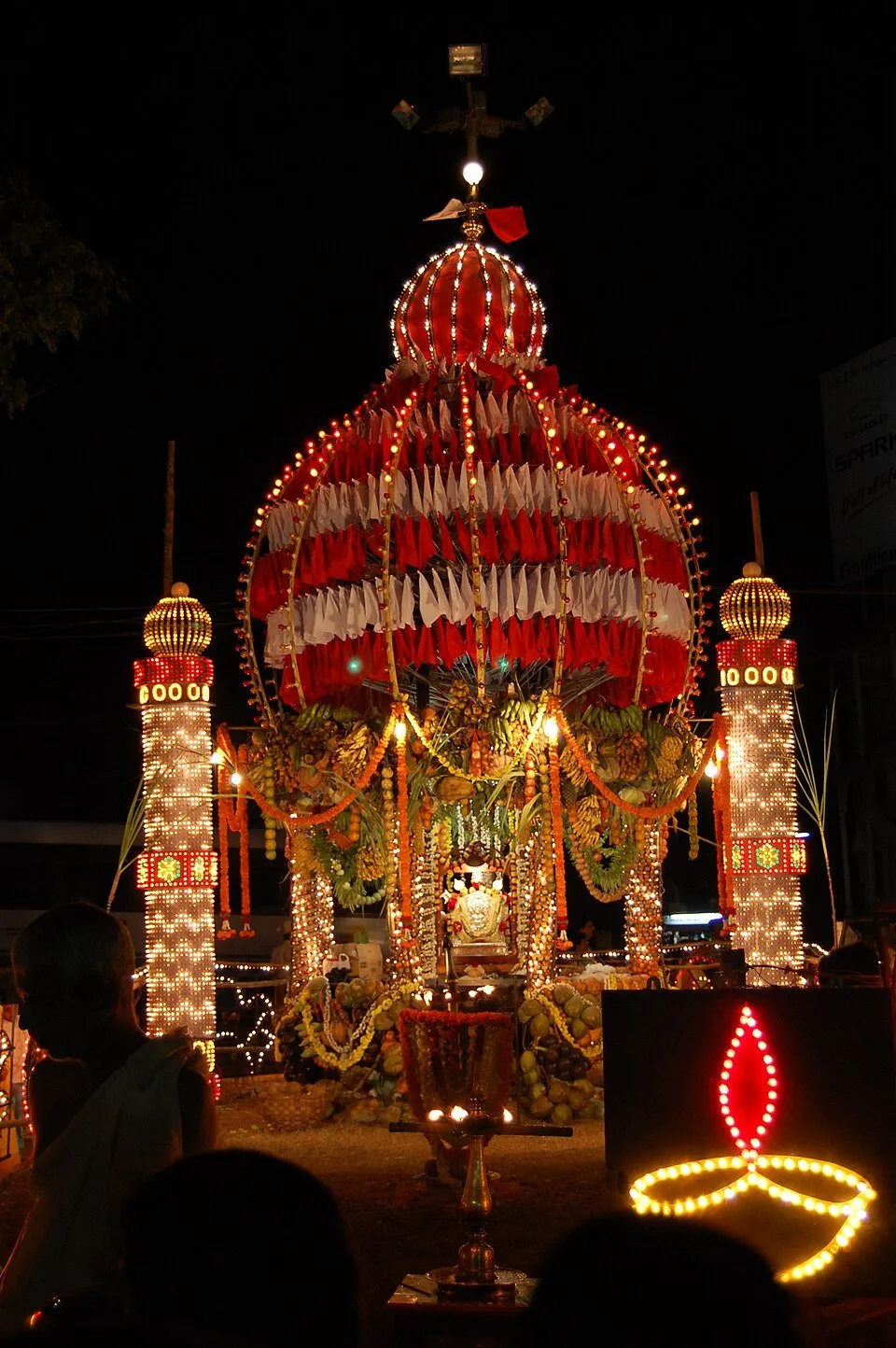

Sharavu Mahaganapathi temple has its own website, which says the name comes from shara, “arrow”.³ The temple stands in the city’s Hampankatta area and is a shrine of Shiva and Ganesha.⁴
About eight centuries ago, the temple’s website says, a powerful king of the Tuluva region, Maharaja Veerabahu, shot a cow by mistake. He had meant to shoot the tiger standing next to it. To erase the sin, he set up a Shiva linga on the advice of the seer Bharadhwaja, and worshipped it as Sharabeshwara. The place was called Sharavu, and the temple’s new tank Sharatheertha.³
A guide site adds that a few years later the images of Siddhilakshmi and Dashabhuja Maha Ganapati, the ten-armed Ganapati, appeared on the temple’s southern wall, and from then Maha Ganapati has been worshipped here as well.⁴ The same site tells a story that Tipu Sultan meant to destroy the temple during a march through the city, but a dream of an elephant crushing him changed his mind, and he gave four gold coins to the temple every year.⁴ That is a tourist guide’s account.
One king in two legends
Veerabahu appears in both temples’ stories. At Sharavu he is the king who shot the cow, and at Mangaladevi he is the childless king who made Bangaraja his heir.¹ ² ³ That is all the sources say. Neither tells of any other link between the two temples.
The temples today
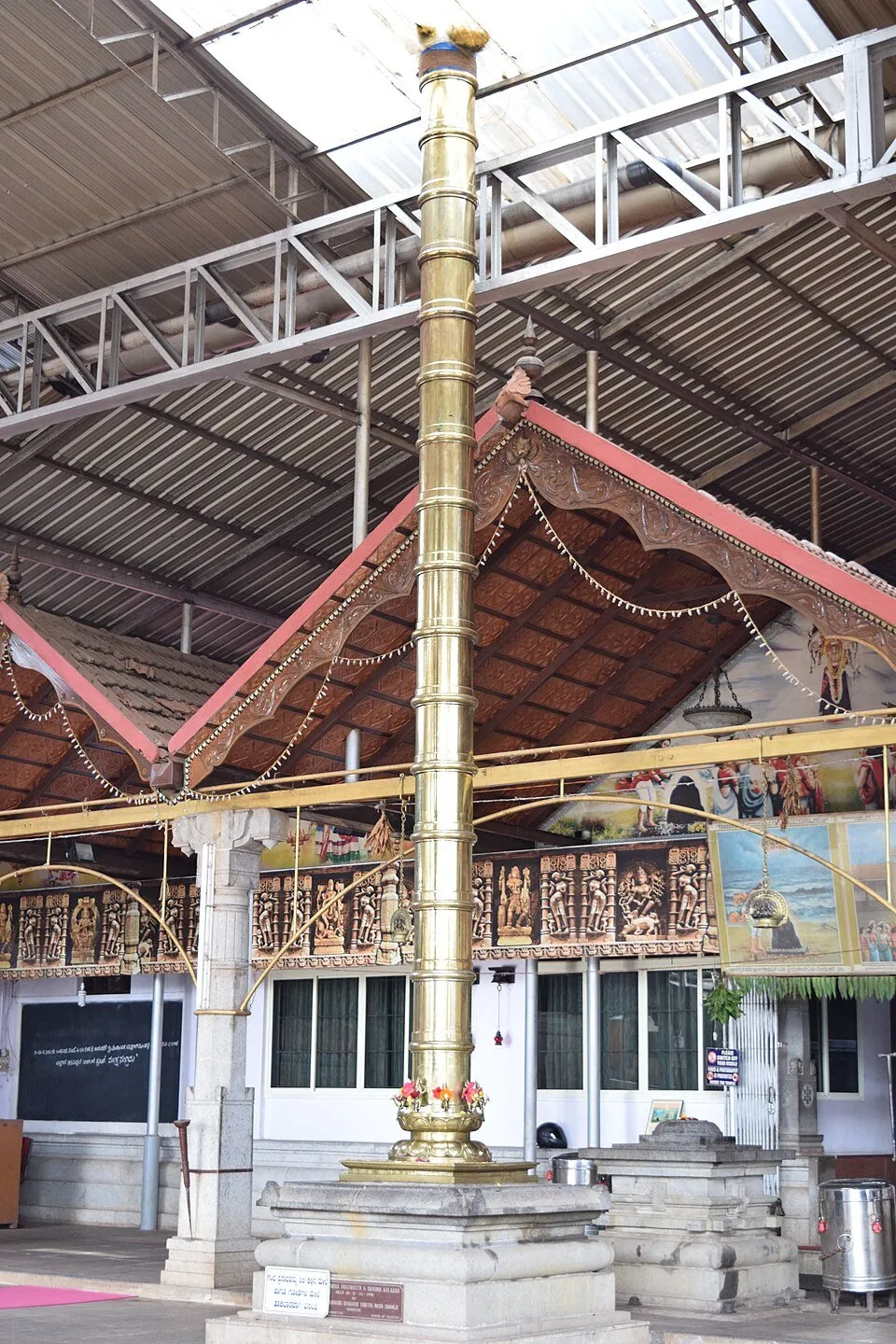

Mangaladevi is built in the Kerala style, with a two-storeyed gateway tower, a wall around all its shrines, a flagstaff and a circular central shrine. The goddess is shown seated, as a dharapatra, with a small linga on her left. A shrine of Nagar, the snake god, stands nearby.¹ In modern times it is looked after by hereditary trustees, according to Wikipedia.¹
Navaratri, called Dasara, is its great festival. On the seventh day the goddess is worshipped as Chandika, on the eighth as Maha Saraswati and on the ninth as Vagdevi, with weapons and tools honoured. On the tenth day the decorated goddess is drawn through the streets on a chariot to Marnamikatte, where she and the shami tree are worshipped.¹ At the start of the Kadri festival, the yogis of the Kadri math visit with prayers and silk cloth.¹
Sharavu draws thousands of devotees every day, and many more on Ganesh Chaturthi, the annual car festival that starts on Chandramana Yugadi, the festival of lights, and Sankashti Chaturthi. The temple is also a centre for Yakshagana, dance drama and social service. Its website lists a “Hereditary Archaka & Managing Trustee”.³
What we could not find
- Sharavu’s own history page. Our notes credit it with a different founding, in which a king named Bangaraja, given as 1208 to 1224 CE, finds the Ganapathy under a dream, and with a line of hereditary priests from a Keshava of Badaje. We could not open that page, so none of it is on this page.
- The trustees. No source we read names the families who look after either temple.
- An inscription. We found none that mentions Mangaladevi itself.
- A date for the name. One popular account puts a mention of “Mangalapura” in 715 CE. We could not confirm it.
- A joint trust. We found no sign that the two temples are run together.
Related
- Kadri Manjunatha: The Hill of Many Faiths, the hill whose yogis visit Mangaladevi each year
- Dharmasthala: The House the Daivas Asked For, where Annappa brought the linga from Kadri
- Parashurama and the Coast That Rose from the Sea, the sage said to have built the first shrine
Sources & further reading
The books and articles behind the numbered notes on this page.
- Wikipedia, “Mangaladevi Temple” (checked 9 October 2026): the temple, the name, Kundavarman and the Nath yogis, Premaladevi, Gorakdandi, the Kadri link, the architecture, the trustees and Navaratri.
- “Mangala Devi Temple, Mangalore: Legends”, Hindu Temples of India (blog, 2022; checked 9 October 2026): Vikhasini, Andasura, Parashurama’s shrine, Bangaraja’s dream, Bharadhwaja, Kundavarman and Premaladevi.
- Sharavu Mahaganapathi temple, home page (the temple’s own site; checked 9 October 2026): the name, Veerabahu and the cow, Sharabeshwara, Sharatheertha, the festivals and the hereditary archaka.
- Holidify, “Sharavu Mahaganapathi Temple” (travel guide; checked 9 October 2026): the age, the legend of the cow, the images on the south wall and the Tipu Sultan story.
Apart from Wikipedia, these are a blog, a temple’s own website and a travel guide. We found no scholarly source.
Words on this page
What the Tulu and other Indian-language terms on this page mean.
- linga
- The rounded stone form in which Shiva is worshipped.
- Nath
- An order of yogis who trace their line to Matsyendranath and Gorakhnath.
Themes
Spotted a mistake, or know more about this? Suggest a correction/addition.