The Land & Its Beginnings · How Tulunadu Began · Also in: Stories: Beginnings, Festivals and Folk Tales
Parashurama and the Coast That Rose from the Sea
Ask almost anyone on the coast how the land between the mountains and the sea came to be, and you will probably hear the same story. Long ago there was no coast at all, only the ocean washing against the foot of the Western Ghats. Then a sage with an axe stood on the mountain tops, and threw.
That sage was Parashurama, and the land he is said to have raised is still called Parashurama Srishti, “Parashurama’s creation”, or Parashurama Kshetra, “Parashurama’s land”.⁵ It is a story told in temples, in pilgrim guides and at grandparents’ knees. It is also a story that historians have begun to question, and this page tells both sides.
Who Parashurama was
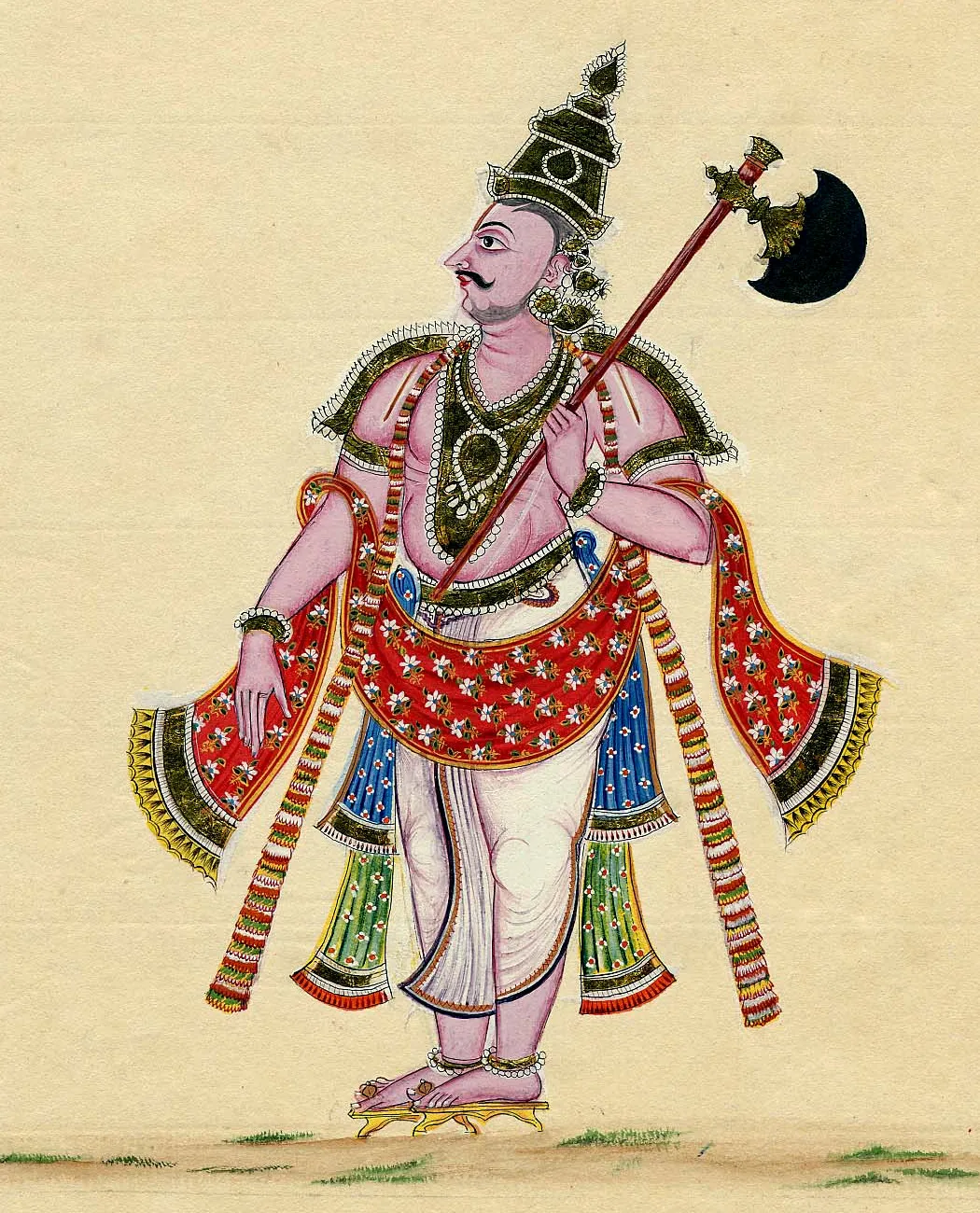

Parashurama’s name means “Rama with the axe”. In Hindu tradition he is the sixth avatar, or earthly form, of the god Vishnu, and one of the immortals who are said to live on until the end of this age.⁴ He was born to the sage Jamadagni and his wife Renuka.⁴
The stories about him are fierce. When Jamadagni, in a fit of anger at his wife, ordered his son to cut off her head, Parashurama obeyed at once. Pleased with his obedience, his father offered him a wish, and Parashurama asked for his mother to live again. Renuka was restored.⁵
Later a king killed Jamadagni, and Parashurama took his revenge on the whole warrior class, the Kshatriyas, killing kings wherever he found them.⁴ ⁵ When the fighting was over he gave away all the land he had won, to the sage Kashyapa. Having given it away, he felt it was no longer right for him to live on it.⁵ He needed land that belonged to no one.
The axe and the sea
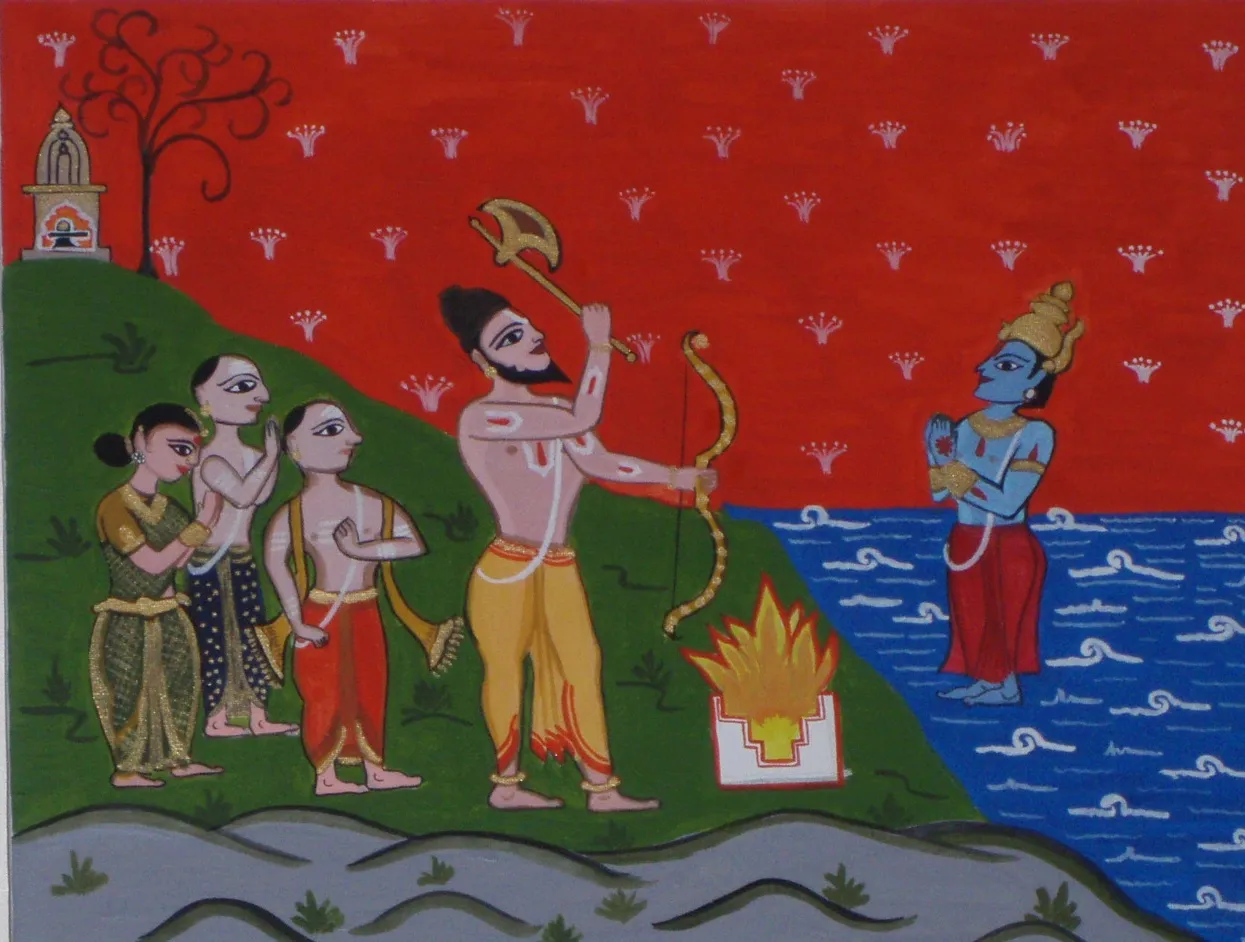

The common telling is simple. Parashurama climbed to the top of the Sahyadri, the Western Ghats, faced the ocean and threw his axe as far as he could. The god of the waters, Varuna, drew the sea back as far as the axe had flown, and a long strip of land rose up between the mountains and the waves.¹ ³ ⁷ In the Kerala tellings, that strip runs all the way from Gokarna in the north to Kanyakumari at the tip of India.³
Tulunadu has its own version, which ties the story to a temple in Mangaluru. Here Parashurama prays to Shiva, who tells him to go and meditate in the Kadalivana, the plantain grove at Kadri, where Shiva will appear to him. But when Parashurama reaches the place, it is under the sea. He asks the king of the ocean to give the land back. The ocean king refuses, and Parashurama, in a rage, throws his axe. Afraid of his anger, the ocean draws back as far as the axe fell, and that is how Tulunadu was made.⁵ The Kadri temple still tells the rest of that story.
Like all old stories, this one comes in more than one shape. Some tellings have Parashurama shoot an arrow instead of throwing an axe, and they do not agree on where he stood. One tradition even places him far to the north, on a hill fort in Maharashtra.⁴
Making the land liveable

The new land was not ready for people. It had come out of the sea, and its soil was full of salt. In one telling, Parashurama called on Vasuki, king of the serpents, whose sacred venom turned the salty ground green and fertile. In thanks, the serpents were made the guardians of the land.³ Some people see in this an explanation for the special place of the naga, the serpent deity, all along this coast (see Nagaradhane).
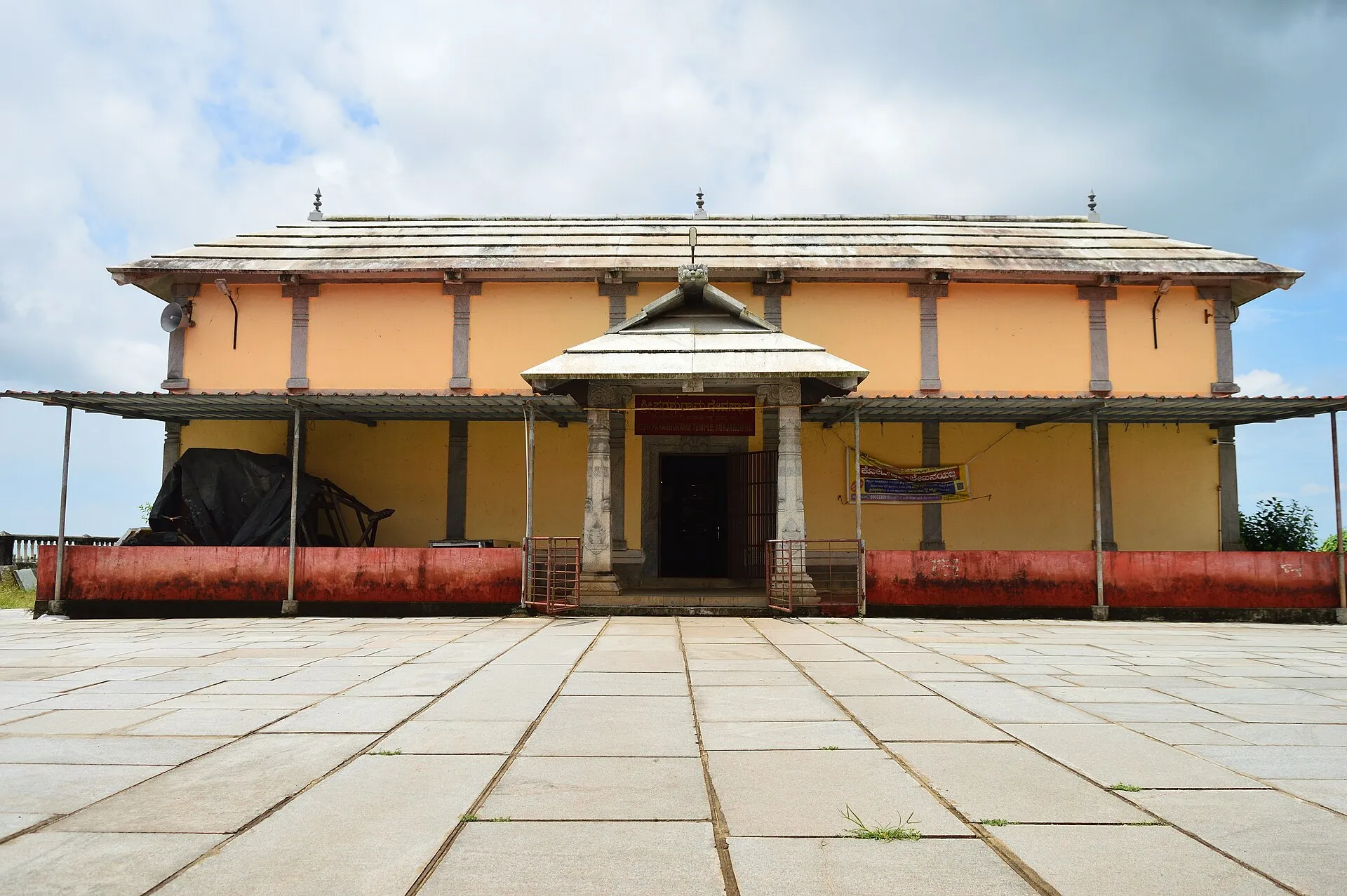
Then the land needed people. According to an old local chronicle, the Gramapaddhati, Parashurama gave the land he had raised to sixty-four families of Brahmins to settle. He also built a temple on Kunjaragiri hill in memory of his mother.¹ The Kerala chronicle called the Keralolpathi tells a longer version: Parashurama brought Brahmins “from the north” and set up sixty-four villages, thirty-two of them in Kerala. The first settlers were so afraid of the serpents that already lived in the land that they fled home, and he had to bring a second group.²
Seven shrines and many legends
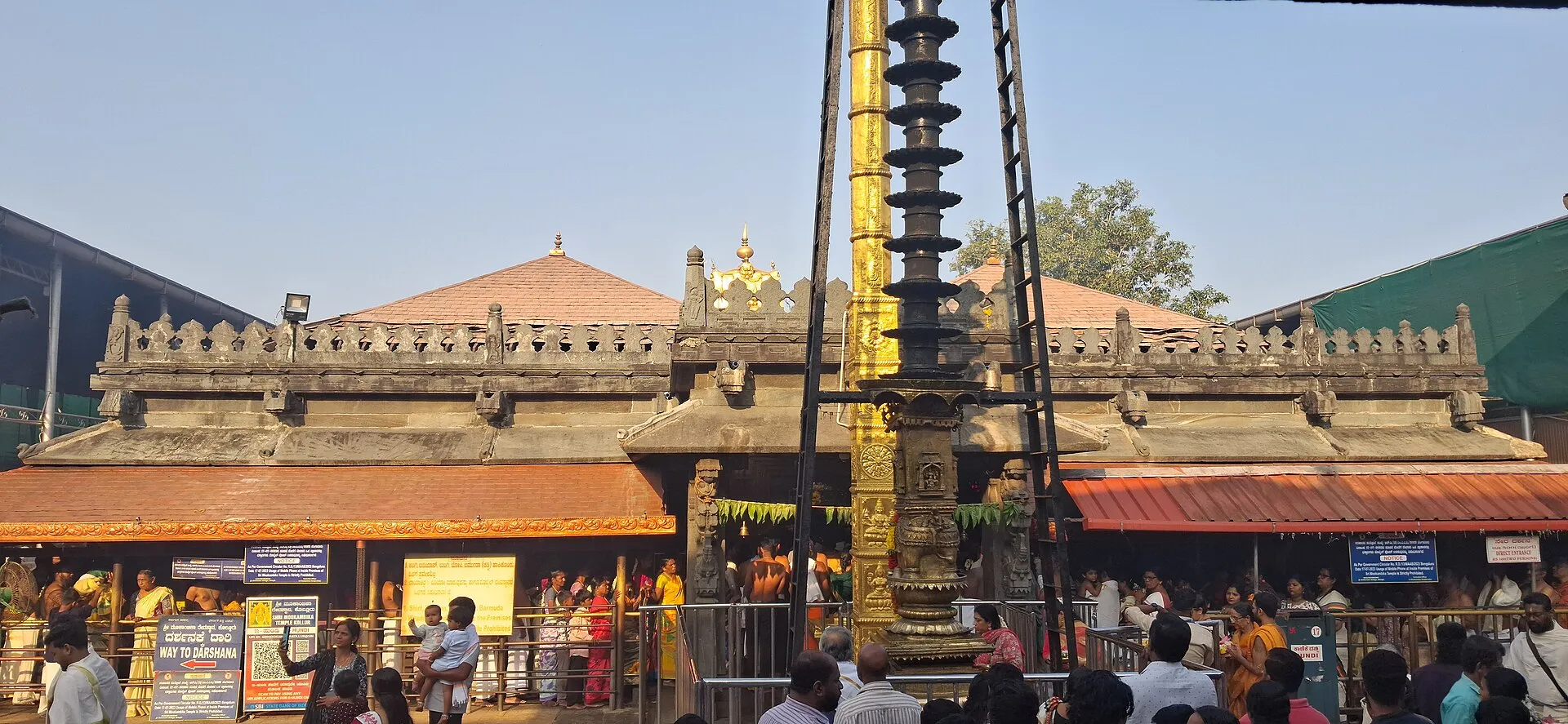

In coastal Karnataka, seven great temples are counted as standing on Parashurama’s land. They are known together as the Mukti Kshetras, or Sapta Mokshadayini Kshetras, the seven holy places that grant liberation:⁶ ⁷
- Udupi, home of the Krishna temple
- Kukke Subramanya, the temple of the serpent god
- Kollur, the temple of the goddess Mookambika
- Kumbhashi, also called Anegudde, where Parashurama is said to have set up images of Vishnu and Shiva side by side⁶
- Koteshwara, a Shiva temple
- Shankaranarayana, where Shiva and Vishnu are worshipped together
- Gokarna, the Shiva temple of Mahabaleshwara
Pilgrims sometimes visit all seven in one journey, and they are compared with the seven great holy cities of India.⁶ Each temple has its own sthala purana, its own story of how it began, and the part Parashurama plays changes from one to the next.⁶
Closer to Mangaluru, the legend turns up again and again. The Kadri temple begins its story with Parashurama. One tradition says he built the Mangaladevi temple, the shrine that gave Mangaluru its name, though another credits a 9th-century Alupa king, Kundavarman.⁸
Not the only beginning
The Parashurama story is not a Tulu story in origin. It is a pan-Indian Hindu legend, shared by the whole west coast from Gokarna to Kerala, and attached in each place to local hills and temples.³ ⁴
Tulunadu has older stories of its own. In the paddanas, the long oral ballads of Tulunadu, the land was made by Bermer, the first and greatest of the daivas, the spirit deities of Tulunadu. In those stories the land’s first lords are its spirits, not a sage from outside.
Even the story of the Brahmin settlement has a rival. Other local paddana traditions say it was Mayurasharma who invited Brahmins from a place called Ahichchhatra and organised the district.¹ Mayurasharma is a real historical figure: a Brahmin who founded the Kadamba kingdom of Banavasi in about 345 CE, whose story is told in a stone inscription at Talagunda.⁹ The Kadambas held power over the coast through their vassals, the Alupa kings.⁹ It is likely, though not proven, that the paddanas remember a real king from outside the region in the role the legend gives to Parashurama.
That there are two different stories of who brought the Brahmins to the coast is itself a clue that neither should be read as plain history.
How true is the story?
In 2024 the Kannada writer Dr Indira Hegde asked that question outright, in a Kannada article titled “How true is the story of Parashurama’s creation?“¹⁰ Her answer is: not very. She makes several points:¹⁰
- The land is far older than any legend. Geologists explain the west coast through the slow movement of the earth’s crust, not a single event. India’s south-west coast was once joined to Madagascar, and the two drifted apart around ninety million years ago.¹¹
- The story came from Kerala. Hegde traces the tale of the sixty-four Brahmin families to the Keralolpathi, and argues that it was a Kerala legend that was only later stretched north to cover Tulunadu.¹⁰ The Keralolpathi itself is hard to date; the versions that survive were written down somewhere between the 15th and 19th centuries.²
- No early Tulu evidence mentions it. She knows of no ancient inscription or text from the Tulu region that tells the story, and she cites the historian P. Gururaja Bhat, author of the best-known history of the region, as saying it has no real connection to Tulunadu’s history.¹⁰
- The people were already here. Hegde points out that the Bunt, Billava and Mogaveera communities, who by her count made up most of the old population, lived on this land long before any settlement the legend describes. She also argues that the story pushed aside older forms of worship, among them the worship of the naga.¹⁰
She ends by wondering why so many in Tulunadu still accept the story without question.¹⁰
None of this makes the legend worthless. It tells us a great deal about how the temples of the coast, and the Brahmin communities who served them, came to see the land and their place on it. It just tells us about the people who told the story, not about how the coast was made.
A word on sources: we have read the Hegde article from photographs of two of its three pages, and our summary is a paraphrase of dense Kannada prose. A Kannada reader may see more in it, and corrections are welcome.
Related
- Bermer: The First Lord of Tulunadu, the older Tulu story of who made the land
- Kadri Manjunatha: The Hill of Many Faiths, where Parashurama is said to have met Shiva in a plantain grove
- Nagaradhane: The Serpent in the Sacred Grove, and Vasuki, whose venom made the new land green
- Udupi Sri Krishna Matha: Eight Monasteries, One Child God, one of the seven temples said to stand on Parashurama’s land
- Mangaladevi and Sharavu: Two Temples, One King, the temple that gave Mangaluru its name, and its neighbour
- The Alupa kings, who ruled the coast under the Kadambas
Sources & further reading
The books and articles behind the numbered notes on this page.
- Wikipedia, “Dakshina Kannada”: the Gramapaddhati account (Parashurama on the Western Ghats, the axe, the sixty-four Brahmin families, the Kunjaragiri temple to his mother), and the paddana tradition of Mayurasharma inviting Brahmins from Ahichchhatra.
- Wikipedia, “Keralolpathi”: the axe, the Brahmins brought from the north, sixty-four villages with thirty-two in Kerala, the settlers who fled the serpents and the second group, and the surviving versions dated between the 15th and 19th centuries.
- Wikipedia, “Tulu Nadu”: the Keralolpathi telling for Kerala and Tulu Nadu, Varuna, the land from Gokarna to Kanyakumari, and Vasuki’s venom making the salty soil fertile.
- Wikipedia, “Parashurama”: the name, the sixth avatar of Vishnu and one of the immortals, Jamadagni and Renuka, the killing of the king and the war on the Kshatriyas, the west-coast legend, the arrow and the Salher fort tradition.
- Nagaraj B. Padithaya, “The story of Parashurama Srishti”, Tulunadu Traditions (blog, 9 January 2018): Renuka’s beheading and return, the gift of the land to Kashyapa, Shiva sending Parashurama to the Kadalivana at Kadri, the ocean king’s refusal and the axe.
- Hindu Blog, “Parashurama Kshetra in Karnataka: 7 Temples Founded by Parashuram” (2019, updated): the seven temples and their deities, the Hari and Hara images at Kumbhashi, the comparison with the seven holy cities, and the pilgrimage to all seven.
- Tirtha Yatra, “Sri Shankaranarayana Temple, Kundapura”: Varuna drawing back the sea as far as the axe fell, and the seven Sapta Mokshadayini Kshetras.
- Wikipedia, “Mangaladevi Temple”: the founding credited to the Alupa king Kundavarman in the 9th century, and the other legend crediting Parashurama.
- Wikipedia, “Mayurasharma” and “Kadamba dynasty”: Mayurasharma as founder of the Kadamba kingdom of Banavasi (reigned about 345–365 CE), the Talagunda inscription, and the Alupas as Kadamba vassals.
- Indira Hegde, “Parashurama srishtiya kathe eshtu nija?” (“How true is the story of Parashurama’s creation?”), Chalukya magazine, 17th year, annual special issue (2024), pp. 53 and 55 (Kannada; p. 54 was not available to us): the geological explanation, the sixty-four families traced to the Keralolpatti, P. Gururaja Bhat’s view, the lack of ancient Tulu evidence, the communities already present, and the pushing aside of Naga worship.
- Wikipedia, “Geology of India”: India’s south-west coast once joined to Madagascar, and their separation about 90 million years ago.
Words on this page
What the Tulu and other Indian-language terms on this page mean.
- daiva
- A guardian spirit; used interchangeably with bhuta.
- kshetra
- A holy place or pilgrim centre, usually a temple and the town around it.
- naga
- The serpent deity, usually pictured as a cobra.
- paddana
- A long oral ballad, sung to tell the story of a daiva or hero.
- sthala purana
- A temple's own legend of how it began.
Themes
Spotted a mistake, or know more about this? Suggest a correction/addition.