Rakteshwari, the Earth-Born Maiden
Walk into the great goddess temple at Kateel, and before you cross the bridge to the shrine in the middle of the river, you pass a huge rock. That rock is Rakteshwari. It is said that when Yakshagana, the region’s all-night dance-drama, is played in the temple street, the goddess comes and sits on a stool beside it to watch.¹
Rakteshwari (also written Raktheshwari or Rakteswari) is a daiva, one of the guardian spirits of the land, and one of the oldest. In most of Tulunadu she is taken to be the same power as Lekkesiri, a spirit of the earth and everything that grows on it. Her story is less about one dramatic event than about how an ancient spirit of the fields slowly became a warrior goddess with a fearsome name.²
The story
A spirit with no birth
Most daivas have a birth story: a piglet raised in Shiva’s garden, an orphan turned away from a shrine. Lekkesiri has none. She is said simply to rise up, of her own accord, wherever water runs freely, the land is beautiful and the fields grow green.² ³
She is in everything that lives on the land. In the water she is a crocodile, in the trees a big cat, in the sky lightning, in the burrows of the earth a serpent, and in the sprouting grass and the fields, Lekkesiri.²
She is both male and female. The oldest idea of her is a heavy, masculine power of the earth, yet she is also called Siri Bolli and Bale Kanye, the young maiden. One Tulu description sums her up: a woman in tenderness, a man in courage.²
How she came to the people
The paddanas (the long sung ballads that tell a daiva’s story) trace her coming to a man named Banu Senava, or Banu Senappa. In his house, it is said, she first showed herself in seven-year-old girls, who danced, leapt and played as if possessed. That is one reason she is remembered first as a young girl.² The shrine at Kuthar adds that in the time of Banu Senava’s line her worship grew grand, and she became a royal daiva, honoured under many names.³
From forest rock to war goddess
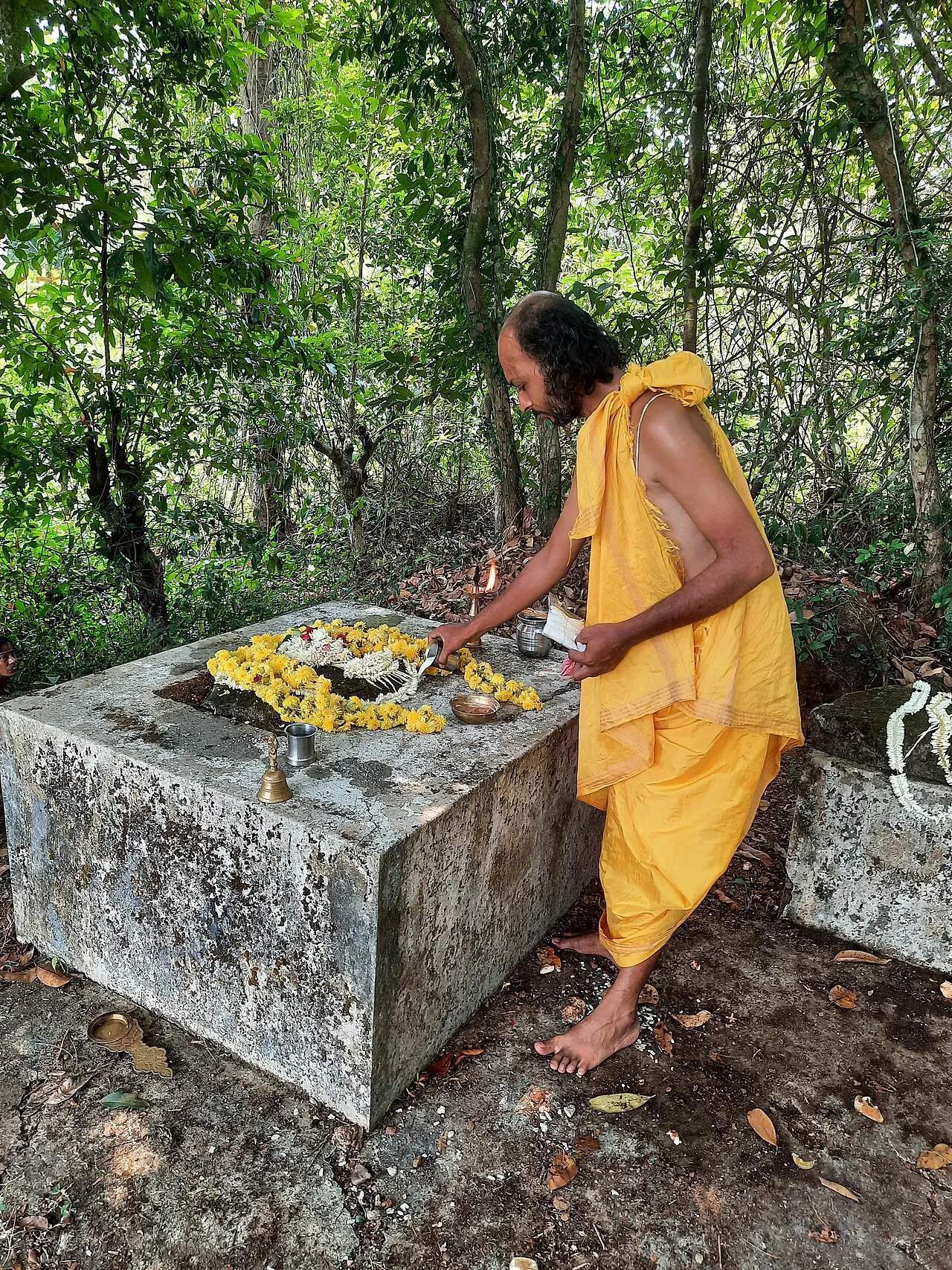

At first she was worshipped very simply, on stones and rocks in the forest, with offerings of water. Later, in the time of the Jain rulers, she was brought into the shrines and courtyards of the big houses.²
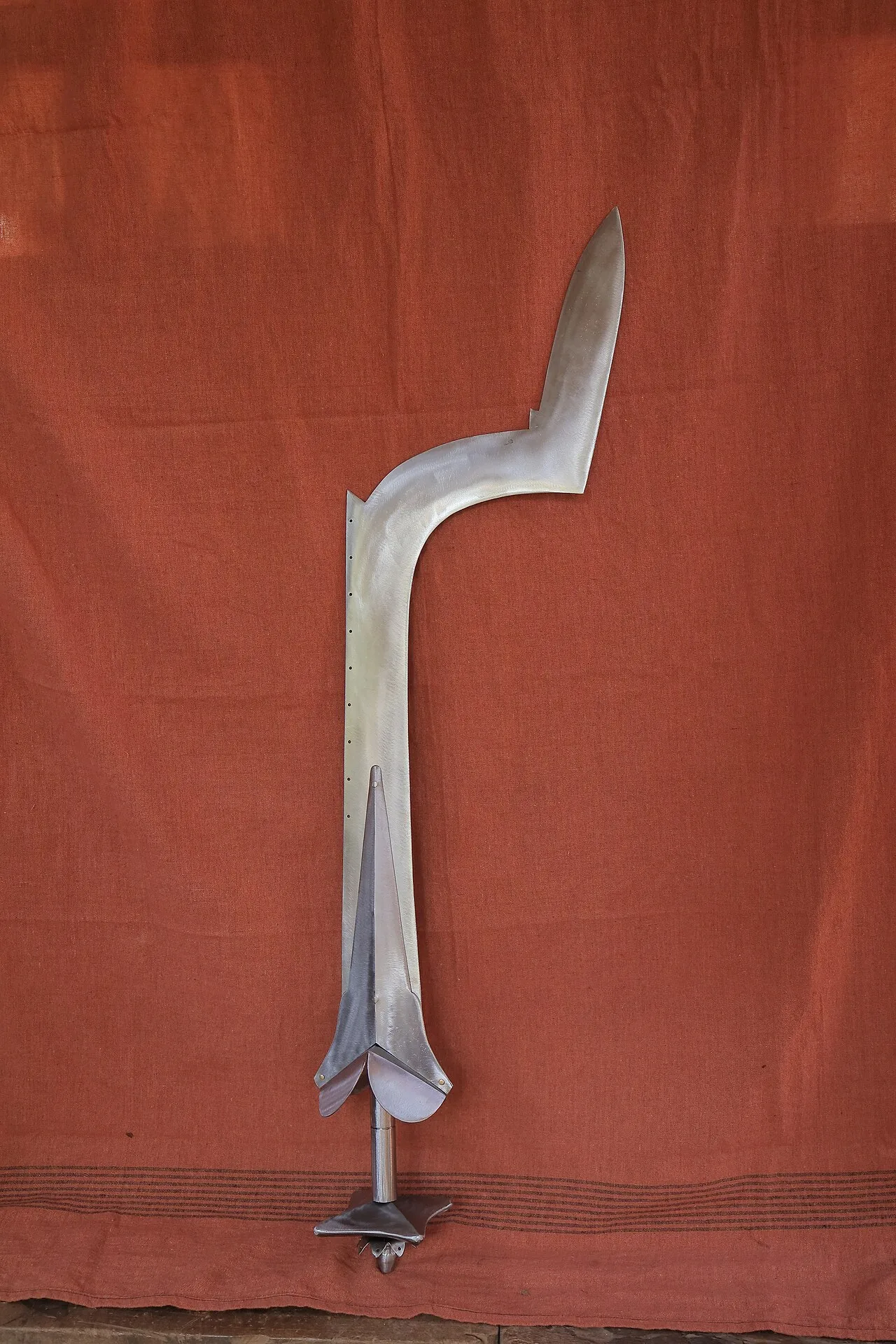
There she was given a long sword and a shield. Families made images of her with a crown on the head and a moustache on the face. The spirit of the fields had become a warrior.² In many shrines today she rides a horse, with a shield in her hand.³ A warrior needs a warrior’s name, and the one that stuck was Rakteshwari, “goddess of blood”.
Leaving Kuthar, and coming home
The best-known story about her comes from Kuthar, just south of Mangaluru, where her shrine calls the village her “original soil”.
Over time, people stopped worshipping her there. Neglected, she left Kuthar and went to Ullal, where she came to be worshipped at the Sri Lakshmi Narasimha temple.
Years later, she came to a devotee named Devu Moolyanna in a vision and told him she wished to go home. Her worship at Kuthar was started again, with its old festivals, and today the village honours her as its protector, the keeper of right conduct, and a healer.³
It is a story Tuluvas know in many forms: a daiva is not a statue that stays where it is put. Forget her, and she goes. Remember her, and she may come back.
How she is worshipped
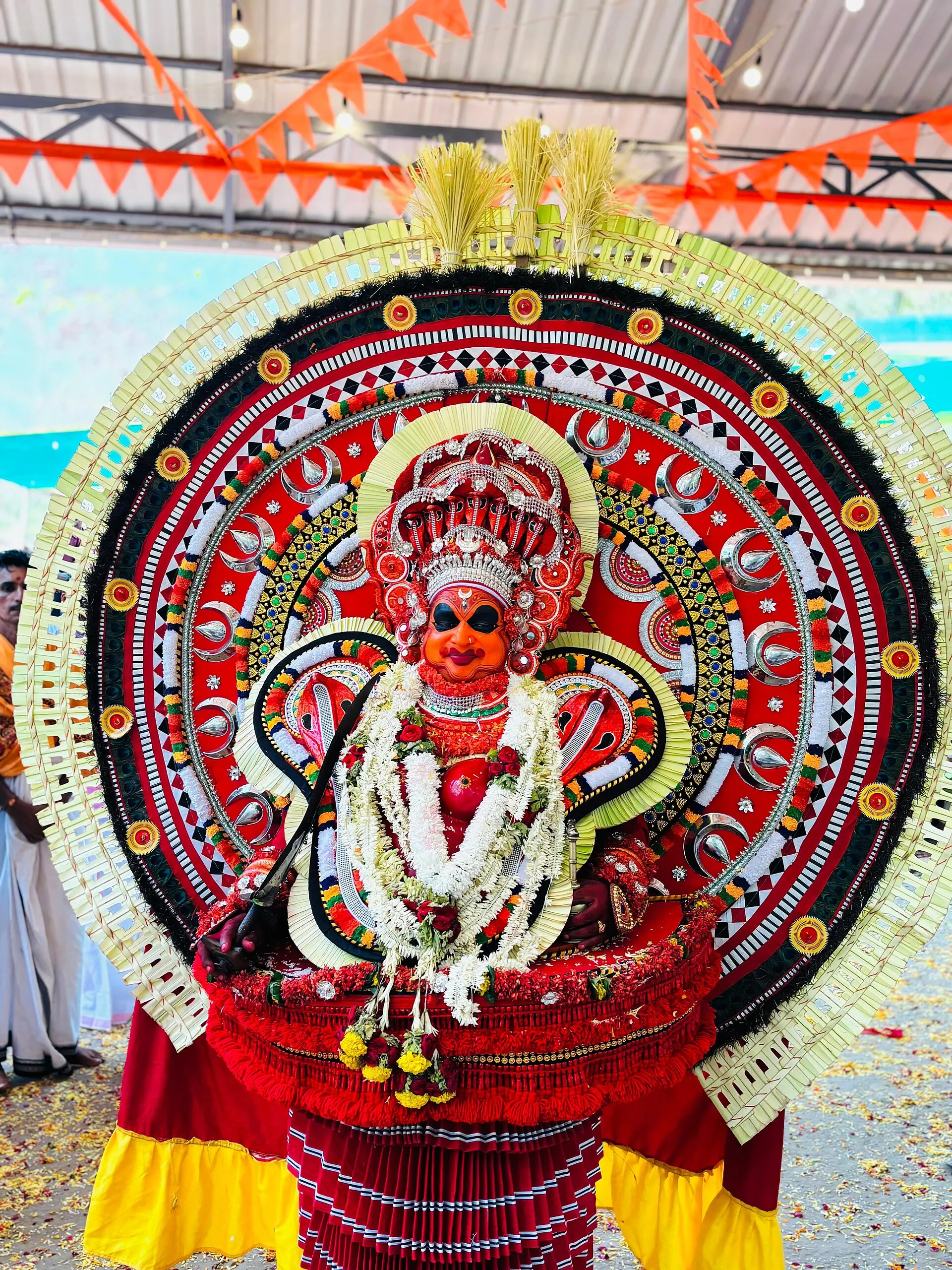

In the old courtyard ceremonies, her medium sat inside a ring of cloth, beating a drum and reciting her sixteen forms one by one. As each form came upon him, an offering was made, and she is still served her share on sixteen banana leaves. In some places, people remember, she entered mediums who danced in fire.²
Roosters were once sacrificed to her. Today her offerings are mostly flowers, plantains, coconuts and rice cakes. At the well-known Billava shrine at Kuppettu she is still honoured with two coconuts.²
From village to village she goes by other names too, among them Karandaye, Kudumuldaye, Bannadkattaye and Mujilnaya.²
She often stands guard at the door of the big goddess temples. At Kateel her rock sits at the entrance.¹ At Mundkur, near Karkala, she and Dhumavati are the guardian daivas of the Durgaparameshwari temple. The temple’s legend says a wicked ruler once had sorcerers from Kerala dim their power and turn the goddess’s image to face east, so that he could plunder the temple’s jewels and wealth.⁴
And she is very much alive. In 2024, people in the Yeyyadi industrial area of Mangaluru began to report strange lights and the sound of anklet bells. A prashna (a ritual divination to find out what a daiva wants) traced it to a Rakteshwari shrine at the foot of a tree, neglected for years. Lamps are lit there again, and her worship has been restarted.⁵
Where did “goddess of blood” come from?

In the Devi Mahatmya, the great Sanskrit poem of the goddess, there is a demon named Raktabija. Every drop of his blood that touches the ground springs up as a new demon, so he cannot be killed. The goddess defeats him by catching his blood on her tongue before it falls. A popular retelling says this is how she earned the name Rakteshwari.⁶ Some writers treat Rakteshwari as a form of Durga herself, and as the guardian goddess of all Tulunadu.⁷
Older Tulu tradition tells it differently. The paddanas about Lekkesiri say nothing about Raktabija. The name Rakteshwari, it has been argued, spread through the popular Yakshagana play Devi Mahatme, where the blood-drinking goddess goes by that name, and only then attached itself to the old spirit of the fields.² That is how a rock at Kateel’s gate could come to be seen as a form of the goddess inside. Kateel’s own temple tradition says just that: Rakteshwari was the form in which the goddess fought the army of the demon Arunasura, before she became the bee that killed him.¹
The two ideas still pull in different directions, even in how she is worshipped. In temple-style worship she is calm and gentle, and receives only vermilion and coconut. In the fiercer, tantric style she is offered meat and animal blood.⁸ In village shrines, roosters once sacrificed to her have mostly given way to fruit, flowers and coconuts.²
Underneath all the layers is something very old: Lekkesiri, a spirit of water and growing fields with no story of where she came from, counted with Bermer (the great spirit-god of the Tuluvas), Panjurli and the Nagas among the first powers the Tuluvas worshipped.²
Related
- Panjurli, the Boar Daiva
- Bhuta Kola: When the Spirits Come to the Village
- Koragajja, the Boy Who Was Turned Away, who shares a shrine with her at Kuthar
- Devi Mahatme, the Yakshagana play of the goddess
- Mundkur, the goddess who was turned to face east
- Nagaradhane: The Serpent in the Sacred Grove, the Nagas counted with Lekkesiri among the oldest powers
- Maisandaya, Guardian of the Herd, worshipped with Lekkesiri at the old shrines of Bermer
- Babbarya, the Daiva of the Sea, worshipped beside Rakteshwari in many Mogaveera shrines
Sources & further reading
The books and articles behind the numbered notes on this page.
- Sri Durgaparameshwari Temple, Kateel, “Deities of the family of Sri Devi” (the temple’s own site): the Rakteshwari rock before the bridge, the goddess watching Yakshagana beside it, and Rakteshwari as the form in which the goddess fought Arunasura’s army.
- Kannada Wikipedia, “ಲೆಕ್ಕೆಸಿರಿ” (Lekkesiri) (in Kannada): Lekkesiri as Rakteshwari, her rising without a birth, her forms in nature, her male and female nature, Banu Senava and the possessed girls, forest worship and the Jain period, sword, shield and images, the sixteen forms, offerings, village names, the Devi Mahatme argument, and her place among the oldest powers. The article draws on the paddanas but lists no published references.
- “Rakteshwari”, Adisthala Swami Koragajja, Kuthar (the shrine’s own account): the earth-born maiden, Banu Senava’s line, the warrior on horseback, her going to Ullal, Devu Moolyanna’s vision and her return.
- “Durgaparameshwari Temple, Mundkur”, IshtaDevata (temple guide): Dhumavati and Raktheshwari as the temple’s guardian daivas, and the ruler who had their power dimmed to plunder the temple.
- Pruthviraj B. U., report on Rakteshwari at the Yeyyadi industrial estate, TV9 Kannada (28 February 2024, in Kannada): the lights and anklet sounds, the prashna, and the restarted worship.
- “ದಸರಾ ವಿಶೇಷ: ದೇವಿಗೆ ಚಾಮುಂಡಿ, ರಕ್ತೇಶ್ವರಿ ಹೆಸರು ಬಂದಿದ್ದು ಹೇಗೆ?” (Dasara special: how the goddess got the names Chamundi and Rakteshwari), Public TV (12 October 2024, in Kannada): Raktabija and the name.
- Wikipedia, “Rakteswari”: Rakteswari as Durga Parameshwari and guardian goddess of Tulunadu, and the vermilion and coconut of temple-style worship.
- Parwati Singari, “Guardian Goddess of Parashuramakshetra” (blog, 22 August 2022): the calm temple style and the fierce tantric style of worship, and their offerings.
Further listening: Maladi Seena Parava, a daiva performer, tells the story of Raktheshwari daiva (YouTube).
No scholarly study of Rakteshwari has been found. What is written here comes from a shrine’s own account, a Kannada encyclopedia article drawn from the paddanas, temple guides, news reports and devotees’ writing, and the tellings vary from village to village.
Words on this page
What the Tulu and other Indian-language terms on this page mean.
- ani
- The tall, decorated frame worn on the performer's back.
- daiva
- A guardian spirit; used interchangeably with bhuta.
- kola
- The ceremony in which a daiva is invited to possess a performer.
- paddana
- A long oral ballad, sung to tell the story of a daiva or hero.
- prashna
- A ritual divination, often by an astrologer, to learn what a daiva or deity wants.
Themes
Spotted a mistake, or know more about this? Suggest a correction/addition.