Pilichamundi, the Tiger Goddess
At Padumale, near Puttur, a kola for Pilichamundi is still held the old way, with none of its rules changed. The performer dances the long road the daiva once travelled, fierce one moment and calm the next. Then the daiva is seated on a tiger carved from wood, and the tiger is pulled along, because the tiger is her mount.³
Pilichamundi is the tiger daiva (guardian spirit of the land) of Tulunadu. Her name joins pili, the Tulu word for tiger, with Chamundi, a fierce form of the Divine Mother.¹ She is one of the daivas Tuluvas trust most,⁴ and her story is about a wild animal that killed cattle and was given the job of protecting them.
The story
Pilichamundi has more than one origin story. This is the best known. It is retold in an online account that draws on a 1971 report on the worship of daivas in South Canara, and again, more briefly, by later writers.¹ ²
A promise made by two birds
Two birds were married under the blessing of Shiva and Parvati. One day the husband was in danger, and his wife made a vow: if the divine couple saved him, she would give them one of her eggs.¹
The husband came home safely. But the egg that was meant for the gods fell to the ground, and out of it came not a chick but a tiger cub.¹ ²
The tiger on Kailasa
Parvati raised the cub on Mount Kailasa, and taught it to look after her cattle.¹
But the tiger could not help itself. Every day it killed a cow. The blood was such a bright red, it thought, that it must taste sweet, like cherries mixed with water.¹
Sent down to guard
Then the tiger killed Shiva’s favourite cow, the one whose milk he drank. Shiva was furious. He sent the tiger down to earth as a spirit, and gave it a new task: to look after the cattle and crops it had once harmed.¹ ²
How she came to Padumale
Padumale, near Puttur, is the home of the twin heroes Koti and Chennaya, and Pilichamundi has been worshipped there since ancient times. Her own paddana (the long sung ballad that tells a daiva’s story) gives her a different beginning, and a journey.³
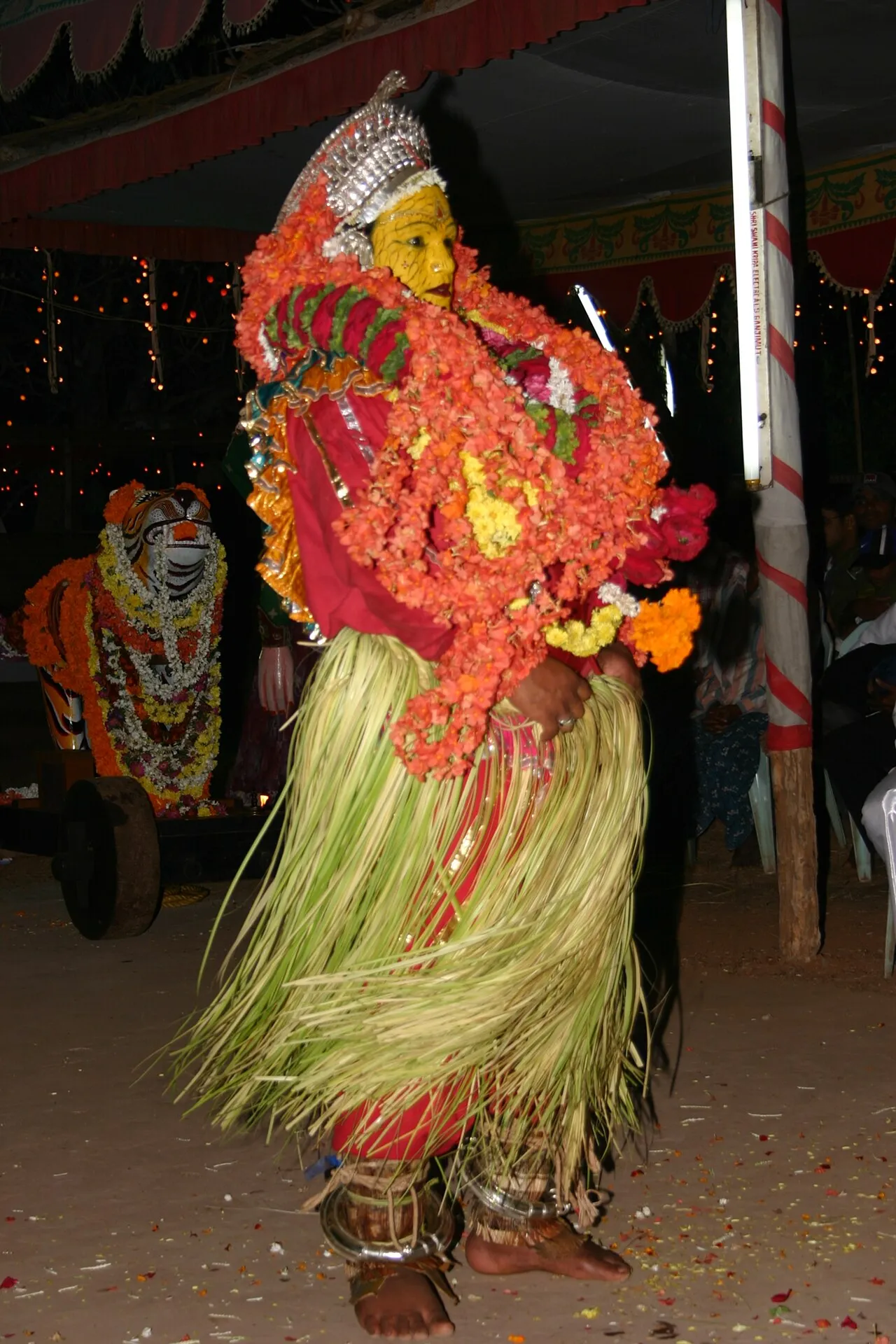

In this telling, Pilichamundi rose from the Ganga, far to the north. From there she came to the Sahasralingeshwara temple at Uppinangady, and then, with a thumbe flower, to the Mahalingeshwara temple at Puttur. She made her first home near the Nellikala Guttu at Padumale, and at last settled in the shrine that stands opposite the palace of the Ballals, the old rulers of Padumale.³
That is the road the performer dances at her kola. At Padumale she is honoured as a rajan daiva, a daiva of high, royal standing, and a special nema is held for her together with the daivas Ullakulu, Malaraya and Rudrandi.³
How Pilichamundi is worshipped
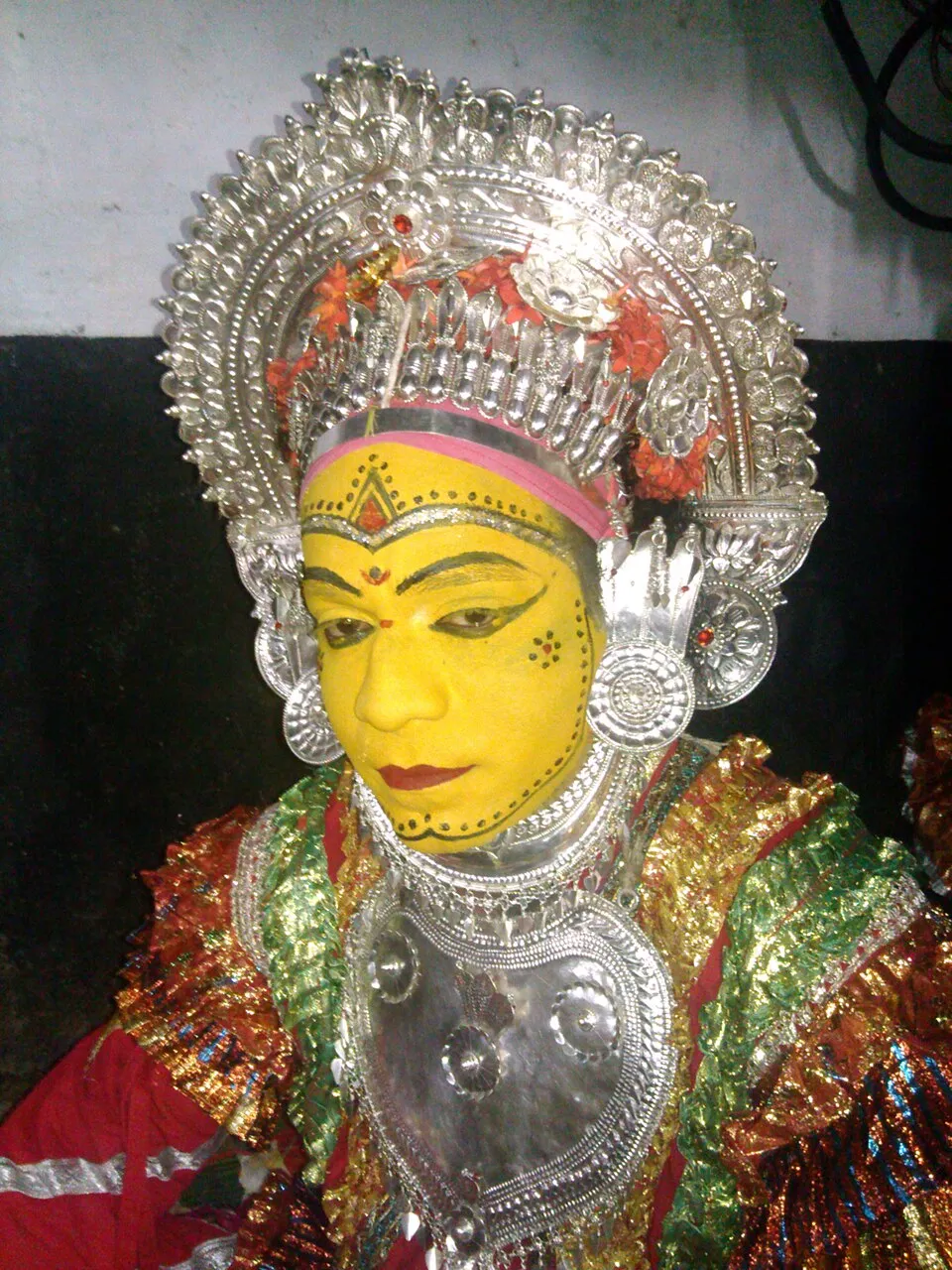

Among the hundreds of daivas of Tulunadu, Pilichamundi holds a special place.³ In the villages where she is the rajan daiva, she is the chief daiva of the place. She is worshipped and danced for mostly at guttu houses, the ancestral homes of landed families, and her kolas draw large crowds of devotees hoping for her blessing.⁴
A bronze from Karnataka, made in the 17th or 18th century, shows Pilichamundi as a tiger, ridden by a figure who holds a knife in the right hand and a shield in the left.¹
The family who would not leave
At Kudumbur, in the Baikampady industrial area of Mangaluru, the Kudumbur Guttu family has worshipped Pilichamundi, along with Dhumavati, Jarandaya and Moola Maisandaya, for some eight hundred years. Kudumbur was once rich farmland. When it became an industrial area, the people moved away. But the daivas, it is said, would not leave their soil, so every year the family comes back and holds their nema there.⁵
In February 2024 the district’s Deputy Commissioner, Mullai Muhilan, came to that nema and asked a Tulu scholar, Dayananda G. Kathalsar, about the worship of daivas. During the ritual, Pilichamundi stroked him in blessing.⁵
Dressing the daiva
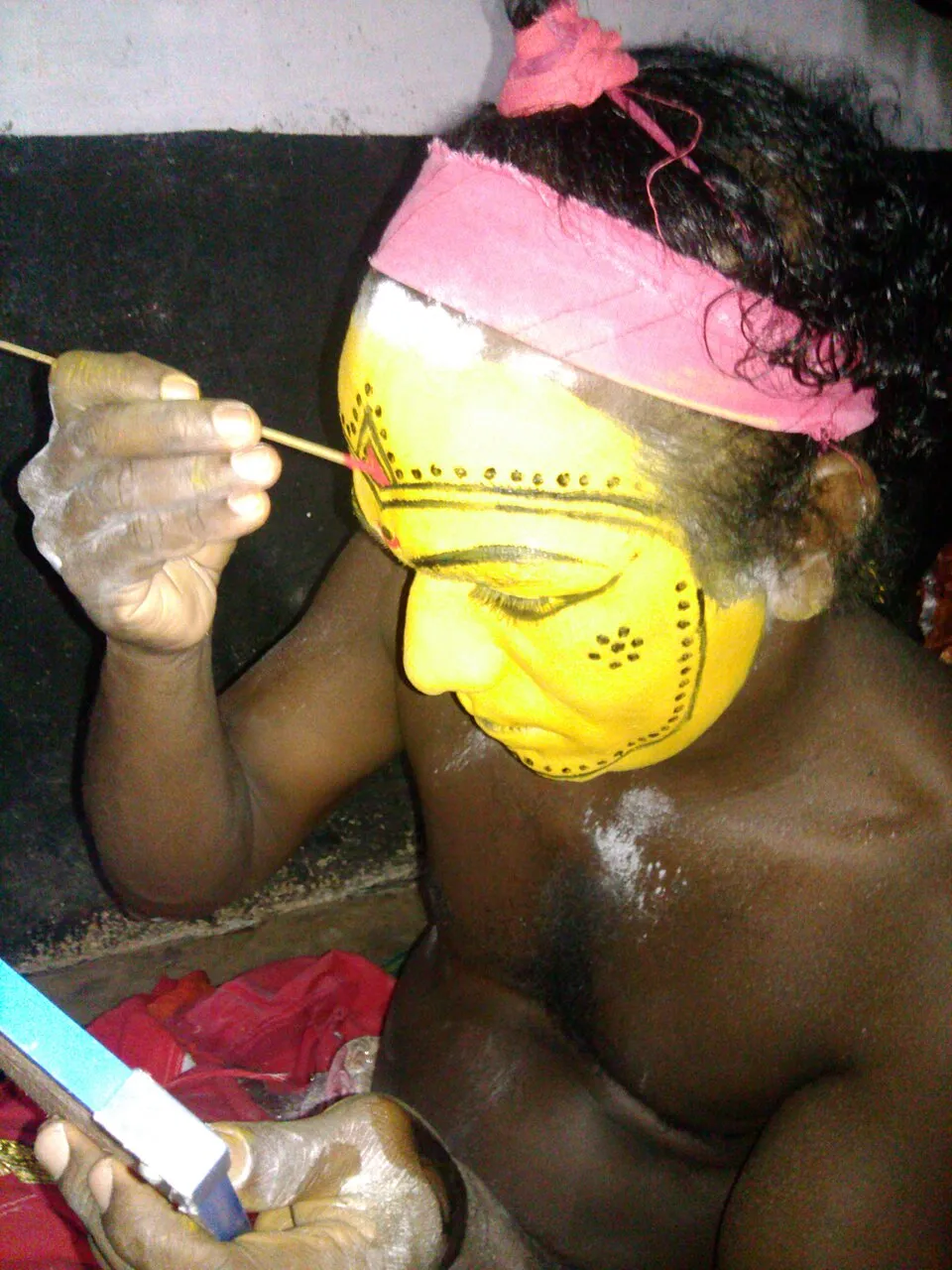

Before the kola, the performer paints his own face, looking into a hand mirror: a ground of yellow first, then fine black lines and dots. Over it go the silver crown and ornaments you can see in the photograph above.
At Padumale, the dancer acts out the stages of her journey, showing the daiva first in her fierce form and then in her calm one, before she mounts her wooden tiger.³
A tiger and a goddess
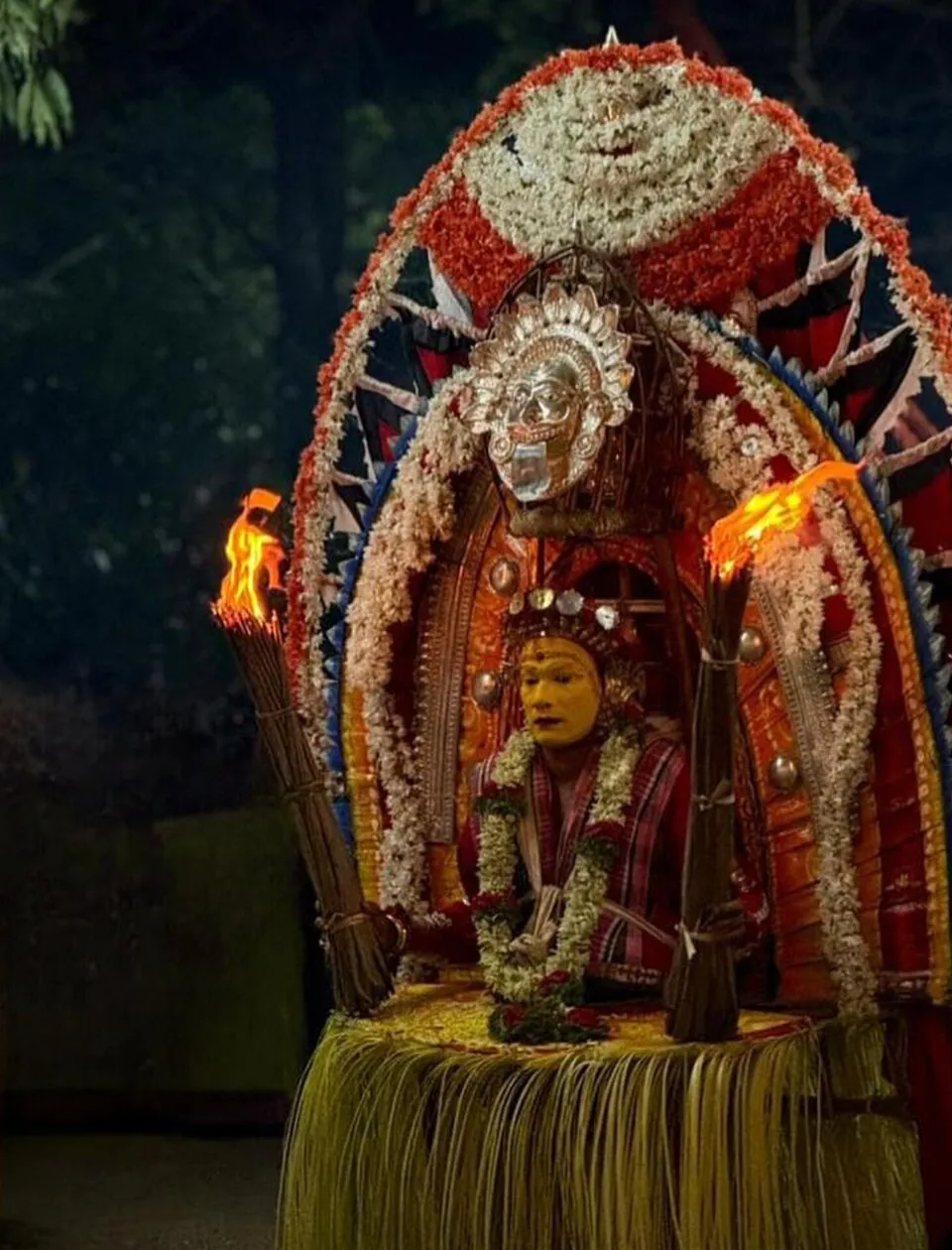

Tulunadu was once a land of thick forest, and until quite recently its people could still meet tigers, which came for their cattle.⁵ The ethnographer Peter Claus pointed out that the wild animals that threatened the farmer, the tiger, the snake, the wild boar and the gaur, each have a mirror image among the daivas. The tiger’s is Pilli, the boar’s is Panjurli, and the gaur’s is Maisandaya.⁶
When tigers became a danger, people say, they began to worship the tiger itself as a daiva, so that it would do them no harm. That is how Pilichamundi’s worship began.⁴ It is the same path that turned the crop-raiding boar into Panjurli.¹ ⁴
Later, writers suggest, ideas from the Puranas joined in, and the tiger was identified with the goddess Chamundi. That may be how the worship of Pilichamundi took the form it has today.⁵ One writer puts it this way: she is not simply Chamundi riding a tiger, but the tiger and the goddess fused into one. People kept her Tulu name, pili, while linking her with the prestige of the Great Goddess.²
There is a male tiger spirit too, Huli Daiva, also called Pili Daiva or Pili Bhuta. According to one account, he is sometimes invoked alongside Pilichamundi, and she is often named as his female counterpart, but the two are related, distinct spirits.⁷ A local news report also lists Pili Bhuta and Pilichamundi separately among the daivas who began as animals.⁵
Tulunadu has one more famous tiger. In the pili vesha, or tiger dance, troupes of young men painted as tigers dance through the streets at Navaratri in honour of the goddess Durga, whose favoured animal is the tiger.⁹
The tiger on screen
The film Kantara: Chapter 1 (2025) gave the tiger spirit a part. When a tribe skilled in black magic is about to kill the hero and his friends deep in the forest, a tiger appears and kills the tribe’s leader. The film later reveals that, long before, the tiger spirit Huli Daiva had appeared to drive that same tribe out when it began to misuse the powers of the daivas.⁸ The writer Akhil Pillai reads the film’s tiger scenes as a portrait of the tiger spirit that came to be joined with Chamundi.²
Versions and open questions
From Kailasa, or from the Ganga. The best-known story has her hatch on Kailasa as a tiger cub.¹ The paddana sung at Padumale has her rise from the Ganga instead.³ Different places tell different stories.
Shiva’s anger. In the telling drawn from the 1971 report, Shiva is furious when the tiger kills his favourite cow.¹ In a shorter retelling, he chooses not to destroy the tiger, and sends it down to earth instead.²
Another name. Some reports call her Pilichandi.⁵
Guliga’s sister. Akhil Pillai writes that long ago people worshipped Guliga’s sister, Chaundi (another spelling of Chamundi), along with Jattiga and Rahu Guliga, and he calls Pilichamundi the most famous form of Chamundi in Tulunadu.² Chamundi is worshipped in many local forms, named for the place or for the daiva she is paired with, so Guliga’s sister is best read simply as Chamundi. Guliga’s page has more on her.
Related
- Bhuta Kola: When the Spirits Come to the Village
- Panjurli, the Boar Daiva, another animal sent down from Kailasa to guard the fields
- Guliga, the Hunger That Became a Guardian, whose sister is Chamundi
- Koti and Chennaya, the Twin Heroes, the heroes of Padumale
- Maisandaya, Guardian of the Herd, worshipped with Pilichamundi at Kudumbur
- Ullaya and the Ullakulu, the King Daivas, who share her nema at Padumale
- Kodamanithaya, the Daiva Who Followed His Devotees, at whose Tibar Jatre she is danced
- Pili Vesha: The Tiger Dancers of Dasara, the tiger dance, a different tradition with a tiger of its own
- Jarandaya, the Prince Who Could Not Swallow an Insult
Sources & further reading
The articles behind the numbered notes on this page.
- Hindu Aesthetic, “An account of Bhūta Kola” (Medium, 9 April 2021; read from an archived copy): the meaning of her name, the bronze of Pilichamundi, the tiger’s role as protector of cattle and crops, and the story of the birds, the egg and Shiva’s cow. It lists as its source P. Padmanabha, Report on Bhuta Cult in South Canara District (1971).
- Akhil Pillai, “The Spirit World of Kantara Chapter 1: A Thematic Study” (blog, 2 October 2025; read from an archived copy): Chaundi (Chamundi), Guliga’s sister; Pilichamundi as tiger and goddess fused into one; a short telling of the egg story; and the tiger scenes in the film.
- Rakshitha S, “Pili Chamundi Kola”, News18 Kannada (in Kannada, 24 January 2024): Pilichamundi at Padumale, the paddana of her journey from the Ganga, and her kola on the wooden tiger.
- Rakshitha S, “Pilichamundi Daiva: the tiger-form daiva”, News18 Kannada (in Kannada, 2024): why Tuluvas worship animal daivas, how her worship began, and her place as a rajan daiva at guttu houses.
- Mallika P, “Pilichamundi daiva blesses the Dakshina Kannada Deputy Commissioner”, Kannada Oneindia (in Kannada, 7 February 2024): the nema at Kudumbur, the family and its daivas, tigers in Tulunadu, and the joining of the tiger with Chamundi under the name Pilichandi.
- Wikipedia, “Buta Kola”: Peter Claus on the wild animals and their mirror images among the daivas.
- Nitten Nair, “Huli Daiva: The Tiger Guardian Spirit of Tulu Nadu”, Mythlok (2025; read from an archived copy): the male tiger spirit, his names, and how he differs from Pilichamundi.
- Wikipedia, “Kantara: Chapter 1”: the tiger and Huli Daiva in the film’s story.
- Wikipedia, “Pili Yesa”: the tiger dance at Navaratri.
Further reading
- Tulu Wikipedia, “ಪಿಲಿಚಾಮುಂಡಿ” (in Tulu): a short article on Pilichamundi and her worship.
Most of this page comes from devotees, local journalists and writers rather than published research. Pilichamundi’s paddanas are sung in many versions, and they differ in their details.
Words on this page
What the Tulu and other Indian-language terms on this page mean.
- ani
- The tall, decorated frame worn on the performer's back.
- daiva
- A guardian spirit; used interchangeably with bhuta.
- guttu
- The ancestral headquarters house of a landed family.
- kola
- The ceremony in which a daiva is invited to possess a performer.
- nema
- Another name for a kola, the annual ceremony for a daiva.
- paddana
- A long oral ballad, sung to tell the story of a daiva or hero.
- rajan daiva
- A daiva of high, royal standing, the chief daiva of a place.
Themes
Spotted a mistake, or know more about this? Suggest a correction/addition.