Language, Literature & Arts · Performance, Spectacle & Sport
Pili Vesha: The Tiger Dancers of Dasara
In the weeks of Dasara, a group of young men walks down a Mangaluru street. Their bare chests are painted in yellow and black stripes. They wear a tail and a tuft of fur on their heads. Behind them a drummer hammers out a beat, and in the middle of the street the tigers crouch, prowl and spring.
This is pili vesha, the tiger dance. It is one of the most familiar sights of the coast’s festival season.
What it is
Wikipedia calls it a folk dance unique to coastal Karnataka, performed at Navaratri to honour the goddess Durga, whose favoured animal is the tiger. It says that the dance originated in Udupi district, and was first performed at Krishna Janmashtami and Ganesha Chaturthi in Mangaluru, Udupi, Moodabidri, Kundapur and many other places in Tulu Nadu.¹ The Manjusha Museum gives the two festivals as Janmashtami in Udupi district and Dussehra in Mangaluru.³
Wikipedia says that the performers originally danced as part of a religious vow.¹ The Manjusha Museum describes the dance as once a neighbourhood ritual, the pastime of local youth during Navaratri, in which boys and men painted as tigers went door to door collecting offerings for community feasts.³ Many of the dancers today, according to the Mangalore Today writer, are there to fulfil a promise made to the gods for a wish granted.⁴
The paint and the costume
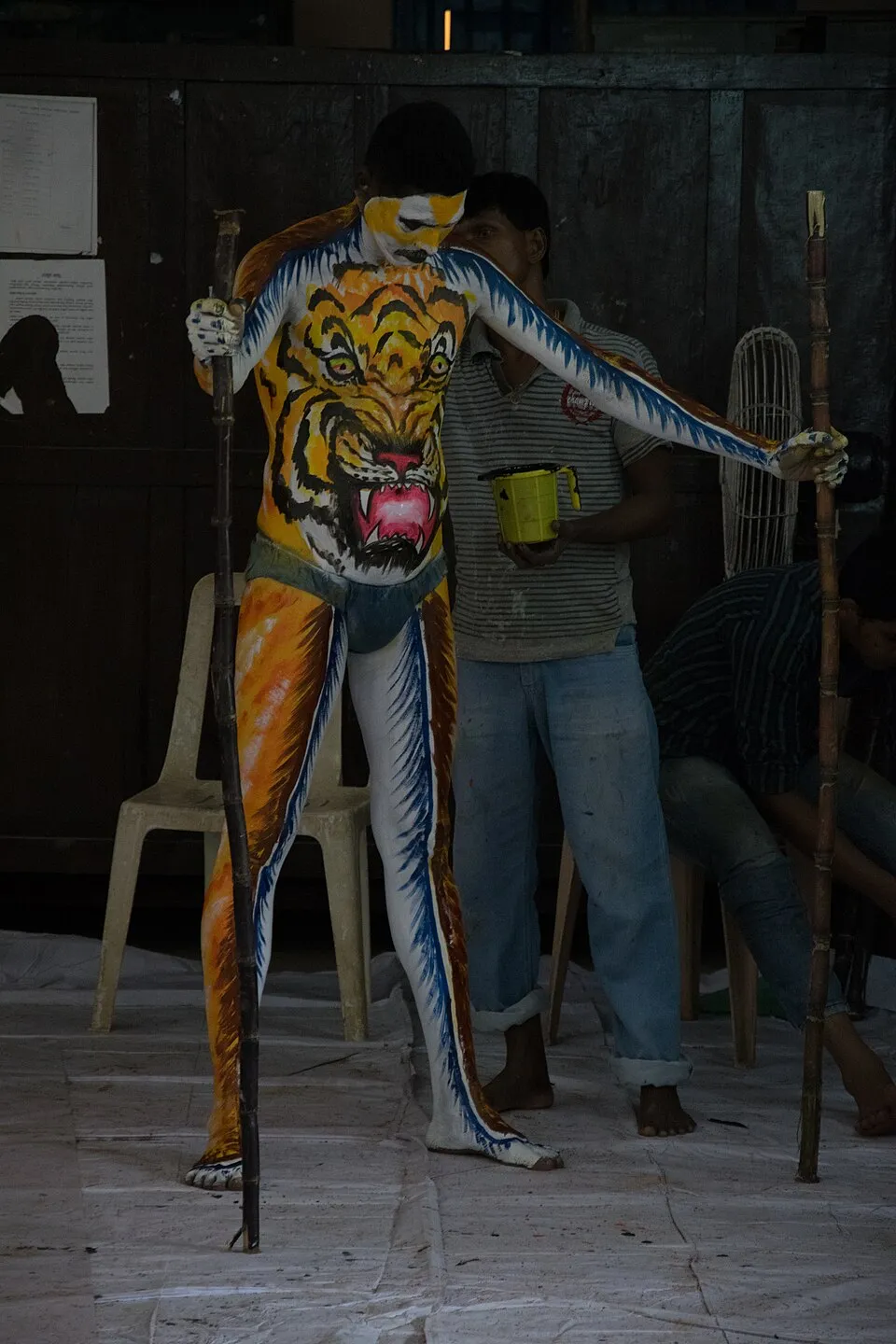

The painting is long and hard. Before it begins, the dancer is shaved of body hair.⁴ The Manjusha Museum describes a wash of yellow and white laid over the skin, then the black stripes, with the dancer standing with legs apart and arms out, holding a rope for balance. It says that hours pass in this process.³ PARI describes yellow, white and brown stripes in acrylic paint, and sheep hair sprinkled over the painted body to give the texture of a tiger.²
In earlier times the colours came from crushed roots, bark, charcoal, mud and fungi, says the Manjusha Museum, and PARI says the same.² ³ Today they come from oil paint, distemper and acrylic.² ³ Paint may stay on for a day or two until the festivities are over.²
The rest of the costume is simple. Each dancer wears shorts, usually with a tiger-skin print. A headpiece or mask of fake fur and sometimes a tail complete it. The painting may also show leopard or cheetah markings.¹ A long white cloth, the jatti, is tied through the waist for balance and support during long performances, and keeps the costume in place during stunts.²
The dance and the drums
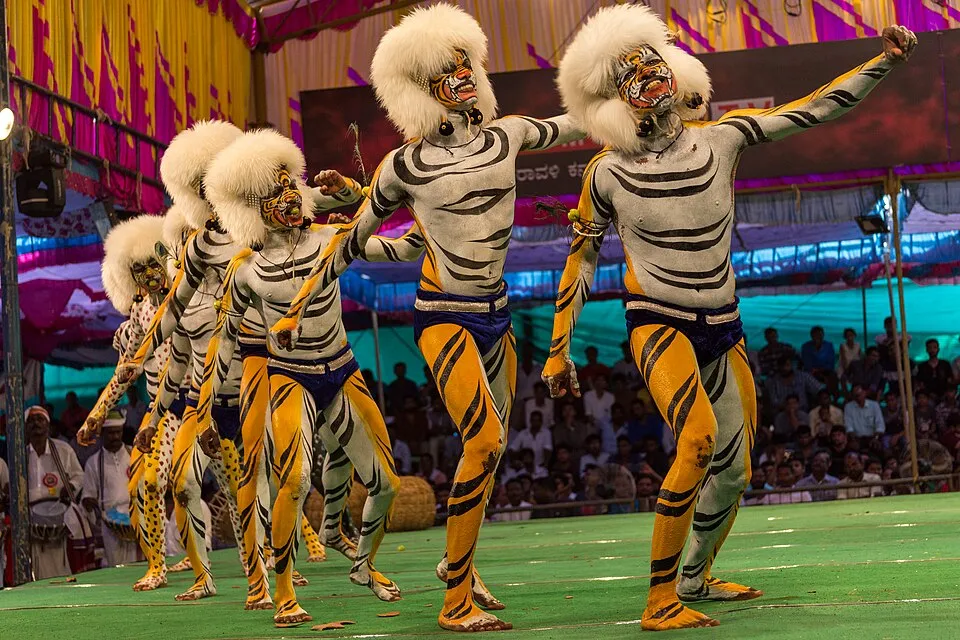

A troupe, Wikipedia says, usually has five to ten members or more, of whom three to five are costumed as tigers. They are accompanied by a band called thaase, with two or three drummers, and by the manager. During Navaratri they roam the streets, stop at homes, shops and roadsides, perform for about ten minutes, and collect money from those who watched.¹ The Manjusha Museum adds that other drums, the chende and maddale, join the thaase, as sometimes do cymbals and the harmonium.³
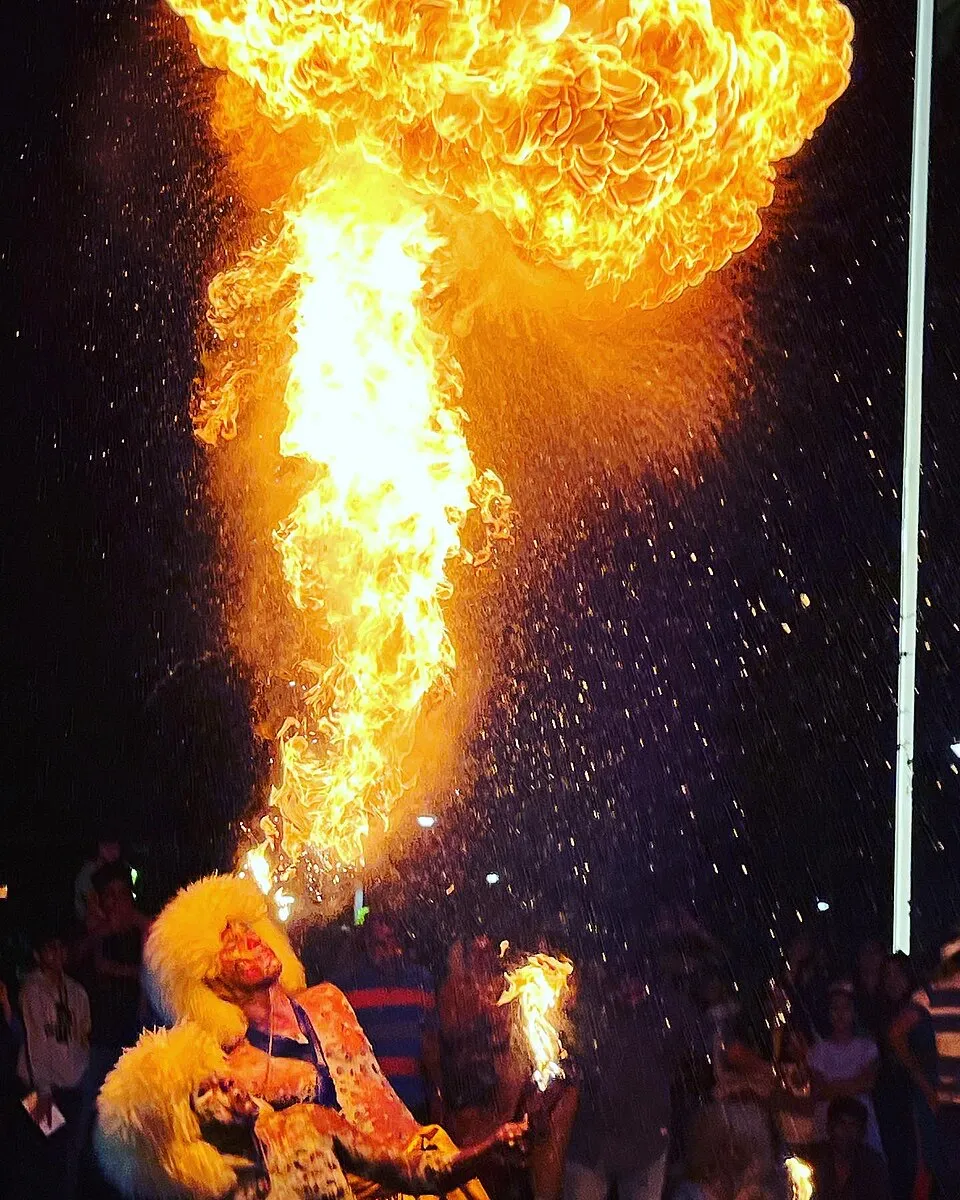

The dancers must know the tiger steps and have the stamina for them. Wikipedia lists fire-breathing, walking on hands, handstands, gymnastic moves, picking up money with the mouth by bending backwards, and lifting a sack of rice with the teeth.¹ PARI adds flips and breaking coconuts on the head, and says the steps have grown more acrobatic with time.²
Where it is seen
The troupes perform until the last day of Navaratri. Almost all of them take part in the Sharada processions of temples such as Mangaladevi, Gokarnanatheshwara and Venkataramana, and when the procession ends the performances stop and the paint is removed.¹ The Manjusha Museum also names the Manjunatha Temple at Dharmasthala, and the Kateel Durgaparameshwari and Kudupu Ananta Padmanabha temples.³
Who dances
Wikipedia says young men form the troupes.¹ PARI reports that girls now take part too, but only recently. Boys are painted all over, while girls get their faces painted and wear a cotton tiger costume.² One dancer told PARI, “You don’t need to learn anything from anyone. This is in our soul.“²
Mangalore Today counted about 70 troupes and nearly 1,000 artistes, with 10 to 15 performers in a typical troupe plus the drummers, and names Barke Friends and Kesari Friends Circle among the best known.⁴ PARI says groups were once rewarded with rice and paddy, and that organising performances costs more than two lakh rupees, which pays for painters and dancers, travel, meals, paint and costumes.² Those figures are from different years, and are only approximate.
Is the paint safe?
The painting is not easy on the body. Wikipedia says that it causes a burning sensation on the skin, which dancers put up with as part of the celebration and to earn extra money in the festive season.¹ Mangalore Today goes further. It says that troupes use automotive acrylic paint, which is meant for cars and trucks, that it does not let the skin breathe, and that it is high in lead and said to be hazardous. A troupe leader told its writer that doctors from a medical college had warned them that the paint is bad for the body, and that he was looking for a safer one.⁴ That is one newspaper’s report, and we have not opened the research on the question.
On screen
Wikipedia notes that the dance has appeared in Kannada films, including a tiger dance in Ulidavaru Kandanthe (2014) and a brief history of pili vesha in Garuda Gamana Vrishabha Vahana (2021).¹ It also lists Kerala’s Puli Kali as a similar dance form in a neighbouring state.¹
What we could not find
We did not find a reliable date for the first performance, though some sources give one. Notes we have mention a 1928 record, and that figure did not appear in the Manjusha Museum article they credit, so we have left it out. Nor did we find any link between pili vesha and the tiger daiva Pilichamundi, and we do not suggest one. A report that a live animal was once used in a stunt comes from one article only, which says that the practice is now banned, and we have not repeated it as fact.
Related
- Yakshagana: The Coast’s Dusk-to-Dawn Dance-Drama, another performance tradition of the festival season
- Kambala: The Coast’s Buffalo-Racing Festival, the coast’s other great spectacle
- Pilichamundi, the Tiger Goddess, a different tiger, a daiva of the kola
Sources & further reading
The books and articles behind the numbered notes on this page.
- Wikipedia, “Pili Yesa” (checked 9 October 2026): the dance, its festivals and origin, the troupes, the costume, the stunts, the paint, and the films. Wikipedia marks this article as needing more citations.
- Siddhita Sonavane and Nithesh Mattu, “Pili vesha folk art: dancing to the beat”, People’s Archive of Rural India (20 November 2023): the paint, the sheep hair, the jatti, the stunts, girls’ participation and the costs.
- Manjusha Museum, “Pilivesha: The Roaring Spirit of Navratri in Dakshina Kannada” (checked 9 October 2026): the festivals, the neighbourhood tradition, the paint and the music.
- “Tigers of the Concrete Jungle”, Mangalore Today (opinion; undated): the troupes, the paint, the vows and the health concern.
Two of these are a newspaper opinion piece and a museum’s own article, and the Wikipedia article is thinly cited. Where they differ, for instance on the weight of the rice sack (42 kg in Wikipedia, 25 kg in Mangalore Today), we have not given a figure.
Words on this page
What the Tulu and other Indian-language terms on this page mean.
- jatti
- The long white cloth tied round a tiger dancer's waist.
- pili vesha
- The tiger dance of the Dasara season.
- thaase
- The drum that sets the pace for the tiger dancers.
Themes
Spotted a mistake, or know more about this? Suggest a correction/addition.