Language, Literature & Arts · Performance, Spectacle & Sport · Also in: Festivals Through the Year
Kambala: The Coast's Buffalo-Racing Festival
In the cool months after the monsoon, a flooded paddy field on the coast of Karnataka turns into a racetrack. Two buffaloes, harnessed side by side and decorated for the day, come charging down a muddy lane, throwing up water, with a runner holding on behind them.
This is Kambala. Thousands of people come to watch it, and some of them bet. Behind the noise there is an older idea: that the field, the cattle and the rain all deserve thanks.
What it is
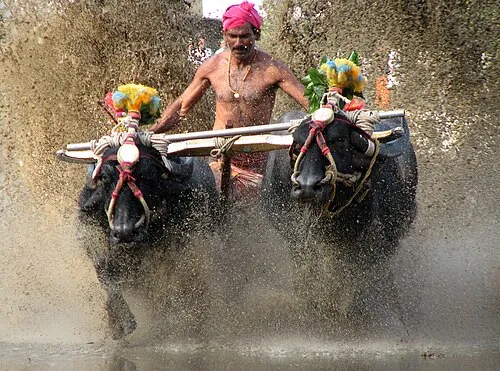

Kambala is an annual buffalo race. Traditionally it is sponsored by local Tuluva landlords and households in the districts of Dakshina Kannada, Udupi and Bhatkal in Karnataka, and Kasaragod in Kerala, the region known as Tulu Nadu. Wikipedia compares it with Maramadi in Kerala.¹
The season generally runs from November to March. Each event is organised by a Kambala samithi, a local Kambala association, and more than 45 races are held across coastal Karnataka each year.¹
The track is a slushy paddy field.¹ The buffaloes wear coloured covers and head-pieces of brass and silver, sometimes with the sun and moon on them, and a special towel called the paavade covers the back.¹
Where the name comes from
People explain the word kambala in more than one way. One account derives it from kampa-kala, where kampa means a slushy, muddy field, and kala means field. Another traces it to kamba, the pole that sends up a spurt of water during a race.¹
Not only a sport
In its traditional form, Kambala was not a contest. The pairs ran one at a time. In modern Kambala, two pairs generally race each other.¹ In villages such as Vandar in Udupi, and Chordi in Shivamogga, farmers race their buffaloes to thank the deities for protecting the animals from disease.¹
There are rites beyond the track too. Wikipedia describes a night-before ceremony in which men of the Koraga community dance through the night. They sing about their special spirit, the daiva Nicha, and offer toddy and a rice pudding called kandel addye, cooked in a large earthen pot that is broken so that the pudding stays in one solid mass.¹ It also says that in earlier days, Kambala was influenced by the Natha tradition.¹
How a race works
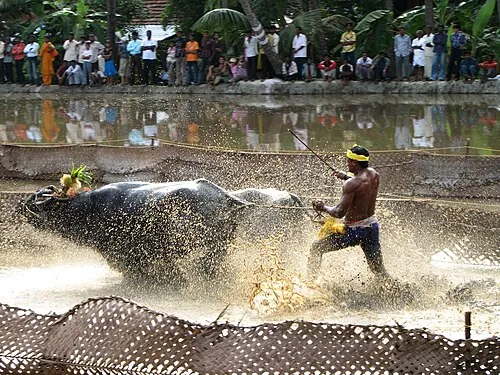

Today, the races are arranged in categories, by how the buffaloes are fitted out and how the runner follows them.¹
- Nayer. The runner holds a plough-like frame tied to the pair. It is for the junior and entry-level buffaloes.
- Bal. A rope is tied directly to the pair, and the runner runs alongside, holding knots in the rope. It is for senior buffaloes.
- Adda palayi. A cross-wise wooden plank is tied to the pair, and the runner stands on it. This is for senior buffaloes only.
- Kane palayi. The runner stands on one leg on a round block of wood, with two holes through which water is forced out as the buffaloes run. The faster they go, the higher the water rises. The height of the spray picks the winner, and a white cotton flag set up on the track lets the crowd judge by eye. It is the category for the most senior pairs.
The winners were once given coconuts and bananas. Today, owners win gold and silver coins, and some committees give an eight-gram gold coin. Some competitions give cash prizes.¹
A well-run Kambala can draw more than 20,000 spectators. Some races are held at night under floodlights, and the buffaloes are carefully fed, with some owners even building swimming pools for them.¹
Two famous Kambalas
Wikipedia names two well-known events. Thonnase Kambala, in Hebri taluk of Udupi district, used to be held every December and is called the Devara Sampradayika (the god’s traditional) Kambala, as it is tied to the deities of the village. Kadri Kambala, in Mangaluru, is called Devere Kambla, the god’s Kambala, because it is associated with the Manjunatha temple. It was patronised by the Alupa kings of Mangaluru about 300 years ago, and so is also known as Arasu Kambala, the king’s Kambala.¹
The legal battle
Kambala has been argued over in court, and the positions on each side are worth hearing.
Critics, including the animal-rights campaigner Maneka Gandhi, say the buffaloes are treated cruelly. They are driven with whips. Organisers say whips are needed to get the best speed, while government officials advise riders to be gentle and avoid using them.¹
- 2014. After lawsuits brought by animal-welfare organisations, the Supreme Court banned Jallikattu and similar activities, in a case called Animal Welfare Board of India v. A Nagaraja. Kambala was banned along with them.¹ ²
- 2017. The ban on Jallikattu was lifted in January, and calls grew to lift the one on Kambala. On 3 July the Prevention of Cruelty to Animals (Karnataka Amendment) Ordinance, 2017, made Kambala legal again in Karnataka.¹
- 2018. The litigation was settled by a new law. The Prevention of Cruelty to Animals (Karnataka Amendment) Bill, 2018, was approved by the President on 19 February 2018.¹ After Kambala was made legal again, Wikipedia notes that buffaloes were still being whipped during races.¹
- 18 May 2023. A five-judge bench of the Supreme Court upheld the Tamil Nadu, Karnataka and Maharashtra laws that allow Jallikattu, Kambala and bullock-cart racing. The bench held that these were valid laws within the states’ powers, and that they gave enough protection against cruelty, along with punishments. It told the authorities to see that the laws are strictly followed, so that animals are protected from physical and mental harm. It chose not to decide whether such events are part of cultural heritage.²
Animal-rights groups did not accept the ruling. People for the Ethical Treatment of Animals (PETA) India said the judgement had “thrown India into the dark ages”, and that it would explore legal remedies.²
A man and his buffaloes
In February 2020, a run at a Kambala in Aikala village, about 30 kilometres from Mangaluru, was shared across India on social media. Srinivasa Gowda, a 28-year-old construction worker from Moodabidri who runs with the buffaloes, covered the track in 13.62 seconds. The reports give the distance as 145 metres in one place and 142 in another.³
Social media worked out that his pace over 100 metres came to 9.55 seconds, faster than Usain Bolt’s world record of 9.58. The Sports Minister said he would call Gowda for trials with top coaches at the Sports Authority of India.³
The comparison was a fun one, but it wasn’t like for like. Gowda was running beside a pair of buffaloes on a wet track, not sprinting alone on a running track.
Related
- The Tulu Year, Month by Month, where Kambala falls in the dry season
- Pattanaje: The Day the Festival Season Ends, the day by which Kambala is expected to have finished
Sources & further reading
The books and articles behind the numbered notes on this page.
- Wikipedia, “Kambala”: the region and sponsors, the season and number of races, the name, the format and categories, the prizes and decoration, the Koraga night-before rites, Thonnase and Kadri Kambala, the criticism, and the legal events up to 2018.
- Down To Earth, “Jallikattu, Kambala can go on in Tamil Nadu and Karnataka, rules Supreme Court”: the Supreme Court judgement of 18 May 2023, quoting LiveLaw, and the reaction of PETA India.
- Gulf News, “‘India’s Usain Bolt’ Srinivasa Gowda to be called up for trials” (15 February 2020): Srinivasa Gowda’s run at Aikala, the figures reported, and the Sports Minister’s offer of trials.
The research behind this page also cites Mangalore Heritage, Karnataka.com, further news and legal reports, and a Wikipedia article and a blog post on a related pre-sowing rite called Kori Kambla or Pookare. We have not opened those, and nothing on this page rests on them. We left the Kori Kambla rite out because the research itself calls it a thin and possibly non-independent lead.
Words on this page
What the Tulu and other Indian-language terms on this page mean.
- daiva
- A guardian spirit; used interchangeably with bhuta.
- kambala
- A buffalo race run through a flooded paddy field.
- Kambala samithi
- The local committee that organises a Kambala.
- kandel addye
- A rice pudding cooked in a pot that is then broken.
- kane palayi
- The Kambala category in which the runner stands on a round block of wood.
Themes
Spotted a mistake, or know more about this? Suggest a correction/addition.