Language, Literature & Arts · Performance, Spectacle & Sport
Yakshagana: The Coast's Dusk-to-Dawn Dance-Drama
When the sun goes down at a temple festival on the coast, a drum starts. A singer takes up a verse, and a figure in a tall crown and bright face-paint steps into the light. By morning the story of a god, a king or a demon will have been acted out, and each night’s version will have been a little different from any other.
This is Yakshagana. It is found across the coast, its verses are in Kannada metres, and its southern style is at home in Tulunadu. That makes it part of Tulu life without being, in its origin, a Tulu form.
What it is
Wikipedia describes Yakshagana as a traditional stage performance and semi-classical dance-drama. It is found in Tulunadu, meaning Dakshina Kannada, Udupi and Kasaragod, and also in Uttara Kannada, Shimoga and the western parts of Chikmagalur in Karnataka. It joins dance, music, dialogue, costume, make-up and stagecraft in a style of its own.¹
The name means “the song of the yaksha”, the nature spirits. Wikipedia says that it has been the scholarly name, in Kannada and Tulu, for about the last 200 years, and that the art was known earlier as aata, kelike, bayalata (“open-field play”) and dashavatara.¹
How a performance works
Two groups work together.¹
- The himmela is the music. It is led by the bhagavata, the lead singer, who also directs the production. The other musicians play the maddale (a hand drum), the chande (a loud drum), the harmonium and sometimes a pipe.
- The mummela is the dance and dialogue group. The actors dance to the music and act out the story as the bhagavata sings it.
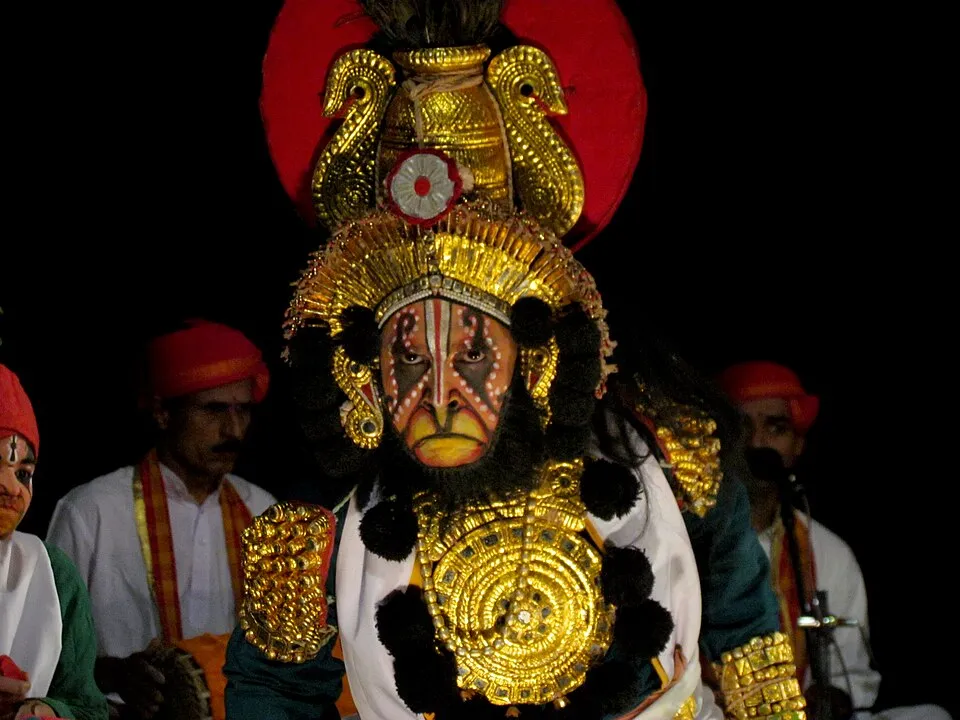

A performance usually takes its story from the great poems, the Kavya, and from the Puranas. Wikipedia says that all of it is improvised: the music, the dance and the dialogue. Depending on the skill and learning of the actors, there will be more or less dialogue, and it is not unusual for actors to get into philosophical debates.¹ Its melodies are linked to different times of the night, through which the performance runs.¹
Where it came from
Nobody knows exactly. Wikipedia says that experts place its origin somewhere between the 11th and 16th centuries, and that it is believed to have grown out of proto-classical music and Sanskrit theatre during the Bhakti movement.¹
The earliest written evidence is an inscription of 1556 at the Lakshminarayana Temple in Kurugodu. It records land given to the performers of the art, so that people could enjoy tala maddale programmes at the temple.¹ A palm-leaf manuscript of 1621 describes the sabhalakshana, and a Virata Parva by the poet Ajapura Vishnu was found on a palm leaf at Ajapura, present-day Brahmavara.¹ By the time of the poet Parthi Subba, around 1600, it was already an established art.¹
Two styles
There are two main regional styles.¹
Tenkutittu, the southern style, is found in Dakshina Kannada, Kasaragod, the western parts of Coorg and some parts of Udupi district. Wikipedia says it shows the influence of Karnatic music, and is known for its high-flying dance steps, its spins and its larger-than-life demons. The Dharmasthala and Kateel Durgaparameshwari troupes, which Wikipedia calls the two most popular, have helped to make it known.¹
Badagutittu, the northern style, is found in Uttara Kannada and the northern part of Udupi district, from Kundapura to Byndoor. It places more weight on facial expression, spoken dialogue and dances that suit the character.¹
The words behind it
Every performance is built on a prasanga, a set of poems written to be sung as a musical drama. The poems use well-known Kannada metres, along with its ragas and talas. The oldest surviving prasanga books are believed to date from the 15th century, and there is evidence that oral compositions were in use before that.¹ The verses are therefore in Kannada metres, even in the Tulu country. That is why this page sits beside Kambala, not beside the sung Tulu epics.
Where it meets the Tulu epics
The two traditions do touch. B. A. Viveka Rai notes that the Koti-Chennaya epic has been adapted for drama, Yakshagana folk theatre and cinema, and that these forms are used to popularise it.² This is the clearest case of a Tulu oral epic passing into a Kannada stage form. The epic itself is covered on The Koti-Chennaya Paddana.
Today
In the 20th century Shivarama Karanth, the writer, experimented with the form. Wikipedia says he introduced Western instruments, cut a performance from 12 hours to under three, and added ideas from films and from Shakespeare. Women now perform in Yakshagana too.¹ Wikipedia also reports about 30 professional and about 200 amateur troupes, who tour between November and May, giving some 180 to 200 shows a season.¹ The festival season ends on Pattanaje, the day by which the troupes are expected to have wound up.
Related
- The Koti-Chennaya Paddana: A Fourteen-Hour Epic, the Tulu epic that Yakshagana has taken up
- Pattanaje: The Day the Festival Season Ends, the day the season’s performances are expected to be over
- Kambala: The Coast’s Buffalo-Racing Festival, the other great spectacle of the coast
- Pili Vesha: The Tiger Dancers of Dasara, the tiger dance of the festival season
Sources & further reading
The books and articles behind the numbered notes on this page.
- Wikipedia, “Yakshagana” (checked 9 October 2026): the definition and regions, the name, the himmela and mummela, improvisation, the 1556 inscription and other early evidence, the two styles, the prasanga, Karanth’s changes and the number of troupes.
- B. A. Viveka Rai, “Epics in the Oral Genre System of Tulunadu”, Oral Tradition 11/1 (1996): 163–172: the Koti-Chennaya epic in drama, Yakshagana and cinema.
Wikipedia’s article is written from other sources, and parts of it are marked as needing a citation. The research notes behind this page also cite Karanth’s Yakshagana Bayalata, which we have not opened, and a few claims in them, such as an origin in tribal and spirit worship, are left out because we could not check them.
Words on this page
What the Tulu and other Indian-language terms on this page mean.
- bhagawatha
- The lead singer of a Yakshagana performance, who also directs it.
- chande
- A loud drum used in Yakshagana.
- himmela
- The musicians in a Yakshagana performance.
- maddale
- A hand drum used in Yakshagana.
- mummela
- The dancers and actors in a Yakshagana performance.
- prasanga
- The sung poems on which a Yakshagana play is built.
Themes
Spotted a mistake, or know more about this? Suggest a correction/addition.