Language, Literature & Arts · Language, Script & Literature
The Koti-Chennaya Paddana: A Fourteen-Hour Epic
Most of the songs sung in Tulunadu are short. They are sung at the start of a ritual, or in the paddy field to keep a rhythm. Two stories are different. They are so long that, by the folklorist B. A. Viveka Rai’s reckoning, they form a class of their own, the long epic.
One is the story of Siri. The other is the story of the twin heroes, Koti and Chennaya. This page is about the second one as a work of oral literature: how long it is, where it is sung, and who has written it down. The story itself is told on Koti and Chennaya, the Twin Heroes.
Two long epics
Rai, of Mangalore University, describes the paddana (the sung oral epic or ballad) as the most popular and most widely spread genre in Tulu oral tradition.¹ Most paddanas are tied to a single bhuta, and tell where it came from and how it came to be worshipped in different places. They are sung while the performer puts on make-up before a kola or nema, and only portions are recited.¹
Rai sets apart a second kind of narrative, the long epic. He names two: the Siri epic and Koti-Chennaya, which are “unique in their length, content, performance tradition, and relationship to cultural identity”. His research group recorded both. The Siri epic runs to about 25 hours and Koti-Chennaya to about 14.¹ Wikipedia likewise calls Koti and Chennayya one of the two truly long epics in Tulu.²
Rai points out that hardly anyone had sung such epics from beginning to end. The singer who performed the Siri epic for his project, Gopala Naika, had never sung it in its entirety before. Rai suggests that for a singer like him, the complete epic is a “mental text”, a master version that lies behind every shorter performance, and that it was sung through only for the sake of the recording. He adds that this is the case with most of the oral epics in Tulunadu.¹
Where it is sung
Rai lists nine settings in which portions of the Koti-Chennaya epic are sung.¹
- During agelu seve, a service in the shrines (garadi) of Koti and Chennaya.
- At the annual festival before the shrines, the Baidarle nema.
- While tapping toddy from palm trees.
- While plucking paddy seedlings in the fields.
- At weddings, in the madarangi, the traditional decoration of the hands and feet with colour.
- In a comic theatrical performance, the Purusha dance, which has a page of its own.
- At a marriage or funeral.
- While peeling dried areca nuts.
- In leisure time, for relaxation.
Some of the matches between the song and the setting are clear. Women plucking seedlings sing the episode in which Koti and Chennaya meet their elder sister Kinnidaru, who welcomes her younger brothers joyfully. Rai says that these working women are known for their hospitality, and find an expression for their own feelings in it. At a wedding, the portion sung during madarangi tells how the children, Koti and Chennaya, were brought up by the Ballala, and of their auspicious shaving ceremony. The ritual is held for both the bride and the groom, on the day before the wedding.¹
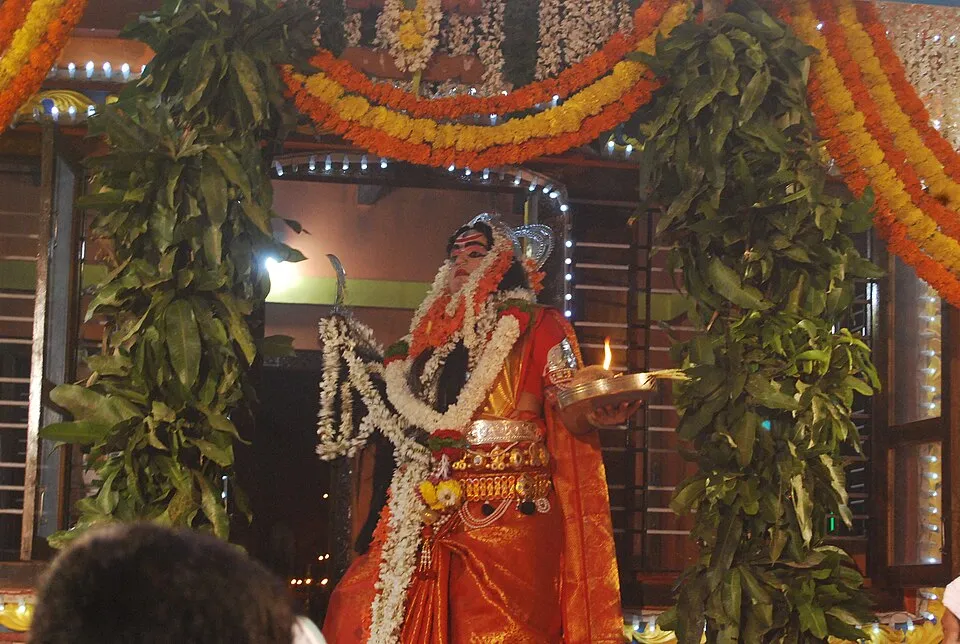
The largest portions of the epic are performed during the Baidarle kola, the ritual in which Koti and Chennaya appear as mythical heroes.¹

A community’s epic
The twins belong to the Baidya or Biruva community, whose traditional work is toddy tapping. In the epic they protest against the Ballalas, the feudal kings, and die in a heroic war, after which they are made daivas. Rai writes that because the twins are Biruvas, the community identifies itself with the Baidarle nema, and regards the epic and its performance as an expression of its cultural identity. He notes that more and more shrines are being built, and that the community is organising itself as a strong cultural unit with the epic at the centre.¹
The epic has also been taken into other forms. Rai names drama, Yakshagana folk theatre and cinema, which he says are used to popularise it.¹ Wikipedia adds that a Tulu film, Koti Chennaya (2007), won at the 54th National Film Awards.²
A comic version
Rai records a different use of the same story, a folk theatre called the Purusha vesha, or Purusha dance. It is not religious in the way a kola or nema is. His colleague Vamana Nandavara collected a version from two Gowda men, Monta and Erappa Gowda, who take the parts of Koti and Chennaya. It runs to about 24 hours. The performance ridicules the traditional folk religion, including the bhuta performances. The men do not recite the whole paddana. The part they perform is sung in alternating lines. Rai says its message is relaxation, not ritual effect.¹ It has its own page.
Writing it down
The epic was first written down in English more than a century ago. A. C. Burnell and R. C. Temple published “The Devil Worship of the Tuluvas: The Song of Koti and Channayya” in Indian Antiquary in 1894, and “The Story of Koti and Channayya” in 1895.² Later editions and studies listed by Wikipedia include Damodar Kalmady’s edition with an English translation by Shankar Narayana D. Poojary (National Folklore Support Centre, 2007), Bannanje Babu Amin’s retelling (Sahitya Akademi, 2009), and papers by Vamana Nandavara and Yogitha Shetty in Indian Literature (2017).²
Related
- Koti and Chennaya, the Twin Heroes, the story of the twins
- The Siri Paddana: Tulunadu’s Longest Oral Epic, the other long epic, and the longer of the two
- Siri, the Princess Who Walked Away, the story of Siri
- Bhuta Kola: When the Spirits Come to the Village, the ritual in which paddanas are recited
- Written Tulu Literature: The Palm-Leaf Manuscripts, on the few Tulu works that were written, not sung
Sources & further reading
The books and articles behind the numbered notes on this page.
- B. A. Viveka Rai, “Epics in the Oral Genre System of Tulunadu”, Oral Tradition 11/1 (1996): 163–172 (read in full): the long epics, their lengths, the nine settings, the Biruva community, and the Purusha dance.
- Wikipedia, “Koti and Chennayya” (checked 9 October 2026): the epic as one of two long Tulu epics, the film, and the list of editions and studies.
Rai wrote in 1996, so his figures and examples describe the tradition as he found it then. We have not opened Burnell and Temple’s articles, Kalmady’s, Amin’s, Nandavara’s or Shetty’s works themselves, and name them only as Wikipedia lists them.
Words on this page
What the Tulu and other Indian-language terms on this page mean.
- daiva
- A guardian spirit; used interchangeably with bhuta.
- garadi
- A shrine to the twin heroes Koti and Chennaya; the word also means a gymnasium.
- madarangi
- The decoration of a bride's and groom's hands and feet with colour, the day before a wedding.
- nema
- Another name for a kola, the annual ceremony for a daiva.
- paddana
- A long oral ballad, sung to tell the story of a daiva or hero.
Themes
Spotted a mistake, or know more about this? Suggest a correction/addition.