Language, Literature & Arts · Language, Script & Literature
Written Tulu Literature: The Palm-Leaf Manuscripts
Most of Tulu’s best-known literature was never written down. The great epics, such as the stories of Siri and of Koti and Chennaya, were sung and remembered. Yet a few books were also copied onto palm leaves, in the Tigalari script, and some of those survive.
This page is about them: what they are, how they were found, and why nobody can say for certain how old they are.
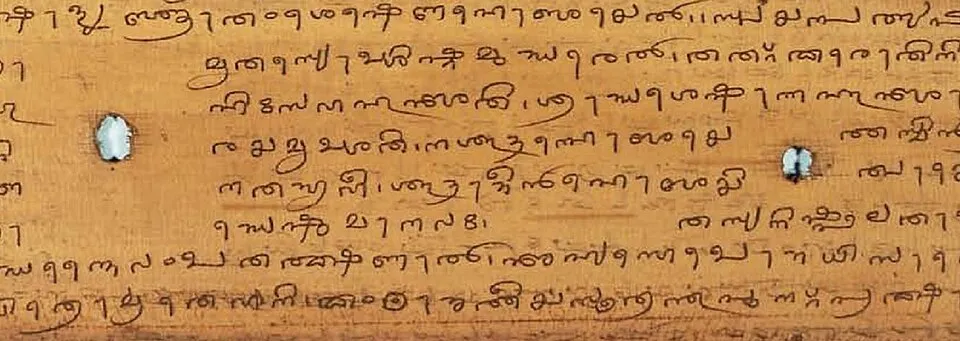

The five texts
Devi Mahatme. A Tulu version of the Sanskrit Saptashati, the verses in praise of the goddess. The Shivalli Brahmins website calls it the oldest Tulu work available.¹ It says the language has features that are not found in Tulu today, such as the use of the passive voice, and it dates the work to about 1200 CE.¹ Wikipedia gives the same date, 1200.²
The Tulu Mahabharato. A retelling of the Adi Parva, the first book of the Sanskrit Mahabharata. Its poet is named Arunabda, or Arunabja, who lived at Kodavoor near Udupi.¹ It has 1,757 stanzas, of which 883 are in eight-line verses. The poet works in local details, such as 26 musical instruments of the Tulu region, children’s games, the dolls on a wedding altar, folding umbrellas, and the worship of bhutas.¹ Wikipedia calls it the earliest Tulu literature that survives.²
The Sri Bhagavato. A Tulu version of the Bhagavata, by Vishnu Tunga. It has 1,988 stanzas in 49 chapters, grouped into three skandas (books), and it is much shorter than the Kannada and Sanskrit versions. The Shivalli Brahmins site says the missing closing verses suggest that the work has not come down to us in full.¹
The Kaveri. A work on the greatness of the river Kaveri, drawn from the Skanda Purana. Only a part of it has been found, and its author is unknown. The manuscripts were found at the Vitla palace in Bantwal taluk and are now kept at Dharmasthala.¹
The Tulu Karna Parva. A short poem on the defeat of Karna by Arjuna. The Shivalli Brahmins site names its author as Immadi Harihara, also called Hariyappa, a king of Vijayanagara, and reads the opening verses as pointing to about 1385.¹ This is the least certain of the five. It rests on that one source, and a reader’s comment on that website questions the attribution.
When were they written?
The dates differ from source to source, and sometimes within a single source.
- Devi Mahatme. About 1200 CE (Shivalli Brahmins site¹ and Wikipedia²).
- Mahabharato. About 1383 (Shivalli Brahmins site¹). Wikipedia lists “1657 AD” next to the poet’s name and, in the same sentence, says he lived around the late 14th to mid 15th century.²
- Sri Bhagavato. The Shivalli Brahmins site says the poet’s own horoscope verse points to about 1737, but that recent studies put him around 1370.¹ Wikipedia gives 1626.²
- Kaveri. About the end of the 14th century (Shivalli Brahmins site¹). Wikipedia gives 1391 in one place, and in another says the Sri Bhagavato and the Kaveri date from the 17th century.²
The only point on which the sources broadly agree is the order: the Devi Mahatme is oldest, then the Mahabharato.
How they were found
Most of what we know about these books goes back to one man, Dr. Venkataraja Punchitthaya. According to the Shivalli Brahmins site, he found the Devi Mahatme manuscript at the house of Sri Thenkillaaya in Puttur, the Mahabharato at the house of Sri Laxminarayana Kekunnaya at Mundya in Puttur taluk, and the Sri Bhagavato at the house of Sri Narayana Saralaya in Madhooru.¹ In other words, the books were not in a library. They were kept in private homes, and were found one at a time.
What is missing
Our main source for the texts is one website run by the Shivalli Brahmins community, together with Wikipedia. We could not open Tulupedia’s page on ancient Tulu literature, which other notes of ours cite. We have therefore left out details we could not check, such as who edited and published each text.
Related
- The Tulu Language and the Tigalari Script, on the script these books were written in
- Siri, the Princess Who Walked Away, one of the sung epics that were not written down in this way
Sources & further reading
The books and articles behind the numbered notes on this page.
- Shivalli Brahmins, “Ancient Tulu Language” (checked 9 October 2026): the five texts, their poets and stanza counts, the finding of the manuscripts, and the dates it gives. It is a community website, not a scholarly publication.
- Wikipedia, “Tulu language” (checked 9 October 2026): the “Written literature” section, with its list of works and dates.
The research notes behind this page also cite Tulupedia and Boloji, which we could not open and so have not relied on.
Words on this page
What the Tulu and other Indian-language terms on this page mean.
- paddana
- A long oral ballad, sung to tell the story of a daiva or hero.
- Tigalari
- The old script used to write Sanskrit, Tulu and Kannada on the coast.
Themes
Spotted a mistake, or know more about this? Suggest a correction/addition.