Language, Literature & Arts · Language, Script & Literature
The Tulu Language and the Tigalari Script
A palm-leaf manuscript from the Tulu coast can look unfamiliar to a reader of Kannada today. Its script, Tigalari, resembles Malayalam more than Kannada. It was the script of the coast’s Brahmin scribes.
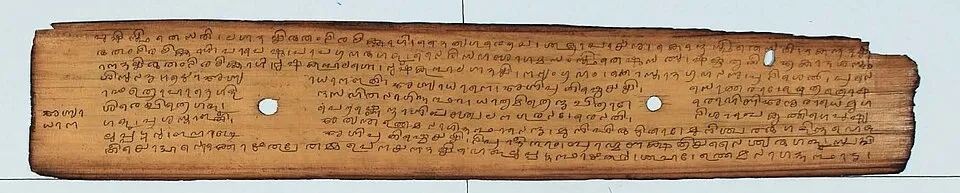

Tulu itself did not disappear. It is still spoken in homes, markets and temples across the coast. But the way it is written, and the question of who writes it, has a history of its own.
Tulu among the Dravidian languages
Tulu belongs to the southern branch of the Dravidian family. Wikipedia says it was the first branch to split from Proto-South Dravidian, the common ancestor of the southern Dravidian languages.¹ How that split is dated is explained on Where Tulu Came From: The Language Before the Texts.
Because it separated so early, Tulu has features that Tamil and Kannada do not. Wikipedia gives one example: it has a pluperfect and a future perfect tense, as French and Spanish do, but it forms them without a helping verb.¹
It is the main spoken language of Tulu Nadu, the districts of Dakshina Kannada and Udupi in Karnataka and the northern part of Kasaragod district in Kerala. The 2011 census counted 1,846,427 native speakers. Wikipedia adds that the true number is hard to know, because Tuluvas who have moved away are often counted as Kannada speakers.¹
UNESCO’s Atlas of the World’s Languages in Danger classifies Tulu as vulnerable.¹ It has no full official status. It is an additional administrative language alongside Kannada in the Dakshina Kannada and Udupi districts, but it has not been declared an official language, and efforts continue to have it included in the Eighth Schedule of the Constitution.¹
The Tigalari script
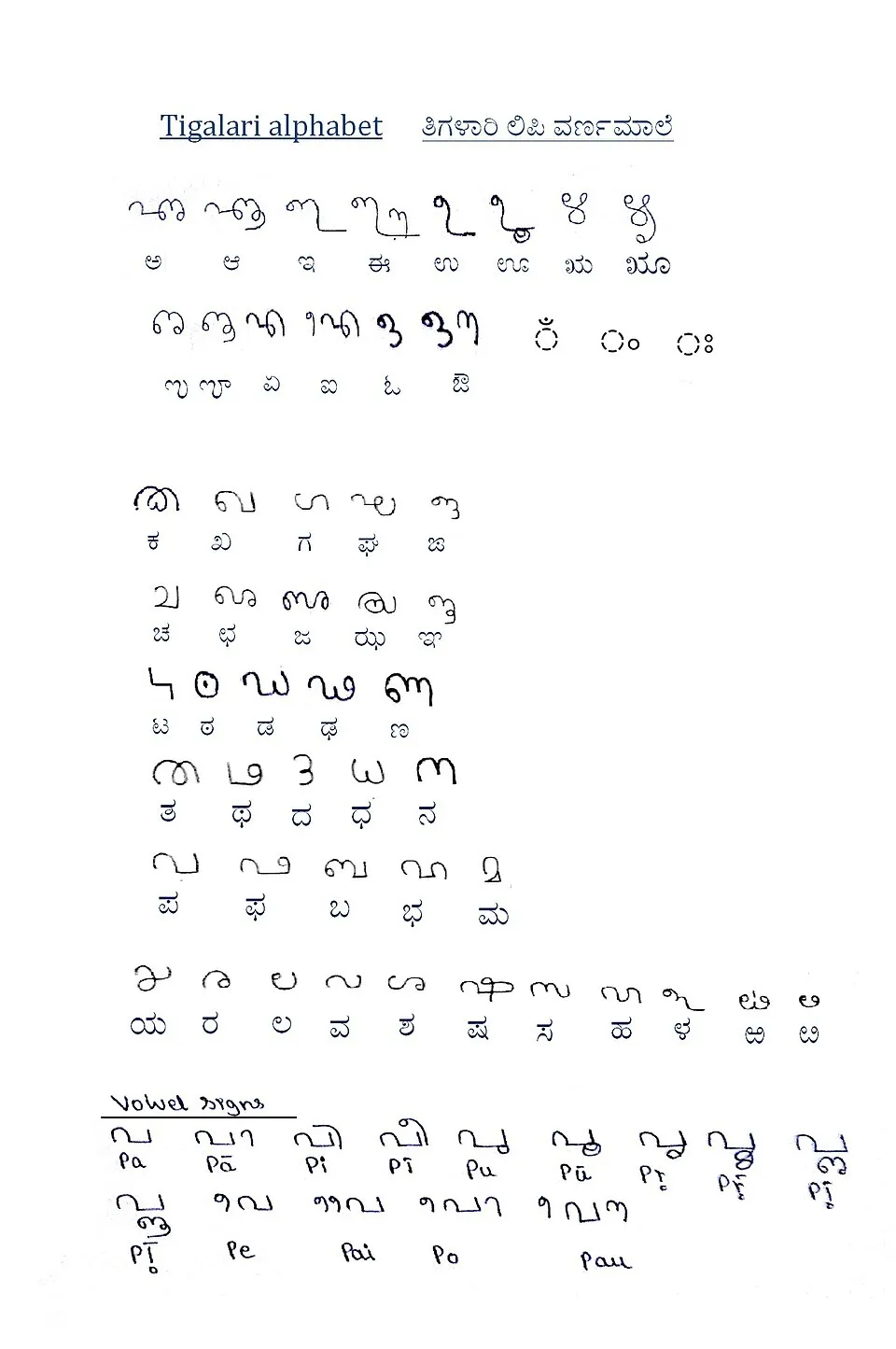

Tigalari is a southern Brahmic script. It was used to write Tulu, Kannada and Sanskrit, and mostly for Vedic texts in Sanskrit.² It grew out of the Grantha script and is a sister of the Malayalam script.²
According to the scholar Arthur Coke Burnell, a form of Grantha first used under the Chola dynasty reached the southwest coast of India in the 8th or 9th century and changed over time in this secluded area.² Wikipedia adds that a single script, which it calls Western Grantha, is assumed to have existed around the 9th and 10th centuries, and later divided into Tigalari and Malayalam.²
The people who used it were Brahmins: Tulu-speaking Shivalli Brahmins, and the Kannada-speaking Havyaka and Kota Brahmins. They wrote Vedic mantras and other religious texts in Sanskrit.² Inscriptions in Tigalari are found around Barkur and Kundapura.¹ The early dates for some of them are argued over, and the page on where Tulu came from sets out what is and is not settled.
The script is still in living use in one place. Wikipedia says that the official script of the eight Udupi monasteries, the Ashta Mathas, is Tulu, and that each new pontiff writes his name in it when appointed.¹
What was written in it
Tulu literature on paper is small beside the great oral tradition. Wikipedia notes that Tulu is one of only five literary Dravidian languages, with Tamil, Telugu, Kannada and Malayalam, but that its written literature is smaller than theirs.¹
Wikipedia calls a Tulu Mahabharato, by a poet named Arunabja, the earliest Tulu literature that survives.¹ Two more works, the Sri Bhagavato and the Kaveri, were also written in this script.¹ The dates given for all of these differ by centuries, and the page on Written Tulu Literature sets out the disagreement. The sung epics of the coast, the paddana (long oral songs), such as the Siri and Koti and Chennaya stories, were not written down in this way. They lived in memory and in performance.¹
What it is called
The script has had several names. In coastal Karnataka it is commonly called the Tulu script or Tulu Grantha script. In Kerala the name is Arya Ezhuttu, or more recently Grantha Malayalam. Manuscript catalogues and many academic works call it Tigalari.²
Gunda Jois, who has studied the script for over four decades, argues from inscriptions, palm-leaf manuscripts and early western scholars that Tigalari is the only name used for it historically. A Tulu Ramayana manuscript in the Dharmasthala archives calls it Tigalari Lipi.² The question of what to call the script is not entirely settled, so this site uses Tigalari and mentions the other names where they matter.
The shift to Kannada print
The Basel Mission arrived in the nineteenth century, and its missionaries wrote about Tulu in print. The missionary J. Brigel wrote in 1872 that Tulu had no literature “in the proper sense of the word”, and that a modification of the Malayalam alphabet was used to write it until the Basel Mission Press introduced the Kannada script for printing in 1834. After that, he says, the Kannada script was generally followed.² A. Männer wrote in 1886 that there was no Tulu literature except some legends on palm leaves, in “Malayalam character”.²
The New Testament was translated into Tulu and printed in the Kannada script in 1847.² Wikipedia, citing the scholar Vaishnavi Murthy, says the introduction of Kannada printing presses contributed to the disappearance of the traditional Tulu script.² Modern Tulu writing today uses the Kannada script. One example is Mandara Ramayana by Mandara Keshava Bhatt, which received the Sahitya Akademi Award.¹
Bringing it back
In September 2024 the Tigalari script was added to the Unicode Standard, in version 16.0. Its block, called Tulu-Tigalari, covers the range U+11380 to U+113FF.¹ Unicode is the system that lets a script be typed, stored and displayed on computers and phones.
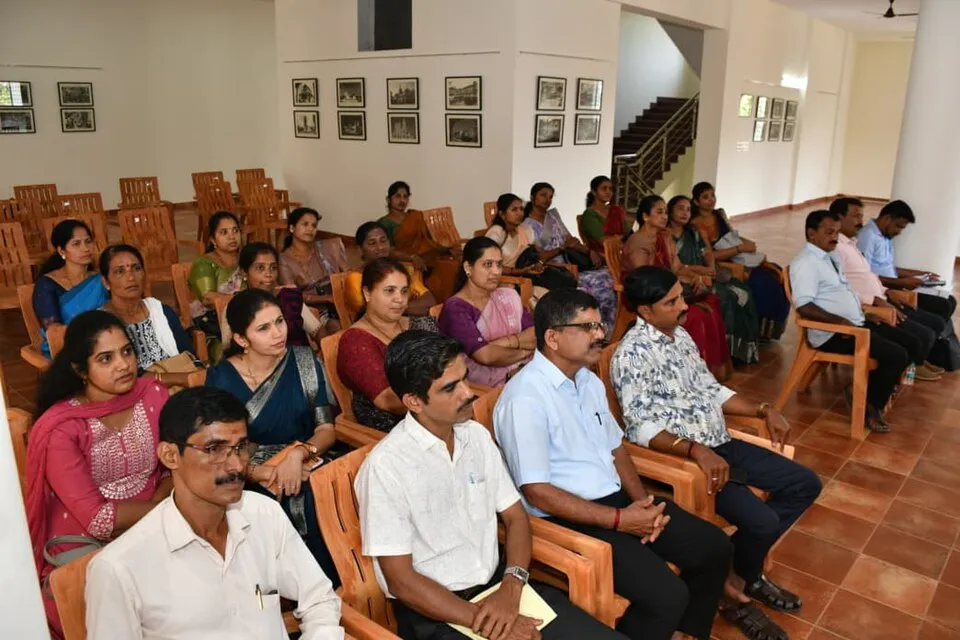
The Karnataka Tulu Sahitya Academy, which the state government set up in 1994, has introduced Tulu (written in the Kannada script) and the Tigalari script in schools across the Mangaluru and Udupi districts. It provides manuals for learning the script and holds workshops.¹ ² The Kerala Tulu Academy was established by the Government of Kerala in 2007 and is based at Hosangadi, Manjeshwar, in Kasaragod.¹ Tulu is also taught at postgraduate level at Mangalore University, and Dravidian University in Kuppam has a department for Tulu studies.¹

What we have left out
Other sources give figures we could not open and check, such as the number of surviving Tigalari documents or of schools teaching the script. We have not repeated them. If you have a source for any of them, we would be glad to hear it.
Related
- Where Tulu Came From: The Language Before the Texts, on how the language branched and the earliest traces of the script
- Siri, the Princess Who Walked Away, a paddana, one of the oral epics that were sung, not written
Sources & further reading
The books and articles behind the numbered notes on this page.
- Wikipedia, “Tulu language” (checked 9 October 2026): the census figures, UNESCO’s classification, the early split from Proto-South Dravidian, the pluperfect and future perfect, Tulu Nadu, official status, the Tigalari inscriptions and literature, the Ashta Mathas, Mandara Ramayana, the two academies, university teaching and the Unicode block.
- Wikipedia, “Tigalari script” (checked 9 October 2026): the script’s use and users, its descent from Grantha, Burnell’s dating, the names for it and Gunda Jois’s argument, the accounts of Brigel and Männer, Kannada printing, and the school programme.
Both are Wikipedia articles, written from other sources, and the research notes behind this page also cite Americas Tulu Association material, Caldwell’s 1856 Comparative Grammar and Brigel’s 1872 Grammar of the Tulu Language, which we have not reopened. Details we could not confirm are left out.
Words on this page
What the Tulu and other Indian-language terms on this page mean.
- Grantha
- An old South Indian script used to write Sanskrit.
- paddana
- A long oral ballad, sung to tell the story of a daiva or hero.
- Proto-Dravidian
- The reconstructed ancestor of all the Dravidian languages, never written down.
- Tigalari
- The old script used to write Sanskrit, Tulu and Kannada on the coast.
Themes
Spotted a mistake, or know more about this? Suggest a correction/addition.