Festivals Through the Year · The Tulu Year, Month by Month
Kural Parba: Welcoming the First Harvest Home
Not every festival needs a drum, a priest or a crowd. In the first days of September, before a single field has been properly harvested, a Tuluva family goes quietly out to its paddy, cuts the first ears of the new crop, and brings them home.
This is Kural Parba. It is one of the plainest festivals in the Tulu year, and one of the oldest in feeling: a family thanking the land before it takes anything from it.
Names and timing
The festival goes by several names. Kural Parba is the one used on this site. Mangalore Heritage writes it as Koral Parba, and it is also called Thene Habba, Thene Parba and Puddar, or illa dinjavune, which means “filling the house with grains”. Around Udupi it is Kadiru Kattuvudu, “tying the paddy ear”, also written Kadru Kattudu or Koral Kattunu.
The name koral comes from a Tamil word, korali, which is another word for the millet called thinai. In Tulu this koral is called thene. Mangalore Heritage draws the link; we have not found more written about what it says of the festival’s age.
It is kept in September, before the harvest of the enel crop (the main monsoon paddy). It usually falls on the day after Cauvery Sankramana, which is the first day of Nirnal in the Tulu calendar. Timing differs from place to place. Deccan Herald says it generally falls during Navaratri, which is considered an auspicious time, so a family in Udupi may keep it a few weeks after one in Dakshina Kannada. On Sankramana day itself, it is customary to make manni, a healthy sweet dish, and some families make it on Ganesh Chaturthi too.
The first ears
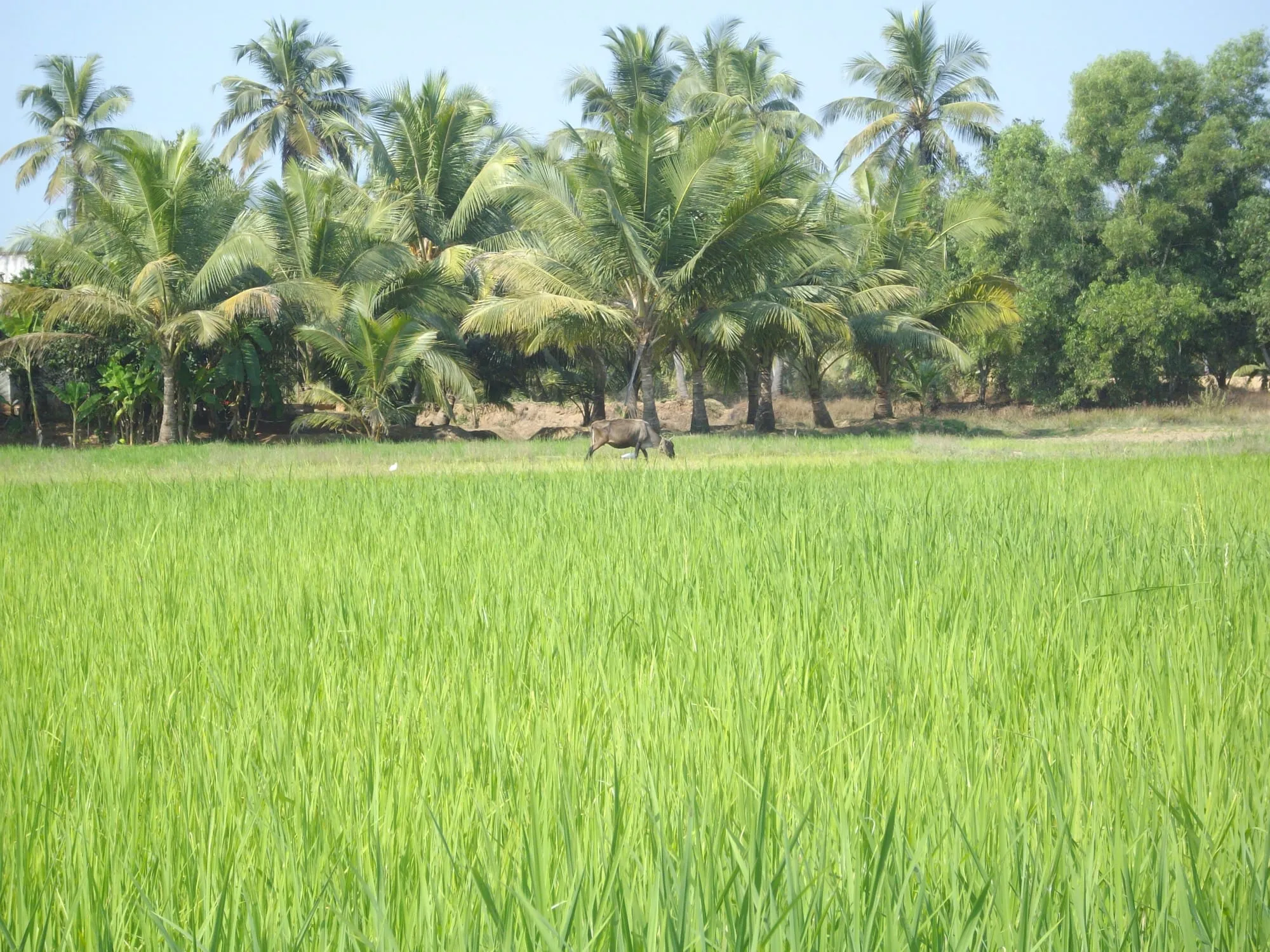

The family bathes early in the morning, cleans the house and the yard, and washes the tools used for farming and housework. Before anyone eats, the men of the family go to the field to bring the koral, the ear of the paddy. The head of the family prays to the crop and the field first, and then cuts the first thene. The others follow him, even the small girls, each with a handful.
The number of ears must be odd: three, five, seven or nine. As they bring them home, they chant Poliyo Poli, a prayer for prosperity and good fortune.
Tying the kadiru
Around Udupi, the day before the festival is a busy one. The house is cleaned and decorated in the traditional way. Deccan Herald, drawing on the Kundapura Kannada dictionary and the scholar Muralidhara Upadhya, adds that on the evening before, the family takes a few paddy saplings from a neighbouring field and plants them in their own, held up by sticks tied in a triangle.
The next day the head of the family offers cucumber pieces to the crop, decorates it with flowers and offers a lamp and incense. The kadiru, the ear or sapling, is carried home in a new basket together with bamboo sprigs, urki plants and mango and jackfruit leaves. A puja is offered with coconut, bananas and vegetables such as cucumber, red amaranth and long beans.
Finally, the kadiru is tied with bamboo, mango and jackfruit leaves, using a rope of coconut leaf sheath, to parts of the house, and in general to the tools used for farming. Kattuvudu, the tying, is also taken to mean uniting and binding, which fits the way the festival draws communities together.
At home, before the shrine
The ears are laid on a banana leaf in front of the Tulasi katte (the raised shrine of the sacred basil plant in the yard) or the family’s household deity, the kuladevatha. The cleaned farming tools are laid beside them. Leaves of mango, bamboo, jackfruit and betel, the skin of the milk tree called aaladamara, flowers, areca nut and vegetables from the field are added.
The whole family prays there for the well-being of the household, the house and the crop. This is called hosthu, or illa dinjavune. Mangalore Heritage describes it as honouring Mother Earth and giving thanks to the grain, mainly paddy.
The new-rice meal
The meal is cooked with an odd number of grains of new rice added to the pot, and the family eats together. This meal is called puddar da vanas, and it has many local dishes. One that must appear is menthe da ganji, a sweet dish of rice and fenugreek seeds.
Before the family eats, the meal is first offered to the ancestors, usually on a banana leaf, with a short prayer from an elder. The full meal is then set outside for a crow to taste. When the crows begin to eat, the ancestors are taken to have accepted it, and the food is served to everyone.
A festival shared across faiths
Both sources say that this is not only a Hindu festival. Deccan Herald writes that people of this region, irrespective of religion and caste, welcome the new harvest to their homes.
Konkani-speaking Catholics keep it too. The Christian ritual is a little different: the community gathers at church, and after prayers each family takes the kadiru home, with sugarcane. They keep it in their place of worship rather than tying it around the house, and they eat a lunch with the extended family. Father Cyril Lobo of Divya Jyothi Institute, Kakkunje, says that families mix new grains, in odd numbers, into milk or other dishes, and even post the new crop to relatives in other cities and countries.
Aboobakkar Karkala, a farmer who has conserved 800 varieties of paddy, shares his crop with Hindu, Christian and Jain families who keep the festival, and once provided 70 varieties to the Udupi Krishna Mutt. He remembers his grandmother tying kadiru to the family’s farm tools, though he says there were few farmers in the Muslim community, so the celebration was rarely seen there.
Kept today
Farming has changed, and so has the festival. Deccan Herald reported in September 2009 on a public celebration of Thene habba in Mangalore, where people of different religions came together to mark it. A speaker there said that most of the farming families who still keep the harvest festival now bring in the new paddy from elsewhere, because paddy farming in the region has fallen sharply.
A separate Deccan Herald feature explains how the festival has coped. As paddy fields disappeared, people came to depend on temples, almost every one of which celebrates the festival, to hand out kadiru as prasadam. Then temples began to run short too. Some people now grow paddy only for the festival, in a small corner of a garden, and some farmers let others take paddy from their fields. In Chantaru, near Udupi, a group of friends called the Mahalingeshwara Geleyara Balaga grew paddy on 40 cents of land and, announcing it on social media, gave crops to nearby temples and to some 500 to 1,000 people. The festival has outlived many of the fields it began in.
Related
- The Tulu Year, Month by Month, where Kural Parba sits in Nirnal
- Aati: Tulunadu’s Monsoon Pause, the monsoon month before the harvest
Sources & further reading
The books and articles behind this page.
- Mangalore Heritage, “Koral Parba – A Significant Celebration Of Tulunadu Region” (27 August 2020): the names, the origin of koral, September and the first of Nirnal, manni on Sankramana, the early-morning cleaning, the odd number of ears and the chant, the banana leaf before the Tulasi katte or kuladevatha, hosthu, the new-rice meal and the offering to the ancestors, and the Christian observance.
- Deccan Herald, “A harvest festival of bountiful celebrations and bonding”: the names Kadiru Kattuvudu and Koral Kattunu, Navaratri timing, the preparations and tying of the kadiru, the temples and paddy scarcity, the Chantaru group, the Catholic observance, Father Cyril Lobo, and Aboobakkar Karkala.
- DHNS, “Different religions join together to celebrate Sauhardha Habba”, Deccan Herald (13 September 2009): Thene habba celebrated by people of different religions in Mangalore, and the remark that most farming families who keep it now source their new paddy elsewhere.
Mangalore Heritage describes the ritual across Tulunadu, and Deccan Herald’s feature describes it in Udupi and Dakshina Kannada, so some details differ by place. The 2009 piece records an interfaith celebration. We could not open two further pages that the research cites, Nature inFocus and a News Karnataka report, because their sites blocked our request, so nothing here rests on them. We did not find a scholarly study or an origin story for the festival.
Words on this page
What the Tulu and other Indian-language terms on this page mean.
- daiva
- A guardian spirit; used interchangeably with bhuta.
- katte
- A raised platform shrine.
- Kural Parba
- The festival of the first ears of new paddy.
- thene
- An ear of new paddy, or the festival named after it.
Themes
Spotted a mistake, or know more about this? Suggest a correction/addition.