Faith & Worship · Temples, Mathas & Basadis · Also in: Stories: Temples and Sacred Places
Karinja: The Hill of Bhima, Arjuna and the Monkeys
Every afternoon, after the main puja, the priests of a hilltop temple put out a heap of hot rice on a stone, and monkeys come out of the forest to eat it.
The leader eats first. People gather to watch.
The hill
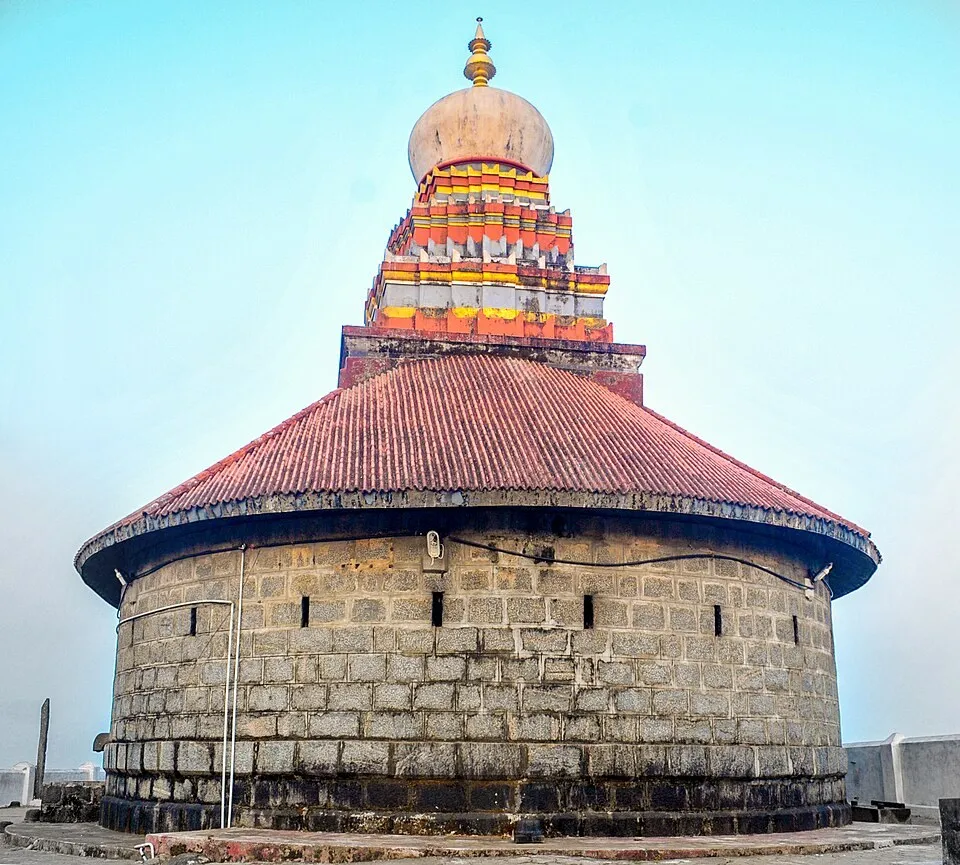

Mangalore Heritage says that the Karinjeshwara temple is 44 km from Mangaluru, near Bantwal, among the Kodyamale hills and forests, about 1,000 feet above sea level. The rock hill has two main temples on two levels, one for Parvati, halfway up, and one for Karinjeshwara, the Shiva temple, at the top. There are several small ponds and a park. The page counts about 355 steps to the top, and says that the Parvati temple can also be reached by road, but that steps are the only way to the hilltop.¹
Wikipedia gives about 600 steps and the same height, and says that the temple lies in Kavalamudur village of Bantwal taluk.² We do not know the reason for the difference in the count. Wikipedia lists Maha Shivaratri, a car festival, Navaratri, Deepotsava and Aati Amavasya among the festivals, and gives the year 1200 CE as the temple’s completion, without a source.²
Mangalore Heritage says that the style of the temple shows both Vaishnava and Jain influence, and that a stone sculpture at the base of the flagpost suggests that the Keladi rulers, who were under Vijayanagara, gave the temple royal support.¹ The temple opens from 9 am to noon, with the Mahapuja at noon, and again from 6 to 7 pm.¹
Bhima’s ponds
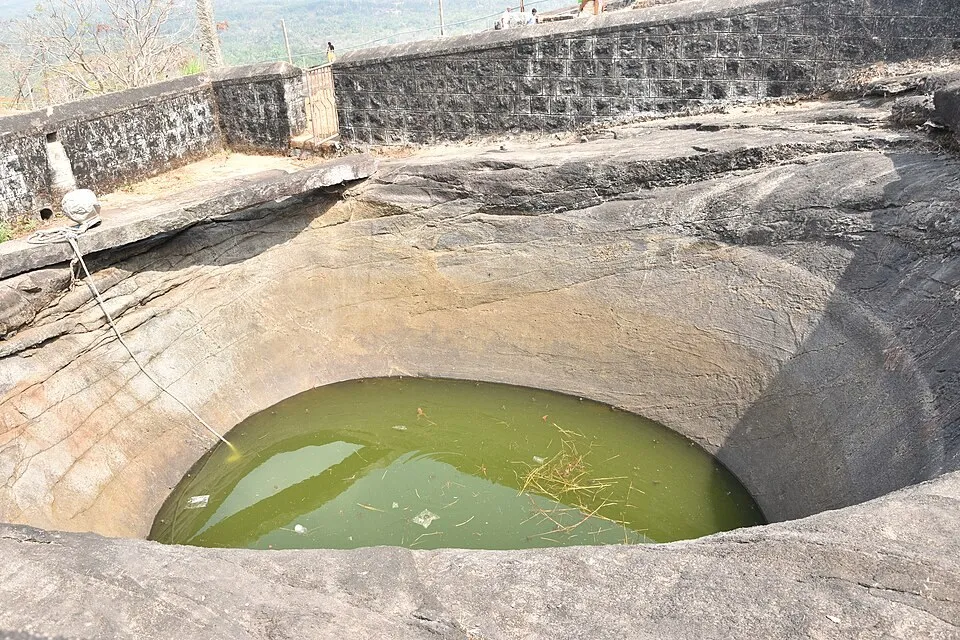

Mangalore Heritage says that Bhima threw his mace on the ground and a pond formed, called Gadha Theertha. His thumb made the Angushta Theertha, and when he knelt, another pond, the Janu Theertha, appeared. The page says the ponds can be seen at the temple, that they supply water to the temple all year, and that a dip in them on certain days is believed to cure skin diseases.¹
Wikipedia names two of the ponds, the Gadha teertha at the foot of the hill and the Ungusta teertha halfway up.²
Arjuna’s arrow
A pond called Handi Kere is found inside the temple, and Mangalore Heritage says it is believed to have been formed when Arjuna shot a pig with an arrow.¹ Our notes tell the whole episode, in which Shiva appears to Arjuna as a hunter, they shoot the same boar, fight, and Arjuna loses, until Shiva and Parvati reveal themselves. That is the story of the Kiratarjuniya in the Mahabharata, and the details come from a blog that we could not open, so we do not give them here.
Four names for four ages
The temple is believed to have stood through all four ages of the world, the page says. It was called Roudra Giri in the Krita age, Bhima Shaila in the Dwapara age, Gajendra Giri in the Treta age, and Karinja in the Kali age.¹
The monkeys
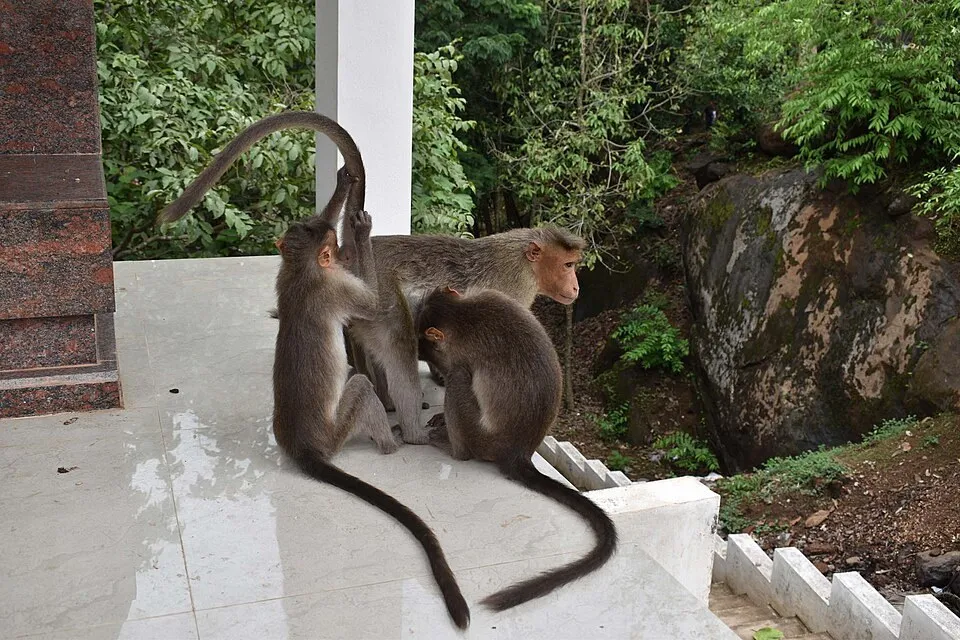

Wikipedia says the hill is home to monkeys, who are revered. Every day after noon a naivedya, a food offering, mainly of rice, is put on a large rectangular stone in front of the Shiva temple, and the monkeys eat it. This is called the Vanara Anna Seva, the monkeys’ rice offering. The leader of the troop, usually called Karinja Dadda, takes the first bite.²
Mangalore Heritage connects the custom to Rama. It says that Rama visited the place with his brother Lakshmana, and that a large amount of rice is offered at the noon puja and then poured on a rock slab in front of the Shiva temple for the monkeys. Many people gather to watch the monkeys come from every side of the forest to eat the hot rice.¹ The page also warns visitors to watch for monkeys on the way up, which try to snatch bags and fruit.¹
Shivaratri
The page says that Shivaratri is one of the most important festivals at the temple. There are elaborate pujas, devotees come from the area around, and the festival lasts four days.¹ The page also mentions the Narahari Sadashiva temple, another hill temple, about 20 km away. Our page on Narahari Parvata tells of it.
What we could not find
- The founding by two brothers. Our notes say that in the 12th century two Brahmin brothers, Karinjattaya and Ichlattaya, came from Uttara Kannada, that one settled at Ichlampady and the other at Karinja, which gave the place its name, and that they gave the temple and their lands to the Bunt families who helped them. The 12th-century date is close to the year Wikipedia gives, 1200, but we could not read the blog the notes cite, and we found nothing else for the story.
- The temple’s builder in Kalkuda’s story. Our notes say folk tradition counts Karinjeshwara among seven temples the sculptor Kalkuda built in a night. We found no source for it, and it conflicts with the brothers’ story. Our page on Kalkuda and Kallurti tells of the sculptor.
- The number of steps. The sources say about 355 and about 600.
- A history of the temple or a record of who runs it. We found none. Wikipedia’s website entry points to a government portal that we did not open.
- A scholarly study. We found none.
Related
- Narahari Parvata: Where Krishna and Arjuna Atoned, another hill temple of Bantwal taluk with a Mahabharata legend
- Kalkuda and Kallurti, the Sculptor and His Sister, the sculptor said to have built seven temples in a night
- Aati: Tulunadu’s Monsoon Pause, the month whose new-moon day is one of the festivals here
Sources & further reading
The books and articles behind the numbered notes on this page.
- Mangalore Heritage, “Karinjeshwara Temple At Bantwal Dedicated To Lord Shiva” (blog; read 9 October 2026): the hill, the steps, the timings, the ponds, the four names, the monkeys and Shivaratri.
- Wikipedia, “Karinjeshwara Temple” (checked 9 October 2026): the location, the steps, the ponds, the festivals and the monkeys.
The first is a blog and the second a short Wikipedia article. We found no scholarly source.
Themes
Spotted a mistake, or know more about this? Suggest a correction/addition.