Festivals Through the Year · The Tulu Year, Month by Month
Bisu Parba: The Tulu New Year
Early on the morning of 14 April, before most of the house is up, someone lights a lamp in the room where the family’s god is kept. Banana leaves are laid out, and on them go a cup of rice, two betel leaves, a half-husked coconut, a bunch of kepula (ixora) flowers and a stick of sandalwood. Around them come vegetables, flowers, fruits, gold ornaments and a mirror.¹
This is the Bisu kani, and it is meant to be the first thing the family sees in the new year. It is the opening of Bisu Parba, the Tulu New Year.
The first day of the year
The Tulu calendar is considered one of the oldest solar calendars in India. Its new year begins on the first day of Paggu, the first of its twelve months, and that day is called Bisu. It falls on 14 April, on Mesha Sankramana, the day the sun enters the sign of Mesha. Deccan Herald says that the elaborate celebration of the day gives it the name Bisu Parba, a festival as significant as Deepavali itself.²
It comes at a turning point in the farming year. Mangalore Heritage describes it as the time of transition between seasons, when Suggi, the last month of the old year, ends and Paggu begins. It is also the time when farmers take up work on the summer crop.³ Wikipedia adds that the day is held to be lucky for starting new ventures.¹
This is the solar new year. Mangalore Heritage notes that the lunar new year, Chandramana Ugadi, is celebrated in March.³
The Bisu kani
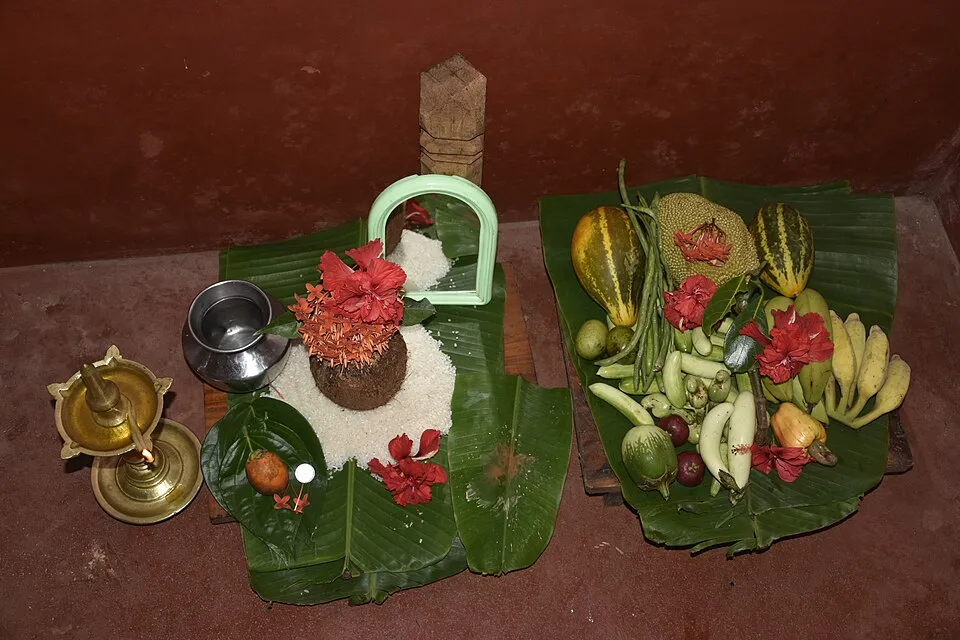

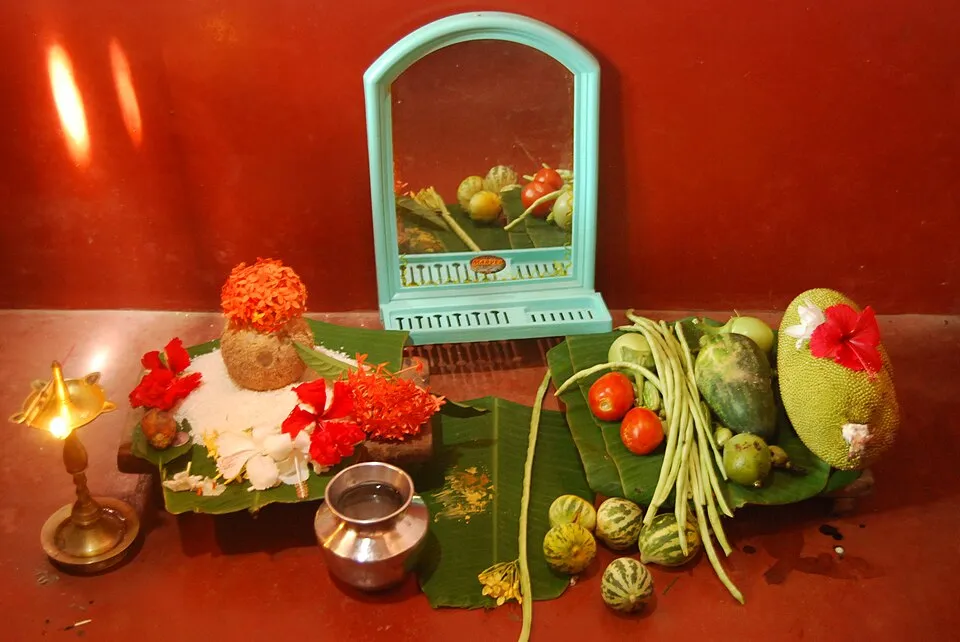

Wikipedia describes how the kani, the display, is made. In the room of the god or the daiva, or in the hall, a foot lamp is lit at each end of a wooden bed or a place on the floor. Banana leaves hold a pot of water, a cup of rice, two betel leaves, a half-husked coconut and a bunch of kepula flowers, along with a stick of wet sandalwood. This arrangement is called suthye dipuna. In front of it are placed vegetables, flowers, fruits, gold ornaments and a mirror.¹
The vegetables and fruit include brinjal, cucumber, pumpkin, ivy gourd, long beans, bottle gourd and okra, and jackfruit, banana, cashew apple, mango and pineapple. Areca nut and coconut, a part of everyday life on the coast, are part of the kani too. Wikipedia adds that in the past, tenants took the vegetables they had grown to their landlords, the danikulu.¹ Mangalore Heritage says that farmers show their thanks to the landowners at Bisu, and the landowners help them in return.³
Rice, coconut, cucumber, gold, fruit and areca nut are offered in the puja.³
The blessing of the elders
Everyone in the house prays together before the Bisu kani. Wikipedia says the day is a time for putting right the relationships in the family and strengthening those between the old and the young. The younger people touch the feet of the elders to receive their blessing, which can be seen in almost every Tuluva family on this day. The elders give money to the children, and everyone enjoys the feast.¹
Special worship is also held in the daivaradhane chavadi (the hall where the daivas are worshipped) and in the temples.¹ Mangalore Heritage adds that farmers who grow vegetables in this season delight in what they have grown, filling their homes with it. They offer prayers for the bounty of nature, and then go to the homes of their relatives and neighbours and eat lunch together.³
The first sowing
Bisu is also the day on which the new farming year begins in the field. Wikipedia says that in the morning, families set aside new paddy seed. In the evening, the sowing is carried out at the edge of the field. The seed is placed beside the mulch and shaded with leaves of the saroli tree (Aporosa villosa). Tenants ask permission to continue the practice of planting in the year that follows.¹
What is eaten
It is a day for resting at home, and for special food. Wikipedia names moode, which is similar to kadubu, and lentil dosas for breakfast. For lunch there is a curry of cashew nut and green gram, cucumber, a dry fry of ivy gourd, and payasa (a sweet milk dish), served with steamed rice.¹
Mangalore Heritage describes a vegetarian feast served on plantain leaves, with salt, pickle, many kinds of vegetable dishes, rice, pappad, mango curry, payasa and jackfruit.³
One date, many new years
Bisu falls on the same day as several other spring festivals. Wikipedia says that Vishu is celebrated on the same date in the nearby Malabar region, with similar customs and a similar meaning, and that harvest festivals such as Bihu, Vaisakhi and Puthandu coincide with it too.¹ Deekaiah, a folk enthusiast who has worked for years to popularise the Tulu calendar, told Deccan Herald that most indigenous calendars start the new year on 14 April: whether it is Bisu, Vishu, Baisakhi or Bihu.²
A calendar that is fading
Deccan Herald reports that the Tulu calendar is known today mainly to elderly people and farmers in rural areas, and that many younger people do not know the names of its months. The festivals and the daiva rites of the year were once planned by the new-moon and full-moon days, and the Sankranti, the day the sun changes sign. Deekaiah has been bringing out a printed Tulu calendar for 15 years.²
The same article mentions Singode, the day after every Sankranti, which Tuluvas consider auspicious. On Singode, they do not give away anything that stands for wealth and well-being.²
Related
- The Tulu Year, Month by Month, where Bisu Parba opens the twelve months
- Kural Parba: Welcoming the First Harvest Home, the festival of the first ears of the new paddy
- Pattanaje: The Day the Festival Season Ends, which falls about six weeks after Bisu
Sources & further reading
The books and articles behind the numbered notes on this page.
- Wikipedia, “Bisu Parba”: the date, the suthye dipuna and the Bisu kani, the blessings of the elders, the food, the first sowing, and the related festivals.
- Bhakti V. Hegde, “A saga of a glorious Tulu calendar”, Deccan Herald: Bisu on 14 April and Mesha Sankramana, the name Bisu Parba, the twelve months, the views of Deekaiah, the fading of the calendar, and Singode.
- Mangalore Heritage, “Bisu Parbha Is An Important Festival Of The Tuluva Culture”: the meaning of the festival, the offering, the date, Suggi and Paggu, the farmers and landowners, and the vegetarian lunch.
These are encyclopaedia, newspaper and heritage-website sources. The ritual details vary from house to house and place to place, so treat this page as a general picture and not a fixed procedure. We did not find a scholarly study of the festival.
Words on this page
What the Tulu and other Indian-language terms on this page mean.
- Bisu kani
- The display of rice, fruit, vegetables, flowers and gold laid out on the morning of Bisu Parba.
- Bisu Parba
- The Tulu New Year.
- Paggu
- The first month of the Tulu year.
- Singode
- The day after every Sankranti, considered auspicious.
Themes
Spotted a mistake, or know more about this? Suggest a correction/addition.