Festivals Through the Year · The Tulu Year, Month by Month
Kangilu: The Full-Moon Dance of the Arecanut Dancers
Not every Tulu festival is held in a temple or a grand procession. Some turn up on the full-moon night as a ring of green-clad dancers, ankle bells jingling, moving from yard to yard. Kangilu is one of these.
It comes in Maayi, the eleventh month of the Tulu year, around March, when the farming year is closing and the new one is about to begin. For those who keep it, the dance is a shield against sickness and bad luck.
A dance in green
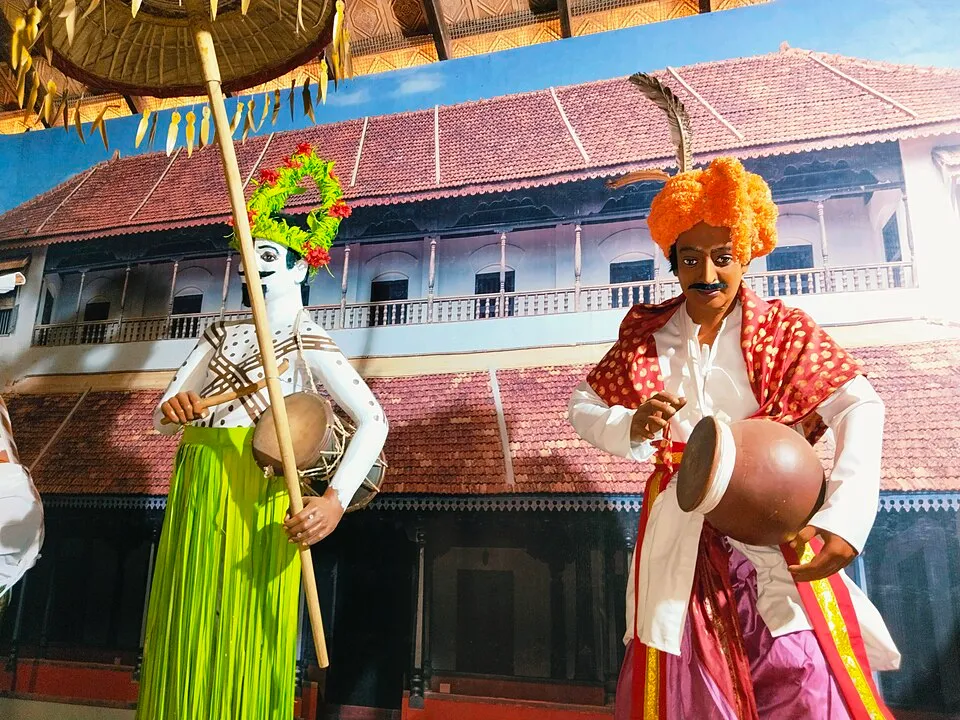

Kangilu, also written Kangeelu, is a spiritual folk dance of Udupi and Dakshina Kannada. It is performed on the full-moon day, pournami, of the Tulu month Maayi, which corresponds to March. It is believed to keep away disease, evil spirits and other negative energy, and to bring peace and a sense of community.
The name is said to come from kang, the Tulu word for the arecanut tree. Mangalore Heritage explains that the dancers wear costumes of arecanut fibre. Wikipedia’s description of the dress differs a little, with palm leaves, so accounts of the exact costume vary. Both agree on the green look and the bells on the ankles. Troupes are small, from about five to twelve dancers, and the dancers use a staff. In some places they also wear a turban or headgear.
The dancers form a circle. Four singers wearing bells stand at the centre and sing, and the rest of the troupe dances to the song. The traditional song is called Karungilo, and a song called Aati Kalenje is sung at the end. The music comes from two traditional instruments, the kaase and the dholu.
A day and a night
The dancers dance in the morning. At night they visit chosen houses of the community and collect alms, mainly grain and other food. The collected grain is cooked into a communal feast.
Before the dance, the dancers worship their deity, who is named as Khadgeshwari, Kadageshwari or Mariyamma. After it, people cook rice and coconut outside their homes and offer it to the goddess. Wikipedia adds that the goddess’s wooden image is carried in procession to the outskirts of the village.
In the middle of the dance, one performer appears in a mask with black paint smeared over the body. People who keep the tradition believe that if the dance is not held every year, trouble will follow.
Who dances
Accounts differ on who performs it. Wikipedia says it is generally the mundaala community of Udupi and Dakshina Kannada, with men dancing in Dakshina Kannada and women in Udupi. Mangalore Heritage names the Mundal and Gowda communities. The names mundaala and Mundal may be two spellings of one name, but we have not found a source that says so.
A second story: Koragajja
Mangalore Heritage also records another version of why the dance is held. In it, Kangilu is an offering to please the spirit Koragajja, who is called on by people in danger and when something is lost.
Kangilu was once held with great grandeur, and Mangalore Heritage notes that the practice is growing weaker.
Related
- The Tulu Year, Month by Month, where Kangilu falls in Maayi
- Koragajja, the Boy Who Was Turned Away, the spirit the dance is also said to honour
- Aati: Tulunadu’s Monsoon Pause, another seasonal folk tradition, with a masked visitor of its own
Sources & further reading
The books and articles behind this page.
- Wikipedia, “Kangilu”: the full-moon day of Maayi, around March; Udupi and Dakshina Kannada; the mundaala community and who dances where; the circle of singers; the songs; the kaase and dholu; the alms rounds and communal feast; and the goddess’s procession.
- Mangalore Heritage, “Kangilu Nalike”: the arecanut meaning of kang and the fibre costume; the full moon of Maayi; worship of Kadageshwari or Mariyamma; five to twelve dancers; the Mundal and Gowda communities; the offering of rice and coconut; the fading of the practice; and the Koragajja connection.
Both sources are tourism and heritage writing, and they may not be fully independent of each other. We did not find a scholarly study. Treat the details as well attested but not deeply cross-checked.
Words on this page
What the Tulu and other Indian-language terms on this page mean.
- daiva
- A guardian spirit; used interchangeably with bhuta.
- kangilu
- A full-moon folk dance in which Koragajja appears.
- pournami
- The full-moon day.
Themes
Spotted a mistake, or know more about this? Suggest a correction/addition.