Language, Literature & Arts · Performance, Spectacle & Sport
Chennemane and the Games of Tulunadu
In the heaviest weeks of the monsoon there is little to do in a Tulu village but wait. The paddy has been planted, the rain keeps people indoors, and the house is full of family. For generations, one answer to that long wait has been a rectangular wooden board, a bag of seeds, and a game that could last for hours.
This page is about that game, Chennemane, and about the other games of the coast, of which far less has been written down.
Chennemane
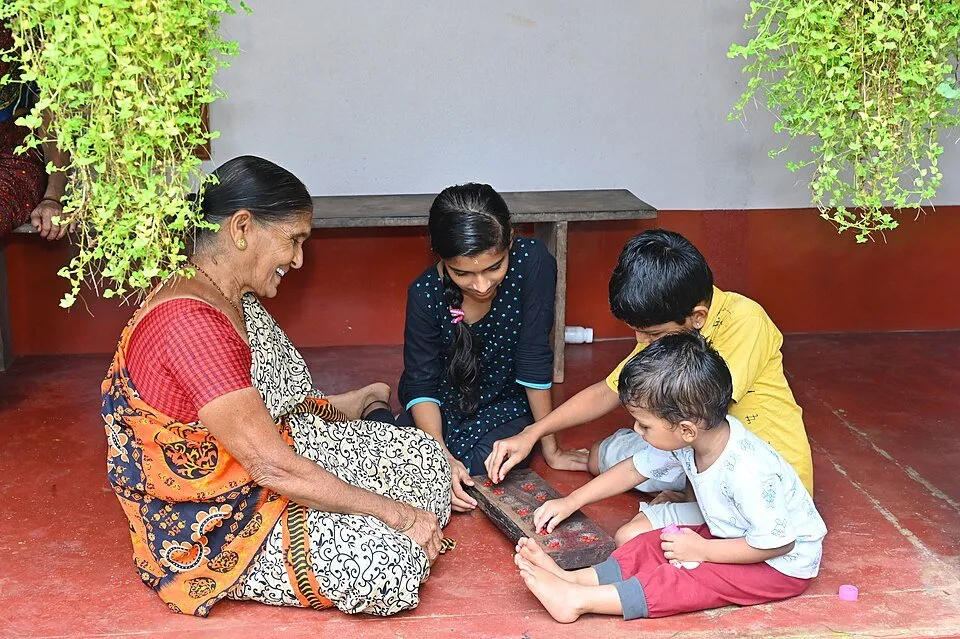
Chennemane, or Chenneda Mane, has been the popular indoor game of Tulunadu during Aati, the monsoon month. A Mangalore Heritage article calls it a symbol of the region’s culture and says it was a game for all ages, “from 3 year olds to 100 years old”, and a way for a family to spend hours together.¹
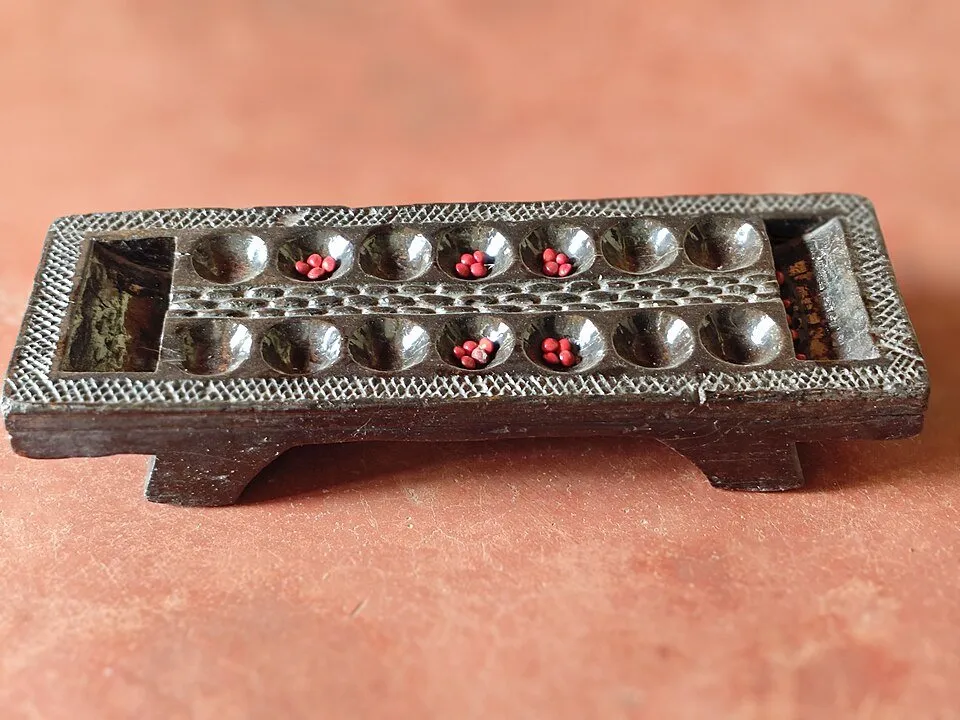

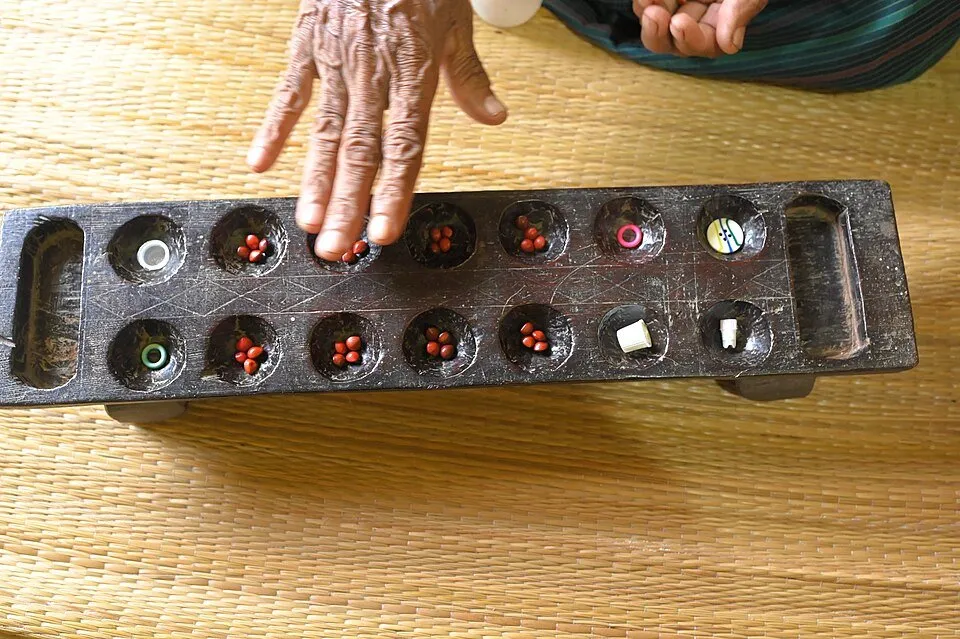
Mane is the Tulu word for the wooden board. It is rectangular, and its design varies from place to place, with no standard measurements. The board in the article has seven pits on each side. The counters are seeds from local trees, such as the coral tree or the manjottikai (gulaguñji), the most common. The seeds are called chennedakai or bithu, and 56 of them are needed to play.¹
Many of the game’s terms come from farming. The article gives bule perga (“the produce earned”) and muguli (three seeds, like the three shoots of a young plant).¹

When it is played
Traditionally the first game of the year is played on the full-moon day of Aati, after drinking metteda ganji or paale kasaya. The game is played until Krishnashtami. The boards are then put away until the next Aati.¹ The article explains the season: farm work is slight in the heavy rains, so people turned to indoor games.¹

The variants
The same article says there are 40 ways of playing. The common ones are:
- Bule Perga, for two players.
- Arasu Aate, for three: a king (arasu), a minister (pradhana) and a tenant (geni). The author reads this as a picture of rulers and tenants in the earlier society, with the tenant paying rent for use of the king’s or landlord’s property.
- Seete Aata, for one player, a game with no end. It is said to be the game that Sita played while she waited for Rama.
Other names the article lists are Joduperga, Kodillkatta, Mantriyata, Ajjinakar, Katari, Mata, Ekkadi, Kompalachenne, Anchil-Bachil, Arate Mukve and Erate Katte.¹ Most people used wooden boards, and the article says that kings of the region had them made of gold or silver.¹
A custom is attached to it: some believe the game should not be played between husband and wife, or between two sisters, because it brings quarrels.¹
The article compares it with Mancala, the African counting-and-capture game, which has six pits on each side to the seven of the Tulu board.¹ In a 2012 lecture reported in the Deccan Herald, Dr Gananath Ekkar said that Chennemane helped to explain the political life, farmers, traders and rulers of Tulunadu.²
Chenne in the Siri epic
The game is in the story of Siri. Her granddaughters, the twins Abbaga and Daraga, quarrel over a game of chenne, and the quarrel ends in their deaths. The Siri Jatre festival acts this scene out. The story is told on Siri, the Princess Who Walked Away, and the festival on The Siri Jatre. In the festival, researcher Yogitha Shetty writes, the priest possessed by Kumara stops the quarrel before the twins re-enact their deaths.³
Other games
Chennemane is the best recorded, but it is one of very many. In the 2012 lecture, Dr Ekkar said that there were “over 168” traditional games played by the people of Tulunadu, each with varieties. He said they were not just entertainment but a way of teaching knowledge and values and building character, and that changing farming patterns changed the games.² He also said the paddana, the oral epics, hold detailed information about the traditional games.²
The Indira Gandhi National Centre for the Arts has a 25-minute documentary, Folk Games of Tulunadu, which looks at three of them: Huli Dana, Juglu and Chini Dandu. Its description says that the games were suited to the region’s geography, that the players’ affection for animals shows in the spirit of the game, and that Huli Dana, which reflects the region’s farming life, is still popular among young people.⁴
Is Kambala a game?
The buffalo race is the sport most people think of. Dr Ekkar’s view was that Kambala is not a game but a tradition, one that shows the farmer’s emotional bond with his land.² It has its own page: Kambala: The Coast’s Buffalo-Racing Festival.
Fading, and being recorded
Mangalore Heritage says that television, phones and online games have taken the place of Chennemane. The boards now sit in lofts or museums, and the craft of making them is fading. Some people still play it, now throughout the year.¹ The games of the coast have been collected in a book, Janapada Aatagalu by Gananath Ekkar, according to the same article.¹ Dr Ekkar suggested giving the traditional games and dances “a modern touch” so that they can be preserved for future generations.²
What we could not find
- The rules of the game itself. We do not have the starting position, how the seeds are sown, or how a player wins. The sources describe the board, the seeds and the variants, but not play.
- Huli Dana, Juglu and Chini Dandu. We know only the IGNCA’s description of the film. We do not know how any of them is played, and we have not assumed that Huli Dana is the same as the Goats and Tigers game played elsewhere in India.
- Children’s games and village sports. A Mangalore University study of the region’s folk games names others, among them Kage-Gili, Jubuli, Lagori, Baleyata and Chendu, but we have not been able to open it. Some are known from a search listing only, so they are left out until we have read it.
- The 168 games. The number comes from a spoken lecture reported in a newspaper. We have not found a list.
- The age of Chennemane. The article connects Seete Aata to Sita, which is a belief and not a date. We found no source that dates the game.
Related
- Kambala: The Coast’s Buffalo-Racing Festival, the best-known sport of the coast
- Kori Katta: Cockfighting in Tulunadu, another traditional contest
- The Siri Paddana: Tulunadu’s Longest Oral Epic, the epic in which the twins play chenne
- Siri, the Princess Who Walked Away, the story of Siri and the twins
Sources & further reading
The books and articles behind the numbered notes on this page.
- Mangalore Heritage, “Chennemane – an interesting indoor game of Tulunadu” (2021; read in full on 9 October 2026): the board, the seeds, Aati, the variants and the customs. A heritage website, and the only source we found with these details.
- Deccan Herald, “Culture of Tulu Nadu influenced by agriculture practices” (16 December 2012): a report of a lecture by Dr Gananath Ekkar on traditional games.
- Yogitha Shetty, “Ritualistic World of Tuluva: A Study of Tuluva Women and the Siri Possession Cult”, Rupkatha Journal on Interdisciplinary Studies in Humanities 5(2): Kumara and the twins’ quarrel.
- Indira Gandhi National Centre for the Arts, “Folk Games of Tulunadu” (documentary, dir. Milind Gaur, 25 min 30 s): the film’s description of Huli Dana, Juglu and Chini Dandu.
Words on this page
What the Tulu and other Indian-language terms on this page mean.
- Aati
- The monsoon month, a pause in festivals.
- kambala
- A buffalo race run through a flooded paddy field.
- paddana
- A long oral ballad, sung to tell the story of a daiva or hero.
Themes
Spotted a mistake, or know more about this? Suggest a correction/addition.