Agoli Manjanna, the Bhima of Tulunadu
Most heroes of the coast are remembered for a war, a curse or a god. Manjanna is remembered for what he ate and what he could lift.
He was strong, hungry and kind, and he is called the Bhima of Tulunadu, after the Pandava brother who was the strongest of them all.
The story
The story below follows one English account, a 2009 page on the Mangalore Taxi website. It says that Panje Mangesh Rao wrote many stories for children about Manjanna, and that all his adventures and achievements were “super human”. Other tellings will differ in places.¹
A child of the goddess
Duggu, the sister of Baggana Adyanthaya of Chelaru Guttu, was married to Narayana Shetty of Kattabalike. For a long time she had no child. She prayed to Ullalti, the goddess of Bappanadu, and she had a son, whom she named Manjanna.¹
He was born at Katla, in the village of Surathkal. The place is now called Manjanna Barke, and the page says that a large slab of stone there is the one his mother used to bathe him on.¹
Manjanna did not have his mother’s love. He lived with his paternal aunt. The page says he ate too much rice at one time, an agoli, a measure it puts at 20 kg, and that this gave him his strength, and his name.¹ He once told his aunt, in a dreamy way, that he wished the Kodinje rock were a kadubu, a steamed rice cake, and the water of Gujjarakere lake were milk.¹
Running the guttu
When Baggana Adyanthaya had to go to war against a neighbouring country, he asked his nephew Manjanna to look after the guttu.¹ That is the custom of the matrilineal families of the coast, the aliyasantana, in which a man’s heir is his sister’s son.
The pig in the leaves
Manjanna had to bring a large load of green leaves to the cowshed every day, and his aunt was never satisfied with what he brought. One day he gathered a heap the size of a hill and carried it on his head, and did not notice that a wild pig was in it. When he put the load down in the courtyard, the grinding stone beneath it sank into the earth. The pig ran out, squealing, and the people around ran into their houses. The page says the stone is now in the Chelaru guttu house.¹
The hay from Panja
Once there was no hay for the cattle, and his uncle sent him to Panja Guttu to fetch some. The people at Panja told him to carry as much as he could. Manjanna remembered that they had taken some bundles of rice from his uncle and never repaid them. He bound the rice into the bundle of hay and carried both home.¹
The first kambala at Mulki
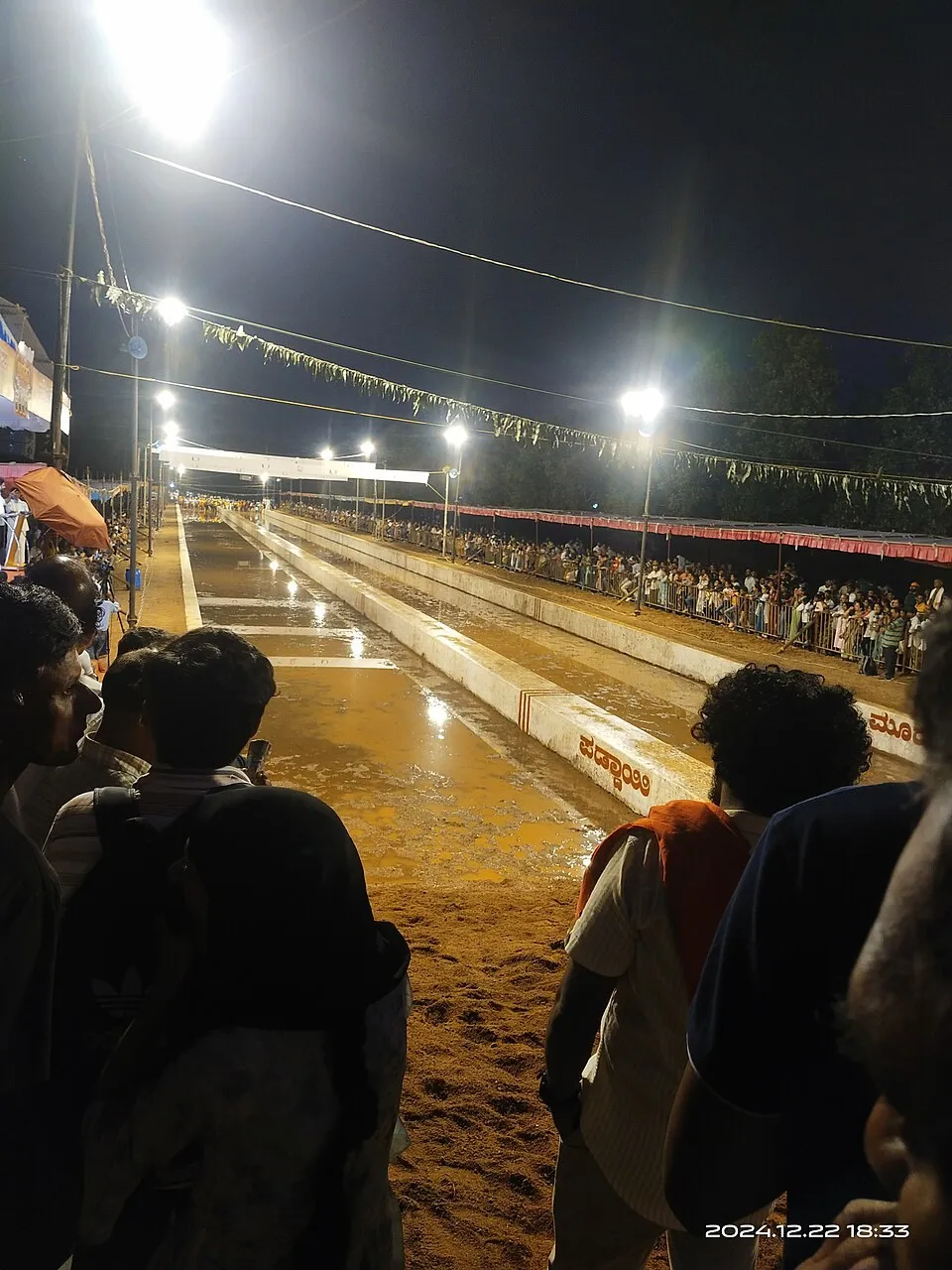

There was no kambala, the buffalo race, in the Mulki region. The king, Dugganna Sawantha, wanted one, but he could not find anyone to do the work of preparing a track, which is not easy. Manjanna came forward. He went to Panambur to measure the track there and learn how the race was run, and then he did the work himself. So he was the person behind the buffalo race at Mulki. The people of Panambur, whose place lost importance, came to hate him, and others were jealous of his strength and hard work.¹ Our page on Kambala describes the race.
The sugarcane and the iron rod
At the festival at Yermal there was a challenge for him. A bundle of sugarcane stalks had an iron rod hidden in it, and it was announced that whoever broke the bundle would win a reward. It was meant to shame him in front of the crowd. But Manjanna knew of the plot. He lifted the bundle and broke it in two, iron rod and all, and the people who had set the challenge slipped away without paying.¹
The slabs at Bappanadu
Manjanna did not take revenge. He wanted to show his strength to the people of Yermal who had cheated him. With one hand he lifted a slab of granite that served as the bridge over a stream at Yermal, and with the other another, and he carried them both to the Bappanadu temple and laid them across the stream in front of it as a bridge. The page says that the two slabs can still be seen in front of the Sri Durgaparameshwari temple at Bappanadu, Mulki, 4 feet wide and 15 feet long, and that today no fewer than fifty strong men would be needed to lift them.¹ Our page on Bappanadu tells of the temple.
The kind of hero he was
The page says that Manjanna was never a ruler, and had no name for learning, skill or cleverness. Like Bhima in the Mahabharata, it says, he used his strength for the public good and never for wicked ends or to wrong anyone, and both men were loyal to their elders. He kept away from envy and jealousy. The page adds that he was not worshipped as a bhoota after his death, as other heroes of his time were, and that, it is said, he picked coconuts by shaking the tree, without climbing it.¹
What is shown today
The page lists places tied to him: Manjanna Barke at Katla, the stone grinder in the Chelaru guttu house, the slabs at Bappanadu, and Manjanna Gudda, a hill by the Kulur–Kavoor road, which the page says was being demolished.¹
What we could not find
- When he lived. Our notes cite a Daijiworld report that puts him about five generations ago. We could not open it, and the account above gives no date.
- Who raised him. Our notes say that sources differ between a paternal aunt and the household of his maternal uncle. The account we read says the aunt.
- How he died. The accounts we have do not say.
- The film. Our notes say a multilingual feature film, Superman of Tulunadu: Agoli Manjanna, was announced. We could not open the report.
- Other tellings. Our notes cite a Tulu-language blog and a travel blog for the Mulki kambala, the Bappanadu slabs and the Yermal episode. We could not open either.
- A scholarly study. We found none.
Related
- Bappanadu: The Goddess and the Merchant Who Built Her Temple, where the two slabs are shown
- Kambala: The Coast’s Buffalo-Racing Festival, the race whose first track at Mulki Manjanna is said to have built
- Kantabare and Budabare, the Twin Heroes of Mulki, other heroes of the Mulki country
Sources & further reading
The books and articles behind the numbered notes on this page.
- “Agoli Manjanna – Bhima of Tulunadu”, Mangalore Taxi (travel website, 17 March 2009; read 9 October 2026): the whole story, the places and the comparison with Bhima.
This is a single informal retelling on a tourism site. We found no scholarly source. For further reading, our notes list Panje Mangesha Rao’s children’s stories about Manjanna, in Kannada, which we have not seen.
Words on this page
What the Tulu and other Indian-language terms on this page mean.
- aliyasantana
- Inheritance through the mother's line.
- guttu
- The ancestral headquarters house of a landed family.
- kambala
- A buffalo race run through a flooded paddy field.
Themes
Spotted a mistake, or know more about this? Suggest a correction/addition.