Faith & Worship · Temples, Mathas & Basadis · Also in: Stories: Temples and Sacred Places
Ananthapura: The Lake Temple and Its Crocodile
Most temples in Tulunadu stand on a hill or a river bank. This one stands in the middle of a lake, and is reached by a footbridge.
It is in Kerala, a few kilometres south of the border, in a part of the coast that was Tulu country for a long time.
The temple in the lake
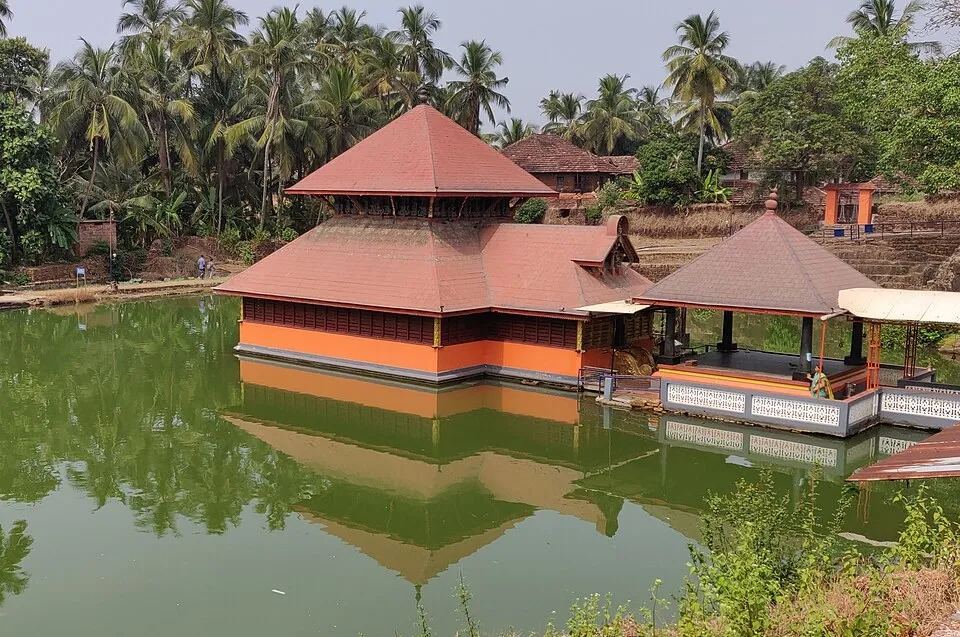

Wikipedia says that the Sri Ananthapadmanabha Swamy Temple, also called the Ananthapura Lake Temple, is in Ananthapura village of Manjeshwaram taluk, Kasaragod district, Kerala. It stands at the centre of a rectangular tank, often called a lake, and is the only temple of this kind in Kerala. The tank measures about two acres. The sanctum, the Namaskara-mandapam, the Thitappalli and the shrine of Jala-Durga are all in the lake, and the Namaskara-mandapam is joined to the eastern rock by a footbridge, the only way to the sanctum.¹
The article says that a spring keeps the lake supplied with pure water, that ruins of temples lie all round it, as evidence that it was part of a larger temple complex, and that the temple is open to all, whatever their religion or caste. The nearest railway station is Kumbla, about 5 km away.¹
The first home of the god?
Wikipedia says that, by some traditions, the temple is the original seat, the Moolasthanam, of Ananthapadmanabha, the god of the Padmanabhaswamy Temple in Thiruvananthapuram. It is considered one of the 108 Abhimana Kshethrams of the Vaishnava tradition. The article also says that a cave in the north corner of the lake is where, in a local legend, the god went all the way to Thiruvananthapuram, which is why the two places have similar names.¹
That is a claim about which shrine is older. We found no source that settles it, and we give it as tradition.
The sage and the child
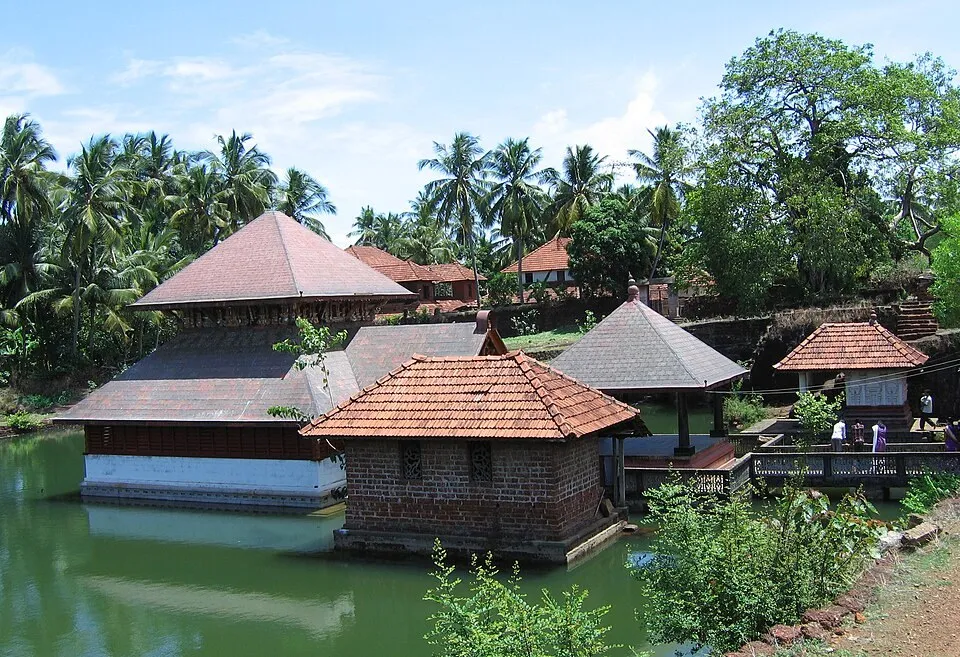

The article gives the legend of the temple. It says the past of the temple is still obscure, except for some myths. The great Brahmin sage Divakara Muni Vilwamangalam did penance and performed pujas here. One day Narayana appeared before him as a glowing child, who said he had no father, no mother and no home. The sage felt pity and let him stay. The boy made one condition: whenever he felt humiliated he would leave at once.¹
The child served him for a while, but his pranks became too much, and the sage reacted violently. Humiliated, the boy vanished, saying that if the sage wished to see him he would have to go to Ananthankat, the forest of the serpent god Ananta. Vilwamangalam, now sorry, found a cave where the boy had disappeared and followed it. It took him to the sea and then south, to a wooded place near the shore, where he saw the child disappear into a huge illippa tree. The tree at once fell, and took the shape of Vishnu lying on a thousand-hooded serpent.¹
The images
Wikipedia says the original images in the sanctum were not of metal or stone but of a mixture of more than seventy medicinal materials called kadu-sharkara-yogam. In 1972 they were replaced by images of panchaloha, a five-metal alloy, given by the head of the Kanchi Kamakoti monastery, Jayendra Saraswathi, and efforts are said to be under way to bring back the old kind. The main image shows Vishnu seated over the five-hooded serpent king Ananta.¹
Babiya
Wikipedia says that Babiya, a crocodile that lived in the lake, was also famed for being vegetarian. It died aged 75 on 9 October 2022. It is believed to have eaten only the temple offerings, served to it twice a week, and never to have harmed anyone. In November 2023 a new crocodile was seen in the lake, much smaller than Babiya, which also seemed peaceful and did not hunt the fish.¹
The age at death is reported differently elsewhere. Our notes say that figures from about 60 to nearly 80 appear in news reports.
Why it is on this site
Ananthapura is in Kerala, in a district where Malayalam is now the official language, and not in Dakshina Kannada or Udupi. Wikipedia’s article on Kumbla gives the reason it belongs here. Kumbla was the seat of the Kumbla dynasty, which ruled the southern part of Tulu Nadu between the Chandragiri and Netravati rivers, from the Maipady Palace. The dynasty had been a vassal of the Kolathunadu kingdom of North Malabar before the Vijayanagara conquests, and had a mixed lineage of Malayali Nairs and Tuluva Brahmins.² Our notes add that Kasaragod was part of South Canara until 1956. The same article adds that Parthisubba, the Yakshagana exponent known as the “Father of Yakshagana”, was born at Kumbla in the 18th century.²
What we could not find
- Who runs the temple. We found no trust, Devaswom board or other record.
- A date for the temple or the legend. Wikipedia gives none.
- The reports on Babiya’s age. Our notes cite news outlets we could not open, and give ages from about 60 to nearly 80.
- A story of three crocodiles in 150 years, including one shot by British soldiers in 1942. Our notes call it folklore from a single lifestyle website, and we found no other source.
- A link with Kudupu. The Kudupu temple has the same god and the same name. We found no source linking the two.
- A scholarly study. We found none.
Related
- Kudupu Ananthapadmanabha: One Shrine, Two Stories, another temple of the same god, with no known link
- Kollur Mookambika: The Goddess and the Mute Demon, another temple at the edge of Tulunadu
- Yakshagana: The Coast’s Dusk-to-Dawn Dance-Drama, the art whose “father” is said to have been born at Kumbla
Sources & further reading
The books and articles behind the numbered notes on this page.
- Wikipedia, “Ananthapura Lake Temple” (checked 9 October 2026): the temple, the tank, the Moolasthanam claim, the legend, the images and the crocodile.
- Wikipedia, “Kumbla” (checked 9 October 2026): the Kumbla dynasty and Parthisubba.
Both are Wikipedia articles, and the first is thinly referenced. We found no scholarly source.
Themes
Spotted a mistake, or know more about this? Suggest a correction/addition.