Faith & Worship · Temples, Mathas & Basadis · Also in: Stories: Temples and Sacred Places
Kollur Mookambika: The Goddess and the Mute Demon
A goddess is named here for a demon who could not speak. The story goes that he was about to be granted anything he asked for, and the words would not come.
The temple is at Kollur, and it is one of the best-known goddess shrines of the south. It lies on the edge of Tulunadu, and most of those who come to it are not Tuluvas.
The demon who lost his voice
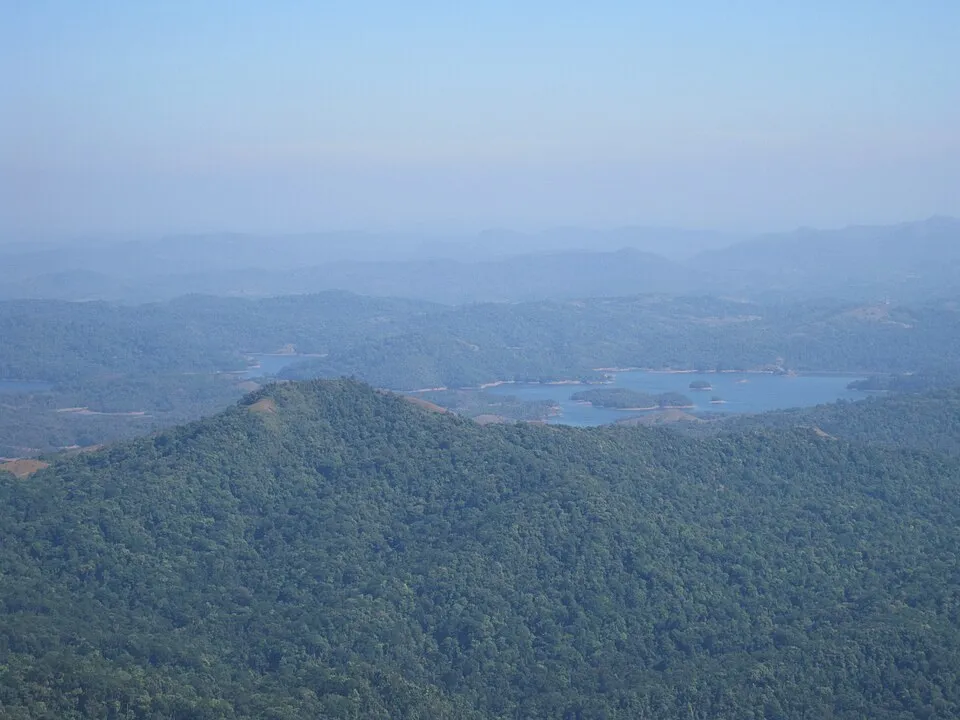

Wikipedia’s article on the temple tells the story this way. The sage Kola Maharishi was doing penance at Kollur when a demon kept troubling him. The demon had been praying to Shiva for powers that would make him invincible. The goddess Shakti knew his evil mind and struck him dumb, so that when Shiva appeared he could not ask for any boon. Enraged, the demon went on harassing the sage, who called on the Divine Mother. The goddess came down and killed him.¹
From then on, the article says, she was known in the region as Mookambika. The demon’s name is given as Mookasura, the dumb demon, and also as Kaumasura, which the article gives as another name for him.¹ A second Wikipedia article calls him Kamasura.²
The story has details that our notes take from other tellings, such as who exactly silenced the demon, a warning from the demons’ teacher that a woman would kill him, and the gods hiding in the Kodachadri forests. We could not open those sources, so we leave them out.
The linga with a golden line
The sage then asked that Shiva and his consort stay at Kollur for ever. Wikipedia says a jyotirlinga, a pillar of light in the form of a linga, appeared with a swarnarekha, a golden line, running through its middle. One half stands for Shiva, Vishnu and Brahma, and the other for Parvati, Lakshmi and Saraswati.¹
The Sringeri monastery gives the same picture and adds some detail. Its page says the line divides the linga into two unequal parts. The smaller right side stands for Brahma, Vishnu and Maheshvara, and the larger left side for the goddess, who holds the powers of Mahakali, Mahalakshmi and Mahasaraswati. It dates the legend to the 28th Dwapara Yuga of the present age of the world, and says the linga came into being after Mookasura was killed.³ The Sringeri page also says that before Adi Shankara’s visit the devotees worshipped only the linga.³
Wikipedia adds a sequel. After Mookasura died, the goddess is said to have done a rite of destruction, marana homa, and to have blessed the demon’s soul, so that he is worshipped as Brahmalingeshwara at Maranakatte, about 20 km away. The name Maranakatte means, roughly, the place of death.¹
The image behind the linga
Behind the linga stands the figure of the goddess. Wikipedia says she is of panchaloha, a five-metal alloy, seated in the lotus position on a lion, with four arms. Two hold a conch and a discus, and the other two make the gestures of fearlessness and of granting wishes.¹ ²
The two sources do not agree about how she came to be there. The temple article says Adi Shankara installed her.¹ The Mookambika article says he is regarded as having found an image that matched the goddess and set it up behind the linga.² The Sringeri page says that he did penance at Kollur, saw the goddess in a vision, and asked the Vishwakarmas, the craftsmen, to carve an image of what he had seen.³ No source gives a date.
The goddess who stopped
The second legend is also about Shankara. Wikipedia’s article on Mookambika says he wanted to build a temple to the goddess in Kerala, and did penance to please her. She agreed, on condition that he lead her there without looking back. He agreed, but at Kollur her anklets stopped jingling, and he looked round. Because he broke the condition, she stayed where he had turned. In return for his austerities, the goddess agreed to be present also at the Chottanikkara temple in Kerala, which is why, the article says, the doors of Chottanikkara are opened just after those of Kollur.²
The temple and its worship
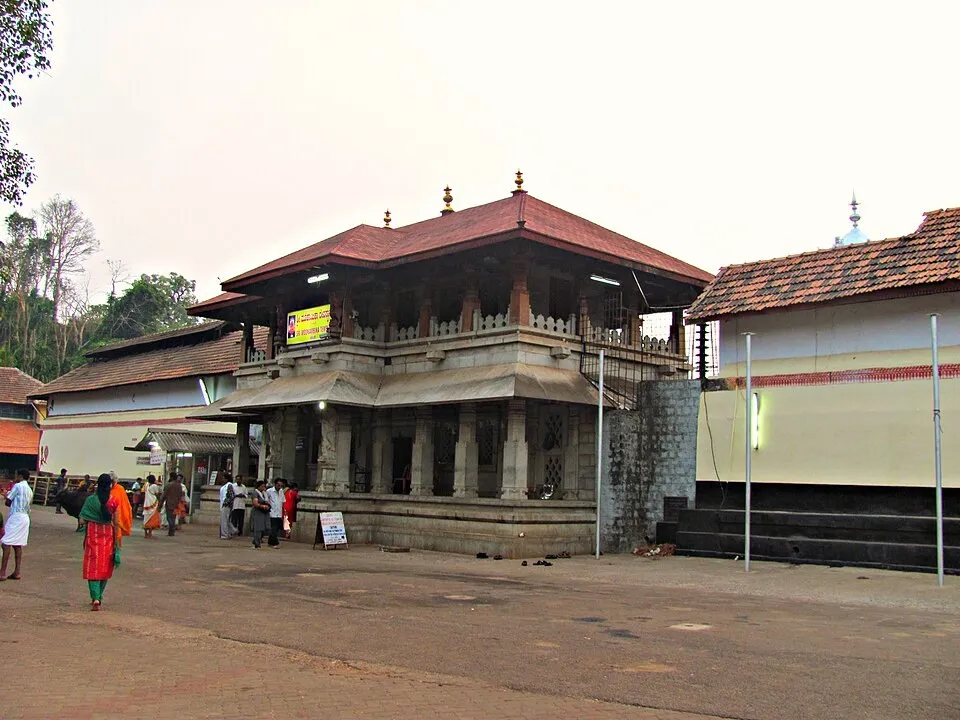

The temple lies at the foot of the Kodachadri hills on the south bank of the Sauparnika river. Wikipedia says it is among the 108 Durgalayas and 108 Shivalayas, and that it lies in the land between Gokarna and Kanyakumari that Parashurama is believed to have made.¹ Our Parashurama page counts it among the seven holy places on his land.
There are small shrines for Ganapati, Shiva, Vishnu, Hanuman, Subrahmanya, Virabhadra and the serpent gods. The main festivals are the Rathotsava, the car festival, in the month of Phalguna, and Navaratri in Ashwin.¹ The goddess is honoured as Saraswati in the morning, Lakshmi at noon and Parvati in the evening.²
Wikipedia says that most of the devotees are from Kerala, though the temple is in Karnataka, and that it is one of the shrines most visited by Malayalis of every religion and caste.¹
The Sringeri connection
The Sringeri monastery’s page describes its tie to Kollur. It says that a ruler of Keladi, in the Shalivahana year 1552, used to visit Sringeri and asked the Jagadguru to bless his land. The Jagadguru came, went on to Kollur, and composed the Sri Mookambika Stotram there. By the usual conversion, that year is 1630 CE.³ Our notes have given 1552 as a date in the common era, which cannot be right.
The page says later heads of the monastery have visited, a marble statue of Shankara was placed in the temple by the present Jagadguru, a kumbhabhishekam, the rite of renewal, was done by him, and in 2005 he gave the temple a golden chariot. Each Navaratri, it says, the monastery offers the auspicious materials for the Suvasini puja, a rite for married women. And when a new priest takes charge as uttara adhikari, he goes to Sringeri for the Jagadguru’s blessing.³ We have only the monastery’s own word for all this.
What we could not find
- The 1481 inscription. Our notes say an inscription of 1481 already calls the goddess Adi Shakti in the form of a linga. We could not open the temple’s website and Wikipedia does not mention it, so we have left it out.
- The Keladi patronage. Our notes name Sankanna Nayaka and Shivappa Nayaka as renovating the temple, and a plunder of it in the 1750s. We found no source for either.
- Who runs the temple. Our notes call it a state-notified temple under Karnataka’s endowments law. We did not open the government portal, so we say nothing on how it is run.
- The founding date. Wikipedia’s infobox gives about 800 CE and a founder, King Halugallu Veera Sangayya, without support in the text. We do not repeat them.
- The fuller legend. Details such as the warning from the demons’ teacher are in sources we could not open.
Related
- Parashurama and the Making of the Coast, which counts Kollur among the seven holy places of his land
- The Mother Goddess in Tulunadu, on Mookambika among the other goddesses of the coast
- Udupi Sri Krishna Matha: Eight Monasteries, One Child God, another temple of the coast with monasteries at its centre
Sources & further reading
The books and articles behind the numbered notes on this page.
- Wikipedia, “Kollur Mookambika Temple” (checked 9 October 2026): the demon legend, the linga, the image, the festivals, the sub-shrines, the Kerala pilgrims and Maranakatte.
- Wikipedia, “Mookambika” (checked 9 October 2026): the veneration, the vigraham found by Shankara, and the legend of the anklets and Chottanikkara.
- Sringeri Sharada Peetham, “Kollur” (checked 9 October 2026): the linga, Shankara and the carved image, and the monastery’s ties to the temple.
Wikipedia’s articles are thinly sourced, and the Sringeri page is the monastery’s own account. We found no scholarly source.
Themes
Spotted a mistake, or know more about this? Suggest a correction/addition.