Faith & Worship · Temples, Mathas & Basadis · Also in: Stories: Temples and Sacred Places
Venkataramana at Karkala: The Tirupati of the West
Karkala is the town of the great Jain Bahubali on its hill, and of the Jain kings who set him there. In the middle of it stands a Vishnu temple that a community of newcomers built, on land the Jain king gave them.
The newcomers brought with them the god of Tirupati. They called the temple’s town “the Tirupati of the west”.
The newcomers
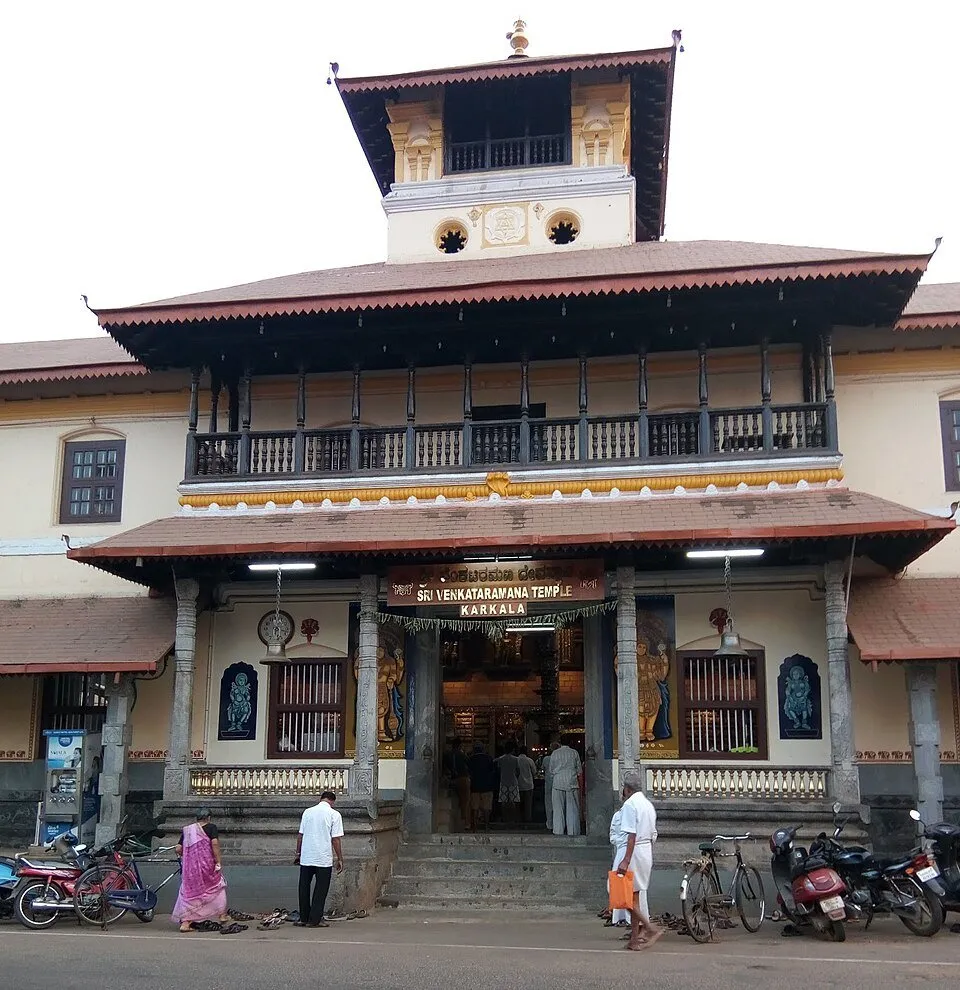

The temple is the work of the Gowda Saraswat Brahmins, or GSBs, of Karkala. Wikipedia says they came from Goa after the Portuguese invaded it, unable to bear the persecution, and scattered along the coast to Karnataka and Kerala. Some settled in Karwar, Ankola, Kumta and Bhatkal, some went to Kerala, and the rest came to Udupi and Dakshina Kannada.¹
The group that came to Karkala is said to have arrived between 1530 and 1550. The first of them to enter was Soire Prabhu, whose great-grandson K. Ramesh Prabhu is named as the temple’s present trustee. Another family that came with them was the Soma Sharmas, and Soma Sharma had been a priest at Tirupati.¹
The land from the Jain king
The article says the Jain Bhairarasa Odeyars ruled Karkala. Some of the newcomers met the Jain kings and told them about the Prabhus, the Sharmas and the GSB priests, and were given leave to stay. The GSBs then went to the Jain king Immadi Bhairava and asked for land to build a temple for Venkataramana. He gave it, with some of the black stone found in the area, and Wikipedia reads this as a sign that the Jains supported other religions.¹
The land was occupied by a woman of a math, a religious house. She agreed to give it up on one condition: that four powerful ganas, the servants of Shiva, be worshipped and given offerings of coconuts, green pumpkins and turmeric, and a yearly sacrifice, or they would be angry. The king and the GSBs said yes, and the temple was built, at first a platform with four pillars and a roof of woven coconut leaves.¹
The idol in the well
Soma Sharma then came back from Tirupati with a second idol of Venkataramana, given to him by the Tirumala priests, and set it beside the first.¹
Dacoits attacked Karkala. The GSBs took their idols and valuables to Mulki and threw them into a well, while the Jain rulers fought the dacoits off. When they went back to the well they could not find the second idol. A man of Mulki found it shining at the bottom and, thinking the god meant to stay at Mulki, installed it in the Veera Vittala temple.¹
The Karkala GSBs hurried to Mulki, but it was too late. That night the idol came to them in a dream and told them to go home. It would come again, it said, with a saint from Tirumala, and with the full power of Tirupati.¹
The hermit from Tirumala
Months later an old man dressed as a hermit came to Karkala with an idol of Vishnu in his bag and asked for a place to rest. That night the Lord of Tirupati came in a dream to the GSBs, and to the hermit. He told the GSBs that the idol was his. He told the hermit to hand it over.¹
The hermit agreed, on one condition: that offerings given to the Lord would be taken to Tirupati from time to time, and the Lord himself taken there once a year. The GSBs agreed. They installed the idol as the dream directed, on 25 April 1537.¹
Dates that do not agree
The dates in Wikipedia’s telling do not line up. It puts the migration to Karkala between 1530 and 1550, and the land grant in 1550, yet gives the installation as 1537. It also puts the dacoit attack in 1500, and the second idol’s arrival from Tirumala at the end of the 14th century.¹ The article says the exact date of the first installation is unknown, because nothing was written down. The temple’s own website says only that it is “an ancient temple having a history of 550 years”.² We have not tried to reconcile them.
The temple today
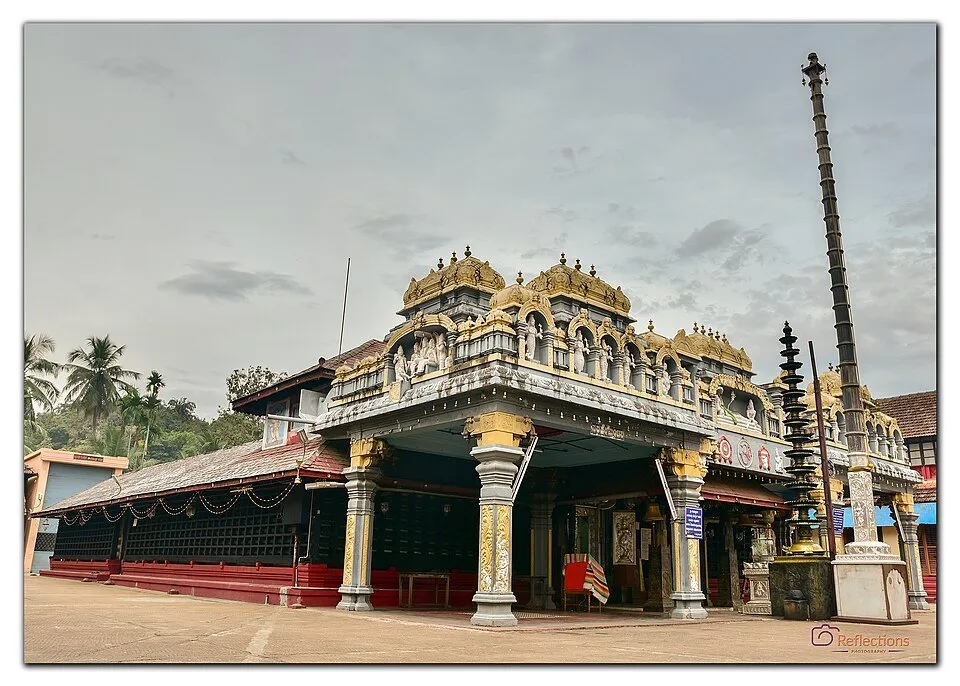

The temple follows the rituals of Tirumala. Its doors open in the morning with the Dwara Puja for Jaya and Vijaya, the door guardians of Vishnu’s heaven, and the Suprabhatam, the hymn that wakes the god. A panchamrita abhisheka, a bathing with five sweet substances, is done to a shaligrama, a sacred stone, where Tirumala does it to the stone image of the god. In the evening there is an outing in the town, and inside the temple five rounds are made with instruments, the Rig and Yajur Vedas, music and a Yakshagana drum and cymbal, and at the end the god is put to bed.¹
Wikipedia says the whole temple was renovated in 1699–1700, with the subsidiary gods Mukhyaprana, Garuda, Lakshmi and Ganapati installed two years later, and again in 2017.¹ Its income comes from offerings, from rented houses and leased land, and from a hall hired out for weddings and cultural programmes.¹ The temple website lists a Gow Shala, an education trust and a Rathotsava, the annual car festival, for which it says no date of origin is recorded.²
What we could not find
- A c. 1450 founding. Our notes credit the temple’s own history page with an original installation around 1450 under Soma Sharma and the Sohire Prabhu family. We could not open that page, and the article gives a different story, so we have left the date out.
- The Rama Dandu. Our notes mention a pilgrimage to Tirupati, last recorded in 1970. We could not find it in either source.
- Immadi Bhairava’s date. The article gives none beyond 1550.
- How the trust is run. We have no source on the trustees beyond the one name.
- A scholarly study. We found none.
Related
- Kalkuda and Kallurti, the Sculptor and His Sister, whose story begins with the king of Karkala and the great Bahubali
- Dharmasthala: The House the Daivas Asked For, another temple looked after by a family, on Jain land
- Moodabidri: Eighteen Basadis and the Thousand Pillars, another Jain town of the coast
Sources & further reading
The books and articles behind the numbered notes on this page.
- Wikipedia, “Sri Venkataramana Temple, Karkala” (checked 9 October 2026): the migration, the Jain land grant, the legend of the idols, the dates, the rituals, the renovations and the income.
- Sri Venkatramana Temple Karkala, temple website (home page; checked 9 October 2026): the “550 years”, the GSB community, the Tirupati rituals, the Gow Shala, education trust and Rathotsava.
Both sources are informal: a Wikipedia article that is long on legend and short on references, and the temple’s own site. We found no scholarly source.
Themes
Spotted a mistake, or know more about this? Suggest a correction/addition.