Faith & Worship · Temples, Mathas & Basadis · Also in: Stories: Temples and Sacred Places
Venkataramana at Kodiyal: The Idol in the Sack
A wandering holy man in Mangaluru in 1804 needed money. He left a sack with a shopkeeper as security, on the understanding that if he did not come back, the shopkeeper could do what he liked with what was in it. The shopkeeper put it in the loft of his shop and forgot about it.
One day, fumes began to rise from the loft. The watchman ran to the shopkeeper’s house to say that the shop was on fire.
The idol in the sack
The temple’s own history page gives two accounts of how the main idol, Lord Veera Venkatesha Swamy, came to Mangaluru, and it calls the second “the widely accepted one”.¹
In the first, a Bairagi, an ascetic or recluse, came to Mangaluru in 1804 with the idol and took shelter in a temporary hut in Car Street, where he worshipped it. Crowds gathered to watch the daily puja, so he moved to lower Car Street. The people there, most of them GSBs, were determined to have the idol for their temple. They went to the respected family of Sowkar Thimmappa Pai, who agreed to get it for them.¹
In the second, the Bairagi had the idol wrapped in cloth in a sack, and left the sack with Sowkar Thimmappa Pai in his shop as security for a loan. If the Bairagi could not repay, the Sowkar was free to use what was inside. The Sowkar did not know what it held, and put it in the loft. Then came the fumes. The Sowkar and his men rushed to the shop and found no fire and no damage, only fumes coming from the sack. When he opened it he found the idol.¹
He carried the idol to his family temple, opposite the Gokarna Math on Car Street, and asked people to look for the Bairagi. The search failed.¹
The swami’s blessing
The family and the community leaders agreed to show the idol to Shrimad Vibhudhendra Thirtha Swami of the Kashi Math Samsthan, who was camping at Manjeshwar. The swami was delighted and declared the idol miraculous. He advised that it be consecrated in the community’s own temple, where Veera Vittala was the presiding deity, for the good of the GSB people.¹
The idol was consecrated on Jyeshta Shuddha Trayodashi of the Rakatakshi Samvatsara, under the swami’s guidance, in a ceremony of three days led by four learned priests.¹ The page gives the year as 1804.¹
The layers of the temple
The history page describes a temple that grew in layers. Its earliest history goes back to the mid-17th century, when the idol of Sri Moola Venkataramana was installed in the shrine. In 1736 a man named Sowkar Mhal Pai consecrated the bronze idols of Veera Vittala and Gopalakrishna. At that time the temple was only a sanctum. The landmark was 1804, when the main idol, Veera Venkatesha Swamy, was consecrated as the Patta Devaru, the chief idol.¹
In 1816, the page says, the temple became known as the Kodial Sri Venkataramana Temple. Ranga Bhat was the Paryaya Archak, the chief priest, and Vittala Acharya the Purana Vachak, the reciter of the Puranas.¹
A list of later steps follows. The 1821 car festival was graced by the presence of Shrimad Sumathindra Thirtha Swami, the next head of the Kashi Math. The temple received a navaratna crown in 1878, its silver palanquin first went out in procession in 1888, the idols of Lakshmi and Ganapati were installed in 1896 and 1898, and work on a small chariot began in 1909. A silver-clad flagstaff went up in 1966, a diamond crown was given in 1977, and a golden palanquin was first seen in 1999. In 2011 the temple was renovated and rebuilt (Jeernodhara), and the deities were reinstalled on 16 January 2012 in the presence of the heads of the Kashi Math.¹
The idol
The main idol is of panchaloha, a five-metal alloy, about 2 feet tall with its pedestal. The temple’s page says that it is in the style of the Vijayanagara period. It carries a sword (katari) at its right waist, and that is where the title “Veera”, the brave, comes from. The page gives a reading of the sword and the bridegroom’s crown on the head: the Lord is on his way to his wedding with Padmavati, and the sword is to drive away anything that blocks his way. The temple also says that tradition has it that the Vijayanagara emperors prayed to the idol before going into battle.¹ We have no source for that tradition apart from the temple.
The car festival
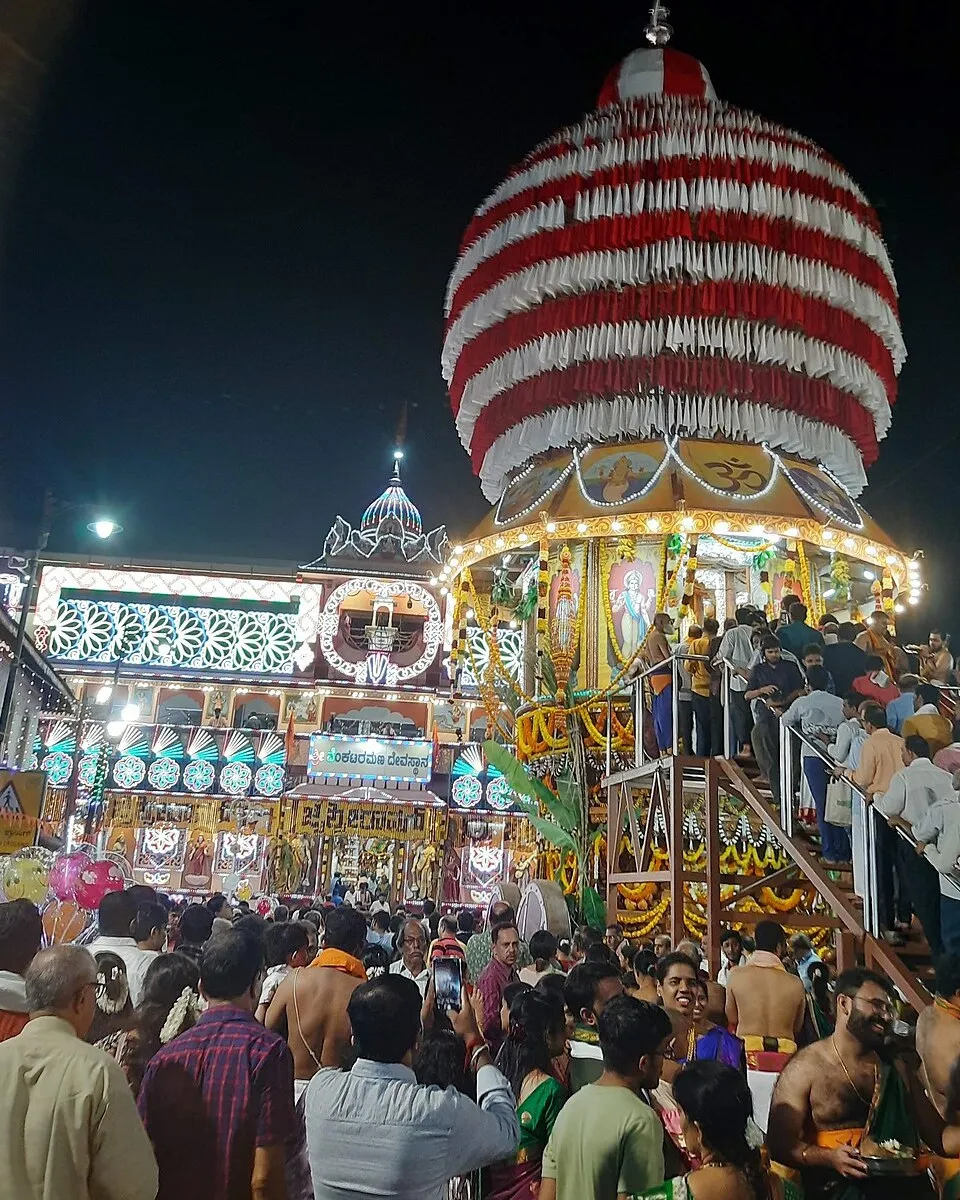

The temple follows the Madhwa Vaishnava tradition of Madhwacharya, in which Vishnu is the supreme being. Its main event is the annual car festival, which runs from Magha Shudda Tadige to Ashtami and draws thousands of devotees.¹ ² The street the temple stands on is called Car Street. The history page records a car festival in 1821, and our notes describe a 200th anniversary in 2021. We could not confirm that figure.
What we could not find
- The 200th anniversary. Our notes cite a Daijiworld report of February 2021. We could not find it, and we could not open the Udayavani report that numbers the 2022 festival, so we give only the temple’s record of the festival of 1821.
- The trusteeship. Our notes say the Sawkar Bappai family were hereditary trustees from 1804 to 1947, after which a rotating paryaya archak and a purana vachak took over. The temple’s pages name a Paryaya Archak and a Purana Vachak only in 1816, and do not mention trustees before today’s, so we have left the change out.
- A link to the Goa migration. No source ties this temple to the GSBs’ move from Goa, so we do not connect them.
- The Deccan Herald account. We did not read the article our notes cite, so the temple’s own page is the only source.
Related
- Venkataramana at Karkala: The Tirupati of the West, the same god, with a different legend, in a Jain town
- Udupi Sri Krishna Matha: Eight Monasteries, One Child God, another Madhwa Vaishnava temple, run by monasteries that take turns
- Kudroli Gokarnanatha: The Temple the Billavas Built, another Mangaluru temple built by a community
Sources & further reading
The books and articles behind the numbered notes on this page.
- Sri Venkataramana Temple, Car Street, Mangalore, “History of Sri Venkataramana Temple” (the temple’s own site; read in full on 9 October 2026): the two accounts of the idol, the layers of the temple, the 1816 name, the 1821 festival, the later milestones and the description of the idol.
- Sri Venkataramana Temple, Car Street, Mangalore, home page (read on 9 October 2026): the GSB community, the Madhwa tradition and the car festival dates.
Both sources are the temple’s own pages. We found no independent account.
Themes
Spotted a mistake, or know more about this? Suggest a correction/addition.