Faith & Worship · Temples, Mathas & Basadis · Also in: Stories: Temples and Sacred Places
Polali Rajarajeshwari: The Clay Goddess and the Football Match
Most temple legends say a goddess appeared. This one says she was made by two men who had lost everything, out of river clay, and that the first thing they did was to put a crown on her.
The temple is at Polali, a village beside the Phalguni river, and on the days of its festival it is also a football ground.
The king and the merchant
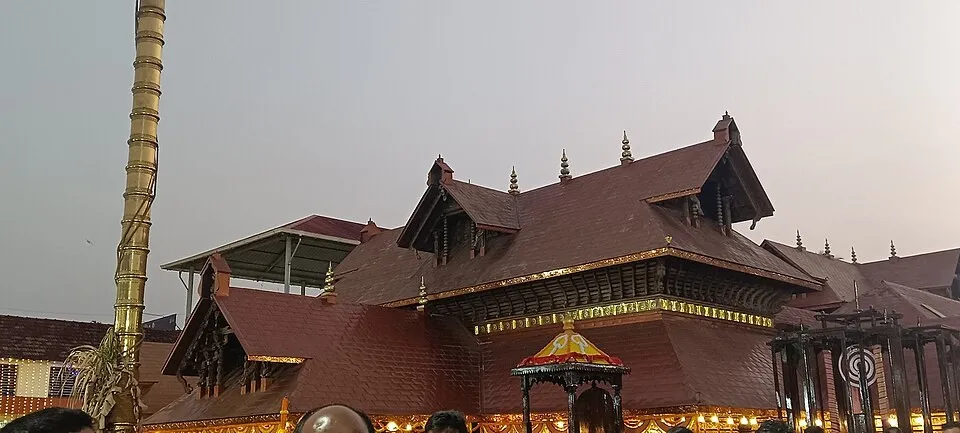

The temple’s own history page says that Shree Rajarajeshwari temple is in Kariyangala village, Bantwal taluk, surrounded by hills and paddy fields, with the Phalguni flowing a short way to its north and turning south behind it.¹ The legend is the story that frames the Devi Mahatme, the text of the goddess’s three battles, which our page on Kateel describes. In that text a king and a merchant, both dispossessed, go to a sage for answers. At Polali, the temple says, they made the goddess herself.¹ ²
King Suratha, the history says, lost a war against a band of hunters called the Kolavidhwamsi, even though they were less powerful. He went home, and his ministers, seeing him weak, took charge of the army and the treasury. Afraid they would hand him over to his enemies, he said he was going hunting and rode off into a dense forest, where he found the hermitage of a great ascetic, Sumedha.¹
The sage took him in. One day, as Suratha walked about mourning his kingdom, wealth, wife and children, he met a merchant, who told him that his wife and children had driven him out for his wealth. The king took the merchant to the sage. Both bowed to him, and the sage told them to worship the Divine Mother as the scriptures lay down, and to ask her blessing.¹
The clay image
Both of them, still grieving for the people who had turned on them, wanted to see the goddess face to face. They chose a spot, not far from the hermitage, from which water had recently drawn back. There they built a hermitage and made an image of the Divine Mother out of clay, with her attendant deities, following the rules of tantra and of sculpture. They repeated the Devi Sooktha and called into the image Chandika, the one form of Mahakali, Mahalakshmi and Mahasaraswati.¹
The history page says that the king installed and worshipped the goddess, and put his own crown on the head of the image.¹ Wikipedia says it is widely believed that Suratha built the temple and gave her a crown studded with jewels.² The part of the story in which the goddess appears and grants their wishes, a kingdom to Suratha and release to the merchant, is not in the part of the page we could read.
The name and the age
The history page says that the place was called Pural and the goddess Porala Devi in several old records and ancient inscriptions, that Puliapura is the Sanskrit form, and that Polali is the Kannada.¹ Wikipedia adds that Pural is said to mean flute in Tulu, and also “changing sides”, which may suit the river’s sharp turn near the temple.²
Wikipedia dates the temple around the clay image to the 8th century CE, on the strength of an inscription found nearby.² The temple’s own site goes further. It says that the temple is mentioned in the Ashokan inscriptions and in the accounts of foreign travellers.¹ It names no inscription, and we found nothing to support it. The history page also admits that the temple’s age cannot be shown from the evidence, and that inscriptions around the temple were probably lost. A few from Ammunje, Kariyangala and the temple itself are in the care of the Karnataka government.¹
The image has changed. Wikipedia quotes a record of 1448 by Abdul Razzak in which the temple was first built of molten brass, and had four platforms. At the top stood a deity 5 to 6 feet high, with rubies for eyes. Today, Wikipedia says, the main image is a stucco figure 10 feet high, made with clay prepared with herbal mixtures. Every twelve years, at a rite called Lepashta Gandha, the images are coated with a soil mixture with eight medicinal properties, prepared hundreds of years ago.²
Polali Chendu
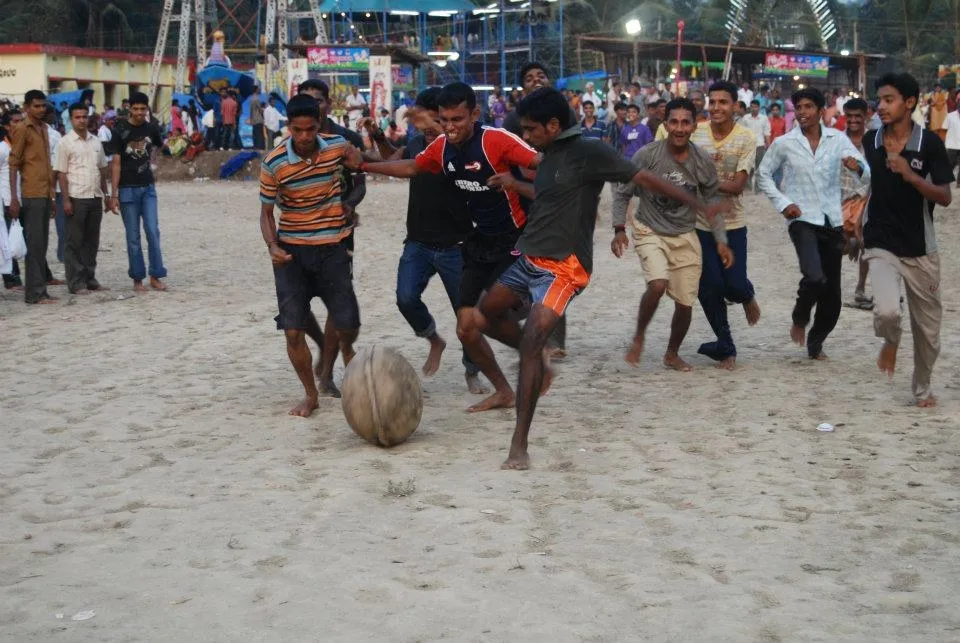

Wikipedia describes Polali Chendu, “the football festival”, as a game in which up to five hundred people may play, and any number may join. The aim is to get the ball to the opposing side. The game stands for the fight of good against evil, and the car festival at the end stands for the victory of good.²
The temple’s site calls Polali Chendu a unique festival, held during the annual festival.¹ Our notes add more: that the two sides are the villages of Ammunje and Manel, that the ball is made each year at Moodabidri, and that the festival was lengthened after the visit of Chennammaji of Keladi in 1679. We could not read the source for those details, and leave them out.
The festival
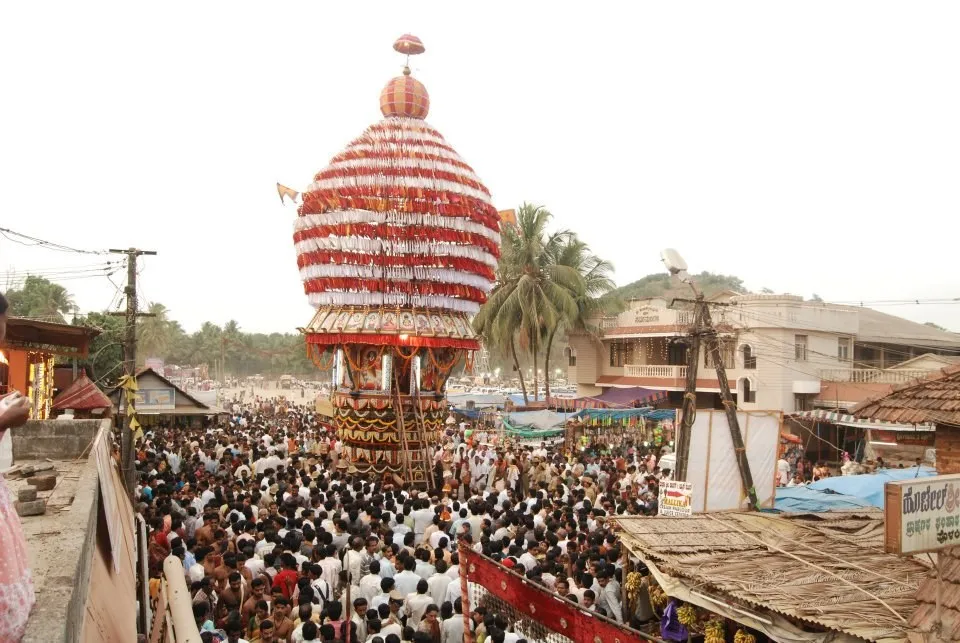

Wikipedia says that the annual festival is in March and lasts a month. During it, the image is placed on a circular crown called Prabhavathi, and on the fourth day it is carried to the Simhasana Katte, a platform about 100 metres from the temple, for a special puja.² The temple’s site says that Chennammaji of Keladi visited Polali and had a great chariot made for the temple.¹
What we could not find
- The goddess’s answer. The part of the history page where she appears, grants the king his kingdom and the merchant release, and the crown is placed, is not in the text we could read.
- The 5,000-year age of the clay image. Our notes call it tradition. We found no source for it.
- The Ashokan inscription. The temple says it is mentioned. We found no inscription named, and Wikipedia only lists it in a box.
- The detail of Polali Chendu. The teams, the ball, the 1679 change and the story of Tipu Sultan’s viewing platform, called Sultan Katte, come from a magazine article we could not open.
- The priests. Our notes say pooja rights have passed from father to son for over 350 years, and that the senior priest is the Pavitrapani, the same title as at Mundkur. We found this in no source we could read.
- The flood of 1446. Our notes say that a flood destroyed the surroundings and spared the sanctum. We found no source.
- A scholarly study. We found none.
Related
- Kateel Durgaparameshwari: The Goddess Who Became a Bee, where the Devi Mahatme is told in full
- Mundkur Durgaparameshwari: The Goddess Who Was Turned to Face East, whose image Suratha is said to have had installed after Polali’s
- Mangaladevi and Sharavu, another goddess temple of the coast
Sources & further reading
The books and articles behind the numbered notes on this page.
- Shree Kshethra Rajarajeshwari Temple, Polali, “History” (the temple’s own site; read in part on 9 October 2026): the legend of Suratha, Samadhi and Sumedha, the clay image, the name, the age and the Ashokan claim.
- Wikipedia, “Polali Rajarajeshwari Temple” (checked 9 October 2026): the name, the 8th-century date, the images, Polali Chendu and the festival.
The history page is the temple’s own account, and Wikipedia’s article rests on tourist websites. We found no scholarly source.
Themes
Spotted a mistake, or know more about this? Suggest a correction/addition.