Faith & Worship · Temples, Mathas & Basadis · Also in: Stories: Temples and Sacred Places
Kateel Durgaparameshwari: The Goddess Who Became a Bee
The goddess of Kateel is said to have won her greatest battle as a swarm of bees.
The story is told on the temple’s own website, and it is also played, night after night, by a troupe that belongs to the temple.
An island in the river
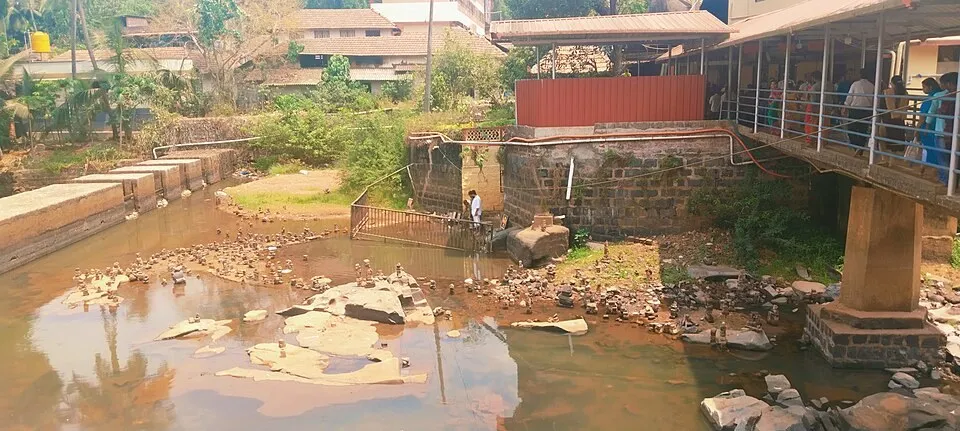

Wikipedia calls Kateel a temple town in Dakshina Kannada, on the banks of the river Nandini and about 20 km from Mangaluru. The temple stands on an islet in the middle of the river, among trees.¹ The temple’s own site says the same.²
The name is explained in Tulu. Kati means middle, and ila is land or area, so Kateel is the place in the middle. Wikipedia says it lies midway between Kanakagiri, where the Nandini rises, and Pavanje, where she reaches the sea.¹
The river that was cursed
The temple’s history page begins with a sage, Jabali, meditating in a cave near a lake of the emblic tree. There was a drought, and Jabali went to Indra to ask for the divine cow Kamadhenu, whose gifts would let him perform a sacrifice that would bring rain. Kamadhenu was away, so Indra offered her daughter Nandini, who was as blessed as her mother.²
Nandini refused to go. The page says she was proud, and she said that the earth was a place of sinners and she would never set foot on it. Jabali lost his temper and cursed her to flow on earth as a river. At once he was sorry, but a curse could not be taken back. He told her to pray to the Supreme Mother. The goddess came to Nandini on the Kanaka mountain and said that the sage’s words had the force of a mantra, and that she must flow as a river. She would be freed in time.²
So Nandini flowed from the foot of the mountain on the full moon of Magha, and went to meet Jabali on the way to the western sea. He knew her touch and blessed her. The page says that the drought was swallowed up in her flow.²
The Devi Mahatme: The Goddess’s Three Battles
Kateel’s story is told as a sequel to the Devi Mahatme, the “Glory of the Goddess”, also called the Durga Saptashati, because it has 700 verses. Wikipedia says it is chapters 81 to 93 of the Markandeya Purana, that it was added to the Purana in the 5th or 6th century CE, and that it is generally dated between 400 and 600 CE.⁴ It tells of the goddess in three episodes.⁴
In the first, Vishnu sleeps on the cosmic waters, and two demons, Madhu and Kaitabha, rise from his earwax and threaten Brahma. Brahma sings to the goddess, who withdraws her power of sleep from Vishnu. He wakes and fights the demons for five thousand years and kills them.⁴
In the second, the shape-shifting demon Mahishasura defeats the gods, because he has a boon that only a woman can kill him. The gods give out their strength, and it takes the form of the goddess Durga. They give her weapons and a lion, and she kills him. This is the battle shown in the image of Mahishamardini at Mundkur, where the goddess holds the buffalo demon upside down.⁴
In the third, the demon brothers Shumbha and Nishumbha conquer heaven. The goddess meets their servants Chanda and Munda, and Kali, who comes from her forehead, kills them. Kali also kills Raktabija, from whose every drop of blood another demon is born. The goddess finally stands alone against the brothers and kills them. The gods praise her, and she promises to come again whenever demons threaten.⁴
The Kateel history picks up where this one ends. Its demon Arunasura is a minister of Shumbha and Nishumbha who escapes when they fall.²
The demon who could not be killed
The second part is about the demon Arunasura. The page says he was the chief minister of Shumbha and Nishumbha, two demon brothers, and that he escaped when the goddess killed them. He did penance, and Brahma gave him a boon of near-immortality, saying that the order of the universe did not allow outright deathlessness. The page’s account of the terms is long.²
Wikipedia’s article on the goddess Bhramari gives a shorter version, from the Devi Bhagavata Purana. In it Brahma’s boon is that Arunasura will not die in any war, or by any weapon, or at the hands of any man or woman, or of any creature with two legs or four. The goddess knew the terms, and decided to kill him with six-legged creatures.³
The Kateel history says that the demon’s strength lay also in the Gayatri mantra, which he said every day. The gods sent Brihaspati, the teacher of the gods, disguised as an old Brahmin. He argued that Arunasura owed his power to his own penance, and that the mantra was a trap, until the demon gave it up. After that Arunasura ordered that he himself be worshipped as god, and festivals stopped.²
The bees
The goddess went to the demon’s pleasure garden in the shape of a young woman. His ministers saw her and told him, and he rushed to the garden to claim her. She mocked him, and when he drew his sword she vanished into a rock. The page says she then took a terrible form, as Raktheshwari, and destroyed his army.²
Arunasura stabbed at the rock where she had gone. Out came a swarm of bees, and the goddess became a great bee, Bhramari, and killed him. The page ends the fight with the explanation: a bee has six legs, so it is neither two-legged nor four-legged, and it is neither god, nor demon, nor man, and a sting is no weapon. The boon was kept to the letter.²
The linga in the middle of the river
After the fight the gods, on Jabali’s instructions, bathed the angry goddess in tender coconut water to calm her. Nandini took her own shape again and asked to be freed from the curse. The goddess said that the place was spoiled by the demon’s death, so she would take the form of a linga in the middle of the Nandini instead, where the river divides in two and then joins again before reaching the sea.²
The page says that, because the bee dislikes the strong scent of the champaka flower, that flower is not used in the shrine, and that tender coconut water is a favourite offering. It adds that, because the goddess appeared as a dancing young woman in the demon’s garden, she is fond of the Yakshagana dance that devotees offer her.²
The temple’s own troupe
The temple’s website describes the Kateel Sri Durgaparameshwari Yakshagana Dashavatara Mandali, known as the Kateel Mela, as an important harake seva troupe. It performs when a devotee who has taken a vow asks for a Yakshagana show, to fulfil a wish or as service.² Wikipedia says that the temple has six melas, that it is famous for the tenkutittu, the southern style of Yakshagana, and that devotees may have a show played by any of them at their own place.¹ The temple’s site names one troupe where Wikipedia counts six, and we have not found a reason for the difference.
Our notes say that the play the troupes stage most is the Devi Mahatme, the Yakshagana version of the goddess’s three battles. We could not confirm it in the sources we opened. Our page on Yakshagana describes the art itself.
More than worship
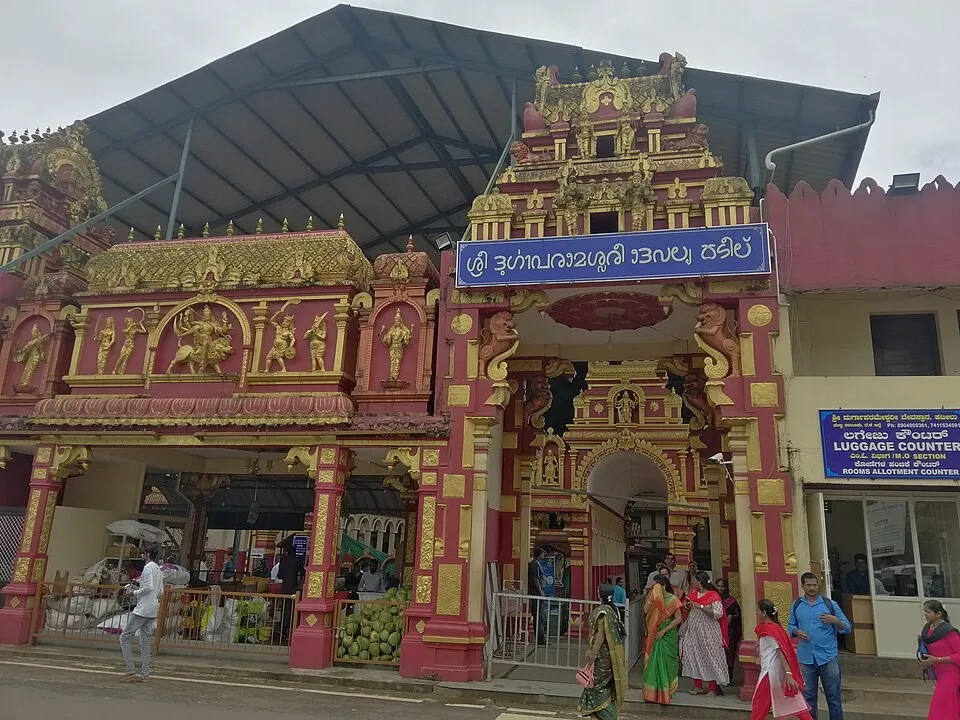

The temple’s site says that it runs five institutions: a higher primary school, a high school, a junior college, a first grade college and a centre for postgraduate studies and research in Sanskrit. It says the temple gives its students education and a midday meal and takes nothing in return.² Wikipedia names the first grade college and the Sanskrit centre among the temple’s institutions.¹
The site’s menu also lists a goshala, a cow shelter, and a seva, a service one can book, for the cows, called Nandini Goseva.²
What we could not find
- The history of the temple. The history page is a legend, with no date, no patron and no record of who has run the temple. We found no inscription or administrative history. A fuller one may exist in Kannada or archival sources we did not reach.
- The rock of Raktheshwari at the entrance, and the Bermer shrine. Our notes place the rock at the entrance and a shrine to Bermer in the temple grounds. The history page makes Raktheshwari a form the goddess takes in the story, and does not mention an entrance rock or a Bermer shrine. Our Bermer page notes a renovated Bermer shrine in the grounds.
- The Devi Mahatme play. Our notes say the Yakshagana text adds episodes the Sanskrit lacks, such as a backstory for Mahishasura’s birth to Malini and Vidyunmali, and that the Kateel troupes perform it more than any other. The source for these, the National School of Drama’s page, would not open, and we found none of it elsewhere. We also did not find how the play is performed at Kateel, or how often. Figures for the number of performances come from blogs, and we do not repeat them.
- The belief that the goddess comes to watch the shows after midnight. Our notes cite a newspaper article that we did not read.
Related
- Rakteshwari, the Earth-Born Maiden, the daiva whose name is the one the goddess takes in this story
- Bermer: The First Lord of Tulunadu, whose shrine is said to stand in the temple grounds
- Yakshagana: The Coast’s Dusk-to-Dawn Dance-Drama, the stage art in which this story is played
- Dharmasthala: The House the Daivas Asked For, another great temple of the coast that runs schools
Sources & further reading
The books and articles behind the numbered notes on this page.
- Wikipedia, “Kateel” (checked 9 October 2026): the location, the name, the islet, the Yakshagana melas and the institutions.
- Kateel Shree Durgaparameshwari Temple, official website and its history page (read 9 October 2026): the legend of Nandini and Arunasura, the Kateel Mela and the schools.
- Wikipedia, “Bhramari” (checked 9 October 2026): the Devi Bhagavata Purana account of Arunasura’s boon and of the goddess as a bee.
- Wikipedia, “Devi Mahatmya” (checked 9 October 2026) (the article’s title uses the Sanskrit spelling): the text, its dating and its three episodes.
The legend is the temple’s own account, and we found no independent history of the temple.
Themes
Spotted a mistake, or know more about this? Suggest a correction/addition.