Faith & Worship · Temples, Mathas & Basadis · Also in: Stories: Temples and Sacred Places
Mundkur Durgaparameshwari: The Goddess Who Was Turned to Face East
The goddess at Mundkur looks east. The temple says that this was not her first direction, and that she was turned round by force.
The story that explains it has a wicked ruler, a river that parts, and two heroes. It ends with a village that still keeps its own order around the temple.
Where the demon fell
Mundkur is a village in Karkala taluk, Udupi district. Wikipedia says the Durga Parameshwari temple here was built about the 9th century CE. The main image is of the goddess as Mahishamardini, the slayer of the buffalo demon Mahisha, holding him upside down and piercing his body with a trident.¹
A local history gives a legend for the name. It says the goddess killed a demon called Mundaka here, as the Skanda Purana tells, and the place was named Mundakooru, which became Mundkur. The sage Bhargava is said to have installed the image at the request of King Suratha, after the installation of Rajarajeshwari at Pulinapura, now Polali, before 800 CE.² Wikipedia gives a different derivation, from a phrase beginning Mundakke oori, “as per one version”, and does not explain it further.¹
The same history says that Dr P. Gururaja Bhat, a researcher of the temples of South Kanara, estimated the Mahishamardini image to belong to the early 8th century.² That is earlier than Wikipedia’s date for the temple, and we found no reason for the difference.
The goddess turned round
The local history says the image first faced west. During the rebuilding of the temple in 2005–06, it adds, the original door frames were found in the western wall of the sanctum and have been kept in the temple grounds, and the temple tank to the west is still called Bhargava Theertha.²
Then it says that, in the time of Jain rule, a ruler called Veeravarma, who was known as a bad king, turned the idol to face east in order to take out the riches buried under it. The idol has faced east since.²
The history links this to the absence of Jains. It says that no Jain family lives in Mundkur today, though the ruins of a Jain basadi and a palace, and a street called Jainpete, can be seen, and that this is said to be the result of the goddess’s curse on the earlier Jains and their ruler. Jain devotees come to seek her blessing, but there is no resident Jain family.² We give this as local tradition, not as history of the Jains of the coast.
The twins
The twins Kanthabare and Boodabare, the history says, were born at Ulepady and were devotees of the Mundkur goddess. In a paddana, an old Tulu folk song, they killed Veeravarma and his men because of their bad character and behaviour.²
How Veeravarma cheated the twins and how they defeated him is told on another page, in the section on Mundkur: Kantabare and Budabare.
The Chowtas take charge
With no one left to govern, the local history says, the Chowta rulers of Moodabidri stepped in and put matters right.² Its other statement on the handover is a date. It says that, in the records, King Narasimha Banga Raja of the Bangas transferred the administration of the Mundkur magane, the district of the three villages of Mundkur, Mulladka and Inna, to the Chowta rulers in the Shaka year 1337.² By the usual conversion, that is about 1415 CE. The history does not say how this transfer fits the story of the twins.
The temple was given to Brahmins of eight families of the Bhargava gotra, headed by the Madmannaya family as pavitrapani, the chief of ritual, with eight guttu households, four parari and four balike, to support them on behalf of the villagers of the three villages.² Our page on the Chowtas tells of the dynasty.
The history adds that the king gave land, two wooden pillars made from a single jackfruit tree from the Chowta palace yard, which it says can still be seen, and logs of timber, and that the queen gave her jewelled ornaments for the main image, still used to decorate it at festivals.²
The car festival and the kings
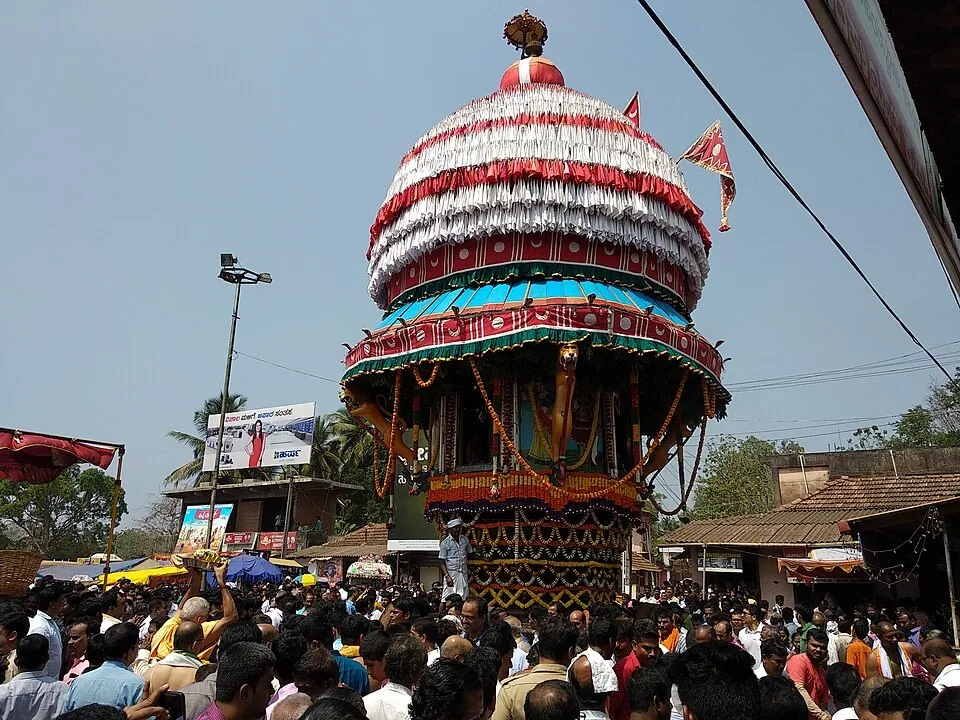

The history says that the Chowta rulers used to come to the annual car festival at the personal invitation of the head of the Madmannaya family. The king and his party rested at Sacheriparari, on the village edge, where a stone bed said to be the king’s can be seen, and the villagers received him at Jarige Katte. On the last day he joined the young men’s football game, chendu-aata, followed by the Arasara Katte puja and the lamp festival of the tank.²
It says that the visits stopped in 1855, after a misunderstanding between the villagers and the head of the Madmannaya family, and that the day is still kept as Arasara Bali Utsava.² A reader’s comment on the Shivalli Brahmins page about the temple gives the cause of the misunderstanding as a quarrel over donating a jackfruit tree to the temple for its car.³
The temple and the village
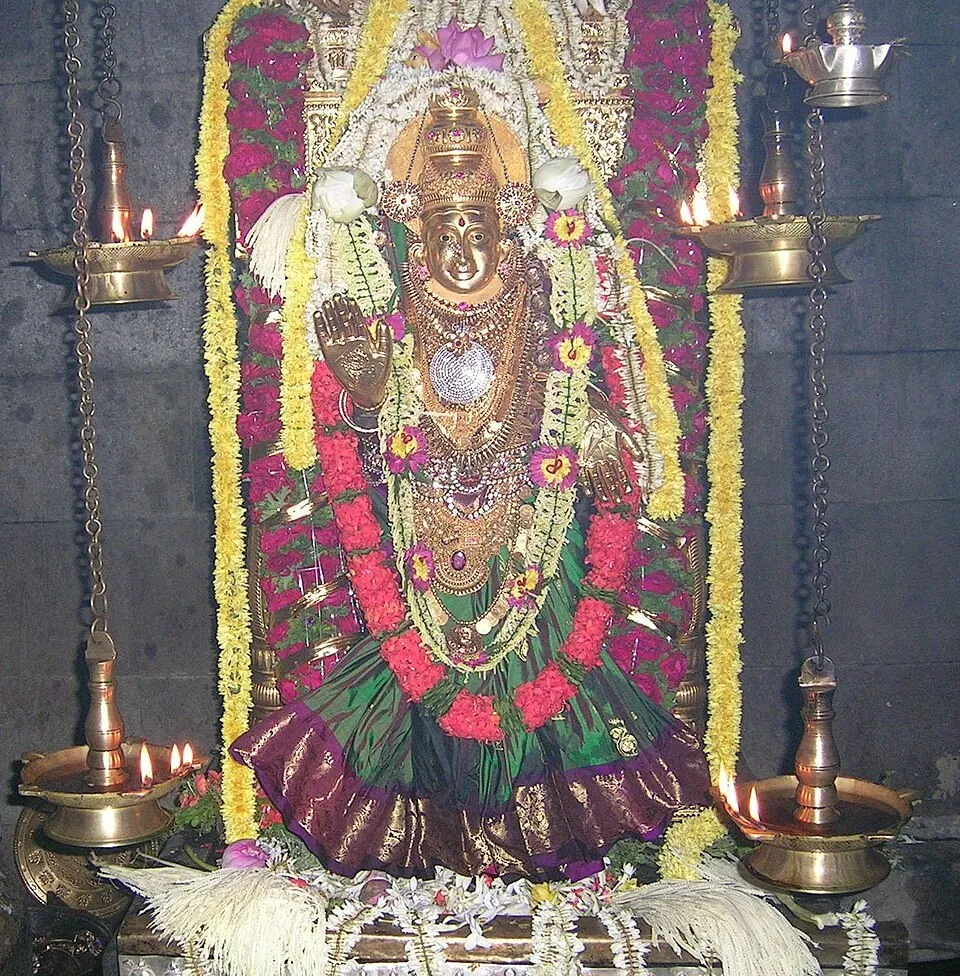

The same history describes the magane as the centre of administration, the place where disputes were settled and discussions held for the three villages, and says this continues. It also says no function may be held in the three villages between the raising of the flag and the closing bath of the festival, which it says is still observed.²
Mundkur Durga, it says, is the family goddess of Brahmins of the Bhargava gotra, and many families of GSBs, Bunts, Billavas, Kulalas, Devadigas and others worship her as the goddess of their original house. It adds that Christians and Muslims also offer flowers and prayers.²
Wikipedia lists other gods in the temple: Mahaganapati, the Navagraha, the serpent gods, the sacred fig tree, Dhumavati, Raktheshwari, Vyaghra Chamundi (Pili Chandi), Varahi (Panjurli), and a guardian against evil spirits.¹ Our page on Rakteshwari tells of one of these.
What we could not find
- The date of the temple. Wikipedia says about the 9th century CE. The local history gives the early 8th century for the image, on one scholar’s estimate. We found no inscription.
- How the twins’ story fits the Chowta handover. The history gives both, a killing by the twins and a transfer by the Bangas in about 1415, and does not join them.
- The sugarcane test, the divine sword and the other details of the twins’ fight with Veeravarma. They are told on the Kantabare and Budabare page, but only from our notes, which take them from IshtaDevata, a guide we could not open.
- The queen’s lost earring. Our notes have a story of a Jain queen’s earring, and have found no written source for it. We found none.
- A change of gotra in the office of pavitrapani. Our notes say that the priestly rights passed from one gotra to another and back. We could not find this in the sources we opened.
- A scholarly study. We found none. Wikipedia lists a temple history, Mundkur Kshetra Mahatme (1992), and Dr Gururaja Bhat’s Temples of South Kanara, which we have not read.
Related
- The Chowtas: A Jain Royal House Ruled Through the Mother’s Line, who took charge of the Mundkur magane
- Moodabidri: Eighteen Basadis and the Thousand Pillars, the Chowta capital and a Jain town
- Rakteshwari, the Earth-Born Maiden, who stands at the doors of the great goddess temples
- Dharmasthala: The House the Daivas Asked For, another temple whose running is bound up with a family and a community
Sources & further reading
The books and articles behind the numbered notes on this page.
-
Wikipedia, “Mundkur” (checked 9 October 2026): the date, the main image, the name and the other deities. It cites Omkar Ballal’s Mundkur Kshetra Mahatme (1992) and Jayarama Acharya’s Bhargavi Smriti (2004).
-
“Namma Munkoor”, Mundkur history post (local blog, 2009; read 9 October 2026): the legend, the west-facing door frame, Veeravarma, the twins, the Chowtas, the temple’s running, and the visits until 1855.
-
Shivalli Brahmins, “Mundkur Shri Durga Parameshwari” (read 9 October 2026): the twins killing Veeravarma, the handover to the Chowtas and, in a reader’s comment, the jackfruit tree quarrel.
These sources are informal: a short Wikipedia article, one local blog and a temple page with reader comments. We found no scholarly source.
Themes
Spotted a mistake, or know more about this? Suggest a correction/addition.