History & Heroes · The Story of Tulunadu
The Chowtas: A Jain Royal House Ruled Through the Mother's Line
Alongside every larger power in Tulunadu’s story, one smaller family kept going. The Alupas faded, Vijayanagara and Keladi rose and fell, and the Chowtas stayed on, in a smaller and smaller seat, for about six hundred years.
A Jain house, a mother’s-line throne
Wikipedia calls the Chowtas a Jain dynasty of Jain Bunt origin who ruled Tulu Nadu from the 12th to 18th centuries, and says they followed the Bunt custom of matrilineal inheritance, aliyasantana.¹ In that system an heir comes through a sister, and not through a son. Within the family’s own rules, then, a queen taking the throne was ordinary.
A list on Tulupedia, a Tulu community site, names several women who ruled, among them an earlier Abbakkadevi, said to be Tirumalaraya’s niece and to have reigned until 1316, and Padumaladevi, Chennammadevi and Tirumaladevi.² We have only that one source for the names and dates.
Three seats
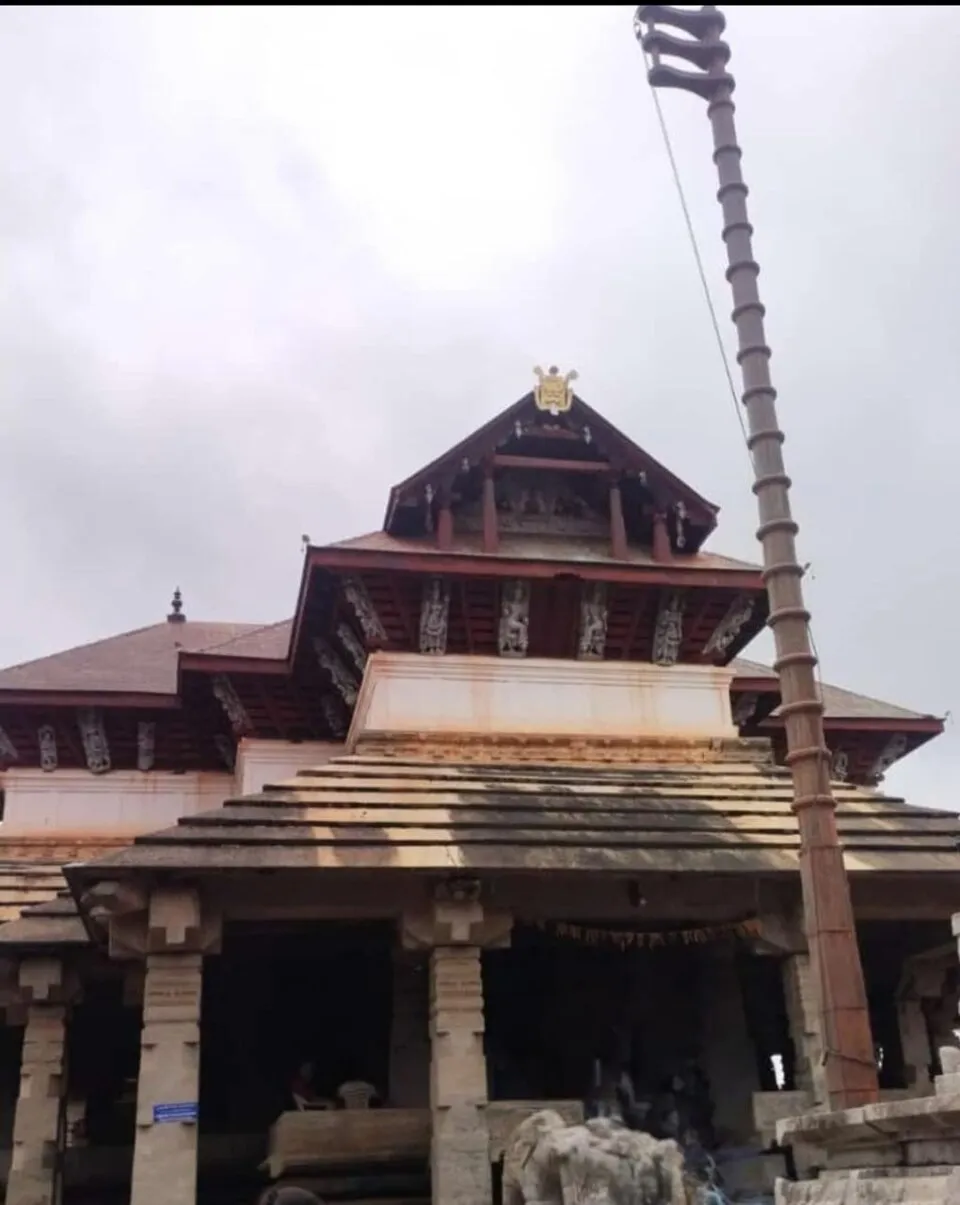

The first known king, Tirumalaraya Chowta I, is dated 1160 to 1179. His seat was Ullal, then a prosperous trading town. Channaraya Chowta I (1179 to 1219) moved the capital to Puttige.¹
In 1544 the principality divided into two branches, one at Ullal under Queen Abbakka Chowta, and one at Puttige.¹ Around 1603 the family moved to Moodabidri.¹ The Chowtara Aramane, the family palace in Moodabidri with its carved woodwork, is still home to descendants.¹ It stands close to the Jain basadis of Moodabidri.
Who they answered to
Like the Alupas, the Chowtas did not rule free. Tulupedia’s account puts them under each power in turn. It says that in Krishnadevaraya’s time the Chowta king built a Subraya temple at Kadandale and brought its idol from Vijayanagara. It says Queen Abbakkadevi II fought the Portuguese and beat them back. And it says the Ikkeri king Veerabhadrappa Nayaka, of the Keladi line, arrested Bhojaraya III (1630 to 1644) and put him in jail.²
The same page says Hyder Ali of Mysore conquered Ikkeri in 1763, after which the Chowtas lived under Mysore. For Abbakka’s own part in the Portuguese story, see the page on Vijayanagara, Keladi and the Portuguese.
The last ruler
The invasions of Hyder Ali and Tipu Sultan weakened the Chowtas. Chandrasekhara Chikkaraya Chowta V (1783 to 1822) was the last ruler with real authority. After the British took South Canara, Wikipedia says, the Chowtas “lost all their power except that they received a small pension.“¹
When the family’s story formally ends is less clear. Tulupedia has the line effectively ending around 1833, and the pension and title passing on as late as 1880.²
Related
- The Alupas, the other long-lived local dynasty
- Moodabidri, the temple town the Chowtas made their seat
- Under Mysore, the years of Hyder Ali and Tipu
Sources & further reading
The books and articles behind the numbered notes on this page.
- Wikipedia, “Chowta dynasty (Tulu Nadu)” (accessed 7 October 2026): the Jain and Bunt identity, aliyasantana, the capitals and dates, the 1544 split, the last ruler and the pension.
- Tulupedia, “Chowtas of Puttige Moodabidri” (accessed 7 October 2026): the named queens, Krishnadevaraya’s time, Bhojaraya III, Hyder Ali’s conquest of Ikkeri and the later dates. This is a community history site, not an academic source.
The research notes behind this page also give the Chowtas an overlord chain starting with the Hoysalas, and describe the dynasty’s origin in two conflicting ways (a rise c. 1160 against a rise after the Hoysala collapse in the mid-14th century). We could not confirm these in the two sources we checked, so they are left out, and so are the notes’ reign dates for Rani Abbakka, which differ from Wikipedia’s article on her.
Themes
Spotted a mistake, or know more about this? Suggest a correction/addition.