Festivals Through the Year · The Tulu Year, Month by Month
Pursere Kattuna: The Night Dance of the Suggi Full Moon
Late on a full-moon night, long after most of a village has gone to bed, a group of men gathers at a chosen spot. They dress in whatever the village can supply: leaves, cloth, paint. Then they set off down the lane, chanting loudly to announce themselves, and walk from house to house.
At each courtyard, they wake the family, light a lamp, and begin a performance that will go on until the morning. It is part prayer, part play, and part rowdy comedy. This is Pursere Kattuna, the dance of the last full moon of the Tulu year.
The last full moon of the year
Suggi is the twelfth and final month of the Tulu calendar, about March to April, and Bisu Parba, the new year, follows it. Pursere Kattuna is held at the full moon of this month.¹ ³ The Wikimedia writers who documented it describe it as marking the culmination of the farming year, and say it can run for three to five nights around the full moon.²
It is performed in the villages of Belthangady taluk in Dakshina Kannada, and is mainly done by men.¹ ²
A night of many characters
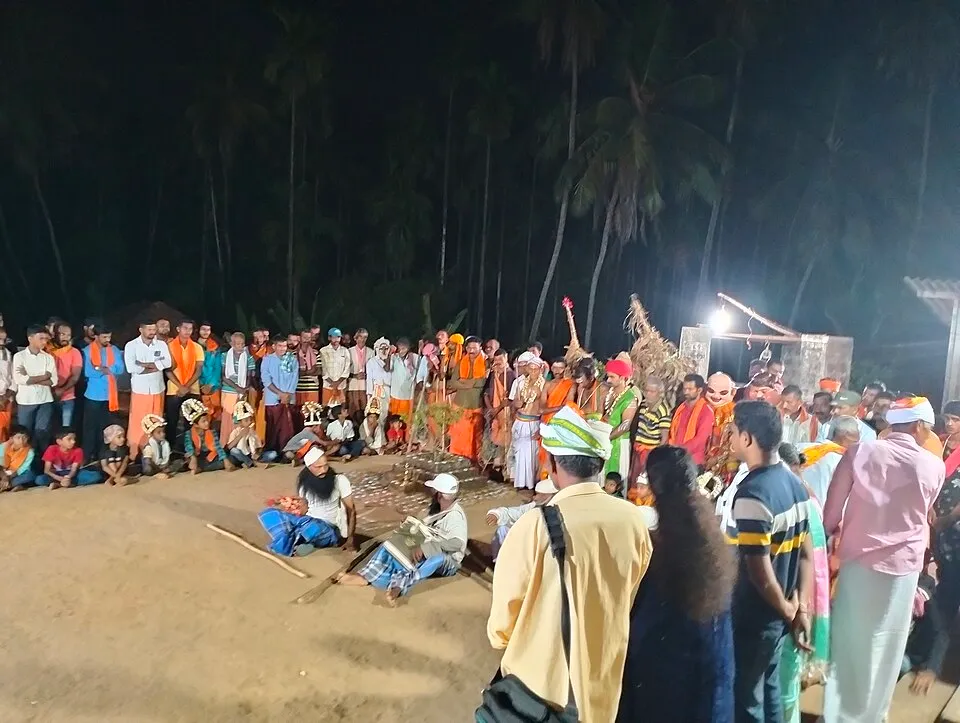

The performance runs from late evening until the early hours of the morning. The dancers visit the homes of people from different social groups and bless them with healing, prosperity and protection. There is acting, singing, dancing, symbolic storytelling and mimicry of myths, and the performers speak to each other and to the people watching.¹
The cast is large and wide. Wikipedia lists costumes of Brahmins and priests, wandering ascetics and fortune tellers, and Koti and Chennaya. There are wild animals such as the bear, the tiger, the lion and the monkey, along with scholars, thieves, ghosts and spirits. There is a Christian man and a Muslim woman. Some characters exist to challenge or provoke through humour, mimicry and farce.¹ The music comes from the tase and dolu (two drums), the nadaswara (a reed pipe) and the shruti, a drone, which guide the rhythm of the dance, the dialogues and the songs through the night.¹
The Sullia cousin: Siddavesa
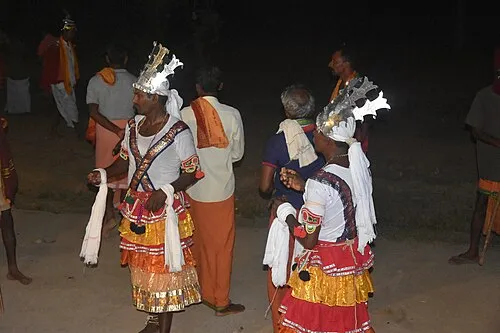

In the Sullia region, a similar performance goes by the name Siddavesa, with a different costume style.¹ ³ Wikipedia says it is performed by the Arebhashe people of Sullia, also at the full moon of Suggi.³
Its three main figures are the Sanyasi, the ascetic, who wears an outfit of dried leaves and is the central figure and a bringer of rude and provocative fun, the Bhatru, the village priest, in a white dhoti with a sacred thread and sandal paste, and Dasayya, in a white dhoti and a red shawl, who holds a conch and a drum. Others include the Koraga, painted dark all over, Koti and Chennaya, and the Byari.³
Wikipedia describes the course of a Siddavesa night. After sunset, the performers gather at a holy place decided in advance, often in front of the Daivaradhane Chavadi (the hall where daivas are worshipped) or the guttu house. After prayers, the eldest members pray to Kadri Manjunatha, to local spirits and to their ancestors. The group then moves from house to house, and at each one performs in the courtyard around a lit lamp, sometimes near the Tulasi shrine.³
When they reach a house, they send the Sanyasi into hiding beside it, and the rest walk in and wake the family. They dance around the lamp, and one of them starts the song: Sidduliṅga mudduliṅga, siddhavēsō. The Sanyasi is then left alone in the courtyard, roaming about and using unusual, provocative language. As they walk the streets, the group loudly calls out Ḍimbisāle, so that people know they are on their way. It is a belief that if another night-time performance, Chennu Nalike, which the Mera community performs, meets Siddavesa on the road, it is a bad omen. The loud chanting prevents that.³
Who takes part
Wikipedia says Pursere Kattuna is mainly started by the Tulu Gowda community, although people from other communities join in.¹ The Wikimedia writers say that it is performed by Tulu-speaking people of various castes, led by the Gowda community, and that it brings people of different castes together.²
Old roots
Both Wikipedia articles say the style shows the influence of the Natha Pantha, a spiritual tradition.¹ ³ The Wikimedia writers add that scholars believe it may have grown under the influence of secret tantric sects in medieval Karnataka.² These are suggestions about its origin, and we found no firm account of when it began.
Keeping it alive
The Karavali Wikimedians, a group of volunteers who document Tulu culture, began recording Pursere Kattuna on camera in 2018 because it was so little represented. Later, they made a Tulu-language documentary, directed by Dr Sundara Kenaje, that runs for just under 40 minutes. The team visited more than seven villages and met 15 troupes of Belthangady taluk.²
They also say that the dance is surrounded by secrecy and deep faith. Villagers were hesitant to reveal its details, for fear of being misunderstood or of harming the tradition.² This page therefore describes only what has been published, and does not try to explain more.
Related
- The Tulu Year, Month by Month, where Suggi closes the twelve months
- Bisu Parba: The Tulu New Year, the festival that follows it
- Aati: Tulunadu’s Monsoon Pause, with its own masked visitor who goes door to door
- Koti and Chennaya, the Twin Heroes, who are among the characters
Sources & further reading
The books and articles behind the numbered notes on this page.
- Wikipedia, “Pursere Kattuna”: where and when it is held, how a night goes, the characters and costumes, the Gowda community, the Sullia form, the instruments, and the Natha Pantha influence.
- Karavali Wikimedians, “Pursa Kattuna: Unveiling the Enigmatic Tulu Ritual Dance and Living Heritages of Tulunadu”, Diff (Wikimedia, 20 November 2023): the three to five nights, the culmination of the farming year, the castes taking part, the possible tantric influence, and the documentation project.
- Wikipedia, “Siddavesa”: the Arebhashe performers of Sullia, the characters, the course of a night, the song and the chant, and the belief about Chennu Nalike.
The two Wikipedia articles are short and may draw on the same documentation project as the Wikimedia post, so these sources are not fully independent of each other. We did not find a scholarly study.
Words on this page
What the Tulu and other Indian-language terms on this page mean.
- guttu
- The ancestral headquarters house of a landed family.
- Pursere Kattuna
- A night-long ritual dance held at the full moon of Suggi.
- Siddavesa
- A similar night dance of the Sullia region.
- Suggi
- The last month of the Tulu year.
Themes
Spotted a mistake, or know more about this? Suggest a correction/addition.