Tulunadu Today · Tuluvas Today
Mangaluru Dasara: A Festival of the Twentieth Century
For ten days in autumn, Mangaluru’s centre is lit up, and on the last night a procession runs through the city until morning.
It looks as if it must always have been there. The sources we found say it is much younger than it looks.
What happens
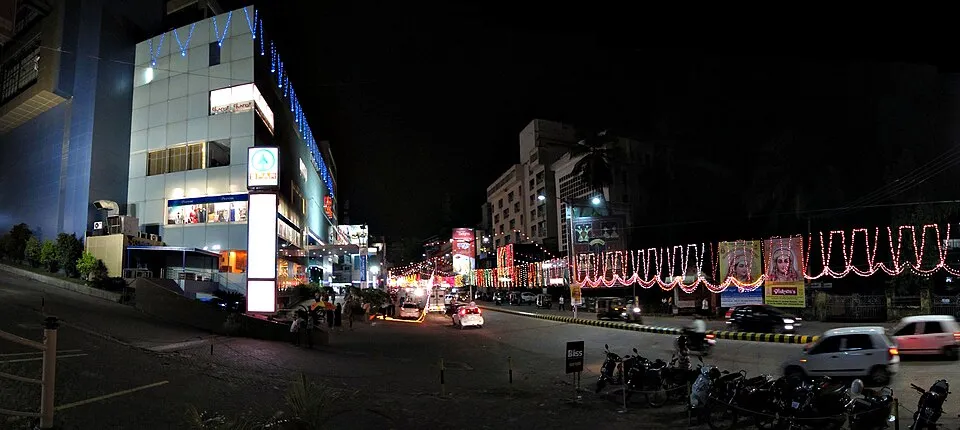

Wikipedia says Mangaluru Dasara, called Marnemi in Tulu and Mannami in Konkani, is the Navaratri festival of the city, and that the city is lit for the ten days. It names the tiger, lion and bear dances as the main attractions.¹
At the Kudroli Gokarnanatheshwara temple, the priests install murtis of Sharada Devi, Mahaganapati, Adi Shakti and the Navadurgas on a golden dais, and puja is done for nine days. The temple also keeps the Gangavatharana, a jet of water falling from the crown of Shiva, running for all nine days, with four 13-foot figures of Shiva and a jet said to rise up to 100 feet.¹ Our page on Kudroli Gokarnanatheshwara tells of the temple.
The procession
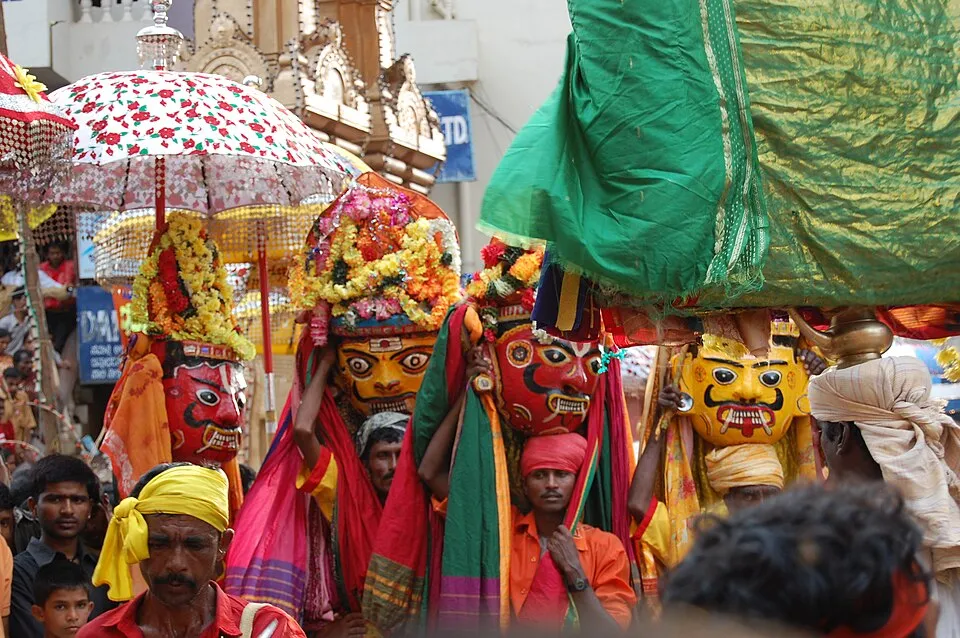

On the evening of Vijayadashami, the procession leaves the Kudroli temple and comes back to it early the next morning, when the idols are immersed in the Pushkarini pond in the temple. The Navadurgas, Mahaganapati and Sharada are carried, with flowers, decorated umbrellas, tableaux, bands, chende drums, folk dances, Yakshagana characters, Dollu Kunitha and the tiger dance. The route passes Kudroli, Mannagudda, Ladyhill, Lalbagh, K. S. Rao Road, Hampankatta, Car Street and Alake.¹ Our page on Pili Vesha describes the tiger dancers.
Wikipedia adds that “Mangaluru Dasara” can also mean the group of events held by other temples. The Mangaladevi temple at Bolar holds its own celebrations, with a car festival on Mahanavami, and the procession reaches Marnamikatta.¹ Our page on Mangaladevi tells of the temple.
The Sharada Mahotsava
Wikipedia describes a separate celebration, the Mangalore Sharadotsava, of six or seven days at the Venkataramana temple on Car Street, where an idol of Sharada is set up on the grounds of the Acharya Mutt. The idol is brought there in a procession, and at the end it is carried through the main streets and immersed in the Mahamaya temple lake before dawn.¹
Swarajya’s article of 2022 is about this festival. It describes a life-size clay idol of Sharada that sits outside the Acharya Mutt, with a portrait of Bharat Mata at the top of her pandal. No mould is used, and the idol is made each year by Naveen Acharya, the third generation of his family to make it. The same idol is dressed as different forms of the goddess over the ten days, and on the last night volunteers carry her on their shoulders through the streets.²
How it began
Swarajya says that the Acharya Mutt, which belongs to the Gowda Saraswat Brahmins, had worshipped the goddess in Navaratri as many centres of learning do, by honouring manuscripts and ancient texts, until the 1920s. A public festival was needed, it says, because gatherings were prohibited by the colonial rulers. On the lines of Bal Gangadhar Tilak’s Ganeshotsav, the Sharada Mahotsava began in around 1922. It was the first such festival in the region, the article says, and it led to hundreds of others in the old Dakshina Kannada district, including what it calls the now famous Mangaluru Dasara. Until the 1980s, it says, it stayed within the temple and the community.² Our page on The Coast in India’s Freedom Struggle puts this in its setting.
Wikipedia’s account is different. It says the festival was started by B. R. Karkera and is organised by the Acharya Mutt, and it marks a hundred-year anniversary celebration in 2012.¹ Our page on Kudroli says that Wikipedia also credits Karkera there with the Dasara, without a date.
We could not make the two dates fit. A start around 1912 would suit the 2012 anniversary, and a start around 1922 would suit Swarajya’s centenary in 2022. They may also be two festivals, since Swarajya says the Sharada Mahotsava inspired the Dasara, and not that the two are the same.
Today
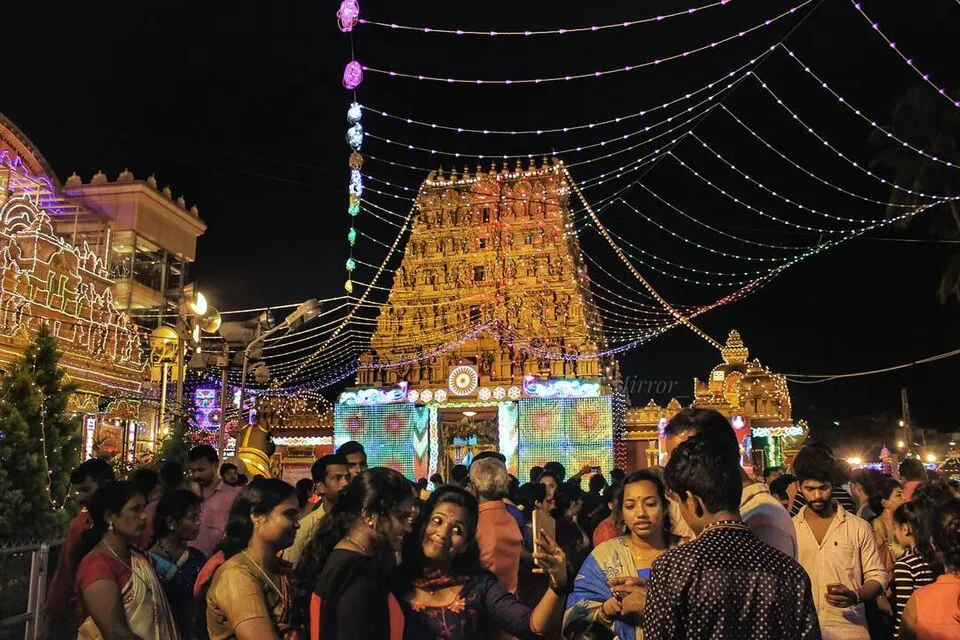

Swarajya says that for the hundredth year the committee was given offerings that included a gold veena and a gold peacock, and that more than 4,000 students were honoured with a Vidya Saraswati recognition. It says no one collects funds from donors, and that visitors come from across the country and beyond.² Neither source gives a figure for the tableaux in the procession.
What we could not find
- When it began. The sources give about 1922 and a centenary of 2012, and we found nothing to settle them.
- Who began what. Wikipedia credits B. R. Karkera. Swarajya names the Acharya Mutt and does not name him. Our notes also record a claim that the former Union Minister Janardhana Poojary introduced “the concept of Mangalore dasara” in 1991, the year the Kudroli temple’s rebuilding was inaugurated. We could not open the blog it comes from, so we have left it out. Our notes call the idea that the two claims fit together this project’s own guess, with no source.
- The size of the procession. Our notes give more than 100 tableaux and the route through Lalbagh and Hampankatta. The blog behind that figure did not open, and neither Wikipedia nor Swarajya gives a number.
- A history of the festival. We found no book or study. Wikipedia’s link to the festival’s own website points to an archived copy that we did not open.
Related
- Kudroli Gokarnanatheshwara: The Temple the Billavas Built, where the procession begins and ends
- Pili Vesha: The Tiger Dancers of Dasara, the dance that joins the procession
- Mangaladevi and Sharavu: Two Temples, One King, the temple that holds its own Dasara
- The Coast in India’s Freedom Struggle, the setting for the festival’s start
- The Tulu Agrarian Calendar, the calendar this festival is not part of
Sources & further reading
The books and articles behind the numbered notes on this page.
- Wikipedia, “Mangaluru Dasara” (checked 9 October 2026): the festival, the Kudroli murtis and procession, the route, Mangaladevi’s Dasara, the Sharadotsava, and the attribution to B. R. Karkera and the 2012 anniversary.
- Harsha Bhat, “100 Years Of Celebrating Sharada On The Coast Of Karnataka”, Swarajya (26 September 2022; read 9 October 2026): the Sharada Mahotsava, its start around 1922, the Tilak comparison, the clay idol, the sculptor and the hundredth-year celebrations.
The first is a short Wikipedia article and the second a magazine feature. We found no scholarly source.
Words on this page
What the Tulu and other Indian-language terms on this page mean.
- pili vesha
- The tiger dance of the Dasara season.
Themes
Spotted a mistake, or know more about this? Suggest a correction/addition.