Faith & Worship · Temples, Mathas & Basadis · Also in: Stories: Temples and Sacred Places
Kukke Subramanya: The Temple of the Serpent's Refuge
The serpent has a home in nearly every village of the coast, in a grove or at the foot of a tree. Here, in the hills, it has a temple.
At Kukke Subramanya the god is the son of Shiva, and the serpents are said to be under his protection.
The serpent’s refuge
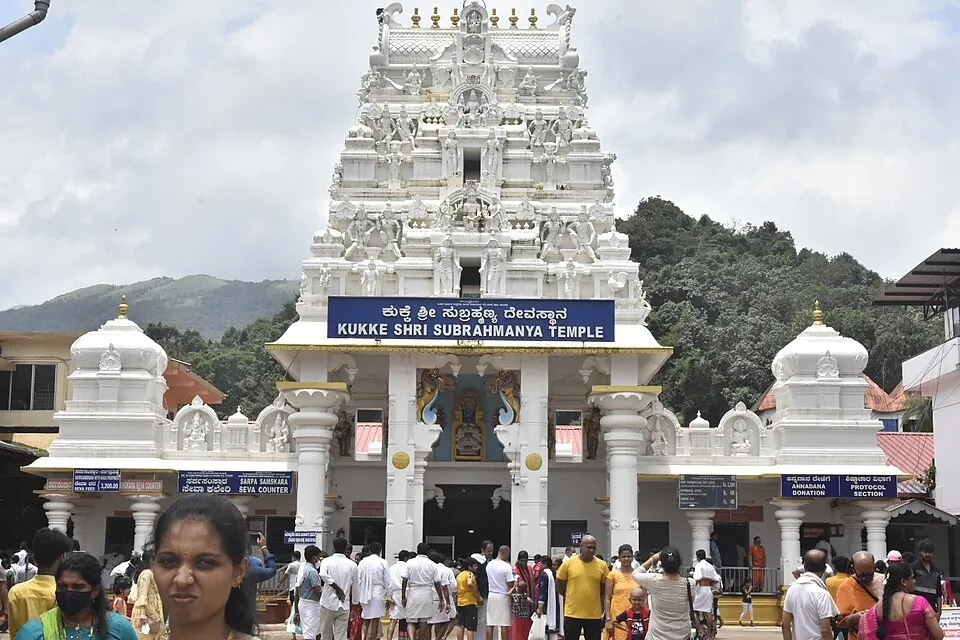

Wikipedia says that the temple stands on the bank of the Kumaradhara river in the village of Subramanya in Kadaba taluk, in Dakshina Kannada. Kartikeya is worshipped there as Subramanya, lord of all serpents, and the epics say that the divine serpent Vasuki and other serpents took refuge under him when Garuda threatened them.¹
Garuda is the great eagle who carries Vishnu, and serpents are his prey. In this legend Vasuki, king of the serpents, comes to Kukke to escape him. The article adds that the place is one of the seven sacred sites said to have been set up by Parashurama. It also says that Kumaraswamy, the god’s other name, and his brother Ganesha defeated the demon rulers Tharaka and Shura Padmasura at Kumara Parvata, a hill near the temple, and that after his victory he married Devasena, Indra’s daughter, in a ceremony attended by the gods.¹
Our page on Nagaradhane tells how serpent worship grows out of the groves and the household shrines. Kukke is the place where that worship has a temple of its own, and a Vedic rite.
Rites for the serpent’s wrath
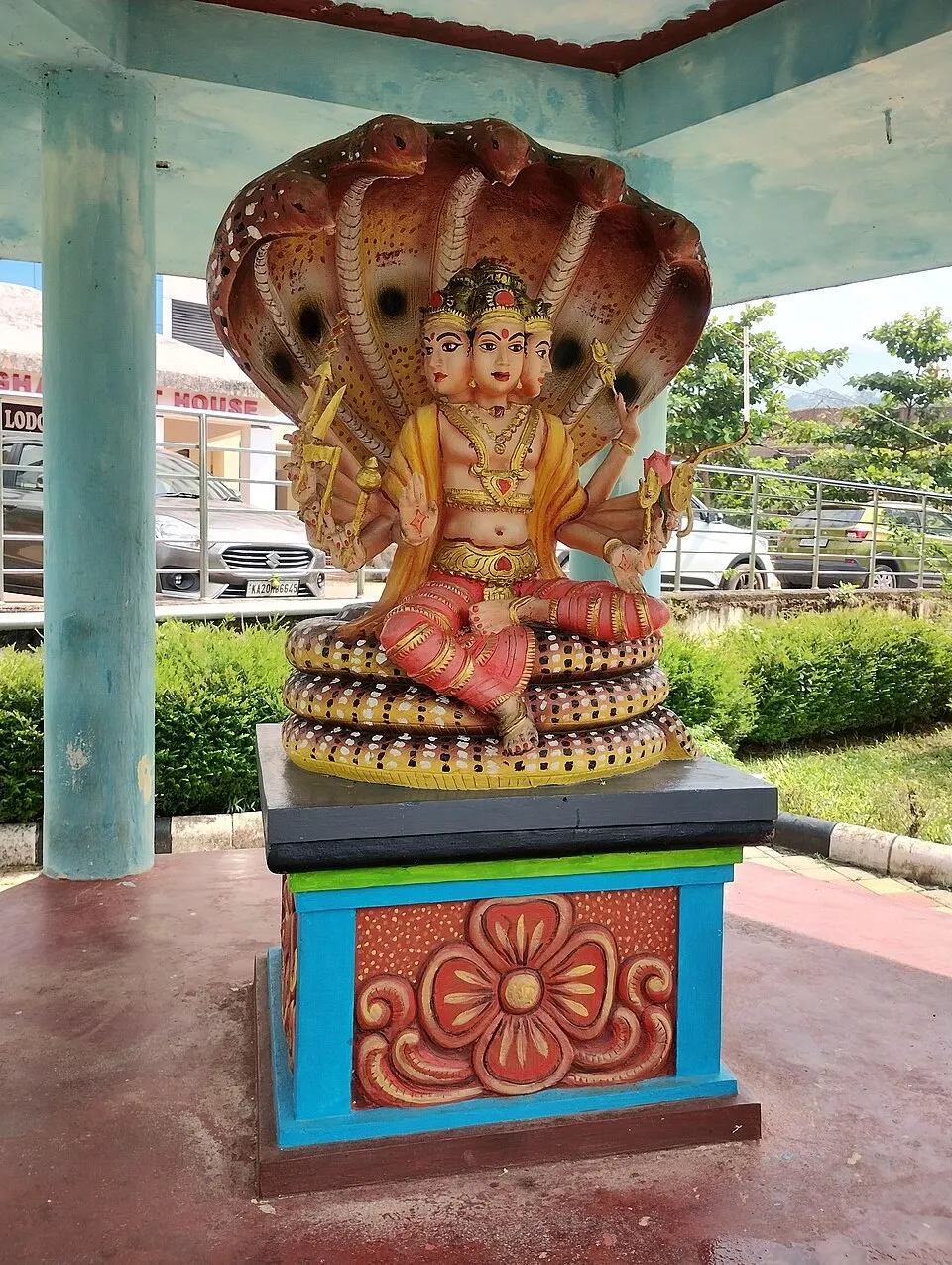

Wikipedia names two rites as the most popular at the temple: Ashlesha Bali, a rite for protection from black snakes, and Sarpa Dosha Parihara, performed to remove the curses tied to the snake god.¹
An independent pilgrim guide, which says it is not the temple’s own site, names Sarpa Samskara, Ashlesha Bali and Nagaprathishte, the installation of a serpent image, as the main rites to put right sarpa dosha, a harm believed to follow from hurting serpents. It calls Sarpa Samskara a two-day Vedic ritual, with a dress code and dietary rules, and says it is booked online through the Karnataka government’s temple portal.² The guide calls the temple the foremost centre for these rites.
The guide also names the festival of Champa Shashti.² Wikipedia lists Shashti, Kiru Shashti and Nagara Panchami as the temple’s festivals.¹
The priests
The priests at Kukke today are Shivalli Madhwa Brahmins, and Wikipedia says the daily rites follow Madhvacharya’s Tantra Sara Sangraha, citing the 1973 Karnataka State Gazetteer: Shimoga.¹ It was not always so.
The article says that the Sthanika Brahmins, whom it calls the oldest Tulu Brahmin group, were the original founders of many of Tulunadu’s great temples, and that Kukke was their most venerated. They stayed chief priests until the early 1900s, when their honorary trusteeship was taken away. It says this followed the murder of their spiritual leader Padma Theertha in 1845, and the hanging of many Sthanika Brahmins by the British, after which the community fell into poverty and the priesthood passed to the Shivalli Brahmins. It then says the Sthanikas founded the Shri Subramanya Sabha in 1908 to lift their community, and still take part in some of the temple’s rituals.¹ The article gives a book as its source for this. We have not read it.
The Gowda administrators
Another thread is the temple’s administration. Wikipedia describes the Koojugodu Kattemane family, of the Arebhashe Vokkaliga Gowda community, as the Sankesha Adhikaris, the chief administrators, for generations from the time of the Ikkeri Nayakas until the state took over. It says they traced their descent to Thimma Nayaka of Ikkeri. They came into conflict with the Ballala of Rathnapura, who ruled parts of the area, and after a confrontation that ended the Ballalas’ rule, the authority over the temple passed directly to the Kattemane chieftains.¹
The article adds that the family kept close ties with the Sringeri monastery. Guided by the Jagadguru, they set up the Chandramouleshwara temple and a Sringeri math inside the temple grounds. It says they lost the running of the temple when the Karnataka Endowment Department took it over.¹ Its source for all this is a book by Puttur Anantharaja Gowda, In Pursuit of Our Roots, which we have not read.
What we could not find
- “The only temple” for Sarpa Samskara. Our notes say that Kukke is the only temple in India that performs the rite with a full Vedic procedure, and that it admits 200 to 250 people a day. The pilgrim guide says “foremost”, not “only”, and we found no figure for daily numbers.
- The state’s takeover. Wikipedia says the Endowment Department took over, and does not give a date. Our notes cite a government portal listing, which we did not open.
- The legend in the other tellings. Our notes mention the Biladwara cave and a river said to rise from the god’s washed weapon. We did not find them in the sources we could open.
- A scholarly study. We found none beyond the two books the article cites.
Related
- Nagaradhane: The Serpent in the Sacred Grove, the worship of serpents in the groves and homes of the coast
- Parashurama and the Making of the Coast, which counts Kukke among the seven holy places of his land
- Kollur Mookambika: The Goddess and the Mute Demon, another of the seven places, on the other side of the hills
- Udupi Sri Krishna Matha: Eight Monasteries, One Child God, another temple whose running has a long history of its own
Sources & further reading
The books and articles behind the numbered notes on this page.
- Wikipedia, “Kukke Subramanya Temple” (checked 9 October 2026): the legend, the rites, the priests, the Sthanika Brahmins and the Koojugodu Kattemane family. It cites the Karnataka State Gazetteer: Shimoga (1973), Achyuta Sharma’s Kukke Sri Subrahmanya Kshetra idara Samshodhanatmaka Ithihasika Hinnele (2015) and Puttur Anantharaja Gowda’s In Pursuit of Our Roots (2015).
- “Kukke Subramanya Editorial”, pilgrim guide (checked 9 October 2026): Sarpa Samskara, booking and the festival. By its own description it is independent and not the temple’s website.
Wikipedia’s account of the priests and administrators rests on books we have not seen, so we give it as the article’s account.
Themes
Spotted a mistake, or know more about this? Suggest a correction/addition.